10 minutes free every day
Continue audio lessons in the app
Word explanations appear automatically in sync with the audio.
No login required · synced translations · playback with the screen locked
Choose your learning language and open this lesson in the app.

About This Lesson
Use Basic prices, weather, and discovery to practice Danish conversation, pronunciation, vocabulary, grammar, and quizzes.
Dialogue
Hvor meget koster den?
voh MAY-th KAW-stuh dehn? How much is this?Hvor bor du?
voh BOHR doo? Where do you live?Vejret er godt.
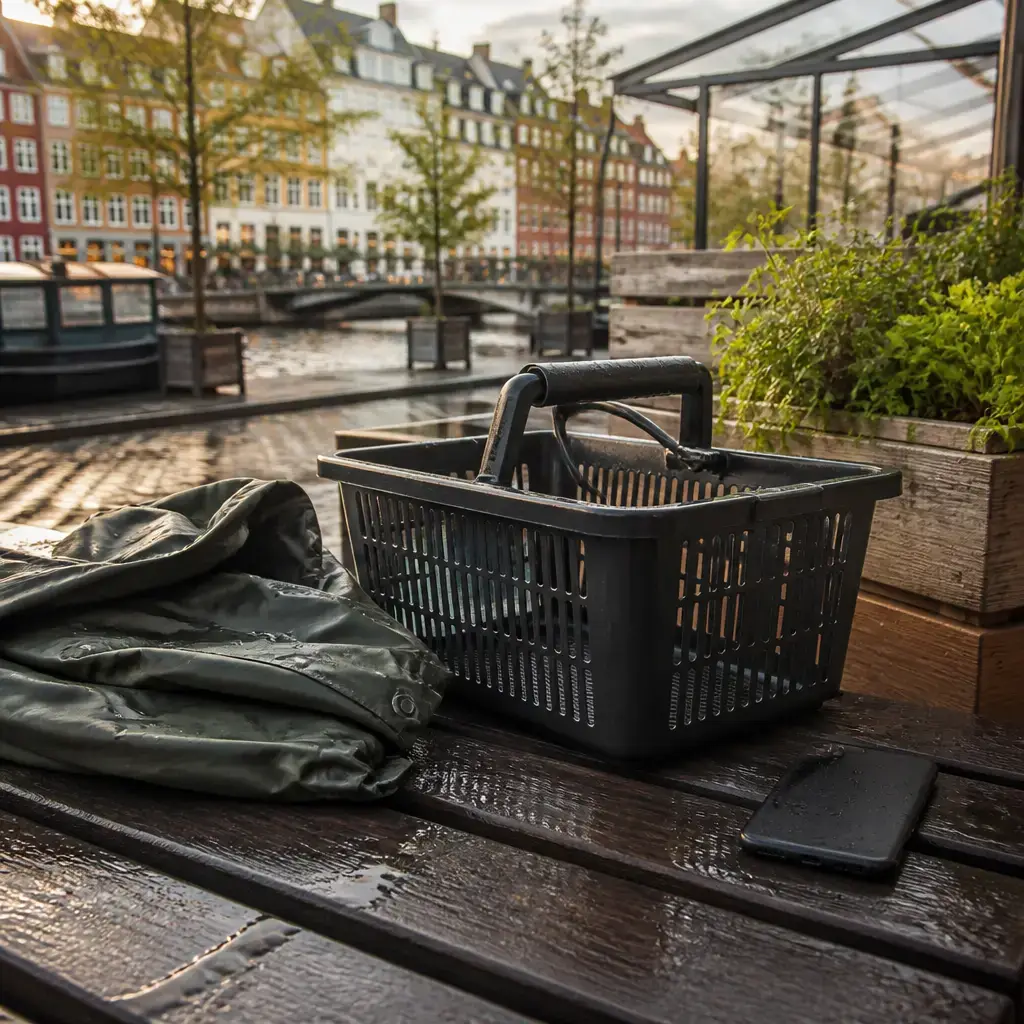
VY-uh air GOHT. The weather is nice.Det regner nu.
deh RYE-nuh noo. It is raining now.Jeg glemte min telefon.
yai GLEM-tuh meen teh-leh-FOHN. I forgot my phone.Jeg fandt den.
yai FAHN dehn. I found it.Sentence explanations
Hvor meget koster den?
How much is this?
- Hvor meget
- how much
- koster
- costs
- den
- this
More detail
Hvor meget asks for an amount: literally, “how much.” It is a reusable question pattern for an uncounted amount or a price. For a countable number, Danish uses Hvor mange instead, as in the example Hvor mange bøger har du? — “How many books do you have?” koster means “costs” here. Its base form is koste (“to cost”), and koster is the present-tense form. Danish present-tense verbs generally do not change according to the subject’s person or number, so the same form can be used with different subjects. Example: Hvad koster den? — “What does it cost?” den is a standalone pronoun referring to a singular common-gender noun; in this fixed utterance, the supplied translation establishes the intended meaning “this.” The form itself is not the verb’s subject or the price: it is the thing whose price is being asked about. Danish also has det for a singular neuter referent, so the choice between den and det follows the grammatical gender of the understood noun, not simply the English word “this.” Together, Hvor meget koster den? forms a question asking for the price of the indicated item: “How much is this?” The question pattern is reusable as Hvor meget koster + a noun or pronoun, for example Hvor meget koster kaffen? — “How much does the coffee cost?”
Hvor bor du?
Where do you live?
- Hvor
- where
- bor
- live
- du
- you
More detail
Hvor means “where” and asks about a place. It can also begin other place questions, such as Hvor arbejder du? — “Where do you work?” bor is the present-tense form of bo, “to live.” Danish present tense does not change for the subject: jeg bor means “I live,” du bor means “you live,” and de bor means “they live.” du is the second-person singular subject pronoun, “you,” used for one person. It is the subject of bor here. In this question, Danish places the question word first, followed by the verb and then the subject: Hvor + bor + du? The literal structure asks “Where live you?”, while the natural meaning is “Where do you live?” Danish does not need a separate equivalent of English “do” to form this present-tense question.
Vejret er godt.
The weather is nice.
- Vejret
- the weather
- er
- is
- godt
- nice; good
More detail
Vejret means “the weather” here. It is the definite form of vejr (“weather”): vejr → vejret. The ending -et marks this noun as singular definite; vejr is a neuter noun. Example: Vejret er koldt. — “The weather is cold.” er is the present-tense form of være (“to be”). It is used with all subjects in the present tense, so it does not change for person or number in this sentence. Example: Jeg er glad. — “I am happy.” godt means “nice” or “good” here. It is the neuter singular form of the adjective god: god with common-gender singular nouns, godt with neuter singular nouns, and gode in plural or definite adjective forms. It agrees with vejr, which is neuter. Example: Et godt vejr — “Good weather.” Together, Vejret er godt. states that the weather is nice: “The weather is nice.”
Det regner nu.
It is raining now.
- Det
- it
- regner
- is raining
- nu
- now
More detail
Det is the subject form used here in the impersonal weather expression. In this use, it does not identify a person or object; Danish uses it as a grammatical subject for weather conditions. The same form can have other uses in other sentences, so its exact role comes from the construction. regner means “rains” or, in this context, “is raining.” It is the present-tense form of regne (“to rain”). Danish present-tense verb forms generally do not change for the subject’s person or number, so the same regner form can be used with different subjects when the meaning permits. Example: Det regner ofte her. — “It often rains here.” nu means “now” and places the event at the current time. It can be moved for emphasis in some sentences, but here it follows the verb and directly specifies when the rain is happening. Together, the pattern Det + present-tense weather verb + time expression gives the meaning “It is raining now.” The fixed sentence therefore describes rain occurring at the present time, without identifying a human or other concrete actor.
Jeg glemte min telefon.
I forgot my phone.
- Jeg
- I
- glemte
- forgot
- min
- my
- telefon
- phone
More detail
Jeg means “I” here: it is the first-person singular subject pronoun. Danish subject pronouns include jeg (“I”), du (“you,” singular), and vi (“we”). Example: Jeg læser. — “I am reading.” glemte is the past-tense form of glemme, “to forget.” It describes the forgetting as completed in the past; the form does not show whether the subject is male or female. Example: Jeg glemte navnet. — “I forgot the name.” min means “my” before a singular common-gender noun. Its form agrees with the possessed noun, not with the possessor: min is used with common-gender singular nouns, mit with neuter singular nouns, and mine with plural nouns. Example: min bog — “my book”; mit hus — “my house”; mine bøger — “my books.” telefon means “phone.” It is a common-gender noun, so its indefinite article is en: en telefon. After the possessive min, no article is used: min telefon means “my phone.” Together, Jeg glemte gives “I forgot,” and min telefon gives “my phone.” The complete utterance therefore means “I forgot my phone.”
Jeg fandt den.
I found it.
- Jeg
- I
- fandt
- found
- den
- it
More detail
Jeg is the Danish first-person singular pronoun, meaning “I” when the speaker is the subject. It does not change for grammatical gender. A useful contrast is jeg “I” versus du “you” when addressing one person. Example: Jeg kommer. — “I am coming.” fandt is the past-tense form of finde, “to find.” The change from finde to fandt shows that the finding happened in the past; fandt is used with jeg and also with other singular or plural subjects, rather than changing for the subject. Example: Hun fandt sin nøgle. — “She found her key.” den is a third-person singular pronoun meaning “it” here. Its specific referent is not identified by the fixed sentence, but the translation establishes this intended object meaning. In Danish, den is used for a singular common-gender referent; det is the corresponding form for a neuter-gender referent. Example: Jeg så den. — “I saw it.” Together, Jeg supplies the subject “I,” fandt places the finding in the past, and den supplies the object “it.” The complete utterance therefore means “I found it.”
Grammar Points
Hvor + verb + subject?
Hvor bor du?
voh BOHR doo?Where do you live?
In Danish questions with Hvor, the verb comes before the subject: Hvor bor du?
Det + weather verb
Det regner nu.
deh RYE-nuh noo.It is raining now.
Danish uses Det for weather expressions, similar to dummy “it” in English.
Danish Vocabulary
Hvor bor du?
Hvor meget koster den?
Det regner nu.
Hvor bor du?
Vejret er godt.
- Gender
- neuter
Vejret er godt.
Hvor bor du?
Hvor meget koster den?
Hvor meget koster den?
Det regner nu.
Det regner nu.
- Gender
- neuter
Vejret er godt.
Quiz
Word Order
Arrange the words in the correct order.
How much is this?
Show Answer
Hvor meget koster den?Where do you live?
Show Answer
Hvor bor du?The weather is nice.
Show Answer
Vejret er godt.Spelling
Tap the letters to spell the word.
the weather
Show Answer
Vejretnice / good
Show Answer
godtcosts
Show Answer
kosterwhere