10 minutes free every day
Continue audio lessons in the app
Word explanations appear automatically in sync with the audio.
No login required · synced translations · playback with the screen locked
Choose your learning language and open this lesson in the app.

About This Lesson
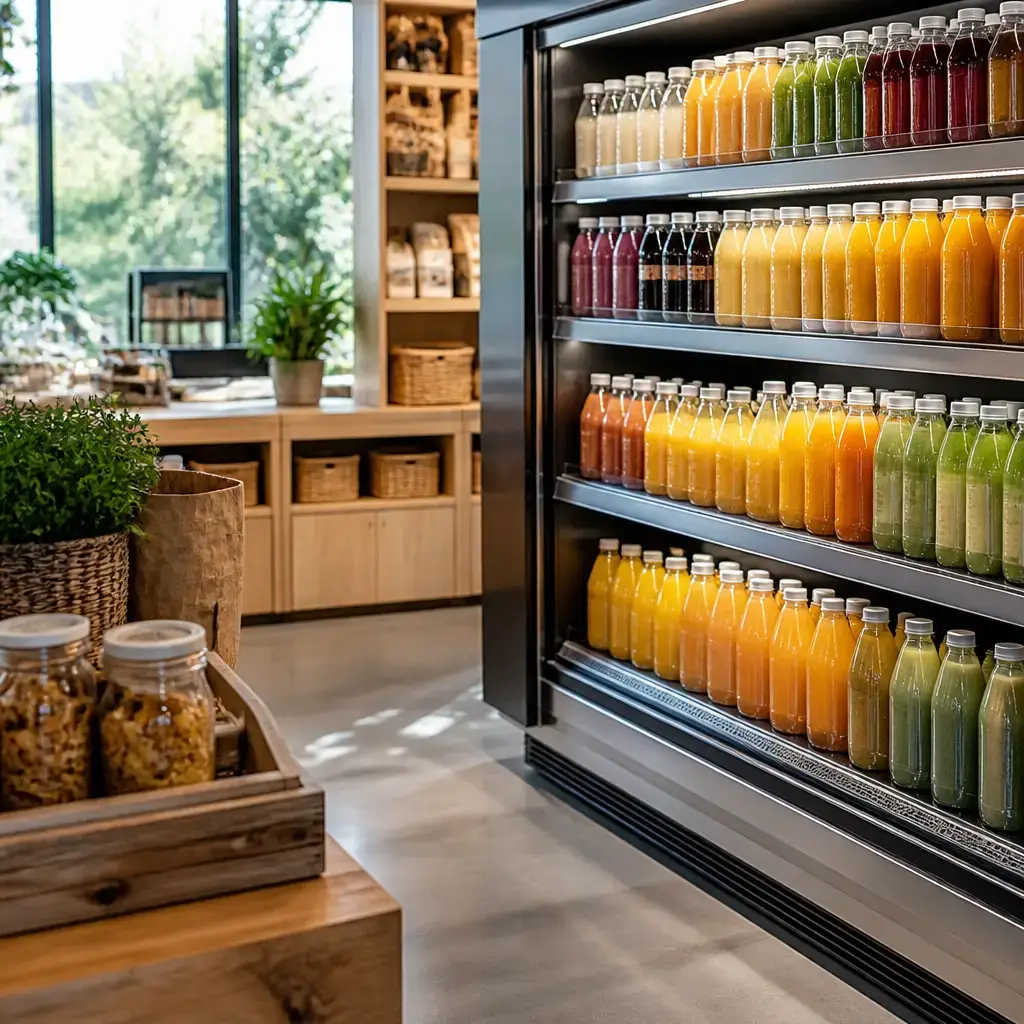
Use Asking for juice and choosing a bottle to practice Danish conversation, pronunciation, vocabulary, grammar, and quizzes.
Dialogue
Undskyld, hvor er juicen?
oon-SGOOL, vohr air YOO-sən? Excuse me, where is the juice?Den er i denne afdeling ved siden af de kolde drikkevarer.
den air ee DEN-uh ahf-DAIL-ing vehd SEE-thən ow dee KUL-uh DREG-uh-vair-uh. It's in this section, next to the cold drinks.Hvad anbefaler du?
va an-beh-FAIR-uh doo? What do you recommend?Denne juice har en frisk smag og er nem at drikke.
DEN-uh YOOS har en FREHSK smay oh air nem ah DREG-uh. This juice has a fresh taste and is easy to drink.Så tager jeg den flaske.
soh TAIR yai den FLAHS-guh. Then I'll get that bottle.Sentence explanations
Undskyld, hvor er juicen?
Excuse me, where is the juice?
- Undskyld
- Excuse me
- hvor er
- where is
- juicen
- the juice
More detail
Undskyld is a polite way to get someone’s attention or say “excuse me” here. It is also used as an apology in other contexts; the surrounding question makes the attention-getting meaning clear. hvor er combines the question word hvor (“where”) with er, the present-tense form of være (“to be”). The pattern Hvor er ...? is a reusable way to ask where something or someone is. For example: Hvor er toilettet? — “Where is the toilet?” juicen means “the juice.” The noun juice has the definite singular form juicen, formed with the ending -en; the ending expresses definiteness rather than a separate word meaning “the.” The noun is common gender, so this form uses -en. Example: Jeg køber juicen. — “I am buying the juice.” Together, Undskyld, hvor er juicen? means “Excuse me, where is the juice?” It is a polite location question about a specific juice item or category. The following context answers with Den er ..., “It is ...,” and locates it in a section next to the cold drinks.
Den er i denne afdeling ved siden af de kolde drikkevarer.
It's in this section, next to the cold drinks.
- Den
- it
- er
- is
- i
- in
- denne
- this
- afdeling
- section
- ved siden af
- next to
- de
- the
- kolde
- cold
- drikkevarer
- drinks
More detail
Den is the Danish third-person singular pronoun for a common-gender referent. In the supplied context, it refers to juicen (“the juice”). Danish distinguishes den for common gender from det for neuter gender; the choice is determined by the referent’s grammatical gender, not simply by its meaning as “it.” er is the present-tense form of at være, “to be.” The same form is used with different subjects in the present: for example, Jeg er her means “I am here,” while De er her means “They are here.” i means “in” here and introduces the location. The pattern være i + place is useful for saying that something is located inside a place or area: Bogen er i tasken means “The book is in the bag.” denne means “this” and is the common-gender singular form of the demonstrative. It agrees with the noun it modifies: denne afdeling is “this section.” With a neuter singular noun, Danish uses dette; with plural nouns, disse is used. afdeling means “section” or “department.” Its indefinite form is en afdeling, and its definite singular form is afdelingen, “the section.” Here it is indefinite in form because denne already identifies it as “this section.” ved siden af is a fixed prepositional construction meaning “next to” or “beside.” It is best learned as a unit. For example, Stolen står ved siden af bordet means “The chair is next to the table.” de is the plural definite article, meaning “the” before a plural noun phrase. It does not show the common/neuter gender distinction that singular Danish articles show. Here it makes de kolde drikkevarer mean “the cold drinks.” kolde means “cold” here. It is the form of the adjective kold used before a definite noun phrase or a plural noun phrase. For example, en kold drik means “a cold drink,” while de kolde drikkevarer means “the cold drinks.” drikkevarer means “drinks” or “beverages.” It is the plural of drikkevare, “drink” or “beverage.” In this sentence, the plural noun is part of the definite phrase de kolde drikkevarer, “the cold drinks.” Together, Den er i denne afdeling means “It is in this section.” The location is then made more precise by ved siden af de kolde drikkevarer, “next to the cold drinks.” The complete utterance therefore means: “It’s in this section, next to the cold drinks.”
Hvad anbefaler du?
What do you recommend?
- Hvad
- what
- anbefaler
- recommend
- du
- you
More detail
Hvad asks for an unspecified thing or choice: “what”. It is used here because the question asks what recommendation is being made. For a person, Danish uses hvem (“who”) instead. anbefaler means “recommend” here. Its base form is anbefale, and anbefaler is the present-tense form. Danish present-tense verbs generally do not change according to the subject’s person or number, so the same form can be used with jeg, du, or de: Jeg anbefaler ... means “I recommend ...”, while Du anbefaler ... means “You recommend ...”. du is the singular second-person pronoun “you”. Danish does not mark formality in this pronoun. The plural second-person pronoun is I, also meaning “you” when addressing more than one person. Together, Hvad + anbefaler + du forms a question with the pattern What + recommend + you? Danish places the verb before the subject in this question: anbefaler du. The complete meaning is “What do you recommend?”
Denne juice har en frisk smag og er nem at drikke.
This juice has a fresh taste and is easy to drink.
- Denne
- this
- juice
- juice
- har
- has
- frisk
- fresh
- smag
- taste
- er
- is
- nem
- easy
- at drikke
- to drink
More detail
Denne means “this” here and is the singular common-gender form used with juice in Denne juice. Danish also has dette for singular neuter nouns and disse for plural nouns. The demonstrative identifies something as near or contextually salient; it does not itself state how many units there are beyond its singular grammatical form. juice is the noun “juice.” In this sentence it is the subject and is treated as a common-gender singular noun, as shown by denne and the article pattern en juice. The noun refers to the drink being described. har is the present-tense form of have, “to have.” It can express possession or a characteristic, as here: the juice has a fresh taste. Present-tense har does not change for the subject’s person or number in this construction. frisk means “fresh.” It describes smag, “taste,” in en frisk smag. In Danish, an adjective before a common-gender singular noun commonly has this unmarked form; compare friskt with a singular neuter noun and friske in plural contexts. For example, en frisk salat means “a fresh salad.” smag means “taste” or “flavor.” It is the thing that the juice has: en frisk smag, “a fresh taste.” Its base form is smag; the indefinite article en in the larger noun phrase marks the noun’s common-gender pattern, not a separate quantity claim in the English translation. er is the present-tense form of være, “to be.” It introduces the second description of the juice. In the present tense, er is used with subjects of different persons and numbers, so it does not change here because the subject is singular. nem means “easy.” In er nem at drikke, it describes how easy the juice is to drink. The adjective is in the common-gender singular form; compare nemt with a singular neuter subject and nemme in plural contexts. For example, Opgaven er nem at forstå means “The task is easy to understand.” at drikke is the infinitive construction “to drink.” at marks the infinitive, and drikke is the base form of the verb. The phrase nem at drikke is a reusable pattern meaning that something is easy for people to drink: Vandet er nemt at drikke means “The water is easy to drink.” Here, the understood object of drinking is the juice itself. Together, Denne juice har en frisk smag says “This juice has a fresh taste.” The conjunction og joins that description to er nem at drikke, “is easy to drink.” The complete utterance is therefore “This juice has a fresh taste and is easy to drink.”
Så tager jeg den flaske.
Then I'll get that bottle.
- Så
- then
- tager
- get; take
- jeg
- I
- den
- that
- flaske
- bottle
More detail
Så means “then” here, linking this action to what came before. At the beginning of the sentence, it occupies the first position; Danish then places the finite verb before the subject. tager is the present-tense form of tage, “to take” or, in this context, “to get.” Danish present tense can describe a planned or imminent action, so tager is translated as “I’ll get” here. Example: Jeg tager bussen. — “I’m taking the bus.” jeg is the first-person singular subject pronoun, “I.” It identifies the speaker as the person who will get the bottle. Danish uses jeg for this subject regardless of the speaker’s gender. den means “that” here and is used with a singular common-gender noun. flaske is common gender (en flaske), so the demonstrative form is den; compare det with a singular neuter noun and de with plural nouns. In den flaske, den points to a particular bottle rather than merely introducing an unspecified one. flaske means “bottle.” Its indefinite form is en flaske; with den, it forms the specific demonstrative phrase den flaske, “that bottle.” Together, Så tager jeg den flaske. has the order “Then get/take I that bottle”: Så comes first, tager is the finite verb, jeg is its subject, and den flaske is what the speaker will get. The fixed meaning is therefore “Then I’ll get that bottle.”
Grammar Points
Substantiv + -en
juicen
YOO-sənthe juice
Danish often marks a common-gender noun as definite with the suffix -en, unlike English, which uses “the” before the noun.
kolde + plural noun
kolde drikkevarer
KUL-uh DREG-uh-vair-uhcold drinks
Adjectives usually take the ending -e before plural nouns: kolde drikkevarer.
Danish Vocabulary
- Gender
- common
Den er i denne afdeling ved siden af de kolde drikkevarer.
Hvad anbefaler du?
Den er i denne afdeling ved siden af de kolde drikkevarer.
Den er i denne afdeling ved siden af de kolde drikkevarer.
Den er i denne afdeling ved siden af de kolde drikkevarer.
Hvad anbefaler du?
Undskyld, hvor er juicen?
Den er i denne afdeling ved siden af de kolde drikkevarer.
- Gender
- common
Undskyld, hvor er juicen?
Den er i denne afdeling ved siden af de kolde drikkevarer.
Undskyld, hvor er juicen?
Den er i denne afdeling ved siden af de kolde drikkevarer.
Quiz
Word Order
Arrange the words in the correct order.
Excuse me, where is the juice?
Show Answer
Undskyld, hvor er juicen?What do you recommend?
Show Answer
Hvad anbefaler du?Then I'll get that bottle.
Show Answer
Så tager jeg den flaske.Spelling
Tap the letters to spell the word.
section; department
Show Answer
afdelingthis
Show Answer
dennecold
Show Answer
koldewhere