10 minutes free every day
Continue audio lessons in the app
Word explanations appear automatically in sync with the audio.
No login required · synced translations · playback with the screen locked
Choose your learning language and open this lesson in the app.

About This Lesson
Use Confirming the Right Bus to practice Danish conversation, pronunciation, vocabulary, grammar, and quizzes.
Dialogue
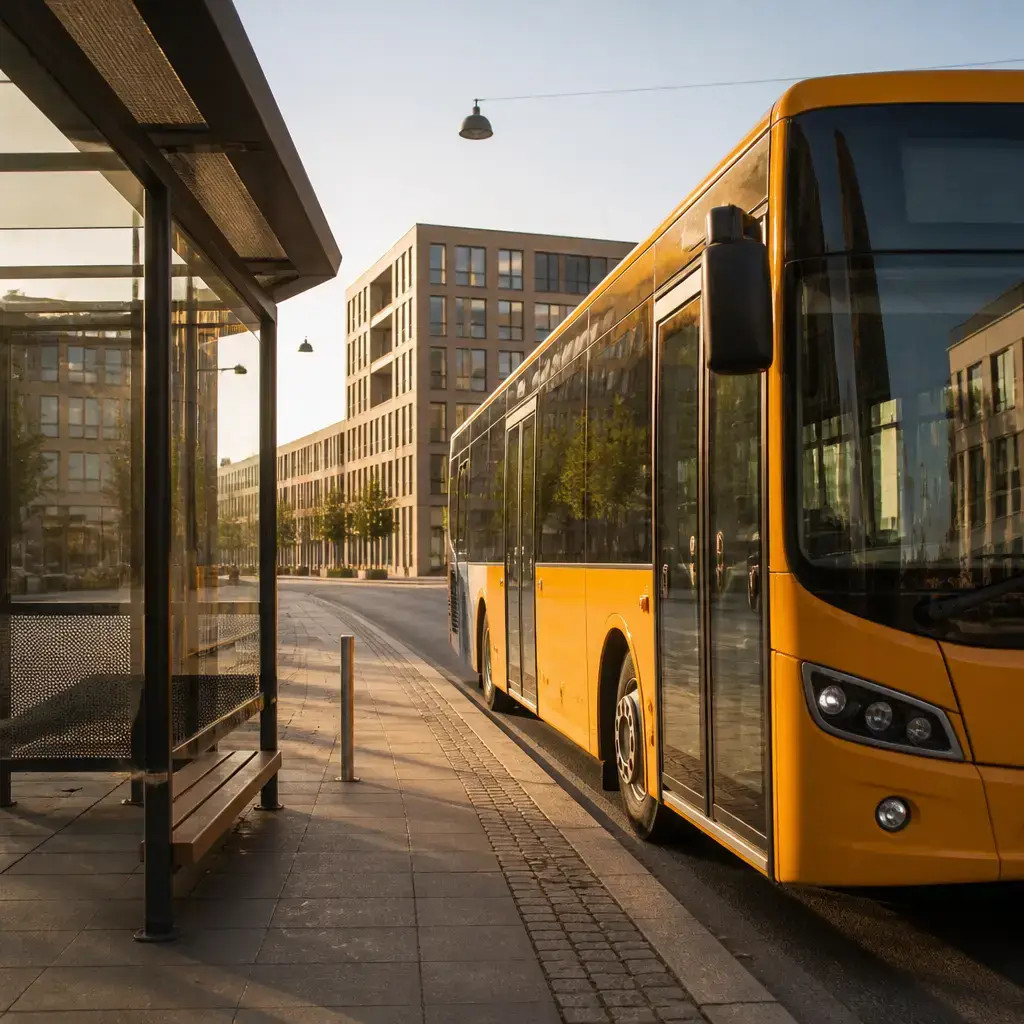
Bussen er her.
BOO-sən air hair. The bus is here.Tror du, det er den rigtige bus?
TROHR doo, deh air den RIG-də boos? Do you think this is the right bus?Lad os spørge chaufføren, før vi stiger på.
Lah ohs SPUR-uh shoh-FUR-ən, fur vee STEE-uh poh. Let's ask the driver before we get on.Undskyld, kører denne bus til stationen?
OON-SGOOL, KUR-uh DEN-uh boos til stah-SYOH-nən? Excuse me, does this bus go to the station?Stationen er det sidste stoppested.
Stah-SYOH-nən air deh SIS-də STOO-bəs-deh. The station is the last stop.Så er det den rigtige bus.
Soh air deh den RIG-də boos. Then this is the right bus.Lad os stige på og gå længere ind.
Lah ohs STEE-uh poh oh goh LENG-uh ihn. Let's get on and move farther inside.Jeg stiller mig tæt på midten.
Yai STIL-uh mai teht poh MEE-dən. I'll stand near the middle.Sentence explanations
Bussen er her.
The bus is here.
- Bussen
- the bus
- er
- is
- her
- here
More detail
Bussen means “the bus” here. It is the definite singular form of bus: en bus = “a bus,” bussen = “the bus.” The ending -en marks definite singular for this common-gender noun; it does not itself state a number beyond the form’s grammatical singular meaning. er is the present-tense form of være (“to be”). It is used with singular and plural subjects alike: Bussen er her = “The bus is here,” while Busserne er her = “The buses are here.” her is an adverb meaning “here,” referring to the place relevant in the situation. It does not change form for the subject. Together, Bussen er her forms a simple present-tense clause: definite subject Bussen + the present form of “to be” er + location her. The complete meaning is “The bus is here.”
Tror du, det er den rigtige bus?
Do you think this is the right bus?
- Tror du
- do you think
- det
- this
- er
- is
- den
- the
- rigtige
- right; correct
- bus
- bus
More detail
Tror du means “do you think?” Here tror is the present-tense form of tro, “to think/believe.” Danish present tror is used with different subjects; the subject is shown here by du, “you.” In this question, the verb comes before the subject: Tror du ...? This is a reusable way to ask for someone's opinion. Example: Tror du, bussen er her? — “Do you think the bus is here?” det is a neuter singular pronoun. In this utterance, the fixed translation supports the meaning “this,” referring to what is being identified as a bus. Its exact referent is supplied by the situation rather than by a noun inside this sentence. er is the present form of være, “to be.” Danish uses er with singular and plural subjects as well as with different persons; the form itself does not mark those distinctions. The pattern det er ... can introduce an identification or description. den is the definite singular form used with a common-gender noun. It agrees with bus, which is common gender: en bus. It is not the same form as neuter det; the choice here is connected to the noun identified as bus. rigtige is the definite form of the adjective rigtig, “right” or “correct.” After den and before a common-gender singular noun, the adjective takes the -e form: den rigtige bus. The adjective describes the bus as the correct one for the intended journey, not merely as a physically right-sided bus. bus is the noun “bus.” Its useful forms are en bus (an/a bus), bussen (the bus), and busser (buses). In den rigtige bus, the preceding den marks the noun phrase as definite, so the noun itself remains bus. Together, det er den rigtige bus identifies the bus being indicated as the correct bus. Placing Tror du first turns that identification into the question “Do you think this is the right bus?”
Lad os spørge chaufføren, før vi stiger på.
Let's ask the driver before we get on.
- Lad os
- let’s
- spørge
- ask
- chaufføren
- the driver
- før
- before
- vi
- we
- stiger på
- get on
More detail
Lad os is the Danish way to propose an action: “let’s …”. lad is the imperative of lade (“let/allow”), and os means “us”; together they form a fixed proposal pattern before an infinitive. Example: Lad os gå. — “Let’s go.” spørge is the infinitive “to ask”. After Lad os, Danish uses the infinitive: Lad os spørge. — “Let’s ask.” The related present-tense form is spørger: Jeg spørger chaufføren. — “I am asking the driver.” chaufføren means “the driver” here. The base noun is chauffør (“driver”); the ending -en marks the common-gender definite singular form, corresponding to “the driver.” The indefinite form is en chauffør — “a driver.” før means “before” and introduces the time relation for the following clause. It can also be used before a noun phrase, as in før frokost — “before lunch.” vi is the subject pronoun “we.” It is the form used for a group including the speaker, whether the group is otherwise specified or not. stiger på means “get on” in this sentence, specifically board a vehicle. stiger is the present-tense form of stige (“step/go up”); på combines with it to make the vehicle-boarding expression. Example: Vi stiger på toget. — “We get on the train.” The sentence first proposes the action with Lad os spørge chaufføren (“Let’s ask the driver”). The clause før vi stiger på says that this should happen before the speakers board, giving the complete meaning: “Let’s ask the driver before we get on.”
Undskyld, kører denne bus til stationen?
Excuse me, does this bus go to the station?
- Undskyld
- Excuse me
- kører
- goes; travels
- denne
- this
- bus
- bus
- stationen
- the station
More detail
Undskyld is a polite way to get someone's attention or apologize; here it means “Excuse me.” It is also related to the verb undskylde (“to excuse” or “to apologize”), but in this utterance it functions as a polite opening rather than describing a separate apology. kører means “goes” or “travels” here, specifically describing the bus's route. It is the present-tense form of køre (“to drive; to travel”). With a vehicle or route, køre can describe traveling: Bussen kører til centrum. — “The bus goes to the city center.” The same form can also mean that someone drives, depending on the subject and context. denne means “this” and is the singular common-gender form of the demonstrative. Danish uses denne with common-gender singular nouns, dette with neuter singular nouns, and disse for plural nouns. In denne bus, it points to the particular bus being referred to. Example: Denne bog er ny. — “This book is new.” bus means “bus.” It is a common-gender noun, as shown by forms such as en bus (“a bus”) and bussen (“the bus”). Here it is uninflected because it follows the demonstrative in the noun phrase denne bus. stationen means “the station.” It is the definite form of station: en station (“a station”) → stationen (“the station”). Danish commonly marks definiteness by adding an ending to the noun rather than using a separate word equivalent to “the.” Example: Stationen er tæt på. — “The station is nearby.” Together, denne bus means “this bus,” and kører ... til stationen means “goes ... to the station.” This is a yes/no question: kører comes before the subject denne bus, giving the pattern [verb] [subject] ...? The complete utterance therefore means, “Excuse me, does this bus go to the station?”
Stationen er det sidste stoppested.
The station is the last stop.
- Stationen
- the station
- er
- is
- det
- the
- sidste
- last
- stoppested
- stop
More detail
Stationen means “the station” here. It is the definite form of station: en station = “a station”, stationen = “the station”. The ending -en marks definiteness for this common-gender noun; it is not a separate word. er is the present-tense form of være, “to be”. Danish uses er with all subjects in the present: Jeg er = “I am”, den er = “it is”, and de er = “they are”. det is the singular neuter definite article, “the”, used here before the adjective and the neuter noun stoppested. In Danish, when an adjective comes before a definite noun, the pattern is often det/de + adjective + noun: det sidste stoppested = “the last stop”. The article agrees with stoppested, whose indefinite form is et stoppested. sidste means “last” in this sentence: it identifies the stop as the final one in the relevant sequence. It is related to sidst, used in expressions such as sidst = “last/latest” in some adverbial uses, but sidste is the adjective form used with a noun here. Example: den sidste bus means “the last bus”; den is used there because bus is common gender, whereas det is used with neuter stoppested. stoppested means “stop” or “stopping place”, especially a place where a bus or similar service stops. Its indefinite form is et stoppested, and its definite form is stoppestedet. Example: Dette er et stoppested. — “This is a stop.” Together, det sidste stoppested forms the definite noun phrase “the last stop”: det marks the neuter noun phrase as definite, sidste describes its position in the sequence, and stoppested names the place. With Stationen er, the utterance says that the station is that final stop: “The station is the last stop.”
Så er det den rigtige bus.
Then this is the right bus.
- Så
- then
- er
- is
- det
- this
- den
- the
- rigtige
- right; correct
- bus
- bus
More detail
Så means “then” here and connects the statement with what has just been established. It can have other functions in Danish, but this sentence uses it to mark the conclusion. er is the present-tense form of at være, “to be.” It is used with different subjects in the present tense: for example, Jeg er klar means “I am ready,” and De er her means “They are here.” det means “this” in the fixed translation and participates in the Danish identification pattern det er .... The specific thing being indicated comes from the situation; this sentence identifies it as the bus. Det is the neuter singular pronoun form, but it does not make bus a neuter noun in this construction. Example: Det er min billet means “This is my ticket.” den is the singular definite article used with a common-gender noun. It marks bus as a specific, identifiable bus. The article itself does not state a numeric quantity. rigtige means “right” or “correct” here, specifically the intended bus. Its base form is rigtig; in the definite noun phrase den rigtige bus, the adjective has the definite form rigtige. Example: den rigtige vej means “the right way.” bus means “bus.” It is a common-gender noun: en bus; its definite singular form is bussen, “the bus.” Together, det er den rigtige bus forms the reusable identification pattern “this is the right bus.” With Så at the beginning, the whole utterance means “Then this is the right bus.”
Lad os stige på og gå længere ind.
Let's get on and move farther inside.
- Lad os
- let’s
- stige på
- get on
- gå
- go or walk
- længere ind
- farther inside
More detail
Lad os is the Danish construction used to propose an action jointly: “let’s …”. Lad is the imperative of lade (“let” or “allow”), and os is the object form meaning “us”. It is followed by an infinitive: Lad os vente means “Let’s wait.” stige på means “get on” or “board” a vehicle. Stige is the infinitive, and på is essential to this boarding meaning; stige alone does not express the same construction. Example: Vi stiger på bussen. — “We get on the bus.” gå is the infinitive “go” or “walk”. Here it is coordinated with stige på after Lad os, so it introduces another proposed action. Example: Lad os spise og gå. — “Let’s eat and go.” længere ind means “farther inside” or “further in”. Længere is a comparative form related to lang (“long”); in this expression it indicates a greater distance inward rather than physical length. Ind indicates movement toward the inside. Example: Gå længere ind. — “Go farther inside.” Together, Lad os stige på og gå længere ind. proposes that the speaker and others get on and move farther inside. The fixed translation is “Let’s get on and move farther inside.”
Jeg stiller mig tæt på midten.
I'll stand near the middle.
- Jeg
- I
- stiller
- stand / position
- mig
- myself
- tæt
- close
- på
- on / at
- midten
- the middle
More detail
Jeg means “I” and is the subject: the speaker performs the action. Danish subject pronouns include jeg “I”, du “you” (singular), and vi “we”. stiller is the present-tense form of stille, here used in the construction stille sig “to position oneself / stand”. In this sentence, the present form describes the speaker’s intended positioning, rendered in the fixed translation as “I’ll stand.” It is not the same as simply being stationary; stille sig presents the act of choosing or taking a position. Danish present-tense verbs do not change form for the subject’s person or number. mig is the reflexive object form used with the first-person singular subject jeg. Thus jeg ... mig means that the speaker positions themself. A reusable pattern is jeg [verb] mig, for example: Jeg sætter mig. — “I sit down.” stiller mig together forms the meaningful reflexive unit “position myself / stand”. The finite verb is stiller, while mig identifies the affected person as the speaker. With another subject, the reflexive form changes, for example Hun stiller sig. — “She positions herself.” tæt means “close” or “near” here and describes the distance of the position. It can also be used in other contexts for things being physically close together. For example: De står tæt. — “They are standing close together.” på is a preposition. In the construction tæt på, the combination means “near / close to”; på alone does not carry that complete meaning here. For example: Bussen er tæt på stationen. — “The bus is near the station.” midten means “the middle” here. It is the definite form of midte, “middle”: en midte is an indefinite form, while midten refers to a specific middle or central area identifiable in the situation. The sentence does not state a numerical quantity; the definite form marks the intended central area as identifiable. The meaningful chunks combine as follows: Jeg stiller mig means “I’ll position myself / stand”, while tæt på midten specifies that the position will be near the middle. Together, the utterance means: “I’ll stand near the middle.”
Grammar Points
Bestemt form: substantiv + -en/-et
Bussen kører.
BOO-sən KUR-uh.The bus goes.
In Danish, the definite article is often attached to the noun: bus → bussen.
Danish Vocabulary
- Gender
- common
Bussen er her.
- Gender
- common
Lad os spørge chaufføren.
før vi stiger på
Bussen er her.
Kører denne bus til stationen?
den rigtige bus
det sidste stoppested
Lad os spørge chaufføren.
- Gender
- common
Kører denne bus til stationen?
før vi stiger på.
Tror du, det er den rigtige bus?
Undskyld, kører denne bus til stationen?
Quiz
Word Order
Arrange the words in the correct order.
The bus is here.
Show Answer
Bussen er her.Excuse me, does this bus go to the station?
Show Answer
Undskyld, kører denne bus til stationen?The station is the last stop.
Show Answer
Stationen er det sidste stoppested.Spelling
Tap the letters to spell the word.
driver
Show Answer
chaufførenbus
Show Answer
Bussenright; correct
Show Answer
rigtigethink