10 minutes free every day
Continue audio lessons in the app
Word explanations appear automatically in sync with the audio.
No login required · synced translations · playback with the screen locked
Choose your learning language and open this lesson in the app.

About This Lesson
Use Buying a train ticket to practice Danish conversation, pronunciation, vocabulary, grammar, and quizzes.
Dialogue
Har du allerede en togbillet?
hah doo AL-uh-ray-thuh uhn TOHG-bih-led? Do you already have a train ticket?Ikke endnu. Jeg skal købe en.
IK-uh en-OO. YAI skal KUR-buh uhn. Not yet. I need to buy one.Der er billetautomater ved indgangen.
dair air bih-LED-ow-toh-MAH-duh vehth ENG-gahng-uhn. There are ticket machines by the entrance.Jeg køber min der.
YAI KUR-uh men dair. I'll get mine there.Jeg har min billet på min telefon.
YAI hah men bih-LED poh men teh-leh-FOHN. I have my ticket on my phone.Så møder jeg dig her igen, når jeg har købt min.
soh MUR-uh YAI dai hair ee-GAYN, nor YAI hah KURBD men. Then I'll meet you back here after I buy mine.Jeg venter i nærheden af automaterne.
YAI VEN-tuh ee NAIR-hay-thun af ow-toh-MAH-duh-nuh. I'll wait near the machines.Se efter mig ved siden af dem.
SAY EF-tuh mai vehth SEE-thun af dem. Look for me beside them.Sentence explanations
Har du allerede en togbillet?
Do you already have a train ticket?
- Har du
- do you have
- allerede
- already
- togbillet
- train ticket
More detail
Har du contains the present-tense form har of have and the subject pronoun du, “you.” In a Danish yes/no question, the finite verb commonly comes before the subject: Har du ...? means “Do you have ...?” The statement order is Du har ... (“You have ...”). allerede means “already” and places the situation before the expected or relevant point in time. Its position here makes the question ask whether you have the ticket by now. The noun phrase en togbillet means “a train ticket.” togbillet is a compound noun: tog means “train” and billet means “ticket.” The indefinite article en marks the noun phrase as indefinite; it does not by itself assert a numerical count. In Danish, nouns with the common-gender article use en, while neuter nouns use et; the article belongs to togbillet here. Together, Har du + allerede + en togbillet forms the yes/no question “Do you already have a train ticket?”
Ikke endnu. Jeg skal købe en.
Not yet. I need to buy one.
- Ikke endnu
- Not yet
- Jeg skal
- I need to
- købe
- buy
- en
- one
More detail
Ikke endnu means “not yet.” Ikke is the ordinary Danish negator, and endnu here means “yet,” referring to something that has not happened up to the relevant time. Together they form a reusable pattern: Ikke endnu. = “Not yet.” Jeg skal contains jeg, “I,” and skal, the present form of skulle. In this sentence, skal expresses the speaker’s need or intention to do something, rather than a simple future prediction. Danish uses skal directly before an infinitive: Jeg skal arbejde. = “I need to work” or “I have to work,” depending on context. The pronoun jeg identifies the speaker as the actor. købe is the infinitive “to buy.” After skal, the infinitive appears without an extra marker: skal købe = “need to buy.” Its present-tense form is køber, as in Jeg køber en billet. = “I am buying a ticket.” en is the standalone pronoun “one” in this sentence. It refers to one ticket, supported by the preceding question about a train ticket and the fixed translation. Danish uses en for a common-gender singular noun and et for a neuter singular noun when the noun is replaced in this way; plural “ones” is commonly nogle. Here en avoids repeating togbillet. The two parts assemble as Ikke endnu. (“Not yet.”) + Jeg skal købe en. (“I need to buy one.”). The first part says the ticket has not been obtained yet; the second states that the speaker needs to buy one. The pattern is reusable with another infinitive: Jeg skal finde en. = “I need to find one.”
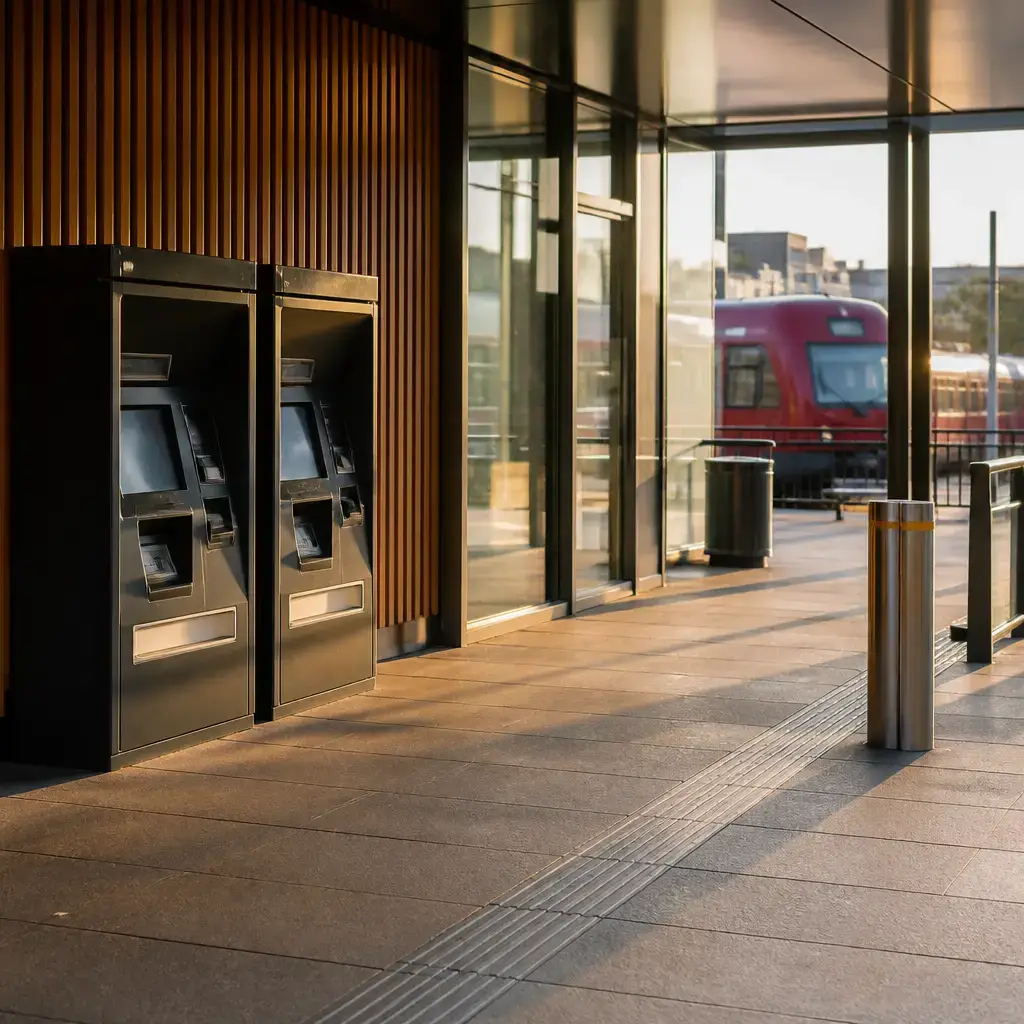
Der er billetautomater ved indgangen.
There are ticket machines by the entrance.
- Der er
- there is/are
- billetautomater
- ticket machines
- ved
- by; at
- indgangen
- the entrance
More detail
Der er is the Danish existential pattern used to introduce something that exists or is present. It can correspond to “there is” with a singular noun or “there are” with a plural noun; the following noun determines the English number. Example: Der er en café her. — “There is a café here.” billetautomater means “ticket machines” here. It is the plural of billetautomat; the compound combines billet (“ticket”) and automat (“machine”). The plural form has no indefinite article in this sentence because it follows the existential pattern as an indefinite plural noun. Example: Der er billetautomater på stationen. — “There are ticket machines at the station.” ved is a preposition meaning “by” or “at” when it places something near a location. Example: Cyklen står ved døren. — “The bicycle is by the door.” indgangen means “the entrance.” It is the definite singular form of indgang (“entrance”): indgang is “an entrance,” while indgangen is “the entrance.” The definite ending is part of the noun form rather than a separate word. Example: Vi mødes ved indgangen. — “We’ll meet by the entrance.” Together, Der er billetautomater introduces the presence of ticket machines, and ved indgangen locates them by the entrance. The complete utterance therefore means: “There are ticket machines by the entrance.”
Jeg køber min der.
I'll get mine there.
- Jeg
- I
- køber
- buy / get
- min
- mine
- der
- there
More detail
Jeg is the first-person singular subject: “I.” It is used for the speaker, regardless of the speaker’s gender. Example: Jeg har en billet. — “I have a ticket.” køber is the present-tense form of købe, “to buy.” In this sentence, the fixed translation presents the purchase as a future intention: “I’ll get.” Danish commonly uses the present tense for a planned or expected future event when the context makes that clear. Example: Jeg køber en billet. — “I’m buying a ticket” or, in a suitable context, “I’ll buy a ticket.” min means “my” or, when the possessed noun is understood, “mine.” It is the common-gender singular possessive form and normally agrees with the thing possessed, not with the person who owns it. Here, the surrounding context identifies the understood item as billet (“ticket”), and min billet means “my ticket”; the noun is omitted in min, giving the intended meaning “mine.” Example: Hvor er min billet? — “Where is my ticket?” der means “there,” referring to a place understood from the situation. In the supplied context, that place is by the entrance, where the ticket machines are mentioned. Example: Jeg venter der. — “I’ll wait there.” Together, Jeg køber min der means “I’ll get mine there.” The structure is subject + present-tense verb + possessive form with its noun understood + place adverb. Here, min refers to the speaker’s ticket, while der identifies the place of getting it. The sentence is concise and conversational; if the noun is stated instead, Jeg køber min billet der means “I’ll get my ticket there.”
Jeg har min billet på min telefon.
I have my ticket on my phone.
- Jeg
- I
- har
- have
- min
- my
- billet
- ticket
- på
- on
- telefon
- phone
More detail
Jeg means “I” here: it is the first-person singular subject pronoun. Danish uses jeg for the speaker regardless of the speaker’s gender. Example: Jeg læser. — “I am reading.” har is the present-tense form of have, “to have.” The same present form is used with different subjects: jeg har “I have,” du har “you have,” and de har “they have.” Here it expresses possession. Example: Jeg har en nøgle. — “I have a key.” min means “my” before the singular common-gender noun billet. Its form agrees with the noun it modifies, not with the owner: min is used with singular common-gender nouns, mit with singular neuter nouns, and mine with plural nouns. Example: min telefon — “my phone,” but mit kort — “my card” and mine billetter — “my tickets.” billet means “ticket.” It is a common-gender noun, so a definite ticket can be billetten; after the possessive, Danish uses min billet rather than adding a separate definite article. Example: Jeg finder billetten. — “I find the ticket.” på means “on” in this use and expresses the ticket’s location in relation to the phone. It can have other meanings in other contexts, so its exact translation depends on the phrase it forms. Example: Bogen ligger på bordet. — “The book is on the table.” telefon means “phone.” It is a common-gender noun here, which is why the phrase uses min telefon, not mit telefon. Example: Min telefon er her. — “My phone is here.” Together, the subject Jeg, the present-tense possession verb har, the possessive noun phrase min billet, and the location phrase på min telefon express that the speaker has their ticket on their phone: “I have my ticket on my phone.”
Så møder jeg dig her igen, når jeg har købt min.
Then I'll meet you back here after I buy mine.
- Så
- then
- møder
- meet
- jeg
- I
- dig
- you
- her igen
- back here
- når
- when
- jeg har
- I have
- købt
- bought
- min
- mine
More detail
Så introduces the result or next step: “then” in this utterance. It can also mean “so” in other contexts, but here the intended meaning is the time-sequencing one. møder is the present-tense form of møde, “to meet”. With jeg as its subject, it has the form møder; the present tense can refer to a planned future event when the context makes that clear. Example: “Jeg møder dig i morgen.” — “I’ll meet you tomorrow.” jeg is the first-person singular subject pronoun, “I”. It is the person carrying out the meeting and the later purchase. Danish does not change this pronoun for grammatical gender. dig is the second-person singular object pronoun, “you”. It is the person being met. The subject and object forms contrast here: “Jeg møder dig” means “I meet you”, whereas “Du møder mig” means “You meet me.” her igen combines the location word her, “here”, with igen, “again”. Together, in this utterance, they give the reusable idea “back here” or “here again”: the meeting is to take place at this location again. Example: “Vi ses her igen.” — “We’ll see each other here again.” når introduces a time clause meaning “when”. Here it places the meeting in relation to the completed purchase; it is a time relation, not a general conditional statement. Danish uses present-tense forms for a future time clause where English commonly uses a present form too: “Når jeg kommer, ringer jeg.” — “When I arrive, I’ll call.” jeg har begins the subordinate clause with jeg as its subject and har, the present form of have, as an auxiliary. The auxiliary combines with the following participle købt to form a completed-action construction. købt is the past participle of købe, “to buy”. In har købt, it expresses that the buying is completed: “have bought”. The participle itself does not show the person here; jeg is shown by the subject, while har carries the finite verb form. Example: “Jeg har købt en billet.” — “I have bought a ticket.” min is a possessive pronoun used without its noun, meaning “mine” here. The supplied context identifies the omitted item as the billet, “ticket”, so the phrase means that the speaker has bought their ticket. Danish possessives agree with the omitted or expressed noun: min for a singular common-gender noun, mit for a singular neuter noun, and mine for plural nouns. Compare “min billet” — “my ticket”, “mit kort” — “my card”, and “mine billetter” — “my tickets”. Together, Så møder jeg dig her igen means “Then I’ll meet you back here”. The time clause når jeg har købt min means “when I have bought mine”: når sets the time, har købt marks the purchase as completed, and min stands for the speaker’s ticket. The complete intended meaning is “Then I’ll meet you back here after I buy mine.”
Jeg venter i nærheden af automaterne.
I'll wait near the machines.
- Jeg
- I
- venter
- wait
- i nærheden af
- near
- automaterne
- the machines
More detail
Jeg is the first-person singular subject pronoun, “I.” It identifies the speaker as the person who waits. A useful contrast is jeg “I” versus du “you” when the subject changes. venter is the present-tense form of vente, “to wait.” Danish present tense can describe an action happening now or a planned action understood from context; here, with the fixed translation, it expresses the speaker’s intention to wait. Example: Jeg venter her. — “I’ll wait here.” i nærheden af is a reusable prepositional construction meaning “near” or “in the vicinity of.” The element af introduces what the location is near. Example: Hotellet ligger i nærheden af stationen. — “The hotel is near the station.” automaterne means “the machines” here. It is the definite plural form of automat: automat “a machine,” automater “machines,” automaterne “the machines.” The ending -ne marks definite plural in this noun form. The fixed translation supports the intended general meaning “machines”; the form can refer to a specific set understood from context. Together, Jeg venter gives “I’ll wait,” and i nærheden af automaterne specifies the location: “near the machines.” The complete utterance is: “I’ll wait near the machines.”
Se efter mig ved siden af dem.
Look for me beside them.
- Se efter
- look for
- mig
- me
- ved siden af
- beside
- dem
- them
More detail
Se efter is the reusable Danish construction for “look for.” Se is the imperative form of se (“to see”); with efter, the combination means searching for someone or something. This is different from using se alone, which normally means simply “see” or “look.” Example: Se efter hunden. — “Look for the dog.” mig means “me” here, the first-person singular object form. The corresponding subject form is jeg (“I”): Jeg ser dig. — “I see you.” Because mig is the object of the search, the sentence does not say that the speaker is doing the looking; it tells the listener to look for the speaker. ved siden af is a fixed prepositional expression meaning “beside” or “next to.” It places one person or thing alongside another. Example: Bogen ligger ved siden af koppen. — “The book is beside the cup.” dem means “them,” the third-person plural object form. In this context, supported by the preceding mention of the machines, it refers to those machines. Danish uses de as the corresponding subject form and dem as the object form: De står der. — “They are standing there”; Jeg ser dem. — “I see them.” Together, Se efter mig gives “look for me,” and ved siden af dem specifies the location: the speaker is beside the previously mentioned machines. The complete utterance therefore means “Look for me beside them.”
Grammar Points
har + participium
har allerede købt
hah AL-uh-ray-thuh KURBDhave already bought
Danish uses har plus the past participle to form the present perfect.
ikke ... endnu
har ikke købt endnu
hah IK-uh KURBD en-OOhave not bought yet
ikke comes after har, while endnu usually comes at the end to mean “yet”.
Danish Vocabulary
- Gender
- common
- Gender
- common
- Gender
- common
- Gender
- common
Quiz
Word Order
Arrange the words in the correct order.
Do you already have a train ticket?
Show Answer
Har du allerede en togbillet?Not yet. I need to buy one.
Show Answer
Ikke endnu. Jeg skal købe en.There are ticket machines by the entrance.
Show Answer
Der er billetautomater ved indgangen.Spelling
Tap the letters to spell the word.
not
Show Answer
ikkeyet
Show Answer
endnuentrance
Show Answer
indgangentrain ticket