10 minutes free every day
Continue audio lessons in the app
Word explanations appear automatically in sync with the audio.
No login required · synced translations · playback with the screen locked
Choose your learning language and open this lesson in the app.

About This Lesson
Use Getting Ready for a Walking Event to practice Danish conversation, pronunciation, vocabulary, grammar, and quizzes.
Dialogue
Jeg er færdig med formularen.
yai air FAIR-dee meh foh-MEH-lah-ren I finished the form.Kan vi være med til det næste gåarrangement?
kan vee VAIR-uh meh teel deh NES-duh goh-ah-rahn-ZHAY-mahn Can we join the next walking event?Ja, I kan være med til det næste gåarrangement.
yah, ee kan vee VAIR-uh meh teel deh NES-duh goh-ah-rahn-ZHAY-mahn Yes, you can join the next walking event.Skal vi tage noget med?
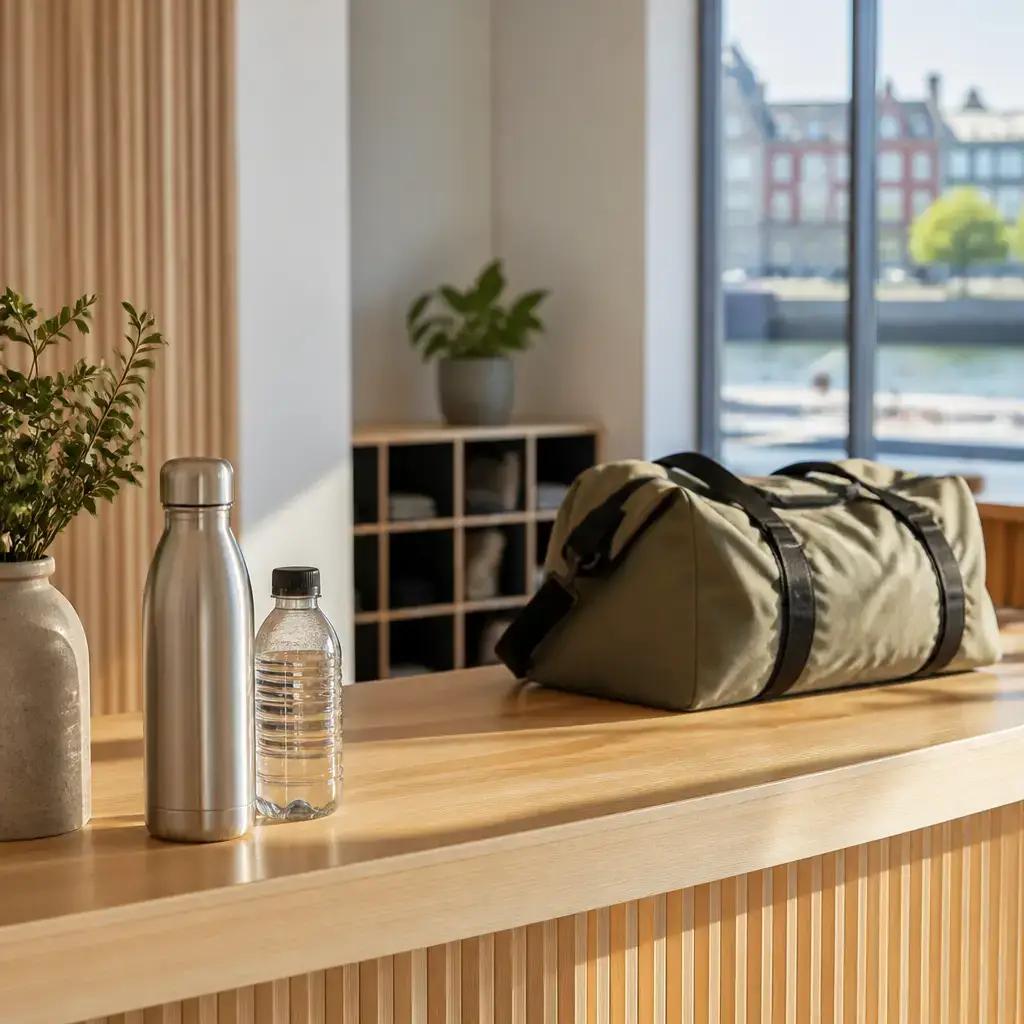
skal vee TAY-uh NOH-uth meh Should we bring anything?Tag venligst en vandflaske med.
tay VEN-ligst uhn VAHN-flas-kuh meh Please bring a water bottle.I kan lægge en stor taske ved skranken.
ee kan LEH-guh uhn stohr TAS-kuh veh SKRANG-uhn You can leave a large bag at the desk.Jeg har en lille vandflaske med.
yai hah uhn LEE-luh VAHN-flas-kuh meh I have a small water bottle with me.Jeg lægger min taske her, før vi starter.
yai LEH-guh min TAS-kuh hair, fur vee STAH-duh I will leave my bag here before we start.Jeg glæder mig til det.
yai GLAIR-uh my teel deh I am looking forward to it.Sentence explanations
Jeg er færdig med formularen.
I finished the form.
- Jeg er
- I am
- færdig
- finished
- med
- with
- formularen
- the form
More detail
Jeg er means “I am.” Jeg is the first-person singular pronoun “I.” er is the present-tense form of være (“to be”): jeg er = “I am.” færdig means “finished” or “done.” It is an adjective. In this sentence, it describes the speaker as having completed the relevant task. A useful pattern is være færdig med + noun (“be finished with + noun”). med means “with.” In the pattern færdig med, it identifies what someone has finished. The preposition does not mean that the speaker is physically together with the form here. formularen means “the form.” formular is the noun “form,” and -en marks its definite singular form: formularen = “the form.” The indefinite form is en formular (“a form”); these are two forms of the same noun, not different nouns. Together, Jeg er færdig med formularen presents the speaker as being finished with the form. In natural English, the fixed translation is “I finished the form.” The reusable pattern is Jeg er færdig med ... (“I am finished with ...”), followed by the thing completed.
Kan vi være med til det næste gåarrangement?
Can we join the next walking event?
- Kan vi
- Can we
- være med til
- join or take part in
- det
- the
- næste
- next
- gåarrangement
- walking event
More detail
Kan vi asks whether the speakers are able or allowed to do something: kan is the present form of kunne (“can”), and vi means “we,” first-person plural. After a modal such as kan, the following verb normally appears in the infinitive: Kan vi deltage? — “Can we participate?” være med til is a reusable Danish construction meaning to join or take part in an activity. være is the infinitive, while er is its present-tense form (“am/is/are”). The whole construction—not være alone—expresses participation here. For example, Vil du være med til festen? means “Do you want to join the party?” det is the preposed definite article used before the adjective in this neuter singular noun phrase. Here it contributes “the” and makes the phrase definite; it does not by itself state a numerical quantity. Danish can also mark definiteness with a suffix on a noun, but this phrase uses the preposed article because an adjective comes before the noun. næste means “next” in this context. It remains the same before definite singular nouns of different grammatical genders: den næste bus means “the next bus,” while det næste tog means “the next train.” The article changes with the noun, but næste does not. gåarrangement is a compound noun meaning “walking event.” Its first part specifies the type of event, while arrangement means “event” or “organized event.” The compound is a neuter noun, which is why the phrase uses det here. Together, Kan vi + være med til asks about the speakers’ participation, while det næste gåarrangement identifies the event. The complete utterance therefore means: “Can we join the next walking event?”
Ja, I kan være med til det næste gåarrangement.
Yes, you can join the next walking event.
- Ja
- Yes
- I kan
- you can
- være med til
- join; take part in
- næste
- next
- gåarrangement
- walking event
More detail
Ja confirms the proposition: “Yes.” It is a short affirmative response and does not itself identify who is able to participate. I kan means “you can.” I is the Danish second-person plural pronoun; it is used for more than one person, unlike du, which addresses one person informally. kan is the present-tense form of kunne (“can; be able to”). In this sentence, it expresses that the addressees have the possibility or permission to participate. Example: I kan komme nu. — “You can come now.” være med til is a reusable construction meaning “join” or “take part in.” After the modal kan, være stays in the infinitive: kan være, not a finite form. The pattern kan være med til + noun can describe being part of an activity or event. Example: Hun vil være med til mødet. — “She wants to take part in the meeting.” næste means “next,” here identifying the event that follows the relevant current or previous one in sequence. Danish uses the same form næste with common-gender, neuter, and plural nouns; the surrounding noun phrase supplies the relevant number and definiteness information. For contrast, første means “first,” as in det første arrangement — “the first event.” gåarrangement means “walking event.” It is a Danish compound: gå specifies the activity, while arrangement is the event itself. Danish compounds are normally written as one word, and the final element is the central noun. A related example is løbearrangement — “running event”; this is an example of the same word-building pattern, not a claim about the supplied conversation. Together, kan være med til expresses the possibility of participating, and det næste gåarrangement specifies which event. The whole utterance therefore means: “Yes, you can join the next walking event.”
Skal vi tage noget med?
Should we bring anything?
- Skal vi
- should we
- tage
- bring
- noget
- anything
- med
- along
More detail
Skal vi is a reusable way to ask “Should we ...?” Skal is the present-tense form of skulle, a modal verb. With vi (“we”) before the main verb, it forms a yes/no question: Skal vi ...? The modal expresses a proposal or question about what would be advisable, not a statement that the action will definitely happen. Example: Skal vi gå? — “Should we go?” tage is the infinitive of tage, “to take.” In this sentence it is part of the expression tage ... med, literally “take ... along,” which commonly means “bring” when the destination or activity is understood. After a modal such as skal, the following verb stays in the infinitive: skal tage, not a finite form of the verb. Example: Jeg skal tage en jakke med. — “I should bring a jacket.” noget means “something” in a positive statement, but in this question it is naturally translated as “anything”: tage noget med means “bring anything.” It is an indefinite pronoun and does not identify what the item would be. Example: Har du noget med? — “Do you have anything with you?” med means “along” or “with” here. Together with tage, it completes the reusable pattern tage noget med (“bring something”). Its meaning in this sentence is not the separate sense “with” in a phrase describing accompaniment; it indicates that an item is taken along. The whole question is built as Skal vi + tage noget med?: “Should we bring anything?” The participants are “we,” and the question asks whether bringing an unspecified item would be advisable or appropriate.
Tag venligst en vandflaske med.
Please bring a water bottle.
- Tag
- bring
- venligst
- please
- vandflaske
- water bottle
More detail
Tag is the imperative of tage (“to take/bring”). In this sentence, the intended meaning is “bring,” and the imperative addresses the listener or listeners directly. Danish uses tag as the imperative form; for example, Tag bogen. means “Take the book.” venligst is a polite word meaning “please.” It softens a request and can be placed with an imperative: Vent venligst. means “Please wait.” en vandflaske means “a water bottle.” vandflaske is a compound noun made from vand (“water”) and flaske (“bottle”). Its indefinite article is en; here, en introduces an unspecified bottle and does not by itself assert a numerical count. The definite form is vandflasken (“the water bottle”), and the plural indefinite form is vandflasker (“water bottles”). med means “along/with” here. Together with tag, the pattern tage ... med means “bring/take ... along”: Tag paraplyen med. means “Bring the umbrella along.” The utterance assembles as Tag (“bring”) + venligst (“please”) + en vandflaske (“a water bottle”) + med (“along”). Thus, Tag venligst en vandflaske med. means “Please bring a water bottle.”
I kan lægge en stor taske ved skranken.
You can leave a large bag at the desk.
- I kan
- you can
- lægge
- leave; put
- stor
- large
- taske
- bag
- skranken
- desk
More detail
I kan means “you can.” I is the Danish second-person plural pronoun, while singular “you” is du; kan is the present-tense form of the modal verb kunne (“can, be able to”). A modal is followed by an infinitive, so the next verb appears as lægge, not as a finite form. lægge means “leave” here in the sense of placing something somewhere. Its infinitive is also the form used after modal verbs: I kan lægge ... (“you can place ...”). A useful contrast is lægge for putting or placing something, versus ligge for being situated or lying somewhere. Example: Jeg lægger tasken her. — “I put the bag here.” stor means “large” here. Its comparison forms are større (“larger”) and størst (“largest”). In en stor taske, stor is the common-gender singular indefinite form agreeing with taske; with a neuter noun the form is stort, and with plural or definite forms it is commonly store. taske means “bag.” It is a common-gender noun: en taske (“a bag”), tasken (“the bag”), and tasker (“bags”). In the utterance, en taske presents one non-specific bag, while stor describes its size. The article itself does not add a separate emphasis on quantity beyond the ordinary indefinite noun phrase. ved means “at” or “by” when indicating a location. It introduces the place associated with the action: ved skranken means “at the desk.” skranken means “the desk” here, specifically the definite form of en skranke (“a desk/counter”). The ending marks definiteness: en skranke becomes skranken (“the desk/counter”). Putting the parts together, I kan supplies the ability or permission, lægge names the act of placing, en stor taske is the object being placed, and ved skranken gives its location. The whole utterance therefore means: “You can leave a large bag at the desk.”
Jeg har en lille vandflaske med.
I have a small water bottle with me.
- Jeg
- I
- har
- have
- lille
- small
- vandflaske
- water bottle
- med
- with; along
More detail
Jeg is the Danish first-person singular subject pronoun: “I.” It identifies the speaker as the person who has or is carrying something. A useful contrast is jeg “I” versus du “you” when addressing one person. har is the present-tense form of at have, “to have”: at have → har (present) → havde (past) → haft (past participle). Here, har combines with med to express having something along with the speaker, not merely ownership. lille means “small” here. It is the singular form used with vandflaske in en lille vandflaske. The adjective has a useful comparison chain: lille “small” → mindre “smaller” → mindst “smallest.” Example: Jeg har en mindre flaske. — “I have a smaller bottle.” vandflaske is the noun “water bottle.” It is a compound built from vand “water” and flaske “bottle.” In this sentence it appears after the indefinite article en as a singular noun: en vandflaske, “a water bottle.” Example: Jeg har en flaske. — “I have a bottle.” med means “with” or “along.” In the construction have ... med, it helps indicate that the speaker has the item with them or is bringing it along. The English “me” in the fixed translation comes from the speaker-oriented construction; med itself is not a separate word meaning “me.” Example: Tag bogen med. — “Bring the book along.” As a whole, Jeg har en lille vandflaske med. means “I have a small water bottle with me.” The pattern Jeg har [object] med is reusable for saying that the speaker has or is bringing an object along: Jeg har min taske med. — “I have my bag with me.”
Jeg lægger min taske her, før vi starter.
I will leave my bag here before we start.
- lægger
- leave
- min
- my
- taske
- bag
- her
- here
- før
- before
- vi
- we
- starter
- start
More detail
lægger is the present-tense form of lægge, “to put” or “to leave” something in a place. Here, with min taske and her, it means leaving the bag here. Danish present tense can also describe a planned future action, which is why the fixed translation uses “will leave.” Compare the past form lagde: Jeg lagde tasken her = “I put/left the bag here.” min means “my” before a singular common-gender noun. The noun taske is common gender, so the form is min; before a singular neuter noun, Danish uses mit, and before a plural noun, mine. Possession is shown by this possessive form, not by an article. taske means “bag.” Its definite form is tasken (“the bag”), and its plural is tasker (“bags”). In this sentence, min taske is “my bag”: the possessive comes before the noun. her means “here,” referring to the place meant by the speaker. It is a location adverb and does not change form for the thing being left. før means “before.” It introduces the event that must happen later in the sequence. The reusable pattern is før + a clause: Vi spiser, før vi går = “We eat before we leave.” vi means “we,” the first-person plural subject. Danish uses vi for a group that includes the speaker; the corresponding singular form is jeg (“I”). starter is the present-tense form of starte, “to start” or “to begin.” In vi starter, it means “we start.” Danish regular present forms commonly end in -r, and starter is used with different subjects as well: Jeg starter = “I start,” while vi starter = “we start.” Together, Jeg lægger min taske her means “I leave my bag here.” The clause før vi starter adds the time relation “before we start,” so the complete utterance means: “I will leave my bag here before we start.”
Jeg glæder mig til det.
I am looking forward to it.
- Jeg
- I
- glæder mig til
- look forward to
- det
- it
More detail
Jeg is the Danish first-person singular pronoun, meaning “I.” It identifies the speaker as the one experiencing the feeling. A useful contrast is du for “you” when addressing one person. glæder mig til is the reusable Danish construction at glæde sig til + noun or clause, meaning “to look forward to” something. glæder is the present-tense form of glæde; in this construction, mig is the reflexive pronoun that refers back to jeg. The form mig is therefore used with “I,” while sig is used with third-person subjects. For example: Jeg glæder mig til ferien. — “I am looking forward to the holiday.” det means “it” here. It is a third-person singular pronoun with the neuter form det; the fixed sentence does not identify exactly what it refers to. The pronoun can refer back to an understood thing or situation without naming it again. Together, Jeg + glæder mig til + det gives “I am looking forward to it.” The present-tense construction expresses the speaker’s current anticipation of the thing referred to by det.
Grammar Points
glæde sig til + noget
Jeg glæder mig til næste gåarrangement.
yai GLAIR-uh my teel NES-duh goh-ah-rahn-ZHAY-mahnI look forward to the next walking event.
The fixed expression uses a reflexive pronoun: glæder mig, glæder dig, glæder sig. It means “look forward to”.
Danish Vocabulary
- Gender
- common
Jeg er færdig med formularen.
Jeg er færdig med formularen.
- Gender
- neuter
det næste gåarrangement
Jeg lægger min taske her.
Skal vi tage noget med?
det næste gåarrangement
en stor taske
Skal vi tage noget med?
- Gender
- common
en stor taske
- Gender
- common
Tag venligst en vandflaske med.
Tag venligst en vandflaske med.
Kan vi være med til det næste gåarrangement?
Quiz
Word Order
Arrange the words in the correct order.
I finished the form.
Show Answer
Jeg er færdig med formularen.Should we bring anything?
Show Answer
Skal vi tage noget med?Please bring a water bottle.
Show Answer
Tag venligst en vandflaske med.Spelling
Tap the letters to spell the word.
anything; something
Show Answer
nogetnext
Show Answer
næsteplease
Show Answer
venligstform