10 minutes free every day
Continue audio lessons in the app
Word explanations appear automatically in sync with the audio.
No login required · synced translations · playback with the screen locked
Choose your learning language and open this lesson in the app.

About This Lesson
Use Planning a Café Meet-Up to practice Danish conversation, pronunciation, vocabulary, grammar, and quizzes.
Dialogue
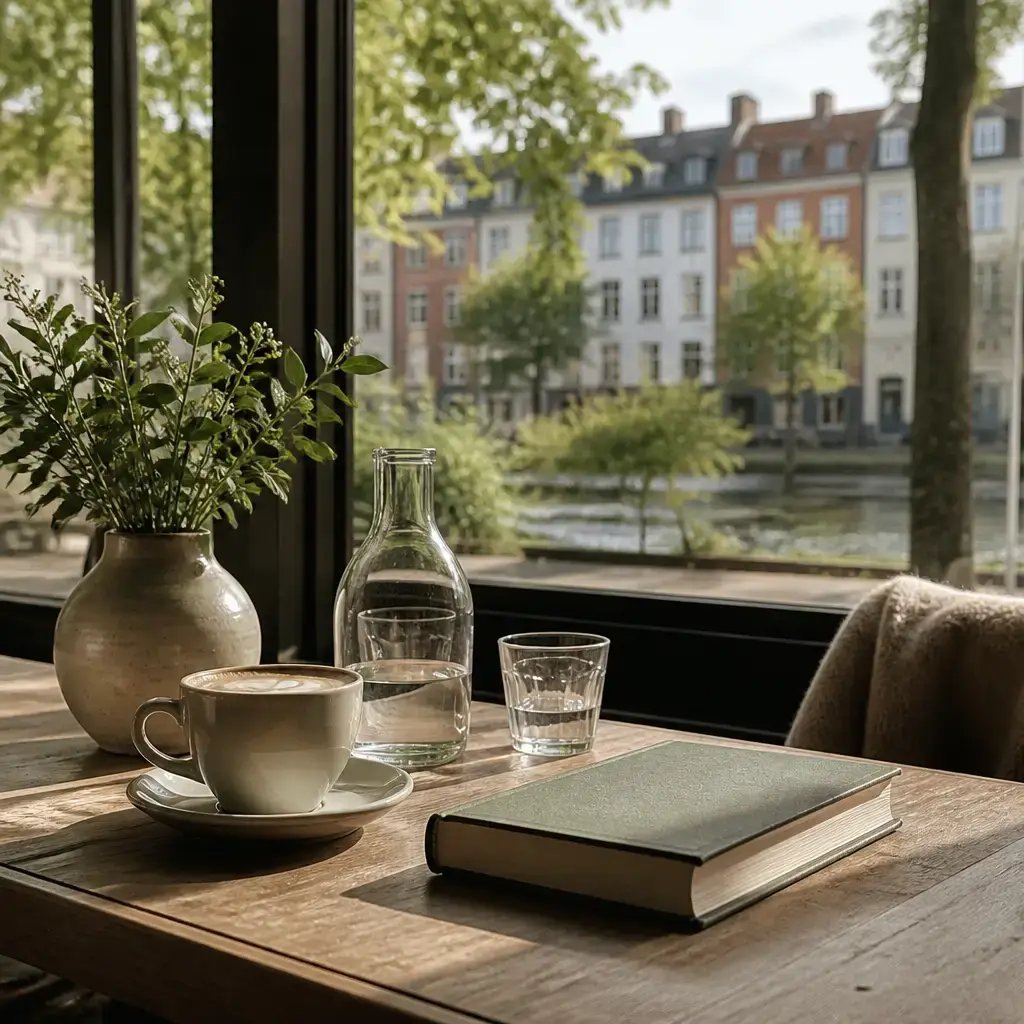
Har du lyst til at mødes på en café?
HAHR doo LUHST təl uh MUH-thus poh en ka-FAY? Would you like to meet at a cafe?Det lyder afslappende.
deh LEW-thuh AHF-SLAB-nuh. That sounds relaxing.Hvilken café kan du lide?
VEL-gun ka-FAY kan doo LEE-thuh? Which cafe do you like?Jeg kan lide den stille café nær parken.
yai kan LEE-thuh den STEL-uh ka-FAY nair PAR-gun. I like the quiet one near the park.Lad os mødes der og nyde roen.
LETH ohs MUH-thus dair oh NEW-thuh ROH-un. Let's meet there and enjoy the quiet.Jeg kan tage en bog med.
yai kan TAY uh BOH meth. I can bring a book.Vi kan læse der et stykke tid.
vee kan LAY-suh dair et STUH-guh TEETH. We can read there for a while.Det ville være en god pause.
deh VEL-uh VAIR en GOH POW-suh. That would be a nice break.Sentence explanations
Har du lyst til at mødes på en café?
Would you like to meet at a cafe?
- Har du lyst til
- would you like to
- mødes
- meet
- café
- café
More detail
Har du lyst til is a common Danish way to ask whether someone would like to do something. Literally, it is built from har (“have”), du (“you”), and lyst (“desire” or “inclination”), followed by til and an activity. Here, du is the subject and har is the present-tense form of have; the whole construction, rather than lyst alone, gives the polite invitation meaning “would you like to …?”. The pattern is Har du lyst til at + infinitive? Example: Har du lyst til at spise? — “Would you like to eat?” mødes means “meet” here. It is the infinitive used after at in at mødes; the form expresses meeting together, without specifying a different participant or changing the subject of the invitation. Danish uses at before this infinitive, just as in the fixed construction til at mødes. Example: Vi skal mødes i morgen. — “We are going to meet tomorrow.” café means “café” or “coffee shop”. In en café, en is the indefinite article before this noun; it presents a café as a nonspecific place, not as a stated numerical count. The noun keeps the spelling café, including its accent. Putting the parts together, Har du lyst til at mødes på en café? asks, “Would you like to meet at a café?” på en café supplies the place, while at mødes names the proposed activity. The question is an invitation about meeting; it does not itself specify a time or which café.
Det lyder afslappende.
That sounds relaxing.
- Det
- that
- lyder
- sounds
- afslappende
- relaxing
More detail
Det is the neuter singular pronoun used here for “that,” referring to the suggestion just mentioned. In Danish, den is the corresponding common-gender singular form, while det is also used in some impersonal constructions; here the fixed translation and context support the demonstrative “that” reading. lyder is the present-tense, third-person singular form of lyde, “to sound.” The present tense can describe how something seems or comes across now. For example: Det lyder godt. — “That sounds good.” afslappende means “relaxing”: it describes something that causes a relaxed feeling. It is related to afslappe, “to relax,” but do not confuse it with afslappet, “relaxed,” which describes someone or something in a relaxed state. Example: Musikken er afslappende. — “The music is relaxing.” Together, Det + lyder + afslappende gives “That sounds relaxing.” The pattern Det lyder + adjective is reusable for giving an impression of a suggestion, plan, or situation: Det lyder interessant. — “That sounds interesting.”
Hvilken café kan du lide?
Which cafe do you like?
- Hvilken
- which
- café
- café
- kan du
- can you
- lide
- like
More detail
Hvilken means “which” when selecting one singular common-gender noun. Danish contrasts hvilken with hvilket for a singular neuter noun and hvilke for plural nouns. Here it asks the listener to identify one café. café is the noun for “café.” In this sentence it is the thing being selected by Hvilken; the phrase Hvilken café therefore means “which café.” Example: Hvilken bog læser du? — “Which book are you reading?” kan du contains kan, the present-tense form of kunne, and du, “you.” In a Danish question, the finite verb comes before the subject: Kan du ...? This gives a reusable question pattern. With lide, however, kan ... lide is the ordinary Danish expression for “like,” rather than a statement about physical ability. Example: Kan du lide te? — “Do you like tea?” lide is the infinitive used after kan. In the expression kan lide, it contributes the meaning “like.” The form is not changed here to agree with du; the modal kan carries the finite present-tense form, while lide remains the infinitive. Together, Hvilken café asks the listener to choose a café, and kan du lide asks about the listener’s preference. The complete utterance means “Which cafe do you like?”
Jeg kan lide den stille café nær parken.
I like the quiet one near the park.
- Jeg
- I
- kan lide
- like
- den
- the
- stille
- quiet
- café
- café
- nær
- near
- parken
- the park
More detail
Jeg is the first-person singular subject, “I.” It is the form used when the speaker refers to themself as the person experiencing or stating the preference. kan lide is a very common Danish construction meaning “like.” Although kan can mean “can” in other contexts, together with lide here it expresses liking, not ability. A reusable pattern is Jeg kan lide + a noun phrase. Example: Jeg kan lide parken. — “I like the park.” den is the definite article used before a common-gender singular noun when that noun is modified by an adjective. In this phrase it belongs with stille café: den stille café means “the quiet café.” The previous question identifies the topic as a café, supporting that café as the intended referent here. stille means “quiet” here. It is an adjective describing café. In the fixed phrase it appears before the noun and after den; Danish uses this attributive pattern for a definite phrase with an adjective. Compare the useful sentence Caféen er stille. — “The café is quiet,” where the adjective follows the verb instead. café is the noun “café” or “cafe.” In den stille café, the definite meaning is marked by den because an adjective stands before the noun. Without the adjective, Danish commonly uses the suffixed form caféen for “the café.” nær is a preposition meaning “near.” It introduces the place used to locate the café. Example: Caféen ligger nær parken. — “The café is near the park.” parken means “the park.” Its base form is park, and -en marks the definite singular form: park → parken. Here the definite form is appropriate because the sentence refers to a particular park as the location reference. Together, Jeg kan lide expresses the speaker’s liking, den stille café identifies the café as quiet, and nær parken locates it near the park. The whole utterance means: “I like the quiet café near the park.”
Lad os mødes der og nyde roen.
Let's meet there and enjoy the quiet.
- Lad os
- let's
- mødes
- meet
- der
- there
- nyde
- enjoy
- roen
- the quiet
More detail
Lad os is the Danish pattern for “let’s”: lad is the imperative of lade (“let/allow”), followed by os (“us”). It introduces a suggestion involving the speaker and at least one other person. The following verbs stay in the infinitive: Lad os spise. — “Let’s eat.” mødes means “meet” here, with the participants meeting one another. It is related to møde (“meet” someone or encounter something), but mødes is the form used for meeting each other or gathering. Example: Vi mødes klokken otte. — “We meet at eight.” der means “there,” referring to a place understood from the situation. It is a place adverb, not a noun, and it does not change for number or gender. Example: Bogen ligger der. — “The book is there.” nyde means “enjoy.” It is the infinitive following the same Lad os suggestion pattern as mødes; the two verbs are coordinated: “let’s meet and enjoy …” Example: Lad os nyde dagen. — “Let’s enjoy the day.” roen means “the quiet” or “the calm.” Its base noun is ro (“quiet/calm”), and -en marks the definite singular form of this common-gender noun: ro → roen. This form refers to a particular quiet or calm understood in the situation, rather than asserting a quantity. Example: Jeg nyder roen. — “I enjoy the quiet.” Together, Lad os mødes der gives “Let’s meet there,” and og nyde roen adds the coordinated suggestion “and enjoy the quiet.” The complete utterance is therefore: “Let’s meet there and enjoy the quiet.”
Jeg kan tage en bog med.
I can bring a book.
- Jeg
- I
- kan
- can
- tage
- bring
- en
- a
- bog
- book
- med
- along
More detail
Jeg means “I” here: the speaker is the subject. Danish personal pronouns distinguish grammatical person and number; jeg is the first-person singular form. Example: Jeg læser. — “I am reading.” kan is the present-tense form of kunne, “can/be able to.” It expresses ability or possibility here. With a modal verb such as kan, the following main verb appears in the infinitive: kan tage — “can bring.” Example: Jeg kan hjælpe. — “I can help.” tage is the infinitive of tage, “take.” In tage ... med, it forms the reusable expression “bring/take ... along”: the object is taken with the speaker to another place. The particle med completes this meaning, so tage en bog med means “bring a book along,” rather than simply “take a book.” en is the indefinite article used with a singular common-gender noun. It introduces an unspecified item; it does not by itself assert a numeric count as a teaching point here. Danish also has the indefinite article et for singular neuter nouns, but the article must agree with the noun. bog means “book.” Its indefinite singular form is en bog; its definite singular form is bogen, “the book.” Example: Jeg læser en bog. — “I am reading a book.” med means “along/with” in this construction. Together with tage, it indicates that the book accompanies the speaker: the pattern tage [something] med is useful for “bring/take [something] along.” The utterance is assembled as Jeg (subject) + kan (modal verb) + tage (infinitive) + en bog (an unspecified book) + med (along). Thus Jeg kan tage en bog med. means “I can bring a book.” The wording presents bringing the book as an available possibility or ability.
Vi kan læse der et stykke tid.
We can read there for a while.
- Vi kan
- we can
- læse
- read
- der
- there
- et stykke tid
- for a while
More detail
Vi kan means “we can.” Vi is the first-person plural pronoun, used for a group that includes the speaker. Kan is the present form of kunne (“can/be able to”); it expresses ability or possibility here. Danish uses the infinitive without at after this modal: Vi kan læse = “We can read.” læse means “to read.” It is the infinitive form and stays unchanged after kan. For example, Vi kan vente means “We can wait.” der means “there,” referring to a place understood from the situation. It is a place adverb, not a noun, and does not change for number or gender. et stykke tid means “a while” or “a period of time.” Et is the indefinite form used with the neuter noun stykke; tid means “time.” Together, this expression gives a limited but unspecified duration. For example, Jeg bliver her et stykke tid means “I’ll stay here for a while.” Combined in order, Vi kan læse der et stykke tid means “We can read there for a while”: the group has the possibility or ability to read, the reading takes place there, and it lasts for an unspecified period.
Det ville være en god pause.
That would be a nice break.
- Det
- that
- ville være
- would be
- en
- a
- god
- good; nice
- pause
- break
More detail
Det means “that” here: it points to a situation or idea, supported by the preceding suggestion about reading for a while. Danish det is the neuter singular pronoun, but in this sentence its referent is the earlier idea, not necessarily a concrete neuter noun. ville være means “would be.” ville is the past form of vil and, with the infinitive være (“be”), forms a conditional expression. The pattern Det ville være ... is reusable for evaluating a possible situation: Det ville være godt. — “That would be good.” en is the indefinite article used with a common-gender singular noun. It introduces pause; here it does not by itself assert a numerical count. god means “good” and, in this context, naturally “nice.” It is the common-gender singular indefinite form. The related forms are godt with a neuter singular noun and gode in plural or definite contexts; the comparison is god — bedre — bedst (“good” — “better” — “best”). pause means “break,” as in a period when an activity stops. It is a common-gender noun: en pause; its plural is pauser. For example, Vi tager en pause. means “We are taking a break.” Together, Det identifies the proposed situation, ville være presents it as a possible result or evaluation, and en god pause describes it as a nice break. The complete meaning is: “That would be a nice break.”
Grammar Points
have lyst til + infinitiv
have lyst til at læse
HAH-vuh LUHST təl uh LAY-suhwould like to read
Use have lyst til before at + infinitive to express a desire or wish to do something.
Lad os + infinitiv
Lad os nyde roen
LETH ohs NEW-thuh ROH-unLet's enjoy the quiet
Use Lad os followed by an infinitive to suggest doing something together.
Danish Vocabulary
Har du lyst til at mødes på en café?
- Gender
- common
Lad os mødes der og nyde roen.
Quiz
Word Order
Arrange the words in the correct order.
That sounds relaxing.
Show Answer
Det lyder afslappende.Which cafe do you like?
Show Answer
Hvilken café kan du lide?I can bring a book.
Show Answer
Jeg kan tage en bog med.Spelling
Tap the letters to spell the word.
like
Show Answer
lidewhich
Show Answer
hvilkenquiet
Show Answer
stillesounds