10 minutes free every day
Continue audio lessons in the app
Word explanations appear automatically in sync with the audio.
No login required · synced translations · playback with the screen locked
Choose your learning language and open this lesson in the app.

About This Lesson
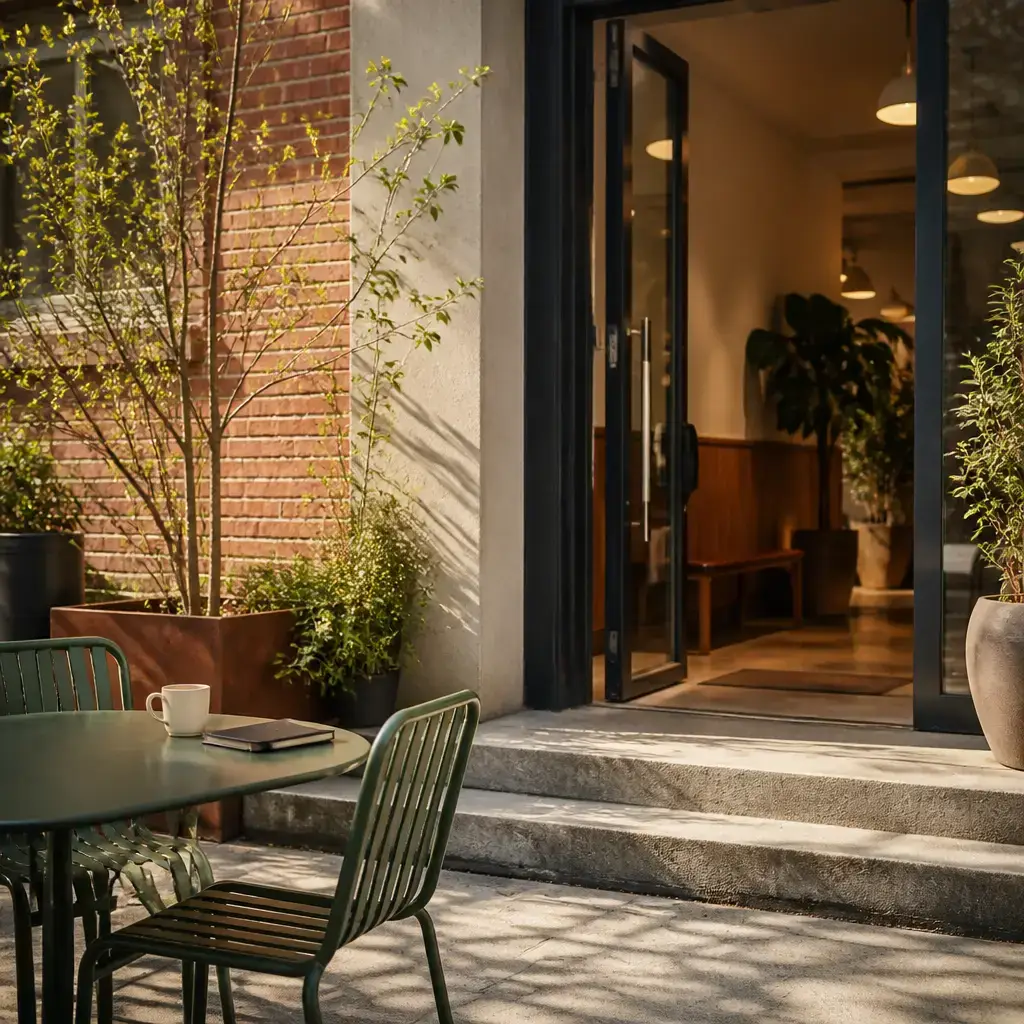
Use Changing the meeting place to practice Danish conversation, pronunciation, vocabulary, grammar, and quizzes.
Dialogue
Jeg er nødt til at ændre planen.
yai air NURT til at EN-druh PLANE-un. I need to change the plan.Hvilken del fungerer ikke?
VEL-kuhn del foong-AIR-uh EG-uh? What part is not working?Mødestedet er for støjende.
MUH-thuh-STAY-thuh air fohr STOY-uh-nuh. The meeting spot feels too noisy.Lad os gå hen til et roligere sted indenfor.
lath us GOH hen til ed ROH-lee-uh-ruh stayth in-un-FOHR. Let's move somewhere quieter inside.Kan vi mødes lige inden for indgangen?
kan vee MUH-thus LEE-uh EN-un FOHR ENG-gang-un? Can we meet just inside the entrance?Det passer mig.
deh PASS-uh my. That works for me.Jeg venter der, når jeg kommer.
yai VEN-tuh dair, nawr yai KUM-uh. I'll wait there when I arrive.Så kan vi finde et roligt sted sammen.
soh kan vee FIN-uh ed ROH-lee stayth SAM-un. Then we can find a quiet place together.Sentence explanations
Jeg er nødt til at ændre planen.
I need to change the plan.
- Jeg
- I
- er nødt til
- need to; have to
- ændre
- change
- planen
- the plan
More detail
Jeg means “I” here: the first-person singular subject. Danish does not mark the speaker’s gender in this pronoun. Example: Jeg læser. — “I am reading.” er nødt til is a fixed necessity construction meaning “need to” or “have to.” Its literal wording is not a general way to translate every use of “need”; it presents the action as necessary. The verb er is the present-tense form of være (“be”), and nødt belongs to this construction. The construction can be reused with a different subject, for example Hun er nødt til at vente. — “She has to wait.” ændre means “change” here. It is the infinitive, introduced by at after er nødt til: er nødt til at ændre = “have to change.” The infinitive itself does not show the subject’s person or number. Example: Vi vil ændre planen. — “We want to change the plan.” planen means “the plan.” Its base form is the noun plan; planen is its singular definite form, formed with the ending -en. The noun’s definiteness is expressed on the noun rather than by a separate word in this phrase. Example: Planen er klar. — “The plan is ready.” Together, Jeg supplies the subject, er nødt til expresses necessity, at ændre names the required action, and planen is the object being changed. The complete utterance therefore means “I need to change the plan.”
Hvilken del fungerer ikke?
What part is not working?
- Hvilken
- which
- del
- part
- fungerer
- works / functions
- ikke
- not
More detail
Hvilken asks the listener to identify one choice from a set: “which”. It is the common-gender singular form. Compare hvilket with a neuter singular noun and hvilke with plural nouns. Here it modifies del, so the form is Hvilken del. del means “part” or “section”. Its base form is del; the plural is dele, as in to dele (“two parts”). In this question, it refers to the relevant part of something without specifying that part in the wording itself. fungerer is the present-tense form of fungere, “to work” or “to function”. The present form can describe something that is currently working or functioning generally. Example: Systemet fungerer. — “The system works.” ikke is the ordinary Danish negation, “not”. In this sentence it negates fungerer, producing the meaning “does not work”. A useful reusable pattern is X fungerer ikke — “X does not work”. Together, Hvilken del means “which part”, and fungerer ikke means “does not work”. The whole utterance is therefore: “What part is not working?”
Mødestedet er for støjende.
The meeting spot feels too noisy.
- Mødestedet
- the meeting spot
- er
- is
- for støjende
- too noisy
More detail
Mødestedet means “the meeting spot” here. It is the definite singular form of the neuter noun mødested (“meeting spot”): et mødested means “a meeting spot,” and mødestedet means “the meeting spot.” The ending -et belongs to this neuter noun. Example: stedet — “the place.” er is the present-tense form of være (“to be”). Here it links the meeting spot to the description that follows. Example: Stedet er roligt. — “The place is quiet.” for støjende is the reusable pattern for + adjective, meaning “too noisy.” støjende means “noisy”; the form ending in -ende does not change here for gender or number: et støjende sted and en støjende gade both use støjende. for presents the degree as excessive for the speaker’s purpose, unlike meget støjende (“very noisy”), where meget only intensifies the description. Example: Musikken er for høj. — “The music is too loud.” Together, Mødestedet er for støjende. says that the meeting spot is too noisy. The fixed translation expresses this as “The meeting spot feels too noisy”; er itself is the verb “is,” while the sentence evaluates the spot’s noise level in this situation.
Lad os gå hen til et roligere sted indenfor.
Let's move somewhere quieter inside.
- Lad os
- let’s
- gå hen til
- go to
- roligere
- quieter
- sted
- place
- indenfor
- inside
More detail
Lad os is the Danish way to propose a joint action: “let’s …”. os is the object form of vi (“we”), and this construction is followed by the verb in its basic form. Example: Lad os vente. — “Let’s wait.” gå hen til expresses movement toward a destination, roughly “go over to” or “go to.” gå is the basic form of “go”; hen til adds the directional idea of moving toward a place. Example: Vi går hen til døren. — “We go over to the door.” roligere means “quieter” here. It is the comparative form of rolig (“quiet”): rolig → roligere → roligst (“quiet” → “quieter” → “quietest”). The comparative form does not change for grammatical gender or number in this use. Example: Dette rum er roligere. — “This room is quieter.” sted means “place.” In et roligere sted, it is a singular indefinite noun with the neuter article et; the adjective describes that place. Example: Vi fandt et godt sted. — “We found a good place.” indenfor means “inside” or “indoors.” In this sentence it specifies that the destination is inside. The following context also uses the related expression inden for for a location just inside something, but the fixed utterance contains the single-word form indenfor. Together, Lad os gå hen til et roligere sted indenfor means “Let’s move somewhere quieter inside.” It proposes that the speaker and the other person go toward an indoor place that is quieter than the current one.
Kan vi mødes lige inden for indgangen?
Can we meet just inside the entrance?
- Kan vi
- Can we
- mødes
- meet
- lige inden for
- just inside
- indgangen
- the entrance
More detail
Kan vi opens a yes/no question: kan is the present form of kunne, “can/be able to,” and vi means “we.” In this sentence, kan expresses a possible plan or suggestion, not physical ability alone. Danish commonly places the modal before the subject in a yes/no question: Kan vi ...? Compare the statement Vi kan ... (“We can ...”). mødes means “meet” here, with the participants meeting one another. It is the form used after the modal kan, so the modal carries the tense while mødes remains in the bare verb form. The same written form can also occur as a present-tense verb in a sentence such as Vi mødes i morgen (“We meet tomorrow”); the surrounding words identify its function. The element -s is part of the Danish verb form used for reciprocal or passive meanings, so it should not be treated as a separate pronoun meaning “us.” lige inden for places the meeting just on the inside of a boundary. lige narrows the location to “just” or “right,” while inden for is the prepositional expression “inside/within.” The two words inden for are separate here because they introduce the following location. In another context, Danish also uses the adverb indenfor, but that does not change the wording of this fixed sentence. indgangen means “the entrance.” Its base noun is indgang; indgangen is its definite singular form, corresponding to “the entrance.” The ending -en marks definiteness for this noun; it does not itself mean a numerical quantity. For example, Jeg står ved indgangen means “I am standing by the entrance.” Together, Kan vi mødes asks whether the speakers can meet, and lige inden for indgangen specifies the place as just inside the entrance. The complete utterance therefore means: “Can we meet just inside the entrance?” It is a concise, neutral way to suggest a meeting location.
Det passer mig.
That works for me.
- Det
- it / that
- passer
- works / suits
- mig
- me
More detail
Det is the subject pronoun here, meaning “that” or “it” in the intended reference to the proposed arrangement. In Danish, det is also the neuter singular form of the third-person pronoun; as a pronoun, its specific referent must come from the situation or context. Example: Det er godt. — “That is good.” passer comes from at passe and is the present-tense form. In this use, passe means “to suit” or “to work for” someone, rather than simply “to fit” physically. The present form is passer for different subjects: Det passer — “It works”; Tiderne passer — “The times work.” Example: Fredag passer mig. — “Friday works for me.” mig is the first-person singular object form of jeg (“I”). Danish uses jeg for a subject and mig after a verb or preposition when the speaker is the affected person: Jeg kommer. — “I’m coming”; Det passer mig. — “That works for me.” Together, Det passer mig has the reusable pattern Det passer + person, meaning “That works/suits + person.” The verb describes the arrangement as suitable, and mig identifies the speaker as the person it suits. Thus the whole utterance means “That works for me.”
Jeg venter der, når jeg kommer.
I'll wait there when I arrive.
- Jeg
- I
- venter
- wait
- der
- there
- når
- when
- kommer
- arrive
More detail
Jeg is the first-person singular pronoun, meaning “I.” It identifies the speaker as the subject of both clauses here. The same form is used regardless of the speaker’s gender. venter is the present-tense form of vente, “to wait.” In this sentence, Danish present tense describes the planned or expected waiting: “I’ll wait.” A useful pattern is jeg venter = “I wait / I’m waiting,” with the exact English tense supplied by context. der means “there,” referring to a place understood from the situation. It is a location word, not a replacement for the person who waits. Compare her = “here” and der = “there.” når introduces a time clause meaning “when.” It connects an event to the time at which another event happens. For example, Når jeg kommer, ringer jeg. means “When I arrive, I’ll call.” kommer is the present-tense form of komme, “to come” or, in this context, “to arrive.” Here it describes the speaker’s arrival. Danish commonly uses the present tense in a future time clause after når, so når jeg kommer means “when I arrive,” not necessarily “when I am arriving.” Together, Jeg venter der means “I’ll wait there,” and når jeg kommer adds the time condition “when I arrive.” The complete utterance therefore means “I’ll wait there when I arrive.”
Så kan vi finde et roligt sted sammen.
Then we can find a quiet place together.
- Så
- then
- kan vi
- we can
- finde
- find
- et
- a/an
- roligt
- quiet
- sted
- place
- sammen
- together
More detail
Så means “then” here: it places the action in relation to what has already been said. Danish så can also mean “so” in other contexts, but the fixed translation supports “then” here. kan vi combines kan, the present form of kunne (“can, be able to”), with vi (“we”). The modal kan is followed by an infinitive, so the reusable pattern is kan + infinitive: Jeg kan komme. — “I can come.” In this sentence, vi is the subject, and the initial Så gives the word order Så kan vi .... finde is the infinitive “find.” After kan, the infinitive appears without a separate infinitive marker: Vi kan finde ... — “We can find ...” et is the indefinite article used with a singular neuter noun. It marks the noun as indefinite; here it does not by itself make a numerical claim beyond the singular form required by sted. roligt is the neuter singular form of the adjective rolig, “quiet” here. It agrees with the neuter noun sted: et roligt sted. The common-gender form is rolig, as in en rolig dag; a useful comparison is roligere (“quieter”). sted means “place.” Its base form is singular, and its plural is steder: flere steder — “several places.” The noun is neuter, which is why it combines with et and the adjective form roligt. sammen means “together.” It describes the participants carrying out the action jointly. For example, Vi arbejder sammen. means “We work together.” Together, Så kan vi finde et roligt sted sammen. means “Then we can find a quiet place together.” The structure is Så + modal and subject (kan vi) + infinitive (finde) + indefinite noun phrase (et roligt sted) + sammen. It presents finding the place as something the speakers are able or permitted to do together.
Grammar Points
Lad os + infinitiv
Lad os gå
lath us GOHLet's go.
Lad os + infinitive is used to make a suggestion. The verb remains in the infinitive.
for + adjective
for støjende
fohr STOY-uh-nuhtoo noisy
For before an adjective means “too” and describes something as exceeding a suitable degree.
Danish Vocabulary
- Gender
- common
- Gender
- common
- Gender
- neuter
- Gender
- common
Quiz
Word Order
Arrange the words in the correct order.
What part is not working?
Show Answer
Hvilken del fungerer ikke?The meeting spot feels too noisy.
Show Answer
Mødestedet er for støjende.That works for me.
Show Answer
Det passer mig.Spelling
Tap the letters to spell the word.
which
Show Answer
Hvilkenchange
Show Answer
ændreplan
Show Answer
planennot