10 minutes free every day
Continue audio lessons in the app
Word explanations appear automatically in sync with the audio.
No login required · synced translations · playback with the screen locked
Choose your learning language and open this lesson in the app.

About This Lesson
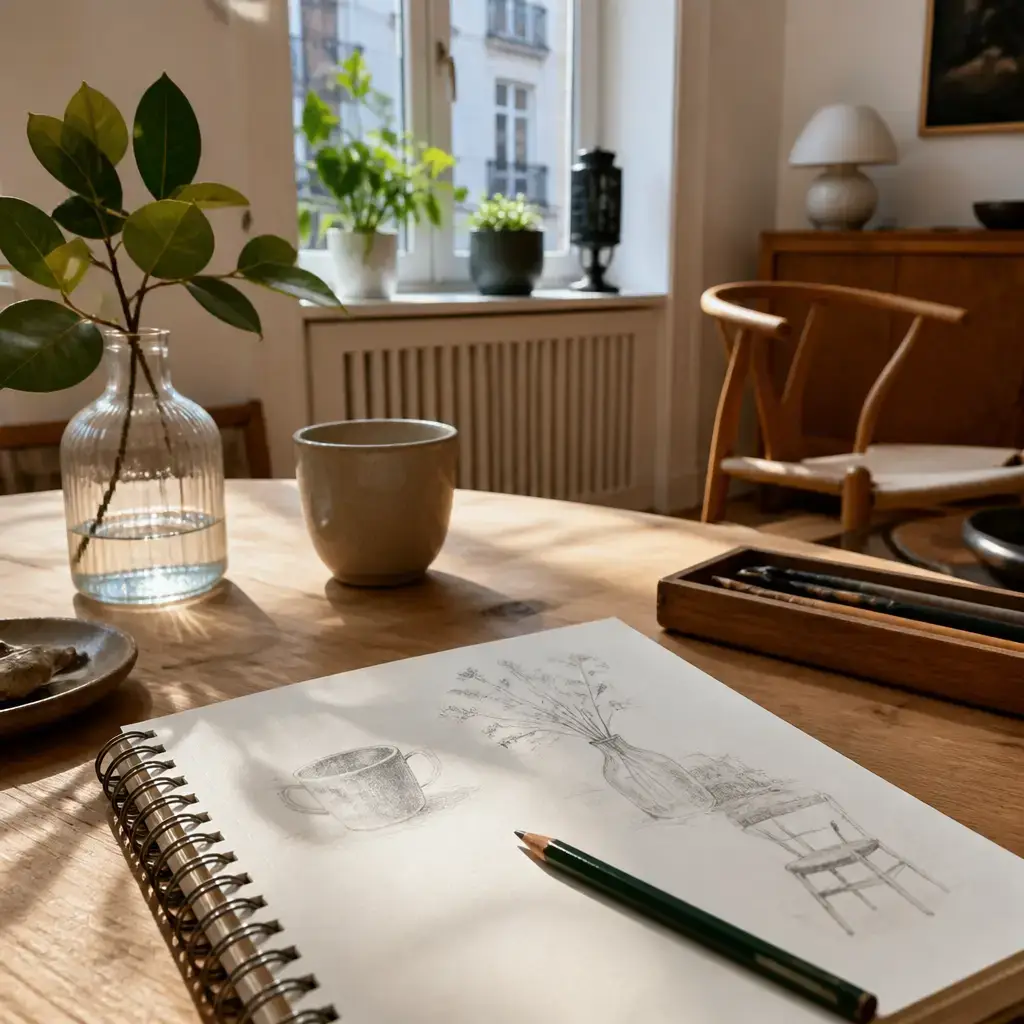
Use Drawing in your free time to practice Danish conversation, pronunciation, vocabulary, grammar, and quizzes.
Dialogue
Hvad laver du i din fritid?
va LAY-wuh doo ee deen free-TEED What do you do in your free time?Jeg kan godt lide at tegne derhjemme.
YAI kan got LEE-uh uh TAY-nuh dair-YEM-uh I enjoy drawing at home.Det lyder som en afslappende hobby.
deh LOO-uh som en ahf-SLAH-buh-nuh HAW-bee That sounds like a relaxing hobby.Jeg tegner normalt små ting i min notesbog.
YAI TENG-nuh NOR-malt smoh ting ee meen NOH-dus-boh I usually sketch small things in my notebook.Øver du dig ofte?
UR-vuh doo sigh OFF-tuh Do you practice often?Lidt, mest når jeg har tid.
lit, mest nair YAI hahd teed A little, mostly when I have time.Måske kan jeg også prøve det.
MOH-skeh kan YAI AW-soh PRUR-wuh deh Maybe I can try it too.Du kan bruge min gamle blyant.
doo kan BROO-wuh meen GAM-uhl BLEE-ant You can use my old pencil.Sentence explanations
Hvad laver du i din fritid?
What do you do in your free time?
- Hvad
- what
- laver
- do
- du
- you
- i
- in
- din
- your
- fritid
- free time
More detail
Hvad means “what” here and asks for the thing or activity being done. It is a question word; compare hvad laver du? (“what are you doing?”) with hvem (“who”) when asking about a person. laver is the present-tense form of lave, “to do” or “to make.” In this sentence it means “do” in the broad sense of carrying out an activity. Danish present-tense verb forms do not change for the subject: jeg laver means “I do,” while du laver means “you do.” du is the second-person singular subject pronoun, “you.” The question uses it as the person whose activity is being asked about. i is the preposition “in” here. With a time period, i introduces the period during which something happens. din means “your” before a singular common-gender noun. Danish possessives agree with the possessed noun: din is used with an en-word, dit with a singular et-word, and dine with a plural noun. Here din agrees with fritid. fritid means “free time.” It is a singular common-gender noun: en fritid. The compound contains fri (“free”) and tid (“time”), but the complete word is the normal noun for time away from work or other obligations. The pattern Hvad + finite verb + subject forms a question about an activity: Hvad laver du? means “What do you do?” or, in another context, “What are you doing?” The phrase i din fritid specifies that the question concerns the time when you are free. Together, Hvad laver du i din fritid? means “What do you do in your free time?”
Jeg kan godt lide at tegne derhjemme.
I enjoy drawing at home.
- kan godt lide
- enjoy; like
- tegne
- draw
- derhjemme
- at home
More detail
kan godt lide expresses liking or enjoyment in this sentence. The useful Danish pattern is Jeg kan godt lide + at + verb: “I like/enjoy doing …”. kan is the present form of kunne (“can/be able to”), but in this fixed expression the whole construction means “like,” rather than simple physical ability. The subject Jeg means “I”; it identifies the person who enjoys the activity. tegne means “to draw.” It is the infinitive form, introduced here by at, so at tegne means “to draw” or “drawing” in the complement of kan godt lide. The same pattern can be reused with another activity, for example: Jeg kan godt lide at læse. — “I enjoy reading.” derhjemme means “at home.” It is a place adverb and specifies where the drawing takes place. It does not identify a separate participant or add a new action. Together, Jeg kan godt lide + at tegne + derhjemme gives: “I enjoy drawing at home.” The sentence states the speaker’s positive attitude toward drawing and places that activity at home.
Det lyder som en afslappende hobby.
That sounds like a relaxing hobby.
- Det lyder
- That sounds
- som
- like
- afslappende
- relaxing
- hobby
- hobby
More detail
Det lyder means “That sounds” here. lyder is the present-tense form of lyde (“to sound”): Det lyder ... is a reusable way to give an impression. Example: Det lyder godt. — “That sounds good.” The pronoun det is the subject of this expression; the fixed translation supports “that” here without identifying a more specific referent. som links the impression to a description or comparison. In the pattern Det lyder som + noun, it corresponds to “That sounds like + noun.” Example: Det lyder som en god plan. — “That sounds like a good plan.” afslappende describes something that provides a relaxing effect. It is an adjective used before the noun here. The form is the same in this phrase if the noun is common gender or neuter, and it also stays the same in the plural. Example: Musikken er afslappende. — “The music is relaxing.” hobby is a noun meaning “hobby.” In this sentence it appears after the indefinite article en, so it is a common-gender noun: en hobby; its plural is hobbyer. The article marks the noun’s grammatical gender here, not a stated numerical count. Together, Det lyder som gives the pattern “That sounds like,” and en afslappende hobby names what it sounds like: “a relaxing hobby.” The complete utterance therefore means “That sounds like a relaxing hobby.”
Jeg tegner normalt små ting i min notesbog.
I usually sketch small things in my notebook.
- Jeg
- I
- tegner
- sketch; draw
- normalt
- usually; normally
- små
- small
- ting
- things
- min
- my
- notesbog
- notebook
More detail
Jeg means “I” here. It is the first-person singular subject pronoun: use it when the speaker is the one doing the action. Example: Jeg læser. — “I read.” tegner is the present-tense form of tegne, meaning “to draw” or “to sketch.” The ending -er is a common present-tense pattern for Danish verbs, and this form is used with jeg as well as other subjects; it does not show person by changing its ending. Example: Hun tegner et hus. — “She is drawing a house.” normalt means “usually” or “normally.” It is an adverb that describes how regularly the action happens. Its position here, after the verb, gives the routine information before the object is introduced. Example: Jeg går normalt hjem. — “I usually walk home.” små means “small” in the form used with the plural noun ting. Its base form is lille; the useful comparison is lille (singular), små (plural), and mindre (comparative, “smaller”). Example: små bøger — “small books.” ting means “things.” The singular is also ting after the common-gender indefinite article: en ting; the plural is ting, while the definite plural is tingene. Example: Jeg ser tre ting. — “I see three things.” min means “my” before a singular common-gender noun such as notesbog. The related forms are mit before a singular neuter noun and mine before a plural noun. The form agrees with the possessed noun, not with the possessor. Example: min stol — “my chair”; mine bøger — “my books.” notesbog means “notebook.” It is a common-gender compound noun: en notesbog. Its plural form is notesbøger. Example: Min notesbog er blå. — “My notebook is blue.” Together, Jeg tegner normalt says “I usually sketch/draw”; små ting adds the object “small things”; and i min notesbog says that this happens in the speaker’s notebook. The complete utterance means: “I usually sketch small things in my notebook.”
Øver du dig ofte?
Do you practice often?
- Øver
- practice
- du
- you
- dig
- yourself
- ofte
- often
More detail
Øver is the present-tense form of øve, “to practise” or “to rehearse.” Here it is used with the reflexive form sig: øve sig means “to practise” an activity. The form øver is used with present-time meaning; the infinitive is øve. Example: Jeg øver mig hver dag. — “I practise every day.” du is the second-person singular subject pronoun, “you,” for addressing one person. In this question, it is the person doing the practising. Danish questions often put the finite verb before the subject: Øver du ...? corresponds to statement order Du øver .... dig is the reflexive object form that refers back to the subject du. Together, du ... dig expresses the reflexive construction du øver dig (“you practise”). The form dig is used with du; for example, Jeg øver mig uses mig because the subject is jeg. The reflexive pronoun is part of the Danish construction and does not mean that the person literally practises “yourself” as a separate object. ofte is an adverb meaning “often.” It describes how frequently the practising happens. Example: Hun læser ofte. — “She often reads.” The pattern Øver du dig ofte? is a present-tense yes-or-no question: finite verb + subject + reflexive pronoun + frequency adverb. The parts combine as øver (“practise”), du (“you”), dig (the reflexive form required with du), and ofte (“often”), giving “Do you practise often?”
Lidt, mest når jeg har tid.
A little, mostly when I have time.
- Lidt
- a little
- mest
- mostly
- når jeg har tid
- when I have time
More detail
Lidt means “a little” here: it expresses a small amount or degree without specifying an exact quantity. It can also stand alone when the activity or quality being discussed is understood. Example: Jeg læser lidt. — “I read a little.” mest means “mostly” here: the statement applies mainly, though not necessarily exclusively, in the situation that follows. It is the superlative form in the Danish comparison chain meget (“much/very”) → mere (“more”) → mest (“most/mostly,” depending on use). In this sentence, mest functions adverbially with the following time clause rather than describing a noun. når jeg har tid is a reusable time clause meaning “when I have time.” når introduces the time situation; jeg is the first-person singular pronoun “I”; and tid means “time,” here referring generally to available time. har is the present form of have; Danish uses har for all grammatical persons in the present, including jeg har (“I have”). Example: Jeg læser, når jeg har tid. — “I read when I have time.” Together, Lidt, mest når jeg har tid. means “A little, mostly when I have time.” The first part gives the amount or degree, and the second part says that this is mainly the case when the speaker has available time. The wording is concise and suitable as a conversational answer.
Måske kan jeg også prøve det.
Maybe I can try it too.
- Måske
- Maybe
- kan jeg
- I can
- også
- too; also
- prøve
- try
- det
- it
More detail
Måske means “maybe” here and expresses uncertainty about the proposition that follows. It commonly introduces a sentence without changing the event itself. Example: Måske kommer hun i morgen. — “Maybe she is coming tomorrow.” kan jeg combines the modal verb kan with the subject pronoun jeg. kan is the present form of kunne and expresses ability or possibility; jeg means “I.” Because Måske comes first, Danish main-clause word order places the finite verb before the subject: Måske kan jeg .... After a modal such as kan, the following verb is normally in the infinitive without at: Jeg kan prøve — “I can try.” også adds the meaning “too” or “also.” In this sentence it makes trying apply to the speaker in addition to whatever is already relevant in the context. Its position can affect what it most directly emphasizes, so it is useful to learn it together with the sentence pattern rather than treating it as part of kan jeg. prøve is the infinitive “try.” Its base form is prøve; after kan, this unchanged infinitive form is used. Example: Jeg kan prøve igen. — “I can try again.” det is the pronoun “it” in the intended translation. Danish det is the neuter singular form of the third-person pronoun and can refer to an identified thing, activity, or situation; the fixed sentence does not specify more precisely what it refers to. It is not the subject here: jeg is the subject, while det is the object of prøve. Together, Måske kan jeg også prøve det. means “Maybe I can try it too.” The structure is Måske + finite modal verb + subject + også + infinitive + object pronoun: the speaker presents trying the identified “it” as a possible additional action.
Du kan bruge min gamle blyant.
You can use my old pencil.
- Du kan
- you can
- bruge
- use
- min
- my
- gamle
- old
- blyant
- pencil
More detail
Du kan means “you can” here. du is the singular informal second-person subject pronoun. kan is the present form of kunne (“can, be able to”); it is used with an infinitive to express ability or permission. After kan, the next verb appears in the infinitive without at: Du kan læse. — “You can read.” bruge is the infinitive of bruge, “to use.” In this sentence it follows the modal kan, so the meaning is “can use.” The same infinitive can be used after other modal verbs, for example Du skal bruge den. — “You must use it.” min means “my” before a singular common-gender noun. Danish possessives agree with the possessed noun, not with the owner: min with a common-gender singular noun, mit with a neuter singular noun, and mine with plural nouns. For example, min bog means “my book,” while mit hus means “my house.” gamle means “old” here. Its base form is gammel; gamle is the form used before a noun phrase made definite by a possessive such as min. The adjective therefore agrees with the noun phrase’s definiteness, not with the possessor. For comparison, gammel means “old,” ældre means “older,” and ældst means “oldest.” blyant means “pencil.” It is a common-gender singular noun, which is why the matching possessive is min. Its plural is blyanter: to blyanter — “two pencils.” Together, Du kan bruge gives “You can use,” and min gamle blyant gives “my old pencil.” The complete utterance is therefore “You can use my old pencil.”
Grammar Points
kan godt lide at + infinitiv
Jeg kan godt lide at tegne derhjemme.
YAI kan got LEE-uh uh TAY-nuh dair-YEM-uhI like drawing at home.
After kan godt lide, use at plus the infinitive to say what you like doing.
øve sig
Øver du dig ofte?
UR-vuh doo sigh OFF-tuhDo you often practice?
øve sig is a reflexive verb; the pronoun changes with the subject, as in øver du dig.
Danish Vocabulary
Det lyder som en afslappende hobby.
Jeg kan godt lide at tegne derhjemme.
- Gender
- common
Hvad laver du i din fritid?
- Gender
- common
Det lyder som en afslappende hobby.
Hvad laver du i din fritid?
Jeg kan godt lide at tegne derhjemme.
Hvad laver du i din fritid?
Det lyder som en afslappende hobby.
Jeg tegner normalt små ting i min notesbog.
Jeg tegner normalt små ting i min notesbog.
Jeg kan godt lide at tegne derhjemme.
Jeg tegner normalt små ting i min notesbog.
Quiz
Word Order
Arrange the words in the correct order.
What do you do in your free time?
Show Answer
Hvad laver du i din fritid?That sounds like a relaxing hobby.
Show Answer
Det lyder som en afslappende hobby.Do you practice often?
Show Answer
Øver du dig ofte?Spelling
Tap the letters to spell the word.
what
Show Answer
hvadsound
Show Answer
lyderfree time
Show Answer
fritiddo