10 minutes free every day
Continue audio lessons in the app
Word explanations appear automatically in sync with the audio.
No login required · synced translations · playback with the screen locked
Choose your learning language and open this lesson in the app.

About This Lesson
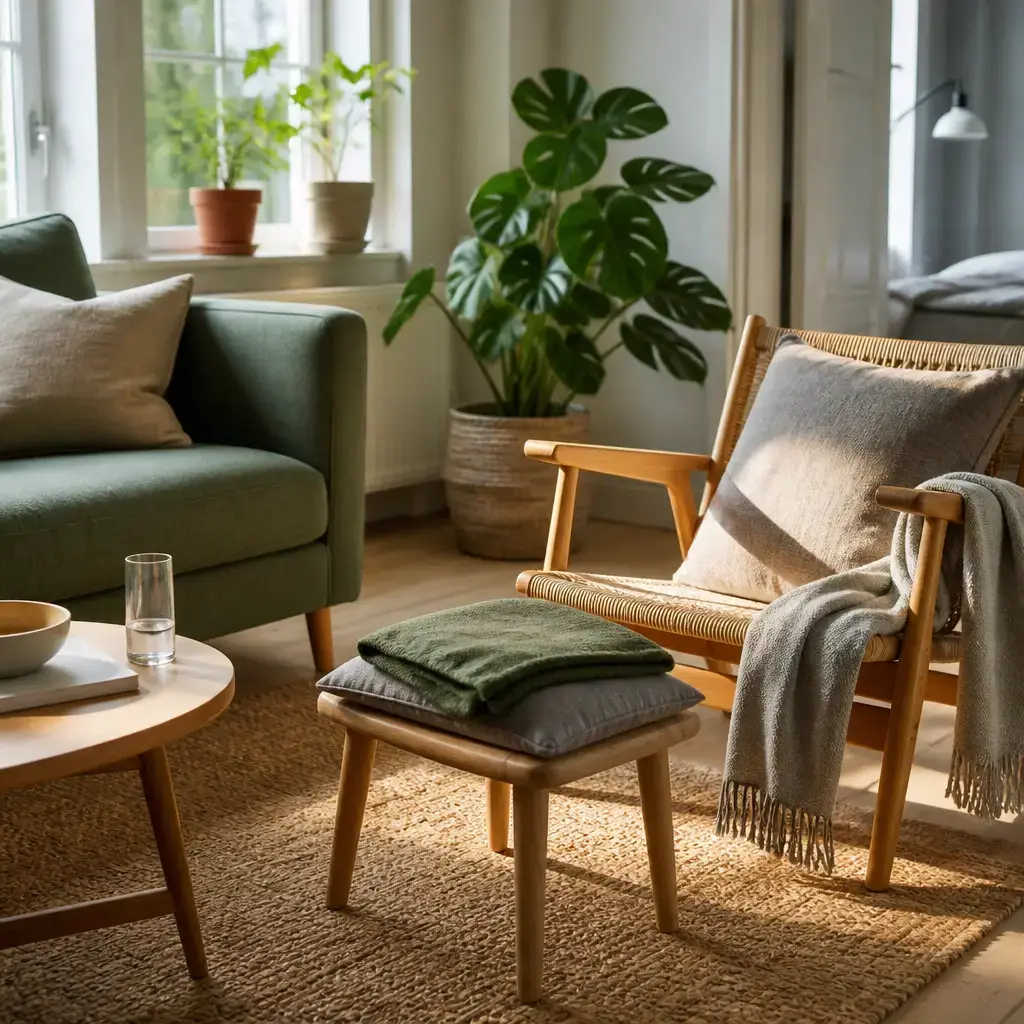
Use Resting a sore leg to practice Danish conversation, pronunciation, vocabulary, grammar, and quizzes.
Dialogue
Mit ben gør lidt ondt.
MEHD BEHN KUH leht OHNT. My leg hurts a little.Sæt dig på denne stol et øjeblik.
SET DAI poh DEN-uh STOHL ed OY-uh-bleg. Sit on this chair for a moment.Jeg gik for meget i dag.
yai GICK foh MAYD ee DAY. I walked too much today.Læg benet op her, og hvil dig.
LAY BEHN-ud OHB HAIR, oh VEEL DAI. Put your leg up here and rest.Må jeg gå lidt rundt senere?
moh yai GOH leht ROHNT SAY-nuh-ruh? Can I walk around a little later?Gå kun, hvis det føles okay.
GOH KOHN, ves de FUH-lus oh-KAY. Walk only if it feels all right.Det føles bedre på sofaen end på denne stol.
de FUH-lus BEH-druh poh SOH-fah-un en poh DEN-uh STOHL. The sofa feels better than this chair.Så sæt dig der, og hold benet i ro.
SOH SET DAI DAIR, oh HOHL BEHN-ud ee ROH. Then sit there and keep your leg still.Sentence explanations
Mit ben gør lidt ondt.
My leg hurts a little.
- Mit
- my
- ben
- leg
- gør lidt ondt
- hurts a little
More detail
Mit is the first-person singular possessive meaning “my.” In Danish, possessives agree with the thing possessed: mit is used with a singular neuter noun, while min is used with a singular common-gender noun and mine with plural nouns. The form here is selected by ben, not by the speaker’s gender. ben means “leg” in this sentence, as fixed by the translation. It is a neuter noun: et ben is “a leg,” and benet is “the leg.” The same Danish word can have another meaning in other contexts, including “bone,” but that is not the meaning here. gør lidt ondt is the Danish pattern used for something hurting: gøre ondt means “to hurt,” and gør is the present-tense form of gøre (“to do/make”) used in this expression. Lidt means “a little,” reducing the stated degree of pain. For example, Min arm gør ondt. means “My arm hurts.” Together, Mit ben identifies the speaker’s leg, and gør lidt ondt says that it hurts to a small degree. The complete utterance therefore means “My leg hurts a little.”
Sæt dig på denne stol et øjeblik.
Sit on this chair for a moment.
- Sæt dig
- sit down
- på
- on
- denne
- this
- stol
- chair
- et øjeblik
- a moment
More detail
Sæt dig means “sit down” here. Sæt is the imperative of sætte (“to put; to set”), and with a person as the object it can mean “help someone into a sitting position” or “sit down” when used reflexively. dig is the reflexive pronoun referring to the person being addressed. Compare the reusable pattern Sæt dig ... (“Sit down ...”) with Sæt dig ikke ... (“Don’t sit down ...”). på means “on” and introduces the surface or place where someone sits. In this sentence it connects the sitting action with the chair: sidde på en stol means “sit on a chair.” denne means “this” and points to one nearby or contextually identified item. It is the common-gender singular form used with stol; Danish also has dette with neuter singular nouns and disse with plural nouns. For example, denne bog means “this book,” while dette hus means “this house.” stol means “chair.” Its base form is the indefinite singular noun en stol; the definite singular form is stolen (“the chair”), and the plural is stole (“chairs”). The adjective-like demonstrative denne identifies the chair as a particular one, so denne stol means “this chair.” et øjeblik means “a moment” here, referring to a short period of time. Øjeblik is a neuter noun, so its indefinite article is et; the definite form is øjeblikket (“the moment”). The phrase et øjeblik can be used after an action or request to limit its duration, as in Vent et øjeblik (“Wait a moment”). Together, Sæt dig på denne stol gives the instruction “Sit on this chair,” and et øjeblik limits how long the person is asked to remain there. The complete utterance therefore means “Sit on this chair for a moment.”
Jeg gik for meget i dag.
I walked too much today.
- Jeg
- I
- gik
- walked
- for meget
- too much
- i dag
- today
More detail
Jeg means “I” here: it is the first-person singular subject pronoun. Danish uses jeg for a speaker regardless of the speaker’s gender. Example: Jeg hviler. — “I am resting.” gik is the past-tense form of gå, “to go/walk.” In this sentence, the fixed translation selects the walking sense: “walked.” The same past form can express movement in other contexts, so the surrounding meaning determines whether “went” or “walked” is the best translation. Example: Jeg gik hjem. — “I walked/went home.” for meget means “too much.” It expresses an excessive amount or degree: for marks “too,” while meget means “much” in this use. This construction can modify an activity: Hun arbejder for meget. — “She works too much.” i dag is the fixed Danish time expression “today.” It identifies the day on which the walking happened. Example: Jeg hviler i dag. — “I am resting today.” Together, Jeg gik gives “I walked,” for meget adds the excessive degree, and i dag specifies the time. The complete utterance therefore means: “I walked too much today.”
Læg benet op her, og hvil dig.
Put your leg up here and rest.
- Læg
- put; lay
- benet
- the leg
- op
- up
- her
- here
- hvil dig
- rest
More detail
Læg is the imperative of lægge (“to put” or “to lay”). The imperative addresses one person directly and gives an instruction: Læg bogen her. — “Put the book here.” benet means “the leg” here. It is the definite singular form of ben: et ben (“a leg”), benet (“the leg”). The definite ending -et marks one specific leg in this utterance; it does not itself mean “one.” op means “up.” With lægge, it forms the directional pattern lægge noget op: “put something up.” Thus læg benet op means “put the leg up,” rather than merely “put the leg.” her means “here,” indicating the place associated with the speaker or the current situation. Læg benet op her combines the imperative, the definite noun phrase, the directional particle, and the location: “Put your leg up here.” hvil dig means “rest.” Hvil is the imperative of hvile (“to rest”), and dig is the second-person singular reflexive pronoun. The reflexive form connects the resting action to the person being addressed. Compare Hvil dig lidt. — “Rest for a while.” The conjunction og means “and” and links the two instructions. The complete utterance gives the addressee two coordinated imperatives: Læg benet op her (“Put your leg up here”) and hvil dig (“rest”). Together: “Put your leg up here and rest.”
Må jeg gå lidt rundt senere?
Can I walk around a little later?
- Må jeg
- May I
- gå
- walk
- lidt
- a little
- rundt
- around
- senere
- later
More detail
Må jeg is a reusable Danish way to ask for permission: må is the present-tense form of måtte (“may/be allowed to”), followed by the subject jeg (“I”). In this question, må expresses permission, not a statement that permission has already been granted. After må, Danish uses the infinitive without at. Example: Må jeg sidde her? — “May I sit here?” gå means “walk” here. It is the infinitive form; after the modal må, it remains an infinitive: må jeg gå (“may I walk”). The same verb can mean “go” in other contexts, so the fixed translation establishes the walking sense here. Example: Jeg går hjem. — “I am walking home” or “I am going home,” depending on context. lidt means “a little” or “a bit.” It is an adverb here and modifies the extent of the walking, rather than naming a counted quantity. Example: Vent lidt. — “Wait a little.” rundt means “around.” Together, gå rundt forms the useful pattern “walk around,” describing movement around an area rather than movement toward one specified destination. Example: Vi går rundt i parken. — “We are walking around in the park.” senere means “later,” referring to a time after the current or relevant time. It does not itself specify exactly when. Example: Jeg kommer senere. — “I will come later.” Assembled, Må jeg gå lidt rundt senere? asks for permission to walk around a little later: “Can I walk around a little later?” The question structure is Må jeg + infinitive verb + the extent or manner phrase + the time word.
Gå kun, hvis det føles okay.
Walk only if it feels all right.
- Gå
- walk; go
- kun
- only
- hvis
- if
- det
- it
- føles
- feels
- okay
- all right; okay
More detail
Gå is the imperative form of gå here, used for the direct instruction “walk” or “go.” The imperative and infinitive have the same visible form in this case, so the form itself does not distinguish those functions; the instruction reading is supported by the fixed translation and sentence structure. Example: Gå langsomt. — “Walk slowly.” kun means “only” and restricts the action. The conditional meaning comes from the following hvis clause, not from kun alone. hvis introduces a condition and corresponds to “if.” A reusable pattern is X, hvis Y — “X if Y.” Example: Kom, hvis du vil. — “Come if you want to.” det is the Danish neuter singular pronoun “it.” Here it is the subject of føles; the fixed translation supports “it,” but does not identify a more specific referent. Danish can use det in this kind of clause without naming a specific object. føles is the present-tense form used in det føles ..., meaning that something has a certain felt quality. It has the -s form associated with føle in this construction; føler is the ordinary present form when a person actively feels something. Example: Det føles varmt. — “It feels warm.” okay means “all right” or “okay” and describes the condition in føles okay. Example: Det føles okay nu. — “It feels all right now.” Together, Gå kun gives the instruction “walk/go only,” and hvis det føles okay supplies the condition “if it feels all right.” The complete utterance therefore means: “Walk only if it feels all right.”
Det føles bedre på sofaen end på denne stol.
The sofa feels better than this chair.
- Det
- it
- føles
- feels
- bedre
- better
- på
- on
- sofaen
- the sofa
- end
- than
- denne
- this
- stol
- chair
More detail
Det føles introduces the experience being evaluated: “it feels.” In Danish, det is a neuter singular pronoun and can function as a formal subject in this kind of impersonal expression; it does not by itself identify a particular object. føles is the present-tense s-form of føle (“to feel”); in this expression, it means “feels.” Compare Det føles okay — “It feels all right.” bedre means “better” here and is the comparative form of god (“good”). The useful comparison is god → bedre → bedst (“good” → “better” → “best”); bedre is not formed by adding a regular ending to god. på means “on” in this location pattern. It links the feeling to the place or surface: på sofaen means “on the sofa.” sofaen means “the sofa.” The base noun is sofa; the ending -en marks the definite singular form for this noun: en sofa (“a sofa”) → sofaen (“the sofa”). The noun itself, not på, carries the definiteness marking. end introduces the second side of a comparison and means “than.” A reusable pattern is X er bedre end Y — “X is better than Y.” Here it connects the first location with the location introduced afterward. denne means “this” and is the common-gender singular form used before the noun stol here. Danish demonstratives must fit the noun’s relevant form: compare denne stol (“this chair”) with dette ... before a neuter singular noun and disse ... with plural nouns. stol means “chair.” It is an indefinite singular noun in denne stol; the demonstrative makes the phrase definite in meaning (“this chair”), so the noun does not also take the definite ending. The definite singular form is stolen (“the chair”), while en stol means “a chair.” Together, Det føles bedre på sofaen says that the situation feels better on the sofa. end på denne stol supplies the comparison: “than on this chair.” The complete utterance is therefore: “The sofa feels better than this chair.”
Så sæt dig der, og hold benet i ro.
Then sit there and keep your leg still.
- Så
- then
- sæt dig
- sit down
- der
- there
- hold
- keep
- benet
- the leg
- i ro
- still; at rest
More detail
Så means “then” here and links this instruction to the preceding situation. It can have other uses in Danish, but here it marks the next step. sæt dig means “sit down.” sæt is the imperative of sætte (“to put” or “set”); with the reflexive pronoun dig, this construction tells one person to sit. A reusable pattern is sæt dig + place: Sæt dig her. — “Sit here.” der means “there.” It is a place adverb and is separate from the verb construction. hold is the imperative of holde, “to hold” or “to keep.” Here it tells one person to maintain a state. A reusable pattern is hold + object + state: Hold døren åben. — “Keep the door open.” benet means “the leg.” Its base form is ben; the neuter indefinite form is et ben (“a leg”), and the definite singular form is benet (“the leg”). In this utterance, the fixed translation identifies that leg as the addressed person’s leg: “your leg.” i ro means “still” or “at rest.” In holde benet i ro, it describes the state in which the leg should remain. Together, Så sæt dig der means “Then sit there.” og joins this to hold benet i ro, meaning “keep your leg still.” The whole utterance is: “Then sit there and keep your leg still.” Both sæt and hold are imperatives addressed to one person.
Grammar Points
Bestemt form: ben → benet, sofa → sofaen
benet; sofaen
BEHN-ud; SOH-fah-unthe leg; the sofa
Danish often marks “the” by adding a suffix to the noun. The suffix depends on the noun's gender.
Danish Vocabulary
- Gender
- neuter
Mit ben gør lidt ondt.
- Gender
- neuter
Læg benet op her, og hvil dig.
Sæt dig på denne stol et øjeblik.
Sæt dig på denne stol et øjeblik.
Jeg gik for meget i dag.
Jeg gik for meget i dag.
Mit ben gør lidt ondt.
Jeg gik for meget i dag.
Mit ben gør lidt ondt.
Læg benet op her, og hvil dig.
- Gender
- common
Sæt dig på denne stol et øjeblik.
Sæt dig på denne stol et øjeblik.
Quiz
Word Order
Arrange the words in the correct order.
My leg hurts a little.
Show Answer
Mit ben gør lidt ondt.I walked too much today.
Show Answer
Jeg gik for meget i dag.Can I walk around a little later?
Show Answer
Må jeg gå lidt rundt senere?Spelling
Tap the letters to spell the word.
chair
Show Answer
stolthe leg
Show Answer
beneta little; slightly
Show Answer
lidtthis