10 minutes free every day
Continue audio lessons in the app
Word explanations appear automatically in sync with the audio.
No login required · synced translations · playback with the screen locked
Choose your learning language and open this lesson in the app.

About This Lesson
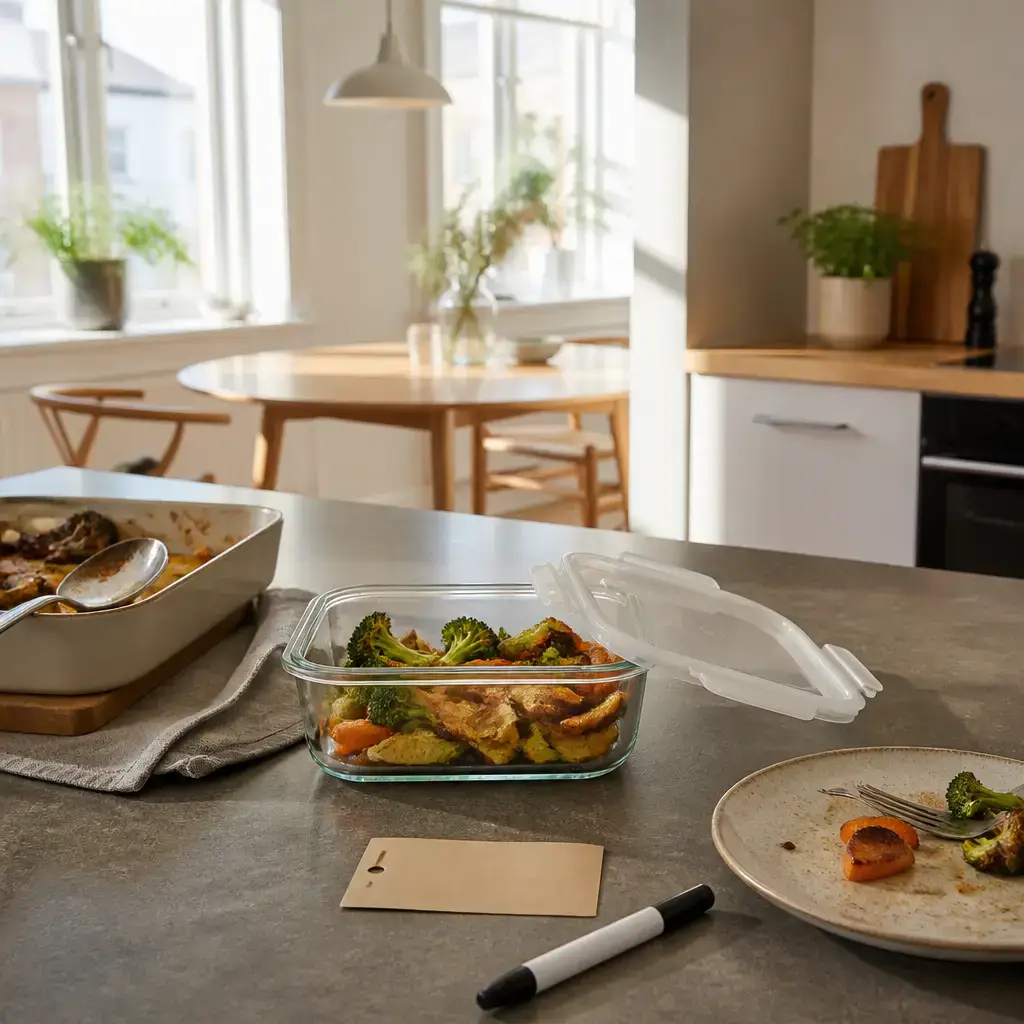
Use Saving leftovers for tomorrow to practice Danish conversation, pronunciation, vocabulary, grammar, and quizzes.
Dialogue
Der er mange rester fra aftensmaden.
dair air MANG-uh RES-dah frah AHF-dens-MEH-then. There are a lot of leftovers from dinner.Lad os komme dem i en ren beholder.
lehth ohs KUM-uh dem ee en RAIN buh-HOH-lah. Let's put them in a clean container.Må jeg varme dem op til frokost i morgen?
moh yai VAR-muh dem op tel FROH-kohst ee MOH-an? Can I reheat them for lunch tomorrow?Du kan, hvis vi opbevarer dem i køleskabet indtil da.
doo kan, ves vee oh-buh-VAIR-ah dem ee KUR-luh-SKAYB en-tel deh. You can if we keep them in the fridge until then.Skal jeg sætte en etiket på beholderen?
skell yai SET-ah en eh-tee-KAYD poh buh-HOH-lahn? Should I put a label on the container?På den måde ved vi i morgen, hvad der er i den.
poh den MOH-theh vay vee ee MOH-an, veh dair air ee den. That way, tomorrow we will know what is inside.Jeg sætter en tydelig etiket på den.
yai SET-ah en TEW-theh-lee eh-tee-KAYD poh den. I'll put a clear label on it.Det vil gøre frokosten nemmere.
deh vel KUR-ah FROH-kohs-den NEM-uh-reh. That will make lunch easier.Sentence explanations
Der er mange rester fra aftensmaden.
There are a lot of leftovers from dinner.
- Der er
- there are
- mange
- many; a lot of
- rester
- leftovers
- fra
- from
- aftensmaden
- dinner; the evening meal
More detail
Der er is the Danish existential pattern meaning that something exists or is present. It is used before the thing being introduced: Der er kaffe. — “There is coffee.” The form er is the present tense of være (“to be”). In this sentence, Der is part of the fixed existential pattern, not a specific referring pronoun. mange means “many” and is used with plural countable nouns. It does not itself mark singular or plural; the noun after it is plural. Compare mange bøger (“many books”) with en bog (“a book”). In the sentence, mange gives the quantity meaning “many” or, naturally in this translation, “a lot of.” rester means “leftovers” here. It is the plural of rest, “leftover” or “remaining portion”: en rest → flere rester. The plural form fits mange. Example: Der er rester i køleskabet. — “There are leftovers in the refrigerator.” fra is a preposition meaning “from.” It can identify the source or origin of something: en gave fra Anna — “a gift from Anna.” Here it links the leftovers to their source, the evening meal. aftensmaden means “the dinner” or “the evening meal.” It is built from aftensmad (“dinner/evening meal”) with the definite ending -en: aftensmad → aftensmaden. This marks one definite meal understood as the relevant dinner, rather than an unspecified dinner. Danish definite marking is attached to the noun in this form; aftensmaden is not a separate article plus noun. Together, Der er introduces something present, mange rester identifies it as a large number of leftovers, and fra aftensmaden identifies their source. The complete meaning is: “There are a lot of leftovers from dinner.”
Lad os komme dem i en ren beholder.
Let's put them in a clean container.
- Lad os
- let's
- komme
- put
- dem
- them
- ren
- clean
- beholder
- container
More detail
Lad os is the Danish pattern for “let’s …”. It consists of lad, the imperative of lade, and os, the first-person plural object form meaning “us”. It is followed by an infinitive: Lad os vente. = “Let’s wait.” komme is the infinitive used here in the sense “put/place”, in the pattern komme noget i noget (“put something into something”). The same verb often means “come” in other contexts, so the surrounding object and destination determine the meaning here. The infinitive follows Lad os without an infinitive marker. dem is the third-person plural object pronoun, “them”. In this context, the bounded conversation supports the reading “the leftovers from dinner”. Danish dem does not change for the grammatical gender of the plural things it refers to. Compare the subject form de (“they”) with the object form dem (“them”): Jeg ser dem. = “I see them.” ren means “clean” here. It is the singular common-gender form of the adjective ren; with a neuter singular noun it is rent, and with a plural noun it is rene: en ren kop = “a clean cup”; et rent glas = “a clean glass”; rene kopper = “clean cups”. The form ren agrees with the common-gender singular noun beholder, not with the pronoun dem. beholder means “container”. It is a common-gender noun, and en beholder is its indefinite singular form. Its definite singular form is beholderen, while the plural is beholdere (indefinite) or beholderne (definite). The chunks combine as Lad os + infinitive komme + object dem + destination phrase i en ren beholder. Thus the utterance means “Let’s put them in a clean container.”
Må jeg varme dem op til frokost i morgen?
Can I reheat them for lunch tomorrow?
- Må jeg
- Can I …?
- varme … op
- reheat
- dem
- them
- til frokost
- for lunch
- i morgen
- tomorrow
More detail
Må jeg asks for permission: “May/Can I …?” Må is the present-tense modal form of måtte, and jeg is the subject “I”. In a yes/no question, the modal comes before the subject. After a modal, the next verb is in the infinitive without at. varme means “to heat/warm” here. Its infinitive is varme; the present-tense form is varmer. Together with the following particle op, it forms varme op, “to heat up” or “to reheat”. The object can stand between the verb and particle: varme dem op. dem is the object pronoun “them”. It is the plural object form; the corresponding plural subject form is de. Danish does not mark gender in dem, so the form itself does not identify the objects’ gender. The fixed translation establishes that the intended objects are the previously mentioned “them”. til frokost means “for lunch”. til introduces the intended meal or occasion here, while frokost is the noun “lunch”. Example: Vi mødes til frokost. — “We’ll meet for lunch.” i morgen is the time expression “tomorrow”. It refers to the day after today and is used without an article in this expression. Example: Jeg arbejder i morgen. — “I’m working tomorrow.” Together, Må jeg + varme dem op + til frokost + i morgen asks whether the speaker is allowed to reheat the objects for lunch tomorrow: “Can I reheat them for lunch tomorrow?”
Du kan, hvis vi opbevarer dem i køleskabet indtil da.
You can if we keep them in the fridge until then.
- Du kan
- you can
- hvis
- if
- vi opbevarer
- we keep/store
- dem
- them
- køleskabet
- the fridge
- indtil da
- until then
More detail
Du kan means “you can” here. kan is the present-tense form of kunne, “can/be able to.” Danish modal verbs are followed by an infinitive when that action is stated, as in Du kan komme (“You can come”). Here the further action is understood from the context, so the utterance can end with kan. hvis introduces a condition and means “if.” It starts the subordinate clause hvis vi opbevarer dem i køleskabet indtil da. vi opbevarer means “we keep/store.” opbevarer is the present-tense form of opbevare; the subject vi is “we.” The present tense can describe a condition that applies to a future situation: Hvis vi opbevarer maden koldt ... means “If we keep the food cold ...” dem is the object pronoun “them.” In this exchange it refers to the items already mentioned, while the fixed sentence does not specify their exact identity. Danish uses dem for a plural object; the subject form is de, as in De kommer (“They are coming”) versus Jeg ser dem (“I see them”). køleskabet means “the fridge.” It is the definite form of the noun køleskab, “fridge”: et køleskab (“a fridge”) → køleskabet (“the fridge”). The preposition i before it gives the location “in the fridge”; the noun itself is the part carrying the definite ending. indtil da means “until then.” indtil marks the endpoint of a period, and da means “then” in this temporal use. The phrase refers to a time already established by the exchange, without specifying a different time of its own. Compare Vent indtil fredag (“Wait until Friday”), where the endpoint is named directly. Together, Du kan supplies the main clause, while hvis ... gives the condition: “You can, if we keep them in the fridge until then.” The comma reflects the placement of the conditional clause after the main clause. The sentence therefore grants the possibility understood from context on the condition that the items remain stored in the fridge up to the relevant time.
Skal jeg sætte en etiket på beholderen?
Should I put a label on the container?
- Skal jeg
- Should I
- sætte
- put
- etiket
- label
- på
- on
- beholderen
- the container
More detail
Skal jeg is the question pattern “Should I …?” Here, skal is the present form of skulle, used with jeg to ask about a proposed action or obligation. The subject jeg means “I”; it is not the object being placed. sætte is the infinitive of sætte, “to put” or “to place.” After skal, Danish uses the infinitive without an infinitive marker: skal jeg sætte ...? means “should I put ...?” The verb sætte commonly describes placing something somewhere. For example: Jeg sætter koppen på bordet. — “I put the cup on the table.” etiket means “label.” The form here is singular and indefinite: en etiket, “a label.” en marks an indefinite common-gender noun; it does not by itself state a numerical count as a teaching point. The definite form is etiketten, “the label.” på means “on” in this placement pattern. Danish commonly uses sætte ... på ... for putting something onto a surface or attaching it to something. For example: Sæt mærket på kassen. — “Put the mark on the box.” beholderen means “the container.” It is the definite singular form of beholder: beholder means “container,” and the ending -en marks definite singular for this noun. Thus en beholder is “a container,” while beholderen is “the container.” The fixed translation identifies this as the container relevant to the question. Together, sætte en etiket på beholderen means “put a label on the container.” With the opening question pattern, Skal jeg sætte en etiket på beholderen? means “Should I put a label on the container?” The utterance asks whether the speaker should carry out that action; it does not assert that the label has already been placed.
På den måde ved vi i morgen, hvad der er i den.
That way, tomorrow we will know what is inside.
- På den måde
- that way
- ved
- know
- i morgen
- tomorrow
- hvad der er
- what is
- i den
- inside it
More detail
På den måde means “that way” or “in that manner.” måde is the noun “way,” and den is the singular common-gender form of “that” modifying it. The phrase presents a method or approach; it is not simply a location. Example: På den måde lærer vi hurtigt. — “That way, we learn quickly.” ved is the present-tense form of vide, “to know.” With vi (“we”), vi ved means “we know”; the form ved does not itself show the subject’s number. This is knowledge of a fact, not the act of finding something out in progress. Example: Jeg ved det. — “I know it.” i morgen means “tomorrow.” It is a time expression, and its position here sets the time for ved: “tomorrow we will know.” Example: Vi ses i morgen. — “See you tomorrow.” hvad der er introduces the content of what will be known: “what is” or, in this sentence, “what there is.” In this embedded question-like clause, hvad means “what,” while der helps form the Danish clause structure; der is not an additional English object to translate separately. The form er is the present form of være, “to be.” Compare the reusable pattern hvad der er + place: Jeg ved, hvad der er på bordet. — “I know what is on the table.” i den means “in it” here. i expresses an interior location, and den is a singular common-gender pronoun. With the supplied context, den refers to the container mentioned in the surrounding exchange. The same pronoun can refer to other appropriate singular common-gender things in another context, so its grammatical form alone does not identify a referent. Example: Nøglen er i den. — “The key is in it.” Together, På den måde gives the method, ved vi gives the main clause “we know,” i morgen places that knowing tomorrow, and hvad der er i den specifies what will be known: “what is inside it.” The complete utterance therefore means “That way, tomorrow we will know what is inside.”
Jeg sætter en tydelig etiket på den.
I'll put a clear label on it.
- Jeg
- I
- sætter
- put
- tydelig
- clear
- etiket
- label
- på den
- on it
More detail
Jeg means “I” and is the first-person singular subject pronoun. It identifies the person carrying out the action. For example, Jeg læser means “I read.” sætter is the present-tense form of sætte, “to put” or “to set.” In this sentence it describes the speaker putting the label in place. The present form can also refer to a planned action, as the English translation “I’ll put” shows. For example, Jeg sætter koppen på bordet means “I put the cup on the table.” 'tydelig means “clear” here, in the sense of easy to see or understand. It is an adjective describing etiket. With the common-gender singular indefinite noun en etiket, the form is tydelig. The comparative is tydeligere, “clearer,” and the superlative is tydeligst`, “clearest.” etiket is a common-gender singular indefinite noun meaning “label.” Its definite singular form is etiketten, “the label.” For example, Jeg læser etiketten means “I read the label.” på den consists of the preposition på, “on,” and den, the common-gender singular pronoun used here for “it.” Together they express placing something on the intended object. Den is the pronoun form, while det is used for a neuter singular referent; the choice depends on the grammatical form of the referent, not simply on its physical size. The supplied sentence and translation support “on it” here without requiring a more specific identification of the object. The sentence follows the reusable pattern Jeg + present-tense verb + en/et + adjective + noun + på den: Jeg sætter en tydelig etiket på den. The subject is the speaker, sætter states the planned placing action, en tydelig etiket is the thing being placed, and på den specifies its destination. Together, the utterance means “I’ll put a clear label on it.”
Det vil gøre frokosten nemmere.
That will make lunch easier.
- Det vil
- that will
- gøre
- make
- frokosten
- lunch
- nemmere
- easier
More detail
Det vil combines det, “that/it,” with vil, the form of ville used here to express a future or expected result. The fixed translation identifies det as “that”: it points to the relevant previously mentioned situation or action, while vil says that the result is expected later. After a modal such as vil, the following verb is in the infinitive. gøre is the infinitive “make” here, in the pattern gøre + object + adjective: “make something [adjective].” It is not inflected for the subject in this construction. Example: Det vil gøre arbejdet nemmere. — “That will make the work easier.” frokosten means “the lunch.” The noun is frokost; its definite singular form is frokosten (en frokost → frokosten). The ending -en marks definiteness for this common-gender noun; it does not itself assert a numerical count. Example: Frokosten er klar. — “Lunch is ready.” nemmere is the comparative form of the adjective nem, “easy.” The useful comparison chain is nem → nemmere → nemmest (“easy” → “easier” → “easiest”). Here, nemmere describes the result of making lunch easier, rather than simply saying that lunch is easy. Example: Denne løsning gør opgaven nemmere. — “This solution makes the task easier.” Together, Det vil sets up an expected future result, gøre introduces the causative pattern, frokosten is the thing affected, and nemmere gives the resulting comparison: “That will make lunch easier.”
Grammar Points
varme + object + op
varme dem op
VAR-muh dem opreheat them
The particle op can come after the object pronoun: varme dem op means “reheat them.”
nem → nemmere
nemmere
NEM-uh-reheasier
nemmere is the comparative form of nem and is used when comparing two options.
Danish Vocabulary
- Gender
- common
There are a lot of leftovers from dinner.
- Gender
- common
Let's put them in a clean container.
- Gender
- common
Should I put a label on the container?
- Gender
- common
Can I reheat them for lunch tomorrow?
Can I reheat them for lunch tomorrow?
You can if we keep them in the fridge until then.
- Gender
- neuter
You can if we keep them in the fridge until then.
You can if we keep them in the fridge until then.
- Gender
- common
Let's put them in a clean container.
- Gender
- common
There are a lot of leftovers from dinner.
Should I put a label on the container?
Can I reheat them for lunch tomorrow?
Quiz
Word Order
Arrange the words in the correct order.
There are a lot of leftovers from dinner.
Show Answer
Der er mange rester fra aftensmaden.That will make lunch easier.
Show Answer
Det vil gøre frokosten nemmere.Spelling
Tap the letters to spell the word.
lunch
Show Answer
frokostenleftover
Show Answer
restercontainer
Show Answer
beholderendinner