10 minutes free every day
Continue audio lessons in the app
Word explanations appear automatically in sync with the audio.
No login required · synced translations · playback with the screen locked
Choose your learning language and open this lesson in the app.

About This Lesson
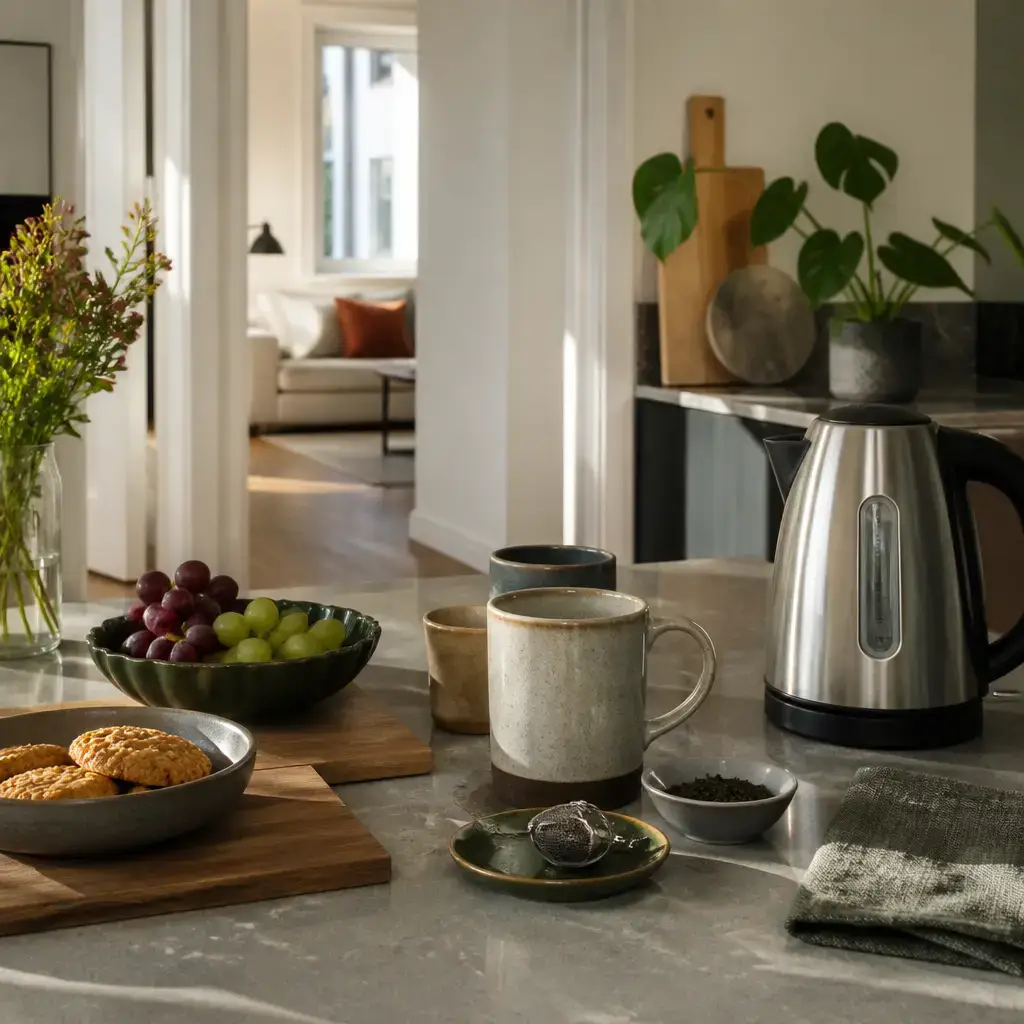
Use Preparing drinks and snacks for a guest to practice Danish conversation, pronunciation, vocabulary, grammar, and quizzes.
Dialogue
Vores gæst kommer snart.
VOH-uhs GESD KUM-uh SNAHD. Our guest will arrive soon.Skal vi servere kaffe eller te?
SKEL vee ser-VEER-uh KAF-uh EE-luh TAY? Should we serve coffee or tea?Te er nok bedre i aften.
TAY air NOK BAY-thuh ee AHF-dn. Tea is probably better this evening.Jeg koger noget vand i elkedlen.
yai KOH-uh NOH-th VAHN ee EL-kay-thlun. I'll boil some water in the kettle.Brug venligst det store krus til vores gæst.
BROO VEN-lisd deh STOH-uh KROOS teel VOH-uhs GESD. Please use the large mug for our guest.Vil du have, at jeg også gør snacks klar?
vel doo HEH-wuh, ed yai AW-suh GUR-uh snegs klahr? Would you like me to prepare snacks too?Læg nogle kiks på den lille tallerken, tak.
LYE NOH-luh KEGS poh den LEH-luh TAL-uh-gun, TAG. Put some biscuits on the small plate, please.Alt vil være klar, før vores gæst kommer.
AHL vel VAIR klahr, fur VOH-uhs GESD KUM-uh. Everything will be ready before they arrive.Sentence explanations
Vores gæst kommer snart.
Our guest will arrive soon.
- Vores
- our
- gæst
- guest
- kommer
- comes; will arrive
- snart
- soon
More detail
Vores means “our” and is a possessive determiner. It does not change for the number or gender of the thing possessed: vores gæst means “our guest,” while vores gæster means “our guests.” Example: Vores hus er stort. — “Our house is big.” gæst means “guest.” Its base form is the singular indefinite noun en gæst; the definite singular is gæsten, and the plural is gæster. Danish nouns use their own article and inflection, so the noun carries the number change here, not vores. Example: Vi har en gæst. — “We have a guest.” kommer is the present-tense form of komme, “to come.” With a time expression such as snart (“soon”), the present tense can describe a future arrival, so kommer snart corresponds here to “will arrive soon.” The same form can also describe a present or scheduled event when the context supports that reading. Example: Toget kommer snart. — “The train will arrive soon.” snart is an adverb meaning “soon,” indicating that the event is expected in the near future. It does not itself change form. Together, Vores gæst is the subject “our guest,” and kommer snart says that this guest will arrive soon. The complete utterance is therefore: “Our guest will arrive soon.”
Skal vi servere kaffe eller te?
Should we serve coffee or tea?
- Skal vi
- Should we…?
- servere
- serve
- kaffe
- coffee
- te
- tea
More detail
Skal vi combines skal with vi. Here, skal is the present form of skulle, used with a first-person plural subject to ask about a proposed or expected action: “Should we…?” The subject is vi, “we.” After a modal verb such as skal, the following verb is normally in the infinitive. servere means “to serve.” It is the infinitive used after skal; the form does not show a separate tense or person here. Example: Vi skal servere mad. — “We should/will serve food.” The exact English choice between “should” and “will” depends on context; in this question, the fixed translation supports “Should we serve…?” kaffe means “coffee.” It is a noun used here as one of the two possible things to serve. Danish commonly uses nouns such as kaffe without an article when referring to the substance or drink generally. te means “tea.” It is the second option in the question. The conjunction eller between kaffe and te means “or,” presenting alternatives. Together, Skal vi servere kaffe eller te? asks whether the speakers should serve coffee or tea: “Should we serve coffee or tea?” The question concerns a shared action by vi (“we”), with kaffe and te as the two alternatives.
Te er nok bedre i aften.
Tea is probably better this evening.
- Te
- tea
- er
- is
- nok
- probably
- bedre
- better
- i aften
- this evening
More detail
Te means “tea” here. It is a noun and is also the subject of the sentence. Danish nouns do not take an article in every subject position; an unmodified noun can appear without one when speaking generally or about the substance. er is the present-tense form of være, “to be.” The present form is used for a current state or an assessment about the present situation. Example: Kaffen er varm. — “The coffee is hot.” nok means “probably” in this sentence. It expresses a likely assessment, not certainty. In other contexts, nok can have other functions, so its meaning is determined by how it is used in the sentence. bedre means “better.” It is the comparative form related to god (“good”): god → bedre → bedst (“best”). The comparison is understood from context; this sentence says that the tea is considered better this evening, without specifying the comparison explicitly in the sentence. i aften is the time expression “this evening.” i is part of this expression, so it should be learned as a reusable phrase rather than translated word by word in isolation. Example: Jeg arbejder i aften. — “I am working this evening.” Together, Te er nok bedre i aften. means “Tea is probably better this evening.” The subject is Te; er links it to the assessment bedre; nok marks that assessment as probable; and i aften gives the time when it is being made.
Jeg koger noget vand i elkedlen.
I'll boil some water in the kettle.
- Jeg
- I
- koger
- boil; am boiling
- noget
- some
- vand
- water
- i
- in
- elkedlen
- the kettle
More detail
Jeg means “I” and is the first-person singular subject. Danish uses jeg for the speaker as subject, regardless of the speaker’s gender. koger is the present-tense form of koge, “to boil.” Danish present tense can describe something happening now, but it can also express a current intention or near-future action. Here, the fixed translation supports the latter reading: “I’ll boil.” Example: Jeg koger æg. — “I am boiling eggs.” noget means “some” here. It refers to an unspecified amount of vand; it does not state a particular quantity. In other uses, noget is also the neuter indefinite form of “some/any” or “something,” depending on the construction. Example: Jeg vil have noget kaffe. — “I would like some coffee.” vand means “water,” the substance being boiled here. In this use it is an uncountable noun. Its definite form is vandet, “the water.” Example: Vandet er varmt. — “The water is hot.” i means “in” and introduces the place or container associated with the boiling. elkedlen means “the kettle” here. It is the definite singular form of the en-word elkedel, “electric kettle”: elkedel takes the definite ending -en, giving elkedlen. The definite form refers to a particular kettle in the situation. Example: Kedlen står her. — “The kettle is here.” Together, Jeg koger noget vand means that the speaker will boil an unspecified amount of water. i elkedlen says that this happens in the kettle. The complete meaning is “I’ll boil some water in the kettle.”
Brug venligst det store krus til vores gæst.
Please use the large mug for our guest.
- Brug
- use
- venligst
- please
- det
- the
- store
- large
- krus
- mug
- til
- for
- vores
- our
- gæst
- guest
More detail
Brug is the imperative of bruge, “to use.” It gives a direct instruction; the subject is understood rather than stated, and the imperative form does not mark whether one or more people are addressed. Example: Brug denne kop. — “Use this cup.” venligst means “please” and softens the instruction. It is a polite adverb and does not change the imperative form. det is the neuter singular definite article used in the definite noun phrase det store krus, “the large mug.” store is the definite-form adjective corresponding to stor, “large.” In this phrase, definiteness is shown by det ... store; compare et stort krus — “a large mug,” where stort is the neuter form in the indefinite phrase. The adjective’s base form is stor, not krus. krus means “mug.” It is a neuter noun: et krus — “a mug,” and kruset — “the mug.” til commonly means “to” or “for.” Here it introduces the intended recipient or purpose expressed by til vores gæst, “for our guest.” vores means “our.” This possessive form does not change for the gender or number of the noun it modifies: vores gæst — “our guest.” gæst means “guest.” It is singular here, and its noun form is indefinite (gæst rather than gæsten), although the possessive phrase vores gæst identifies the guest as belonging to or associated with “our.” The definite form gæsten means “the guest.” Together, Brug venligst forms a polite imperative, and det store krus identifies the object to use. til vores gæst specifies that the mug is intended for the guest. The complete meaning is: “Please use the large mug for our guest.”
Vil du have, at jeg også gør snacks klar?
Would you like me to prepare snacks too?
- Vil du have
- would you like
- at jeg
- that I
- også
- also / too
- snacks
- snacks
- gør … klar
- prepare ...
More detail
Vil du have is a Danish pattern for asking whether someone would like something. vil is the present form of ville, “to want,” and du is the second-person singular pronoun “you.” In this question, the pattern is naturally translated as “would you like.” Example: Vil du have kaffe? — “Would you like coffee?” at jeg begins a clause stating who would perform the action. Here at introduces the clause and jeg means “I.” Example: Jeg vil have, at du kommer. — “I want you to come.” også means “also” or “too.” It adds this preparation to something else already relevant; it does not change the person doing it. snacks is the plural noun “snacks.” Here it refers to snacks without specifying a particular kind. gør ... klar is a split Danish construction meaning “prepare” or “make ready.” gør is the present form of gøre, “to do/make,” while klar means “ready.” The object can occur between the two parts, as snacks does here. Example: Jeg gør maden klar. — “I prepare the food.” Together, Vil du have, at jeg også gør snacks klar? means “Would you like me to prepare snacks too?” The main question asks about the other person’s preference, and the subordinate clause identifies jeg, “I,” as the person who would prepare them.
Læg nogle kiks på den lille tallerken, tak.
Put some biscuits on the small plate, please.
- Læg
- put/place
- nogle
- some
- kiks
- biscuits
- på
- on
- den
- the
- lille
- small
- tallerken
- plate
- tak
- please
More detail
Læg means “put” here. It is the imperative of lægge (“to put/place”), used for a direct instruction. The imperative is often formed by removing the infinitive ending -e: lægge → læg. Example: Læg bogen her. — “Put the book here.” nogle means “some” before the plural noun kiks. It indicates an unspecified amount or number, not a precise count. Compare en kiks — “a biscuit” and nogle kiks — “some biscuits.” kiks means “biscuits” here. This is the indefinite plural form of kiks; the singular indefinite form is also kiks, as in en kiks, while the definite singular is kiksen (“the biscuit”). Example: Jeg køber nogle kiks. — “I am buying some biscuits.” på means “on” in this instruction. With a movement verb such as lægge, it can introduce the surface where something is placed: Læg koppen på bordet. — “Put the cup on the table.” den is the common-gender singular definite article, corresponding here to “the.” It marks the following noun phrase as definite; it is not the word that expresses the noun’s location. In den lille tallerken, den agrees with the common-gender noun tallerken. lille means “small.” Its base form is lille; the plural form is små, as in små tallerkener — “small plates.” In the definite singular phrase den lille tallerken, lille is the form used after the definite article. Example: Det er en lille tallerken. — “It is a small plate.” tallerken means “plate.” It is a common-gender singular indefinite noun: en tallerken. Its definite singular is tallerkenen, and its indefinite plural is tallerkener. tak means “please” at the end of this polite request. It can also mean “thanks” in other positions, but here it softens the instruction rather than naming gratitude for something already done. Together, Læg nogle kiks gives the instruction “Put some biscuits,” and på den lille tallerken specifies the destination surface, “on the small plate.” The final tak makes the request polite. The complete meaning is: “Put some biscuits on the small plate, please.”
Alt vil være klar, før vores gæst kommer.
Everything will be ready before they arrive.
- Alt
- everything
- vil være
- will be
- klar
- ready
- før
- before
- vores
- our
- gæst
- guest
- kommer
- arrives
More detail
Alt means “everything” here. It refers to an unspecified whole rather than naming particular items. Alle is used for plural people or things, whereas alt is the neuter singular form used in “everything.” vil være combines vil with the base form være (“be”). Here, vil gives the clause a future-oriented meaning: “will be.” Example: Det vil være nemt. — “It will be easy.” klar means “ready” here. Klar is the common-gender singular form; the neuter singular form is klart, and the plural or definite form is klare. This entry describes the observed form klar without changing the fixed target text. Example: Maden er klar. — “The food is ready.” før means “before.” It introduces an event that occurs later than the event in the main clause: før ... kommer means “before ... arrives.” Example: Vi spiser, før filmen begynder. — “We eat before the film begins.” vores means “our.” It is the possessive form for the speaker together with at least one other person. Vores does not change for the gender or number of the noun it accompanies. Example: vores hus — “our house.” gæst means “guest.” It is a singular noun in the indefinite form. The definite form is gæsten, “the guest,” with the definite marking attached to the noun. Example: En gæst kommer. — “A guest is coming.” kommer means “comes” or, in this context, “arrives.” Its base form is komme; kommer is the present-tense form. Danish commonly uses the present form after før for an event viewed as future, so før ... kommer means “before ... arrives.” Example: Hun kommer i morgen. — “She is coming tomorrow.” Together, Alt vil være klar expresses “Everything will be ready.” før introduces the later event vores gæst kommer, “our guest arrives.” The complete utterance therefore means “Everything will be ready before they arrive,” with singular “they” in the fixed translation referring to the guest.
Grammar Points
Imperativ: verbets stamme
Brug venligst elkedlen.
BROO VEN-lisd EL-kay-thlun.Please use the kettle.
I imperativ bruges verbets stamme uden -e: bruge bliver til Brug. Venligst gør anmodningen høflig.
Danish Vocabulary
- Gender
- common
i aften
- Gender
- common
- Gender
- common
- Gender
- common
Quiz
Word Order
Arrange the words in the correct order.
Our guest will arrive soon.
Show Answer
Vores gæst kommer snart.Should we serve coffee or tea?
Show Answer
Skal vi servere kaffe eller te?Tea is probably better this evening.
Show Answer
Te er nok bedre i aften.Spelling
Tap the letters to spell the word.
coffee
Show Answer
kaffeguest
Show Answer
gæstbetter
Show Answer
bedreto serve