10 minutes free every day
Continue audio lessons in the app
Word explanations appear automatically in sync with the audio.
No login required · synced translations · playback with the screen locked
Choose your learning language and open this lesson in the app.

About This Lesson
Use Finding the Main Entrance to practice Danish conversation, pronunciation, vocabulary, grammar, and quizzes.
Dialogue
Undskyld, hvilken vej fører til hovedindgangen?
OON-sgull, VIL-kuhn vye FUR-uh til HOH-oo-thuhn-GANG-uhn? Excuse me, which way leads to the main entrance?Følg de gule skilte mod hovedhallen.
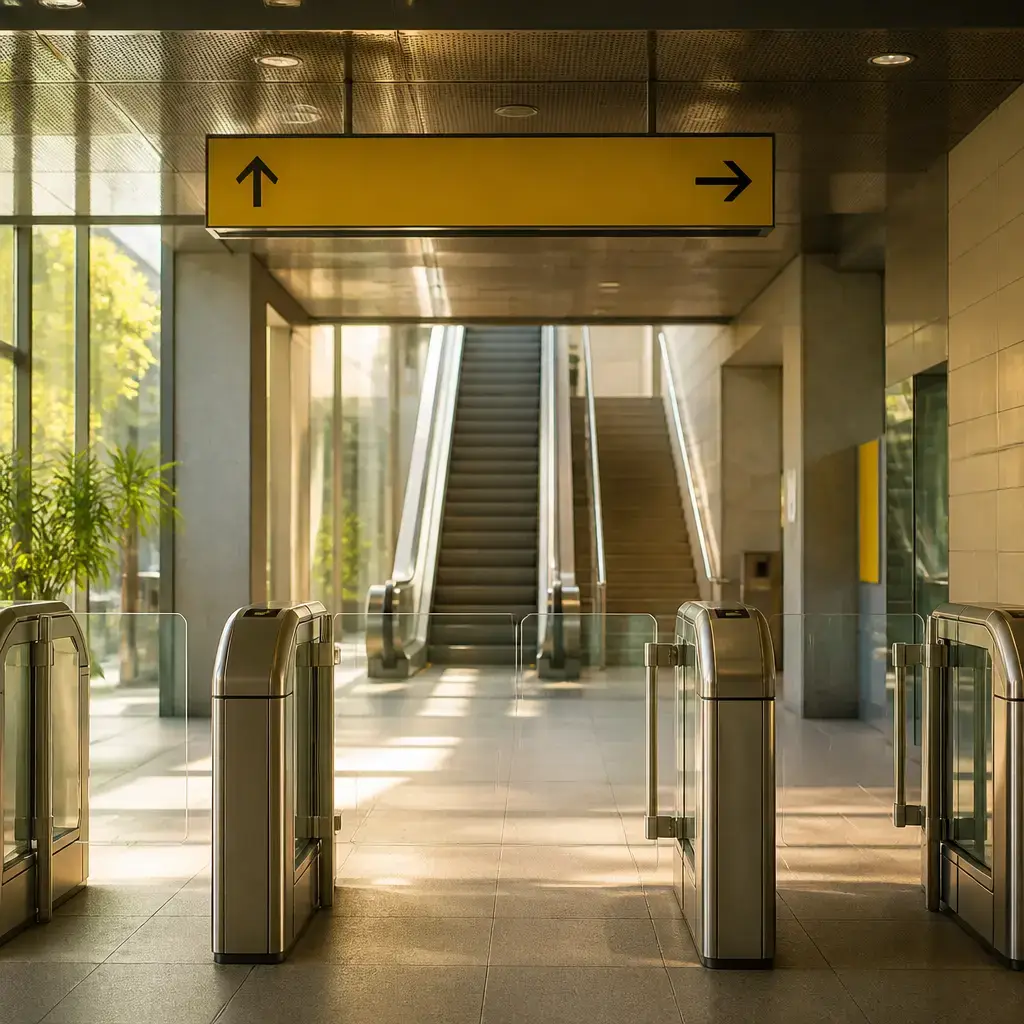
FUHLG dee GOO-luh SGEL-tuh moh HOH-oo-thuh-HAL-uhn. Follow the yellow signs toward the main hall.Skal jeg tage rulletrappen efter billetslusen?
SGEL yai TAY ROO-luh-TRAH-buhn EF-tuh BEL-uhd-SLOO-suhn? Should I take the escalator after the ticket gate?Tag rulletrappen op, og drej så til højre.
TAY ROO-luh-TRAH-buhn OH, oh DRY soh tehl HUY-uh. Take it upstairs, then turn right.Er hovedindgangen langt herfra?
AIR HOH-oo-thuhn-GANG-uhn lahngt hair-FRAH? Is the main entrance far from here?Der er en kort gåtur derfra.
DAH air en KOHRt GOH-toor dah-FRAH. It is a short walk from there.Denne station er lidt forvirrende.
DEN-uh sta-SHOHN air LEHD foh-VEER-uh-nuh. This station is a little confusing.Det er lettere at følge skiltene ovenpå.
Deh air LED-uh at FUHL-guh SGEL-tuh-nuh OH-vuhn-POH. The signs are easier to follow upstairs.Sentence explanations
Undskyld, hvilken vej fører til hovedindgangen?
Excuse me, which way leads to the main entrance?
- Undskyld
- Excuse me
- hvilken vej
- which way
- fører
- leads
- hovedindgangen
- the main entrance
More detail
Undskyld is the polite opener “Excuse me” here. It is also used as an apology in other contexts; the surrounding question makes its function here a way to get someone’s attention politely. hvilken vej means “which way.” hvilken is the common-gender singular form of the question word meaning “which”; compare hvilket with a neuter singular noun and hvilke with plural nouns. vej is the common-gender noun “way” or “route,” with the plural veje. fører is the present-tense form of føre, “lead” or “guide.” In this sentence it describes a route leading somewhere. Danish present-tense verbs generally do not change for the subject’s person or number: jeg fører, du fører, and de fører all use fører when the meaning is “lead/guide.” The pattern føre til means “lead to,” so fører til connects the way with its destination. hovedindgangen means “the main entrance.” It is a definite compound: hoved contributes “main,” and indgang means “entrance”; the ending in indgangen marks the definite singular form, “the entrance.” The plural is indgange, and the definite plural is indgangene. Together, hvilken vej fører til hovedindgangen? asks which route leads to the main entrance. The preposition til means “to,” identifying the destination. With the polite opener, the whole utterance is: “Excuse me, which way leads to the main entrance?”
Følg de gule skilte mod hovedhallen.
Follow the yellow signs toward the main hall.
- Følg
- follow
- gule
- yellow
- skilte
- signs
- mod
- toward
- hovedhallen
- the main hall
More detail
Følg means “follow” here. It is the imperative of følge (“to follow”), used to give a direct instruction. Danish imperatives commonly use the verb form without an expressed subject. Example: Følg vejen. — “Follow the road.” gule means “yellow” in this sentence. The base form is gul; gult is used with a singular neuter noun, while gule is used here with the plural noun skilte and also appears in other definite or plural adjective phrases. Example: gule blomster — “yellow flowers.” skilte means “signs.” Its base form is skilt (“sign”), and skilte is the plural form in this phrase. Example: Se efter skilte. — “Look for signs.” mod means “toward” and marks the direction of movement. It does not by itself say that the destination is reached. Example: Gå mod stationen. — “Walk toward the station.” hovedhallen means “the main hall.” It is built from hovedhall (“main hall”) with the definite ending -en, giving “the main hall.” The compound’s first part, hoved-, specifies the type or function of the hall; it is not a separate article. Example: Vi mødes i hovedhallen. — “We meet in the main hall.” Together, de gule skilte means “the yellow signs”: de identifies the plural signs, and gule agrees with skilte. mod hovedhallen adds their direction, “toward the main hall.” The whole utterance is the direct instruction “Follow the yellow signs toward the main hall.”
Skal jeg tage rulletrappen efter billetslusen?
Should I take the escalator after the ticket gate?
- Skal jeg
- Should I…?
- tage
- take
- rulletrappen
- the escalator
- efter
- after
- billetslusen
- the ticket gate
More detail
Skal jeg combines the present form skal of skulle with the pronoun jeg (“I”). In this question, skal asks whether the speaker ought to do something, so the reusable pattern is Skal jeg + infinitive? = “Should I …?” The same form can express stronger obligation in other contexts, but that is not the intended reading here. tage is the infinitive of tage (“to take”). After the modal verb skal, Danish uses the infinitive without at: Skal jeg tage ...? The present form is tager, as in Jeg tager rulletrappen (“I take/am taking the escalator”), while tog is a past form. rulletrappen means “the escalator.” The noun’s indefinite singular form is en rulletrappe; its definite singular form is rulletrappen, formed with the ending -en. The ending belongs to the noun, not to tage. Example: Jeg ser en rulletrappe — “I see an escalator”; Jeg tager rulletrappen — “I take the escalator.” efter means “after” here and places the escalator in relation to the ticket gate: the intended route is to take it after the gate. Danish efter can also express other kinds of “after” relations, so its exact sense comes from the surrounding phrase. billetslusen means “the ticket gate.” The indefinite singular form is en billetsluse, and the definite singular form is billetslusen, with the definite ending -en. The compound combines billet (“ticket”) and sluse (“gate”), but the observed word is one compound noun. Example: Vi står efter billetslusen — “We are after the ticket gate.” Together, Skal jeg tage rulletrappen efter billetslusen? asks whether the speaker should take the escalator after the ticket gate. The modal question comes first, followed by the action, the object of that action, and the location or sequence phrase efter billetslusen.
Tag rulletrappen op, og drej så til højre.
Take it upstairs, then turn right.
- Tag
- take
- rulletrappen
- the escalator
- op
- up; upstairs
- drej
- turn
- så
- then
- til højre
- to the right
More detail
Tag is the imperative of tage, “to take.” In this sentence it gives a direction: use the escalator. Danish imperatives often have the same form as the verb stem, as in tage → tag. Example: Tag bussen. — “Take the bus.” rulletrappen means “the escalator.” It is the definite singular form of rulletrappe: en rulletrappe means “an escalator,” while rulletrappen means “the escalator.” The ending -en marks this noun as definite singular. Example: Hvor er rulletrappen? — “Where is the escalator?” op means “up” here. With movement, it indicates upward direction; in this utterance, it makes the instruction “take the escalator up” or “take it upstairs.” Danish commonly places such a short directional word after the main verb or its object: Tag trappen op. — “Take the stairs up.” drej is the imperative of dreje, “to turn.” It is a separate instruction after the first one. Example: Drej til venstre. — “Turn left.” så means “then” here. It links the two instructions in time: first take the escalator up, and then turn. Its meaning in this sentence is not the comparative or manner meaning that så can have in other contexts. til højre means “to the right.” højre is the directional word “right”; the preposition til introduces the direction. The contrasting direction is til venstre, “to the left.” Example: Drej til højre ved døren. — “Turn right at the door.” Together, Tag rulletrappen op gives the first instruction, “Take the escalator up,” and og drej så til højre adds the next one, “and then turn right.” The complete utterance is therefore: “Take it upstairs, then turn right.”
Er hovedindgangen langt herfra?
Is the main entrance far from here?
- Er
- is
- hovedindgangen
- the main entrance
- langt
- far
- herfra
- from here
More detail
Er is the present-tense form of være (“to be”). In a Danish yes/no question, the verb commonly comes before the subject: Er ...? means “Is ...?” The same form appears in statements, for example: Indgangen er åben. — “The entrance is open.” hovedindgangen means “the main entrance” here. It is the definite singular form of the compound noun hovedindgang: en hovedindgang — “a main entrance”; hovedindgangen — “the main entrance.” The compound is written as one word. Within it, hoved contributes “main,” and indgang means “entrance”; the ending -en makes the whole compound definite, rather than marking indgang as a separate noun in this sentence. langt means “far” here and is used adverbially to describe distance. It is not an adjective agreeing with hovedindgangen. The related adjective form is lang; its neuter form is also langt, but in this distance expression langt functions adverbially. Example: Er der langt? — “Is it far?” herfra means “from here.” It is a single written location adverb corresponding to her (“here”) plus fra (“from”). A useful related expression is derfra (“from there”). Here, herfra identifies here as the starting point for the distance. Together, Er hovedindgangen langt herfra? follows the pattern Er + subject + distance expression + starting point? and means “Is the main entrance far from here?”
Der er en kort gåtur derfra.
It is a short walk from there.
- Der er
- there is/are
- kort
- short
- gåtur
- walk
- derfra
- from there
More detail
Der er introduces something that exists or is located somewhere: “there is/are.” It is a reusable existential pattern; the following noun phrase identifies what exists. For example: Der er en station her. — “There is a station here.” kort means “short” here and describes the noun gåtur. Its base form is kort; useful comparison forms are kortere (“shorter”) and kortest (“shortest”). In this sentence, kort is the singular common-gender form agreeing with gåtur; Danish also uses kort with singular neuter nouns and korte in the plural. gåtur means “walk,” specifically a walk as an outing or distance. It is a common-gender singular noun here, shown by the article en: en gåtur. The indefinite article marks an unspecified singular noun phrase; in this sentence, the wording does present one walk as the relevant distance, but en alone should not be treated as a numerical count. derfra means “from there.” It is a place adverb combining the meaning of “there” with movement or distance away from that place. A useful contrast from the preceding question is herfra, “from here.” Together, Der er en kort gåtur derfra uses the existential pattern Der er + en kort gåtur, followed by derfra to state the point of reference: “There is a short walk from there,” or naturally, “It is a short walk from there.” The adjective kort describes the walk, while derfra specifies where the walk is measured from.
Denne station er lidt forvirrende.
This station is a little confusing.
- Denne
- this
- station
- station
- er
- is
- lidt
- a little
- forvirrende
- confusing
More detail
Denne means “this” and points to one nearby or contextually identified common-gender noun. In Danish, the demonstrative agrees with the noun’s grammatical gender and number: denne station (common gender, singular), dette sted (neuter, singular), and disse stationer (plural). The form itself does not identify the station beyond the speaker’s pointing or contextual reference. station is the noun “station.” Its indefinite form is en station, and its definite form is stationen (“the station”). Danish nouns with en are common-gender nouns, which is why the singular demonstrative here is denne rather than dette. er is the present-tense form of være, “to be.” It is used with both singular and plural subjects: stationen er means “the station is,” while stationerne er means “the stations are.” The subject here is denne station, so the English meaning is “this station is.” lidt means “a little” or “slightly.” Here it softens the degree of the following description: the station is confusing to a small extent, rather than extremely confusing. Example: Det er lidt svært. — “It is a little difficult.” forvirrende means “confusing” here: it describes something that makes understanding or finding one’s way difficult. It is related to the verb forvirre, “to confuse.” The -ende form functions as a descriptive adjective here and does not change between common-gender and neuter singular: en forvirrende station and et forvirrende skilt both use forvirrende. This describes the station’s effect; it is different from forvirret, “confused,” which describes a person or thing experiencing confusion. Example: Kortet er forvirrende. — “The map is confusing.” Together, denne station identifies one station, er links it to a description, lidt reduces the strength of that description, and forvirrende says what the station is like. The complete utterance therefore means: “This station is a little confusing.”
Det er lettere at følge skiltene ovenpå.
The signs are easier to follow upstairs.
- Det er
- it is
- lettere
- easier
- følge
- follow
- skiltene
- the signs
- ovenpå
- upstairs
More detail
Det er is a reusable impersonal pattern meaning “it is” here. Det is a formal subject; it does not identify a particular person or object. Danish uses this pattern before an adjective and an activity: Det er svært at forstå. — “It is difficult to understand.” lettere means “easier” here and is the comparative form of let (“easy”). The useful chain is let → lettere → lettest (“easy” → “easier” → “easiest”). A comparative presents this activity as easier than another relevant situation, person, or option; the fixed sentence does not specify exactly what the comparison is with or how large the difference is. Danish comparative forms such as lettere do not themselves mark a noun’s gender or number. følge means “follow.” It is the infinitive used after the infinitive marker at: at følge means “to follow.” For example, Det er let at følge instruktionerne. — “It is easy to follow the instructions.” skiltene means “the signs.” Its base noun is skilt; the form chain is skilt (a sign), skilte (signs), skiltene (the signs). The ending in skiltene marks definite plural, presenting the signs as identifiable in the situation. This noun is the object of følge. ovenpå is an adverb meaning “upstairs” in this utterance. Here it places the signs upstairs. Depending on context, the same adverb can also refer to something being up above or on top; the fixed translation selects “upstairs” here. Together, Det er lettere at følge skiltene ovenpå means “It is easier to follow the signs upstairs.” The impersonal evaluation Det er lettere is followed by the activity being evaluated, at følge skiltene, and ovenpå specifies the upstairs location of the signs. The sentence therefore compares following the upstairs signs favorably with another relevant situation without stating that comparison explicitly.
Grammar Points
Imperativ: Følg / Drej
Følg de gule skilte mod hovedhallen.
FUHLG dee GOO-luh SGEL-tuh moh HOH-oo-thuh-HAL-uhn.Follow the yellow signs toward the main hall.
Danish commands often use the verb stem without a subject: følge becomes Følg.
Bestemt form med endelse: -en
hovedindgang → hovedindgangen; rulletrappe → rulletrappen
HOH-oo-thuhn-gang to HOH-oo-thuhn-GANG-uhn; ROO-luh-TRAH-buh to ROO-luh-TRAH-buhn.main entrance → the main entrance; escalator → the escalator
Many common-gender nouns form “the” by adding -en to the noun.
Danish Vocabulary
Følg de gule skilte mod hovedhallen.
Hvilken vej fører til hovedindgangen?
Følg de gule skilte mod hovedhallen.
- Gender
- common
Følg de gule skilte mod hovedhallen.
- Gender
- common
Hvilken vej fører til hovedindgangen?
Hvilken vej fører til hovedindgangen?
Skal jeg tage rulletrappen efter billetslusen?
Følg de gule skilte mod hovedhallen.
Følg de gule skilte mod hovedhallen.
Skal jeg tage rulletrappen efter billetslusen?
Undskyld, hvilken vej fører til hovedindgangen?
- Gender
- common
Hvilken vej fører til hovedindgangen?
Quiz
Word Order
Arrange the words in the correct order.
Excuse me, which way leads to the main entrance?
Show Answer
Undskyld, hvilken vej fører til hovedindgangen?Follow the yellow signs toward the main hall.
Show Answer
Følg de gule skilte mod hovedhallen.Should I take the escalator after the ticket gate?
Show Answer
Skal jeg tage rulletrappen efter billetslusen?Spelling
Tap the letters to spell the word.
yellow
Show Answer
guleto lead
Show Answer
førersign
Show Answer
skilteto follow