10 minutes free every day
Continue audio lessons in the app
Word explanations appear automatically in sync with the audio.
No login required · synced translations · playback with the screen locked
Choose your learning language and open this lesson in the app.

About This Lesson
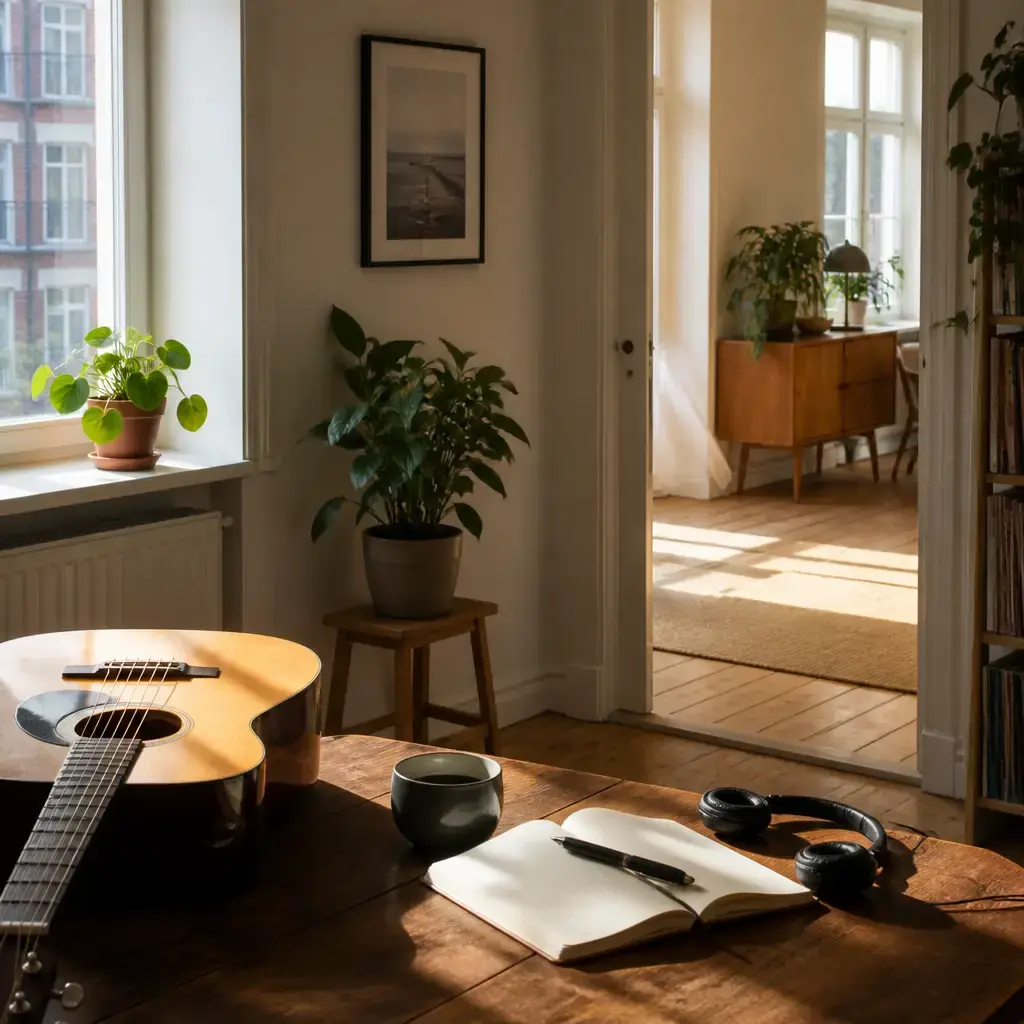
Use Learning Guitar in Free Time to practice Danish conversation, pronunciation, vocabulary, grammar, and quizzes.
Dialogue
Jeg er for nylig begyndt at lære at spille guitar.
yai air fohr NUU-lee beh-GURN uh LAIR uh SPEH-luh gee-TAR I recently started learning guitar.Får du undervisning?
foh doo on-VESS-ning? Are you taking lessons?Jeg tager onlinelektioner efter arbejde.
yai TAY-uh on-LINE-lek-SYOH-nuh EF-tuh AR-bai-duh I'm taking online lessons after work.Er det svært for en begynder?
air deh svair fohr en beh-GURN-uh? Is it difficult for a beginner?Rytmen er svær, men jeg nyder det.
RÜD-men air svair, men yai NUU-uh deh. The rhythm is hard, but I enjoy it.Hvor ofte øver du dig?
vohr OFF-tuh UR-vuh doo sai? How often do you practice?Jeg øver mig om aftenen, når der er stille på mit værelse.
yai UR-vuh mai um AF-tuh-nun, nohr dair air SDEH-luh paw mit VEH-uhl-suh. I practice in the evening when my room is quiet.Et fast tidspunkt bør hjælpe dig med at blive bedre.
ehd fast TEHSS-pongd bur YEL-buh dai meh uh BLEE-vuh BEH-thruh. A regular time should help you improve.Sentence explanations
Jeg er for nylig begyndt at lære at spille guitar.
I recently started learning guitar.
- Jeg er
- I am
- for nylig
- recently
- begyndt
- started
- at lære
- to learn
- at spille
- to play
- guitar
- guitar
More detail
Jeg er means “I am” here. Jeg is the first-person singular pronoun “I”; er is the present-tense form of være (“to be”). In this sentence, er functions as the auxiliary in a perfect construction, not as the main verb meaning “am” by itself. for nylig is a time expression meaning “recently” or “not long ago.” It places the beginning of the activity in the recent past. Example: Jeg flyttede for nylig. — “I moved recently.” begyndt is the past participle of begynde (“to begin, start”). With er, it forms a construction referring to a completed beginning: er begyndt = “has started” or, with the first-person subject here, “I have started.” Danish uses begynde at followed by an infinitive to express beginning an activity. at lære means “to learn.” at marks the infinitive, and lære is the infinitive form. In this sentence, it means acquiring the ability or knowledge involved in playing guitar. Example: Hun vil lære dansk. — “She wants to learn Danish.” at spille means “to play.” It is another infinitive introduced by at; here it is the activity that is being learned. lære at spille is therefore the reusable pattern “learn to play.” Example: De lærer at spille klaver. — “They are learning to play the piano.” guitar is the noun “guitar.” In spille guitar, Danish uses the noun without an article for this activity, giving the natural meaning “play guitar.” The noun itself is unchanged here; the sentence does not specify a particular guitar. Together, Jeg er begyndt says “I have started,” at lære adds what has been started, and at spille guitar specifies the skill: “to play guitar.” For nylig places that start recently. The complete meaning is: “I recently started learning guitar.”
Får du undervisning?
Are you taking lessons?
- Får
- take / receive
- du
- you
- undervisning
- lessons / instruction
More detail
Får is the present-tense form of få, whose basic meaning is “get” or “receive.” In this utterance, få undervisning is a useful Danish combination meaning “receive instruction” or, in this context, “take lessons.” The present form is får with different subjects as well: jeg får, du får, and de får. Example: Jeg får undervisning. — “I take lessons.” du means “you.” It is the second-person singular subject form in Danish. Danish uses I for “you” when addressing more than one person, so du itself does not establish a plural addressee. Here, the fixed translation presents the question as addressing “you.” Undervisning is a noun meaning “instruction” or “teaching.” In få undervisning, it refers to receiving instruction as an activity, while the fixed translation naturally renders that activity as “taking lessons.” The noun can be used without an indefinite article when referring to instruction generally. The word order is a yes/no-question pattern: the finite verb Får comes before the subject du, followed by undervisning. A reusable pattern is [finite verb] + [subject] + ...?, for example Har du tid? — “Do you have time?” Together, Får du undervisning? asks whether the addressee is receiving instruction or taking lessons. The utterance itself does not specify the lessons’ format or timing.
Jeg tager onlinelektioner efter arbejde.
I'm taking online lessons after work.
- Jeg
- I
- tager
- take; am taking
- onlinelektioner
- online lessons
- efter
- after
- arbejde
- work
More detail
Jeg is the first-person singular pronoun “I.” It identifies the speaker as the subject. A useful contrast is du, “you” (singular), as in Du tager onlinelektioner. — “You take online lessons.” tager is the present-tense form of tage, “to take.” Here, tage means participating in or attending lessons, not physically carrying them. Danish present tense can describe an activity happening now or a current situation; it does not require a separate progressive form. For example, Jeg tager bussen. means “I take the bus” or, in a suitable context, “I am taking the bus.” onlinelektioner means “online lessons.” It is a compound noun: onlinelektion is the singular form and onlinelektioner is the plural form. The plural presents the lessons as more than one lesson without stating an exact number. For example, Jeg tager en onlinelektion. means “I am taking an online lesson.” efter means “after.” In this sentence, it introduces the time reference that follows arbejde: the lessons take place after work. It can be used with a noun phrase, as in efter arbejde, “after work,” or with a clause, as in efter jeg arbejder, “after I work.” arbejde means “work” in this expression. It is a neuter noun whose indefinite singular form is also arbejde; its definite singular form is arbejdet, “the work.” In efter arbejde, it appears without an article in the established time expression “after work.” Together, Jeg tager onlinelektioner means “I’m taking online lessons.” Adding efter arbejde specifies that this happens after work. The complete utterance therefore means “I’m taking online lessons after work.”
Er det svært for en begynder?
Is it difficult for a beginner?
- Er det
- Is it
- svært
- difficult
- for
- for
- begynder
- beginner
More detail
Er det begins a Danish yes/no question. Er is the present-tense form of være (“to be”), and placing it before det forms the question pattern Er det ...? (“Is it ...?”). Here det corresponds to “it” and refers to the activity or subject under discussion, without identifying a more specific noun in this sentence. svært means “difficult” here. It is the neuter singular form of the adjective svær: svær with a common-gender singular noun, svært with a neuter singular noun or with det, and svære in the plural or definite forms. For example: Det er svært. — “It is difficult.” for introduces the person or group for whom something has the stated quality: svært for ... means “difficult for ...”. It can be reused in patterns such as Det er let for hende. — “It is easy for her.” begynder is a noun meaning “beginner”. Its base form is begynder; the plural is begyndere. The adjacent en is the indefinite article used with this common-gender singular noun, forming en begynder (“a beginner”). For example: Jeg er en begynder. — “I am a beginner.” Together, Er det asks a yes/no question, svært supplies the adjective “difficult”, and for en begynder identifies the person for whom it is difficult. The complete meaning is: “Is it difficult for a beginner?”
Rytmen er svær, men jeg nyder det.
The rhythm is hard, but I enjoy it.
- Rytmen
- the rhythm
- er
- is
- svær
- hard; difficult
- men
- but
- jeg
- I
- nyder
- enjoy
- det
- it
More detail
Rytmen means “the rhythm.” It is the definite singular form of rytme (“rhythm”): rytme → rytmen. The ending -en marks definiteness for this common-gender noun. er is the present-tense form of at være (“to be”). It links the subject to a description: X er Y means “X is Y.” svær means “hard” or “difficult” here. It is the basic adjective form. Its comparison forms are sværere (“harder”) and sværest (“hardest”): svær → sværere → sværest. men means “but.” It joins two clauses and marks a contrast between them. jeg is the first-person singular pronoun, “I.” It identifies the speaker as the subject of the following verb. In Danish, the subject pronoun does not change to mark the speaker’s gender. nyder means “enjoy” here. It is the present-tense form of at nyde (“to enjoy”): jeg nyder means “I enjoy.” A useful pattern is at nyde + object, as in Jeg nyder musikken. — “I enjoy the music.” det means “it” here. It is a neuter singular pronoun used as the object of nyder; the fixed sentence does not uniquely identify a more specific antecedent for it. The form det is distinct from den, another Danish singular pronoun used in different grammatical conditions. Together, Rytmen er svær means “The rhythm is hard,” and men jeg nyder det means “but I enjoy it.” The complete utterance is therefore: “The rhythm is hard, but I enjoy it.”
Hvor ofte øver du dig?
How often do you practice?
- Hvor ofte
- how often
- øver … dig
- practice
More detail
Hvor ofte asks about frequency: hvor means “how/what” in this question pattern, and ofte means “often.” Together, the reusable pattern Hvor ofte + verb ...? means “How often do ...?” For example: Hvor ofte læser du? — “How often do you read?” øver ... dig is the reflexive form of øve sig, “to practice.” The verb øve means “practice,” while dig is the reflexive pronoun referring back to du (“you”). In the present tense, øver is the form used with du; Danish present-tense verbs generally do not change for person. Other forms include jeg øver mig — “I practice” and hun øver sig — “she practices.” The reflexive pronoun changes with the subject: mig with jeg, dig with du, and sig with third-person subjects. The sentence follows the Danish question pattern Hvor ofte + verb + subject + reflexive pronoun?: Hvor ofte øver du dig? Literally, it asks at what frequency you practice yourself, but natural English is “How often do you practice?” The following context uses the same verb with jeg øver mig, confirming the practice meaning here.
Jeg øver mig om aftenen, når der er stille på mit værelse.
I practice in the evening when my room is quiet.
- Jeg
- I
- øver mig
- practice
- om aftenen
- in the evening
- når
- when
- der er
- there is
- stille
- quiet
- på
- in
- mit
- my
- værelse
- room
More detail
Jeg means “I” here. It is the first-person singular subject pronoun. The related object form is mig, as in Jeg øver mig: the subject and reflexive object refer to the same person. øver mig means “practice” in this sentence. øver is the present-tense form of øve (“to practise/practice”), and mig is the reflexive object pronoun required here. Danish uses the reflexive pattern øve sig when the person practises themselves: Jeg øver mig. — “I practise.” With another subject, the reflexive form changes: Du øver dig. — “You practise.” om aftenen means “in the evening.” The pattern om + a time expression locates an action in a general part of the day. aftenen is the definite singular form of aften (“evening”), so om aftenen is a fixed, natural way to say “in the evening.” For comparison, om morgenen means “in the morning.” når introduces a time condition and means “when.” It connects the main clause to the situation in which it applies: Jeg læser, når der er stille. — “I read when it is quiet.” der er is the Danish existential/present-time construction corresponding here to “there is” or, with a plural complement, “there are.” er is the present form of være (“be”), while der fills the subject position in this construction. For example, Der er en stol. means “There is a chair.” stille means “quiet” here. It is a descriptive adjective after er, describing the situation in the room. In this use, stille does not show a separate masculine/feminine versus neuter form; the fixed sentence uses it predicatively after er. på is a preposition meaning “in” in this location phrase. Danish uses på with this expression for being in or at a room: på mit værelse — “in my room.” Its meaning depends on the following location, so it can have other translations in other contexts. mit means “my” before the neuter singular noun værelse. The possessive is first-person singular, while its form agrees with the possessed noun: mit værelse (“my room”), but min stol (“my chair”) and mine bøger (“my books”). The agreement is with the noun being possessed, not with the owner. værelse means “room.” It is a neuter noun, shown by the form et værelse (“a room”); its definite singular form is værelset (“the room”). In the sentence, mit identifies the room as belonging to the speaker. Together, Jeg øver mig states that the speaker practises, om aftenen places the practice in the evening, and når der er stille på mit værelse gives the time condition: “when it is quiet in my room.” The complete utterance therefore means: “I practice in the evening when my room is quiet.”
Et fast tidspunkt bør hjælpe dig med at blive bedre.
A regular time should help you improve.
- Et
- a
- fast
- regular
- tidspunkt
- time
- bør
- should
- hjælpe
- help
- dig
- you
- med at
- to
- blive
- become; get
- bedre
- better
More detail
Et is the indefinite article used here with the neuter noun tidspunkt: et tidspunkt means “a time” or “a point in time.” The article marks an indefinite noun, not a specific numerical count. fast describes tidspunkt and means “regular” or “fixed” in this sentence. Danish adjectives agree with the noun in relevant forms; with this neuter noun, the form is still fast, not fastt. The phrase et fast tidspunkt therefore means “a regular/fixed time.” tidspunkt means “time” in the sense of a particular point or scheduled time, rather than a general period. Its plural is tidspunkter. bør expresses what is advisable or expected: “should” or “ought to.” It is the present-tense modal form used to give this recommendation. A useful pattern is bør + infinitive, as in Du bør øve dig (“You should practise”). hjælpe is the infinitive “help.” After the modal bør, the following verb stays in the infinitive: bør hjælpe means “should help.” dig is the object form of the second-person singular pronoun, “you.” Compare the subject form du (“you”): Du hjælper mig means “You help me,” while Det hjælper dig means “It helps you.” med at introduces an activity that is helped or made easier. Here it is followed by the infinitive blive, giving the pattern hjælpe dig med at + verb: “help you to …” or simply “help you …”. blive means “become” or “get” and is the infinitive after at. In this sentence it describes a change toward a better state, not merely remaining in a state. For example, Hun bliver træt means “She gets tired.” bedre is the comparative form of god (“good”): god → bedre → bedst (“good” → “better” → “best”). Here it means improving or becoming better; it does not itself specify what aspect is improving. Together, Et fast tidspunkt is “a regular time,” bør hjælpe dig is “should help you,” and med at blive bedre is “with getting better.” The complete utterance means: “A regular time should help you improve.”
Grammar Points
øve sig
Jeg øver mig ofte om aftenen.
yai UR-vuh mai OFF-tuh um AF-tuh-nun.I often practice in the evening.
Verbet øve sig er refleksivt: sig ændres efter personen, fx jeg øver mig og du øver dig.
blive + komparativ
Rytmen bliver bedre.
RÜD-men BLEE-uh BEH-thruh.The rhythm is getting better.
blive + bedre beskriver en forandring: noget udvikler sig i en bedre retning.
Danish Vocabulary
- Gender
- neuter
- Gender
- common
- Gender
- common
Quiz
Word Order
Arrange the words in the correct order.
Are you taking lessons?
Show Answer
Får du undervisning?I'm taking online lessons after work.
Show Answer
Jeg tager onlinelektioner efter arbejde.Is it difficult for a beginner?
Show Answer
Er det svært for en begynder?Spelling
Tap the letters to spell the word.
to play
Show Answer
spilleto start
Show Answer
begyndtto take
Show Answer
tagerlessons; instruction