10 minutes free every day
Continue audio lessons in the app
Word explanations appear automatically in sync with the audio.
No login required · synced translations · playback with the screen locked
Choose your learning language and open this lesson in the app.

About This Lesson
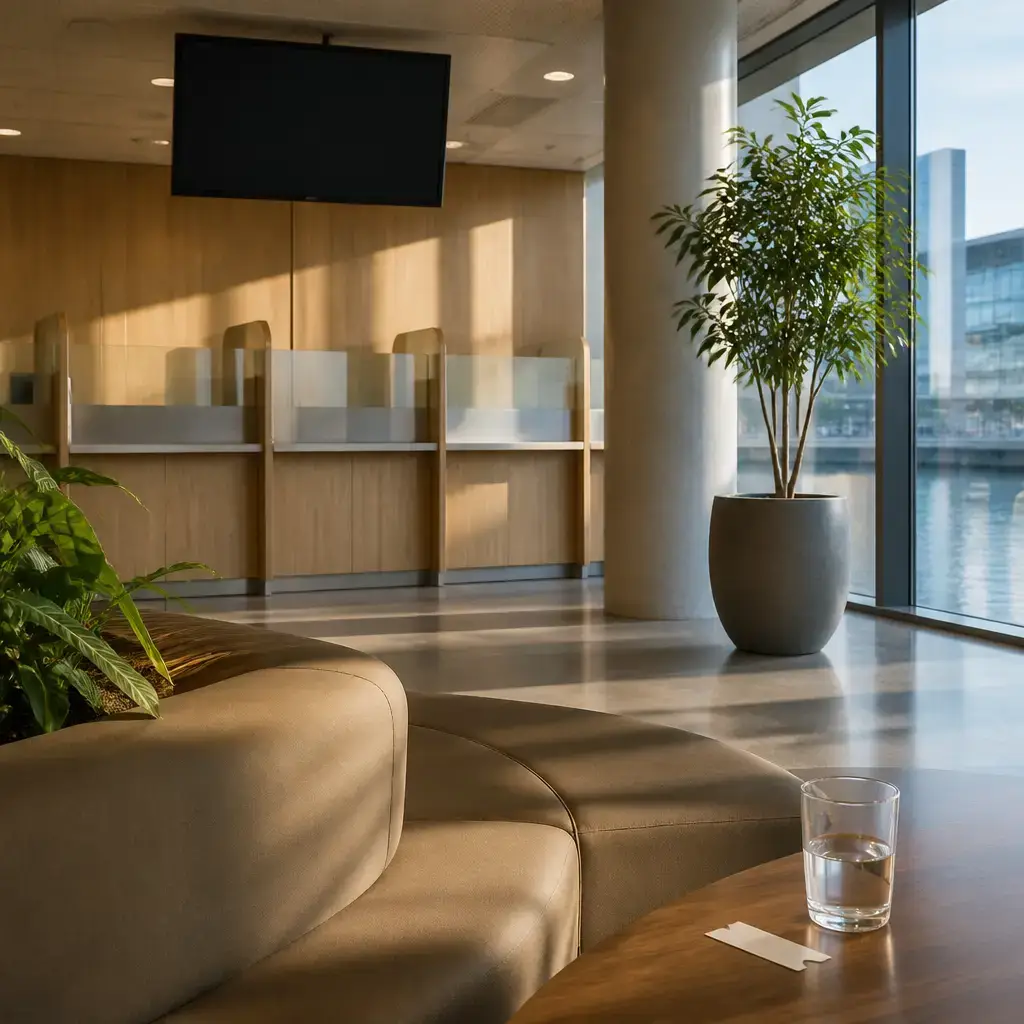
Use Waiting for your turn to practice Danish conversation, pronunciation, vocabulary, grammar, and quizzes.
Dialogue
Jeg venter stadig på, at det bliver min tur.
yai VEN-uh STEL-oh poh, ad deh BLEE-uh meen TOO-uh. I am still waiting for my turn.De bruger lang tid på at kalde på hver person i dag.
Deh BROO-uh lang TEED poh ad KAL-uh poh vair per-SOHN ee DAY. They are taking a long time to call each person today.Så bør jeg blive i nærheden.
Soh buhr yai BLEE-uh ee NAIR-hay-en. So I should stay nearby.De kalder måske på dig snart.
Deh KAL-uh MOS-guh poh die SNAHD. They may call you soon.Hvilken skranke skal jeg holde øje med?
HVEL-ken SKRANG-uh skal yai HOL-uh OY-uh meh? Which counter should I watch?Skærmen viser den rigtige skranke.
SKEHR-men VEE-suh den RIG-duh SKRANG-uh. The screen will show the right counter.Så holder jeg billetten i hånden.
Soh HOL-uh yai BEL-uh-den ee HAWN-en. Then I'll keep the ticket in my hand.Det gør det nemmere, når det bliver din tur.
Deh guhr deh NEM-uh-ruh, nohr deh BLEE-uh deen TOO-uh. That makes it easier when your turn comes.Sentence explanations
Jeg venter stadig på, at det bliver min tur.
I am still waiting for my turn.
- Jeg
- I
- venter
- wait
- stadig
- still
- på
- for
- det bliver
- it becomes
- min
- my
- tur
- turn
More detail
Jeg means “I” and is the subject form used for the speaker. It is the first-person singular pronoun; for example, Jeg kommer. means “I am coming.” venter is the present-tense form of vente, “to wait.” Danish present tense can describe an action that is ongoing now, so Jeg venter means “I am waiting,” not only “I wait.” stadig means “still.” It shows that the waiting continues at the relevant time. For example, Hun venter stadig. means “She is still waiting.” på is the preposition used with vente when specifying what is awaited. With a following clause, the reusable pattern is vente på, at ... — “wait for ... to happen.” Here, på belongs with venter, while the clause after it states the awaited event. det bliver contains det, “it,” and bliver, the present form of blive, “to become” or “to get.” In det bliver min tur, this combination expresses the event of it becoming the speaker’s turn. The present form describes the expected change in this situation; it is not a separate future-tense form. min means “my” before a singular common-gender noun. Danish possessives agree with the possessed noun: min is used with common-gender singular nouns, mit with neuter singular nouns, and mine with plural nouns. min itself does not mark the speaker’s gender. tur means “turn” here, in the sense of a person’s opportunity or place in an order. It is a common-gender noun, so the matching possessive is min: min tur, “my turn.” In another context, tur can also mean a trip or outing, but that is not its meaning in this sentence. Together, vente på, at det bliver min tur means “wait for it to become my turn.” With Jeg and stadig, the complete utterance is: “I am still waiting for my turn.”
De bruger lang tid på at kalde på hver person i dag.
They are taking a long time to call each person today.
- De
- they
- bruger
- take; spend
- lang
- long
- tid
- time
- kalde på
- call for
- hver
- each; every
- person
- person
- i dag
- today
More detail
De means “they” here: a third-person plural pronoun. The form itself does not identify the people by gender. Example: De kommer nu. — “They are coming now.” bruger is the present-tense form of bruge, “to use” or “to spend.” In this sentence it refers to spending time. Danish verbs do not change their form for different grammatical persons in the present tense: jeg bruger, de bruger. lang means “long” and describes tid here. Its useful comparison is lang — “long,” længere — “longer,” længst — “longest.” In lang tid, it describes an extended duration rather than physical length. tid means “time.” The construction bruge lang tid means “take a long time” or literally “spend a long time.” Example: Det bruger lang tid. — “It takes a long time.” kalde på is a verb construction meaning “to call for” or “to call to” someone. The verb is kalde; på is part of this construction in this meaning. After at, Danish uses the infinitive: at kalde på. Example: Hun kalder på lægen. — “She calls for the doctor.” hver means “each” or “every” in a distributive sense. It is followed here by the singular noun person, so hver person means “each person,” considering the people one by one. This differs from a plural expression meaning people collectively. person means “person.” A useful basic form pair is en person — “a person,” and personen — “the person.” In the fixed sentence, person follows hver, which already gives the phrase its “each person” meaning. i dag is the fixed adverbial phrase “today.” Example: Jeg arbejder i dag. — “I am working today.” Together, bruger lang tid på at kalde på expresses “take a long time to call.” The object of the calling is hver person, “each person,” and i dag places the action today. Danish present tense in bruger can express the current situation translated as English “are taking”; Danish does not need a separate progressive form here. The complete meaning is: “They are taking a long time to call each person today.”
Så bør jeg blive i nærheden.
So I should stay nearby.
- Så
- so
- bør
- should
- jeg
- I
- blive
- stay
- nærheden
- vicinity
More detail
Så means “so” here and links the utterance to the situation just mentioned. It can also mean “then” in other contexts, but “so” is the intended connective here. bør expresses what is advisable or expected: “should” or “ought to.” It is the present-tense form of burde; the modal is followed by an infinitive without at, as in bør blive (“should stay”). This expresses advice or expectation, not a definite future event. jeg is the first-person singular pronoun “I.” A useful contrast is du (“you,” singular) and vi (“we”); jeg identifies the speaker as the subject. blive is the infinitive “stay” in this sentence. Its meaning is determined by i nærheden: together they mean remaining nearby. blive can also mean “become” in other constructions, so the surrounding phrase matters. Example: Jeg bliver her. — “I’m staying here.” nærheden is the definite form of nærhed, meaning “vicinity” or “nearness.” The definite form refers to the relevant nearby area rather than introducing the noun as indefinite. In the full phrase i nærheden, it forms the location expression “nearby” or “in the vicinity.” Together, Så bør jeg blive i nærheden means “So I should stay nearby.” Så connects the advice to the situation, bør marks what the speaker considers advisable, jeg is the person who should act, and blive i nærheden describes remaining in a nearby location.
De kalder måske på dig snart.
They may call you soon.
- De
- they
- kalder … på
- call for
- dig
- you (object)
- måske
- perhaps; maybe
- snart
- soon
More detail
De is the subject pronoun intended here as “they.” In this sentence, the initial capital is also required because the word begins the sentence; the fixed translation establishes the “they” reading. In Danish, de is the third-person plural form, while han, hun, and den/det are singular third-person subject forms for different referent types. kalder means “call” here. It is the present-tense form of kalde: jeg kalder, de kalder. Danish uses kalde på when someone calls for or calls out to a person. Example: Hun kalder på lægen. — “She calls for the doctor.” på is part of that verb construction in this sentence. It should not be treated as an independently interchangeable translation of the whole English verb “call.” dig means “you” as the object of the verb. Danish dig is the second-person singular object form; jer is the plural object form. The corresponding subject forms are du and I. Example: Du kalder på mig. — “You call for me.” måske means “maybe” or “perhaps.” It expresses uncertainty about the proposition, so De kalder måske ... presents the calling as possible rather than certain. Example: Måske kommer hun senere. — “Maybe she will come later.” snart means “soon,” referring to a time near the present or near the relevant point in time. It is different from nu, “now”: Han kommer snart. — “He is coming soon.” Together, De kalder på dig means “They call for you,” måske makes that possibility uncertain, and snart places it in the near future. The complete utterance therefore means: “They may call you soon.”
Hvilken skranke skal jeg holde øje med?
Which counter should I watch?
- Hvilken
- which
- skranke
- counter
- skal jeg
- should I
- holde øje med
- watch; keep an eye on
More detail
Hvilken asks the listener to identify one choice from a set: “which one?” In Danish, hvilken is used with a singular common-gender noun, as in hvilken skranke. The corresponding forms are hvilket with a singular neuter noun and hvilke with plural nouns. Example: Hvilken bus tager du? — “Which bus are you taking?” skranke means a counter or service desk. Its definite singular form is skranken. Its indefinite plural is skranker, and its definite plural is skrankerne. Here it is singular and indefinite as the noun selected by hvilken. skal jeg combines the modal verb skal with the pronoun jeg (“I”). In this question, skal expresses what the speaker should do, not a simple future event: “should I …?” Danish questions commonly place the modal before the subject: Skal jeg vente? — “Should I wait?” Skal is the present form of skulle; after it, the following verb stays in the infinitive. holde øje med is a reusable idiom meaning to watch or keep an eye on something. The verb is holde (“to keep/hold”), and øje means “eye”; together with med (“with”), the construction has the idiomatic meaning “watch.” The verb changes with tense, for example holder øje med means “watch(es) / is watching,” while holdt øje med means “watched / kept an eye on.” Example: Jeg holder øje med døren. — “I am watching the door.” Together, Hvilken skranke asks the listener to identify one counter, skal jeg asks what the speaker should do, and holde øje med supplies the action. The complete utterance therefore means: “Which counter should I watch?”
Skærmen viser den rigtige skranke.
The screen will show the right counter.
- Skærmen
- the screen
- viser
- shows
- rigtige
- right; correct
- skranke
- counter
More detail
Skærmen is the definite singular form of skærm, “screen”: the ending -en marks a common-gender noun as definite. Example: Skærmen er stor. — “The screen is big.” viser is the present-tense form of vise, “to show.” Danish present tense can describe a future event when the time is clear from the situation; here, the fixed translation therefore gives “will show.” Example: Bussen viser næste stop. — “The bus shows the next stop.” rigtige comes from the adjective rigtig, “right” or “correct.” In den rigtige skranke, the ending -e is the form used with a definite noun phrase. Here it means the correct counter, not “right” as a direction. Example: Det er den rigtige vej. — “It is the right way.” skranke means “counter” or “service desk.” In den rigtige skranke, it is singular and appears in the unmarked form after the definite determiner den. The determiner makes the noun phrase definite, while rigtige is the adjective form required in this definite construction. Example: Jeg går til en skranke. — “I go to a counter.” Together, Skærmen viser den rigtige skranke means “The screen will show the right counter.” The subject is Skærmen; viser expresses what it shows, and den rigtige skranke identifies the counter as the correct one. In this context, the present-tense verb is understood as referring to the upcoming display information.
Så holder jeg billetten i hånden.
Then I'll keep the ticket in my hand.
- Så
- then
- holder
- keep; hold
- jeg
- I
- billetten
- the ticket
- i
- in
- hånden
- the hand
More detail
Så means “then” here. It places this action after the preceding situation and introduces the speaker’s next step. Example: Så går vi. — “Then we’ll go.” holder is the present-tense form of holde, “to hold” or “to keep.” Here it means “keep,” rather than simply “grasp.” Danish present tense can also refer to a planned or expected future action, so the fixed translation uses “I’ll keep.” A useful form chain is holde — holder — holdt (“to hold/keep” — “hold/keep” — “held/kept”). jeg is the first-person singular pronoun, “I.” It identifies the speaker as the subject of holder. Example: Jeg holder døren. — “I hold the door.” billetten means “the ticket.” Its base noun is billet, “ticket”; -en marks the singular definite form: en billet — “a ticket”; billetten — “the ticket.” It is the object of holder. i means “in.” Here it begins a location phrase with hånden. hånden means “the hand.” Its base noun is hånd, “hand”; -en marks the singular definite form: en hånd — “a hand”; hånden — “the hand.” In i hånden, it expresses the location where the ticket is kept. The phrase itself contains no possessive word; in this fixed utterance, the translation specifies the intended perspective as “in my hand.” Together, Så holder jeg billetten i hånden. means “Then I’ll keep the ticket in my hand.” The pattern is Så + verb + subject + object + location. The present-tense holder is rendered as “I’ll keep” because the utterance presents this as the speaker’s next intended action.
Det gør det nemmere, når det bliver din tur.
That makes it easier when your turn comes.
- Det
- that
- gør
- makes
- nemmere
- easier
- når
- when
- det bliver
- it becomes
- din tur
- your turn
More detail
Det is the subject pronoun meaning “that” here. It points to an already understood situation or action, rather than identifying a new noun in this sentence. Danish det is also used in many fixed or grammatical patterns, so its exact role must be read from the surrounding construction. gør is the present-tense form of gøre, “to do” or “to make.” In gør ... nemmere, it means “makes ... easier.” The pattern gør + something + adjective describes an effect: “makes something [adjective].” nemmere means “easier” and is the comparative form of nem, “easy.” The useful comparison chain is nem → nemmere (“easy” → “easier”). Example: Denne vej er nemmere. — “This way is easier.” når introduces a time clause and means “when.” It connects the main statement with the time at which something happens. Example: Ring, når du kommer hjem. — “Call when you get home.” det bliver contains present-tense bliver, the form of blive, “to become” or “to get.” In this sentence, det bliver din tur is the expression used for “your turn comes” or, more literally, “it becomes your turn.” The det here is the subject of that expression; it does not need to refer to a specific object. din tur means “your turn.” tur is a common-gender singular noun, and din is the singular possessive form used with it. In other contexts, tur can also mean a trip or outing, but here the surrounding expression clearly gives it the meaning “turn.” Example: Nu er det min tur. — “Now it is my turn.” Together, Det gør det nemmere means “That makes it easier.” The subordinate clause når det bliver din tur specifies the time: “when your turn comes.” The whole utterance therefore means “That makes it easier when your turn comes.”
Grammar Points
hver + entalsnavnord
hver person
vair per-SOHNeach person
Hver means “each” or “every” and is used before a singular noun, as in hver person.
nem → nemmere
nemmere
NEM-uh-ruheasier
The adjective nem changes to nemmere in the comparative form, meaning “easier.”
Danish Vocabulary
Quiz
Word Order
Arrange the words in the correct order.
So I should stay nearby.
Show Answer
Så bør jeg blive i nærheden.They may call you soon.
Show Answer
De kalder måske på dig snart.The screen will show the right counter.
Show Answer
Skærmen viser den rigtige skranke.Spelling
Tap the letters to spell the word.
wait
Show Answer
venterbecome; get
Show Answer
bliveruse; take
Show Answer
brugerstill