10 minutes free every day
Continue audio lessons in the app
Word explanations appear automatically in sync with the audio.
No login required · synced translations · playback with the screen locked
Choose your learning language and open this lesson in the app.

About This Lesson
Use Checking meeting room equipment to practice Danish conversation, pronunciation, vocabulary, grammar, and quizzes.
Dialogue
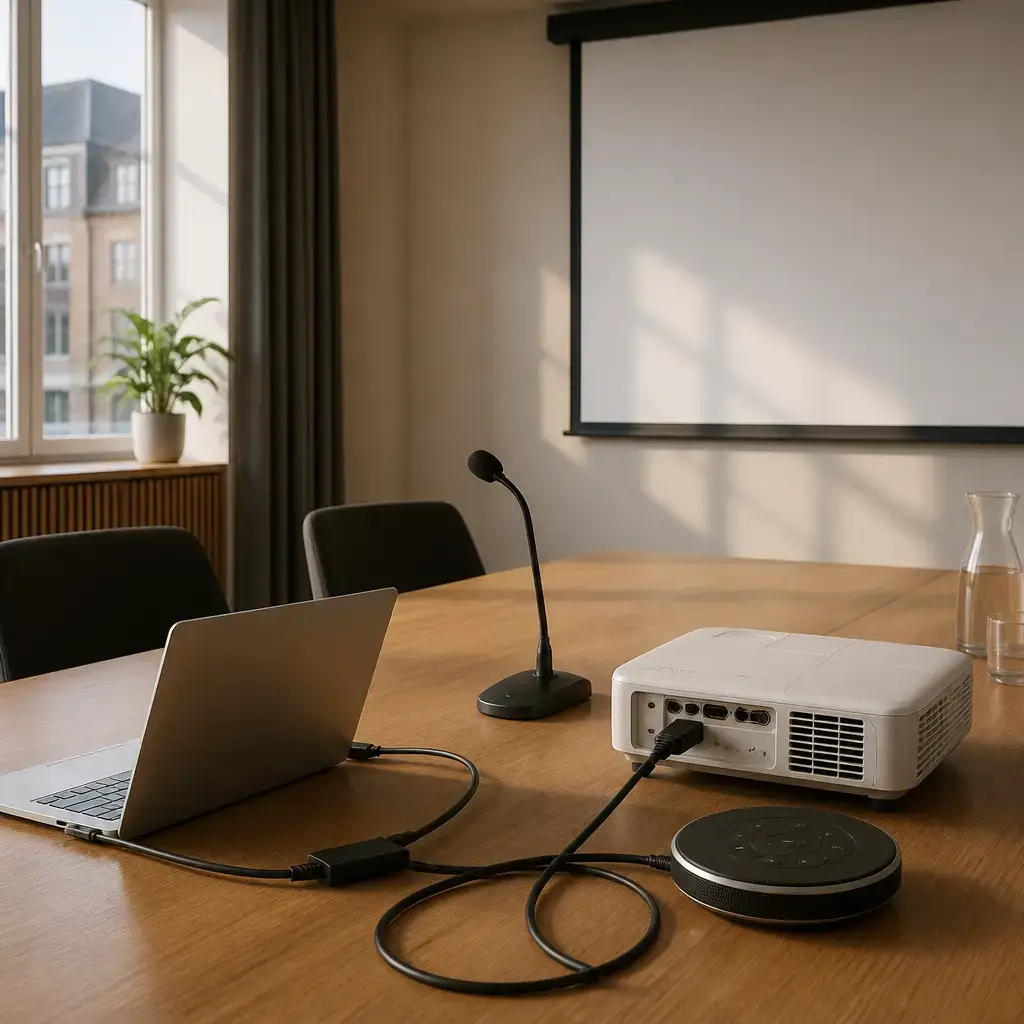
Vi bør tjekke udstyret i mødelokalet.
vee buhr CHEH-guh OOTH-styoo-uhd ee MUH-thuh-loh-KAY-luhd We should check the meeting room equipment.Mødet begynder snart.
MUH-thuh beh-GUN-uh SNAHRD The meeting starts soon.Lad os gøre det nu.
LAH ohs GUR-uh deh NOO Let's do it now.Er projektoren tilsluttet den bærbare computer?
air proh-YEK-toh-uhn tuh-SLOO-thed den BAIR-bah-reh kom-PYOO-tuh Is the projector connected to the laptop?Det er den, men dette kabel sidder lidt løst.
deh air den, men DEH-duh KAY-bul SEH-duh leed LUHSD It is, but this cable feels a little loose.Lad os teste mikrofonen, før folk kommer.
LAH ohs TES-duh mee-kroh-FOH-nuhn, fuhr FOHLG KOH-muh Let's test the microphone before people arrive.Den virker, men lydstyrken er lav.
den VAIR-guh, men LOOTH-styur-kuhn air LAY-oo It works, but the volume is low.Jeg skruer lidt op for den.
yai SKROO-uh leed OHB fohr den I'll turn it up a little.Det lyder bedre. Rummet er klart.
deh LOO-uh BEH-druh. RUHM-uhd air KLAR That sounds better. The room is ready.Sentence explanations
Vi bør tjekke udstyret i mødelokalet.
We should check the meeting room equipment.
- Vi bør
- we should
- tjekke
- check
- udstyret
- the equipment
- mødelokalet
- the meeting room
More detail
Vi bør expresses “we should”: vi is the first-person plural pronoun “we”, and bør is the present form of the modal verb burde. Bør does not change for person or number. A modal is followed by an infinitive: Vi bør tjekke = “We should check”. tjekke means “to check”. It is the infinitive form, used after bør; Danish infinitives commonly appear with at when not governed by a modal, as in at tjekke (“to check”), but the modal construction omits at. Example: Vi bør læse manualen. — “We should read the manual.” udstyret means “the equipment”. Its base form is udstyr, and -et marks the definite form here. Udstyr is generally treated as a mass or uncountable noun, so this form does not assert a numeric count. Example: Udstyret virker. — “The equipment works.” mødelokalet means “the meeting room”. It is built from møde (“meeting”) and lokale (“room”), with the definite ending -t on the compound: et mødelokale = “a meeting room”, mødelokalet = “the meeting room”. The preposition i before it gives the location: i mødelokalet = “in the meeting room”. Together, Vi bør tjekke udstyret i mødelokalet. means “We should check the meeting room equipment.” More literally in structure, it says “We should check the equipment in the meeting room.” The following context says that the meeting starts soon, but the sentence itself expresses the recommendation to check the equipment and does not state that the check has happened.
Mødet begynder snart.
The meeting starts soon.
- Mødet
- the meeting
- begynder
- starts; begins
- snart
- soon
More detail
Mødet means “the meeting” here. It is the singular definite form of et møde (“a meeting”). The ending -et marks singular definiteness for this noun; the noun’s neuter gender is shown by the indefinite article et, not by treating -et itself as a general gender marker. Danish commonly forms definiteness by adding an ending to the noun, rather than using a separate word equivalent to “the.” begynder means “starts” or “begins” here. Its base form is begynde (“to begin”); begynder is the present-tense form. Danish present-tense verbs generally do not change according to the subject’s person or number, so the same form can occur with “I,” “you,” or “they” when the meaning and context require it. Example: Mødet begynder klokken ni. — “The meeting starts at nine.” snart is the adverb “soon.” It places the beginning in the near future relative to the relevant moment. It does not itself mark a precise time. Example: Vi kommer snart. — “We are coming soon.” Together, Mødet begynder snart. means “The meeting starts soon.” The definite noun identifies the meeting as a particular meeting, begynder states its beginning, and snart says that this beginning is expected in the near future.
Lad os gøre det nu.
Let's do it now.
- Lad os
- let's
- gøre
- do
- det
- it
- nu
- now
More detail
Lad os is a reusable Danish way to make a suggestion: “let’s …”. Lad is the imperative of lade (“let”); os is the first-person plural object pronoun, “us”. The construction is followed by an infinitive: Lad os + infinitive. Example: Lad os vente. — “Let’s wait.” gøre means “do” here. It is the infinitive form; useful forms include gøre (infinitive), gør (present), gjorde (past), and gjort (past participle). After Lad os, Danish uses the infinitive, so Lad os gøre ... means “Let’s do ...”. det is a third-person singular neuter pronoun meaning “it” here. Its specific referent is not named in the sentence; it refers to the activity or thing understood from the situation. Example: Vi gør det. — “We do it.” nu is the adverb “now”. It places the proposed action at the present time. Example: Gør det nu. — “Do it now.” Together, Lad os gøre det nu. has the pattern Lad os + infinitive + object + time adverb: “Let’s do it now.” The sentence proposes that the speaker and the listener carry out the understood action at this time.
Er projektoren tilsluttet den bærbare computer?
Is the projector connected to the laptop?
- Er
- is
- projektoren
- the projector
- tilsluttet
- connected
- den
- the
- bærbare
- portable
- computer
- computer
More detail
Er is the present-tense form of være (“to be”). In this yes/no question, it comes before the subject: Er projektoren ...? A statement would normally place the subject first, as in Projektoren er ... (“The projector is ...”). projektoren means “the projector” here. Its base form is projektor; the ending -en marks definite singular for this noun. Danish definite marking is often attached to the noun rather than expressed by a separate word. tilsluttet means “connected” here. It is the participle of tilslutte (“to connect”) and describes the projector’s resulting state. A useful pattern is være tilsluttet (“be connected”); for example, Telefonen er tilsluttet means “The phone is connected.” den is the definite article used with the common-gender singular noun phrase den bærbare computer. It is not a standalone translation of every English “the”; its form is selected by the noun phrase’s grammatical features. bærbare means “portable” here and modifies computer. Its base form is bærbar; the form bærbare is used before a definite noun phrase such as den bærbare computer. For example, den bærbare skærm means “the portable screen.” computer means “computer.” In den bærbare computer, it is the head noun, while bærbare describes its type. Together, den bærbare computer means “the laptop”; the fixed translation identifies this intended sense of the phrase. The complete pattern is Er + subject + tilsluttet + den + adjective + noun? The subject is projektoren, and tilsluttet den bærbare computer describes its connection to the laptop. Thus the utterance asks, “Is the projector connected to the laptop?”
Det er den, men dette kabel sidder lidt løst.
It is, but this cable feels a little loose.
- Det er den
- It is
- men
- but
- dette
- this
- kabel
- cable
- sidder
- sits; is positioned
- lidt
- a little
- løst
- loose
More detail
Det er den is the affirmative first clause: “It is.” In this context it answers the preceding yes/no question, with the property being understood rather than repeated. det and den are Danish pronoun forms; this short response should be learned as a reusable confirmation pattern, not as a claim that every language expresses “yes” in the same way. men means “but” and links the confirmation to a contrasting observation. It does not belong to the meaning of the preceding or following word by itself. dette means “this” and is the neuter singular form used with kabel. Danish has denne for common-gender singular nouns and dette for neuter singular nouns. Example: dette hus — “this house.” kabel means “cable.” Its indefinite form is et kabel; the demonstrative phrase dette kabel therefore means “this cable.” The noun is the thing being described, not a new participant asserted by the earlier clause. sidder is the present form of sidde, “to sit” or “to be positioned.” Danish verbs do not change form for person or number in the present tense: jeg sidder and de sidder both use sidder. With a subject such as a cable, sidde can describe how it is positioned or fits. Example: Stikket sidder fast. — “The plug is firmly in place.” lidt means “a little” and reduces the degree of the following description. It marks a small amount or degree; it does not by itself assert a numerical count. løst is the neuter singular form of the adjective løs, “loose.” In sidder lidt løst, it describes the cable’s fit or position: it is somewhat loose. The related forms are løs (common gender), løst (neuter singular), and løse (plural or definite contexts). Example: Låget sidder løst. — “The lid is loose.” Together, Det er den, men dette kabel sidder lidt løst. means “It is, but this cable feels a little loose.” The first clause confirms the relevant point from the question; men introduces a qualification, and dette kabel sidder lidt løst describes this cable as feeling somewhat loose in its position or fit.
Lad os teste mikrofonen, før folk kommer.
Let's test the microphone before people arrive.
- Lad os
- let's
- teste
- test
- mikrofonen
- the microphone
- før
- before
- folk
- people
- kommer
- come; arrive
More detail
Lad os is the standard Danish way to suggest an action jointly: “let’s …”. Lad is the imperative of lade (“let; allow”), and os means “us”. Together they form a fixed suggestion pattern, followed by the action: Lad os + infinitive. teste means “to test”. It is the infinitive after Lad os; the infinitive is also the form found after many Danish modal or auxiliary-like constructions. Example: Lad os prøve igen. — “Let’s try again.” mikrofonen means “the microphone”. The noun is mikrofon, and the ending -en marks the definite singular form: en mikrofon — “a microphone”; mikrofonen — “the microphone”. The ending belongs to the noun, not to teste. før means “before” and introduces the event that must happen later than the testing in the sentence’s time order. It can introduce a full clause, as here: før + clause. folk means “people”. It is a noun referring to people as a group. In this sentence it appears without an article because the intended meaning is people generally, not a separately specified group. Danish folk has the same form in singular and plural uses in many contexts, so the form alone does not express a numeric count. kommer means “come” or, in this context, “arrive”. Its base form is komme; kommer is the present-tense form. Danish present tense can refer to a future event when the time is clear from context, so før folk kommer means “before people arrive,” not necessarily “before people are arriving” at this moment. Example: Vi går, før toget kommer. — “We’ll leave before the train arrives.” The sentence assembles as Lad os teste (“let’s test”) + mikrofonen (“the microphone”) + før folk kommer (“before people arrive”). The complete meaning is: “Let’s test the microphone before people arrive.”
Den virker, men lydstyrken er lav.
It works, but the volume is low.
- Den
- it
- virker
- works
- men
- but
- lydstyrken
- the volume
- lav
- low
More detail
Den is the Danish singular pronoun used here for “it.” In the supplied context, it refers to the microphone mentioned earlier. Danish uses den with singular common-gender nouns; the corresponding neuter form is det. virker comes from virke, “to work” or “to function.” It is present tense, and the same form is used with different singular and plural subjects: jeg virker, den virker, and de virker can all mean “I work,” “it works,” and “they work,” respectively, according to the subject. men means “but” and connects two contrasting statements. The pattern X, men Y is reusable for saying that Y contrasts with X. lydstyrken means “the volume.” It is the definite singular form of lydstyrke (“volume”): en lydstyrke means “a volume level,” while lydstyrken means “the volume.” The definite ending is part of the noun form, not a separate word. lav means “low” here. It is the adjective lav (“low”), used with the singular common-gender noun lydstyrken. With a singular neuter noun, the form is lavt; for example, et lavt niveau means “a low level.” Together, Den virker says “It works.” men lydstyrken er lav adds the contrasting fact “but the volume is low”: men introduces the contrast, lydstyrken identifies the volume as the subject, and er lav describes its state. The complete utterance therefore means: “It works, but the volume is low.”
Jeg skruer lidt op for den.
I'll turn it up a little.
- Jeg
- I
- skruer … op … for
- turn up
- lidt
- a little
- den
- it
More detail
Jeg means “I” and is the first-person singular subject pronoun. It identifies the person carrying out the action. Danish subject pronouns include jeg (“I”), du (“you,” singular), and vi (“we”). skruer op for is the reusable Danish construction “turn up” or “increase” something, especially a setting such as volume. skruer is the present-tense form of skrue, “to turn/screw”; op contributes the upward or increased setting, and for introduces what is adjusted. In this sentence, the three words work together, so do not translate skruer alone as the complete meaning “turn up.” For example: Jeg skruer op for musikken. — “I turn up the music.” lidt means “a little” and specifies a small degree of increase. It can modify many amounts or changes, as in Vent lidt. — “Wait a little.” den is a standalone object pronoun meaning “it” here. With the supplied context and translation, it refers to the volume, lydstyrken, which is a common-gender singular noun in Danish. Danish uses den with a common-gender singular referent and det with a neuter singular referent; the pronoun’s form follows the grammatical gender of its referent, not whether the referent is animate. In this sentence, den is the object of for in skruer op for den. Together, Jeg skruer lidt op for den. means “I’ll turn it up a little.” The structure is Jeg (“I”) + skruer op for (“turn up”) + lidt (“a little”) + den (“it”). The Danish verb is in the present tense; in this fixed utterance, the translation presents the action as the speaker’s intended immediate action.
Det lyder bedre. Rummet er klart.
That sounds better. The room is ready.
- lyder
- sounds
- bedre
- better
- Rummet
- the room
- klart
- ready
More detail
lyder is the present-tense form of lyde (“to sound”). With det, it means “it sounds” here; det is a neutral singular subject, and lyder is the third-person singular present form. A reusable example is Det lyder godt. — “That sounds good.” bedre is the comparative form of god (“good”): god → bedre (“good” → “better”). In lyder bedre, it compares this impression with an earlier or other impression, without stating exactly what the comparison is against. Det lyder bedre. means “That sounds better.” Rummet means “the room.” It is the definite singular form of the neuter noun et rum: et rum → rummet. The ending -et marks the definite form for this noun; it is not a separate word meaning “the.” klart means “ready” here. It is the neuter singular form of the adjective klar, agreeing with the neuter singular subject rummet. The same adjective can have other context-dependent meanings, including “clear,” but the fixed translation supports “ready” in this sentence. Compare Rummet er klart. — “The room is ready.” The first sentence combines Det (“it/that”), lyder (“sounds”), and bedre (“better”) to say that something sounds better. The second combines Rummet (“the room”), er (“is”), and klart (“ready”) to say that the room is ready. Together, the utterance means: “That sounds better. The room is ready.”
Grammar Points
før + subjekt + verb
Tjek udstyret før mødet begynder.
CHEK OOTH-styoo-uhd fuhr MUH-thuh beh-GUN-uhCheck the equipment before the meeting begins.
After før, Danish places the subject before the verb: mødet begynder. This is also common in subordinate clauses.
skrue op for + noun
Skru lidt op for lydstyrken.
SKROO leed OHB fohr LOOTH-styur-kuhnTurn the volume up a little.
The fixed expression is skrue op for + noun. The preposition for is part of the expression.
Danish Vocabulary
- Gender
- neuter
- Gender
- neuter
- Gender
- neuter
- Gender
- common
- Gender
- neuter
Quiz
Word Order
Arrange the words in the correct order.
We should check the meeting room equipment.
Show Answer
Vi bør tjekke udstyret i mødelokalet.The meeting starts soon.
Show Answer
Mødet begynder snart.Let's do it now.
Show Answer
Lad os gøre det nu.Spelling
Tap the letters to spell the word.
projector
Show Answer
projektorento do
Show Answer
gøresoon
Show Answer
snartto connect