10 minutes free every day
Continue audio lessons in the app
Word explanations appear automatically in sync with the audio.
No login required · synced translations · playback with the screen locked
Choose your learning language and open this lesson in the app.

About This Lesson
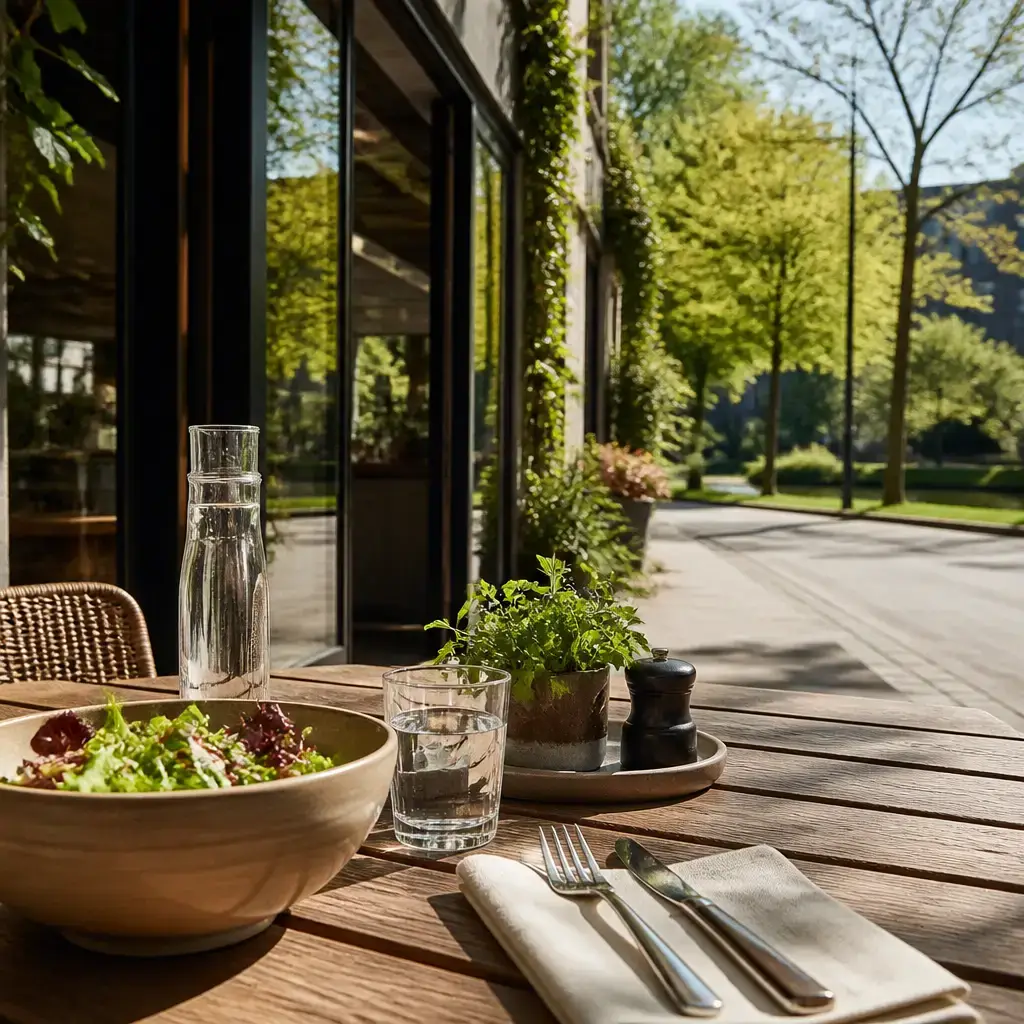
Use Choosing a nearby restaurant for lunch to practice Danish conversation, pronunciation, vocabulary, grammar, and quizzes.
Dialogue
Hvilket sted skal vi vælge til frokost?
VIL-guh stayth skal vee VEL-uh till FROH-kost? Which place should we choose for lunch?Lad os vælge et sted, der er tæt på og nemt at komme til.
lah ohss VEL-uh et stayth, dair air TATE paw oh nemt uh KOM-uh till. Let's pick somewhere close and convenient.Stedet på denne gade har en enkel frokostmenu.
STAY-thuhd paw DEN-uh GAY-thuh har en ENG-gul FROH-kost-muh-NOO. The place on this street has a simple lunch menu.Caféen nær parken er måske mere stille.
KAH-FAY-un nair PAR-kun air MOS-kuh MAY-uh STEL-uh. The cafe near the park might be quieter.Men den ligger længere væk.
men den LEG-uh LANG-uh vayk. But it is farther away.Skal vi reservere bord på stedet i nærheden?
skal vee ray-ser-VAIR-uh bohr paw STAY-thuhd ee NAIR-hay-un? Do we need a reservation for the nearby place?Det tror jeg ikke. På dette tidspunkt kan vi som regel finde et bord.
deh TROHR yai EG-uh. Paw DEN-uh TID-spongt kan vee som RAY-gul FEN-uh et bohr. Probably not. Around this time, we can usually find a table.Så lad os vælge stedet på denne gade.
soh lah ohss VEL-uh STAY-thuhd paw DEN-uh GAY-thuh. Then let's choose the place on this street.Så har vi mere tid til at spise.
soh har vee MAY-uh teed till uh SPEE-suh. That leaves us more time to eat.Sentence explanations
Hvilket sted skal vi vælge til frokost?
Which place should we choose for lunch?
- Hvilket
- which
- sted
- place
- skal vi
- should we
- vælge
- choose
- frokost
- lunch
More detail
Hvilket means “which” here. It is the neuter singular form of hvilken, agreeing with the neuter noun sted (et sted). Compare hvilken with common-gender singular nouns and hvilke with plural nouns; the choice depends on the noun’s grammatical form, not on the thing being considered. sted means “place” or “location.” Its base form is sted; the plural is steder. In this sentence it is the place being selected. Example: Vi mødes på et sted. — “We are meeting at a place.” skal vi combines the modal verb skal with the subject vi, “we.” In this question, skal expresses the proposed or expected action, giving the intended sense “should.” skal can express other meanings in other contexts, such as obligation or a future arrangement, so its precise meaning comes from the sentence. The question order places the modal before the subject: Skal vi vælge ...? means “Should we choose ...?” vælge is the infinitive “to choose.” After the modal skal, Danish uses the infinitive without at: Vi skal vælge — “We should choose.” The form vælge itself does not mark the subject; vi identifies the subject here. A useful contrast is vælger, used for a present-tense statement such as Vi vælger et sted — “We choose a place.” frokost means “lunch.” In til frokost, til introduces the meal occasion, so the phrase means “for lunch” or “at lunchtime.” Danish commonly uses the noun without an article in this kind of meal expression. Example: Vi spiser frokost klokken tolv. — “We eat lunch at twelve.” Together, Hvilket sted asks which location is intended, skal vi vælge asks what the group should choose, and til frokost specifies the purpose or occasion. The whole utterance therefore means: “Which place should we choose for lunch?”
Lad os vælge et sted, der er tæt på og nemt at komme til.
Let's pick somewhere close and convenient.
- Lad os
- let’s
- vælge
- choose
- sted
- place
- der er
- that is
- tæt på
- close by
- nemt
- easy
- komme til
- get to
More detail
Lad os is the Danish way to propose a shared action: literally a form meaning “let us,” followed by an infinitive. It is used for “let’s …,” as in Lad os spise. — “Let’s eat.” vælge is the infinitive “to choose.” The same form follows Lad os; it does not carry a personal ending here. In the earlier question, skal vi vælge uses the same verb after skal vi to ask what the group should choose. sted means “place” or “spot.” In the utterance it appears after the indefinite article et, giving et sted, “a place.” Danish has different indefinite articles, including en and et, so the article is part of choosing the noun phrase; it does not by itself assert a specific numerical count. The plural is steder (“places”). der er introduces a relative description of the place: der is “that/which” here, and er is the present form of være, “to be.” In et sted, der er ..., the clause after the comma describes the place. tæt på means “close by” or “nearby.” tæt is the adjective “close/tight,” and på completes this location expression. For example, Caféen er tæt på. means “The café is nearby.” nemt means “easy” here, specifically in the expression nemt at komme til, “easy to get to.” nem is the base form; nemt is its neuter form. In this construction, nemt describes the ease of the infinitive action at komme til, rather than agreeing with sted as an ordinary noun modifier. Compare the reusable pattern Det er nemt at forstå. — “It is easy to understand.” komme til is the infinitive expression “get to” or “reach.” komme is the infinitive of “come,” and til marks the destination in this expression. Det er nemt at komme til. means “It is easy to get to.” The at before komme introduces an infinitive clause; it is not part of the selected komme til quote. Putting the parts together, et sted, der er tæt på og nemt at komme til means “a place that is nearby and easy to get to.” Lad os vælge makes this a joint proposal: “Let’s choose a place that is nearby and easy to get to.” Thus the fixed utterance naturally means “Let’s pick somewhere close and convenient.”
Stedet på denne gade har en enkel frokostmenu.
The place on this street has a simple lunch menu.
- Stedet
- the place
- på
- on
- denne
- this
- gade
- street
- har
- has
- enkel
- simple
- frokostmenu
- lunch menu
More detail
Stedet means “the place” here. It is the definite singular form of sted (“place”): et sted is “a place,” while stedet is “the place.” Danish commonly marks definiteness at the end of the noun. på means “on” in this location phrase. på can also be used for some other locations and surfaces, so learn the preposition together with useful phrases such as på gaden (“on the street”). denne means “this” and specifies one nearby or contextually identified singular noun. In denne gade, it agrees with the common-gender noun gade; the form is different from dette, used with a neuter singular noun. Example: denne café — “this café.” gade means “street.” Its indefinite form is en gade, and its definite form is gaden (“the street”). Here, gade follows denne in the phrase denne gade, meaning “this street.” har means “has” here. It is the present-tense form of have (“to have”) and does not change for the subject’s person or number: jeg har (“I have”), de har (“they have”). Example: Caféen har en terrasse. — “The café has a terrace.” enkel means “simple” here, describing the lunch menu. It is the common-gender singular form of the adjective; compare neuter singular enkelt in et enkelt valg (“a simple choice”). This adjective is not the same as nem (“easy” or “convenient”), which appeared in the preceding sentence. frokostmenu means “lunch menu.” It is a compound noun made from frokost (“lunch”) and menu (“menu”), written as one word. Its common-gender indefinite form is en frokostmenu; the definite form is frokostmenuen (“the lunch menu”). Together, på denne gade means “on this street.” The subject Stedet på denne gade is “the place on this street”; har adds the meaning “has,” and en enkel frokostmenu is “a simple lunch menu.” The complete utterance therefore means: “The place on this street has a simple lunch menu.”
Caféen nær parken er måske mere stille.
The cafe near the park might be quieter.
- Caféen
- the cafe
- nær
- near
- parken
- the park
- er
- is
- måske
- perhaps
- mere stille
- quieter
More detail
Caféen means “the cafe” here. The ending -en marks the definite singular form of the common-gender noun café: en café is “a cafe,” while caféen is “the cafe.” The definite form identifies a particular cafe, without saying how many cafes exist. nær means “near” or “close to.” It introduces a location relation and can be followed by a noun phrase: Caféen er nær parken. — “The cafe is near the park.” parken means “the park.” It is the definite singular form of park: en park → parken. The noun is definite in this sentence because the intended meaning refers to a particular park. er is the present-tense form of være, “to be.” In Danish, er is used with all persons and with both singular and plural subjects; the form does not change for the subject’s gender or number. For example, De er her. means “They are here” or, in a formal context, “You are here.” måske means “perhaps” or “might.” It expresses uncertainty about the statement. In this sentence it applies to the whole claim that the cafe is quieter, rather than naming a separate property of the cafe. mere stille expresses a comparison: “quieter” or literally “more quiet.” stille is the base adjective “quiet,” and mere marks the comparative form used here. Danish can also use the suffixed comparative stillere in suitable contexts, but the source specifically uses mere stille; it should not be silently replaced. Example: Dette rum er mere stille. — “This room is quieter.” The meaningful structure is Caféen nær parken (“the cafe near the park”) + er (“is”) + måske (“perhaps/might”) + mere stille (“quieter”). Together, the utterance means: “The cafe near the park might be quieter.”
Men den ligger længere væk.
But it is farther away.
- Men
- but
- den
- it
- ligger
- is located
- længere
- farther
- væk
- away
More detail
Men means “but” and links this sentence contrastively to the preceding idea. It is a coordinating conjunction and does not change form. den means “it” here and refers to the café mentioned in the supplied context. In Danish, den is used for a singular common-gender noun, while det is used with a singular neuter noun. The pronoun’s grammatical form reflects the noun’s gender; it is not a marker of distance. ligger is the present-tense form of ligge, “to lie” or “to be located.” Danish present-tense verbs generally do not change according to the subject’s person or number, so ligger can be used with different subjects. With a place or object, it commonly describes location rather than physical lying. længere is the comparative form related to lang, “long.” In this context, the comparison concerns distance, so it means “farther.” The useful chain is lang → længere → længst (“long” → “longer/farther” → “longest/farthest”), although the exact interpretation depends on what is being compared. væk means “away.” Together, længere væk is a reusable expression meaning “farther away.” Væk supplies the idea of being at a distance, while længere makes that distance greater than the comparison point. Together, den ligger længere væk means “it is farther away,” literally describing where the café is located. Men sets this against the preceding possibility that the café might be quieter, giving the complete utterance: “But it is farther away.”
Skal vi reservere bord på stedet i nærheden?
Do we need a reservation for the nearby place?
- Skal vi
- shall we…? / do we need to…?
- reservere
- reserve
- bord
- table
- på stedet
- at the place
- i nærheden
- nearby
More detail
Skal vi begins a yes/no question. skal is the present form of skulle; with vi and a following infinitive, it can express “shall we…?” or a need/requirement, depending on context. Here the intended question is whether making a reservation is necessary. In a statement, the same pattern is vi skal reservere (“we shall/need to reserve”); the question places skal before vi. reservere means “to reserve” or “to book.” It is the infinitive after the modal skal, so it does not carry a separate person ending here. Example: Vi skal reservere et bord. — “We need to reserve a table.” bord means “table.” The form is singular and indefinite in this expression, but Danish commonly uses the noun without an article in the fixed-like activity reservere bord, meaning “book a table.” With an explicit indefinite article, et bord means “a table”; et also shows that bord is a neuter noun. på stedet means “at the place” or “on site.” sted is the noun “place”; stedet is its definite singular form, “the place,” and på here introduces the location. The phrase refers to booking at the place being discussed, rather than naming a separate type of reservation. i nærheden means “nearby” or “in the vicinity.” i means “in,” while nærheden is the definite form of nærhed, “proximity.” This is a location phrase and modifies stedet: stedet i nærheden means “the place nearby.” Together, Skal vi + reservere asks whether the participants should or need to make a reservation; bord specifies a table, and på stedet i nærheden identifies the nearby place where this would be done. Thus the utterance means: “Do we need a reservation for the nearby place?”
Det tror jeg ikke. På dette tidspunkt kan vi som regel finde et bord.
Probably not. Around this time, we can usually find a table.
- Det tror jeg ikke
- I don’t think so
- tidspunkt
- time; moment
- kan vi
- we can
- som regel
- usually
- finde
- find
- bord
- table
More detail
Det tror jeg ikke means “I don’t think so” here. det is a pronoun referring to the proposition being rejected; the supplied translation supports that meaning, without identifying a specific noun as its referent. tror is the present form of tro, “to think/believe.” In this construction, jeg is the subject of tror, while ikke negates the thinking. Danish commonly places the negated opinion in this compact pattern: Det tror jeg ikke. tidspunkt means “time” or “moment,” especially a particular point in time. Its plural is tidspunkter. In På dette tidspunkt, the preposition på and demonstrative dette make the meaning “around/at this time”; dette agrees with the neuter noun tidspunkt. Example: På hvilket tidspunkt kommer du? — “At what time are you coming?” kan vi combines kan, the present form of kunne (“can, be able to”), with vi, “we.” The order kan vi occurs because the clause is introduced by the time phrase På dette tidspunkt; Danish main clauses generally place the finite verb before the subject after such an initial element. kan does not itself mark past time here. Example: I morgen kan vi spise ude. — “Tomorrow we can eat out.” som regel is a fixed adverbial construction meaning “usually” or “as a rule.” It describes what normally happens, not an absolute guarantee. Example: Hun kommer som regel tidligt. — “She usually arrives early.” finde means “find.” It is the infinitive after the modal kan: kan finde means “can find.” The infinitive form is also used after other modal verbs, for example vil finde (“will/want to find,” depending on context). Example: Vi kan finde en løsning. — “We can find a solution.” bord means “table.” It is a neuter noun: et bord is “a table,” and the definite form is bordet, “the table.” In this utterance, et bord is the object of finde; the indefinite article introduces a table without asserting a numerical count. Together, På dette tidspunkt sets the relevant time, kan vi expresses the group’s ability or possibility, som regel adds the idea of what normally happens, and finde et bord means “find a table.” The first sentence rejects the idea under discussion with “I don’t think so.” The whole utterance therefore means: “I don’t think so. Around this time, we can usually find a table.”
Så lad os vælge stedet på denne gade.
Then let's choose the place on this street.
- Så
- then
- lad os
- let’s
- vælge
- choose
- stedet
- the place
- på
- on
- denne
- this
- gade
- street
More detail
Så means “then” here and links this decision to what was just discussed. It can also mean “so” in other contexts, but in this utterance it marks the result or next step. lad os is a reusable Danish way to suggest an action: “let’s …”. lad is the imperative of lade (“let”/“allow”), and os means “us”. The lexical verb for the suggested action follows: lad os vente means “let’s wait.” This construction does not itself identify a number of people beyond the speaker and the group included by “us”. vælge means “to choose” and is the infinitive used after lad os. Its present-tense form is vælger: Vi vælger et sted means “We choose a place.” The infinitive is also used after other Danish constructions that require an infinitive. stedet means “the place” in this utterance. The base noun is sted, “place”; stedet is its definite singular form, formed with the ending -et. The ending belongs to the noun, not to an adjective. For example, et sted is “a place,” while stedet is “the place.” på means “on” here and introduces the location phrase. Danish uses på with expressions such as på en gade (“on a street”) and på denne gade (“on this street”). Its meaning can vary with the following expression, so it is the surrounding location phrase that establishes the meaning here. denne means “this” and identifies one nearby or contextually relevant singular common-gender noun. In denne gade, it agrees with gade, which is a common-gender noun. The corresponding neuter form is dette, as in the example dette sted (“this place”); plural forms use disse, as in disse gader (“these streets”). gade means “street.” It is a common-gender noun: en gade means “a street,” and gaden means “the street.” In the fixed utterance it follows denne, so the phrase is denne gade, “this street.” Together, lad os vælge forms the suggestion “let’s choose.” stedet supplies the object, “the place,” and på denne gade specifies which location is meant: “on this street.” With Så at the beginning, the complete utterance means: “Then let’s choose the place on this street.”
Så har vi mere tid til at spise.
That leaves us more time to eat.
- Så
- then; so
- har vi
- we have
- mere
- more
- tid
- time
- til at
- to, introducing an infinitive
- spise
- eat
More detail
Så means “then” here, linking this result to what has just been decided. Danish så can also mean “so” in other contexts; the intended sense here is the sequencing/result sense. har vi consists of har, the present-tense form of have, and vi, “we.” Because Så is placed first, Danish main-clause word order puts the finite verb before the subject: Så har vi ... = “Then we have ...”. With the subject first, the corresponding order is Vi har .... mere means “more.” It is the comparative form used with tid here: mere tid = “more time.” The related form meget means “much” or “very,” while mere makes a comparison or indicates an increased amount. tid means “time.” In this sentence it is an uncounted amount of available time, so the phrase is mere tid, not a counted number of time units. Example: Jeg har tid. — “I have time.” til at introduces an infinitive phrase expressing what the time is available for. In the pattern tid til at + infinitive, it means “time to ...”. spise is the infinitive “to eat.” Danish uses the infinitive after at: at spise = “to eat.” Example: Vi har tid til at spise. — “We have time to eat.” Together, Så har vi mere tid til at spise means literally “Then we have more time to eat.” In the fixed translation, “That leaves us more time to eat” presents the same result naturally in English.
Grammar Points
lad os + infinitiv
Lad os vælge en enkel frokostmenu.
lah ohss VEL-uh en ENG-gul FROH-kost-muh-NOO.Let's choose a simple lunch menu.
Use “lad os” followed by the infinitive to suggest an action together.
Danish Vocabulary
- Gender
- common
- Gender
- common
- Gender
- common
- Gender
- common
- Gender
- neuter
- Gender
- neuter
- Gender
- neuter
Quiz
Word Order
Arrange the words in the correct order.
But it is farther away.
Show Answer
Men den ligger længere væk.Spelling
Tap the letters to spell the word.
street
Show Answer
gadewhich
Show Answer
Hvilketlunch
Show Answer
frokosteasy; convenient