10 minutes free every day
Continue audio lessons in the app
Word explanations appear automatically in sync with the audio.
No login required · synced translations · playback with the screen locked
Choose your learning language and open this lesson in the app.

About This Lesson
Use A Better Home Office to practice Danish conversation, pronunciation, vocabulary, grammar, and quizzes.
Dialogue
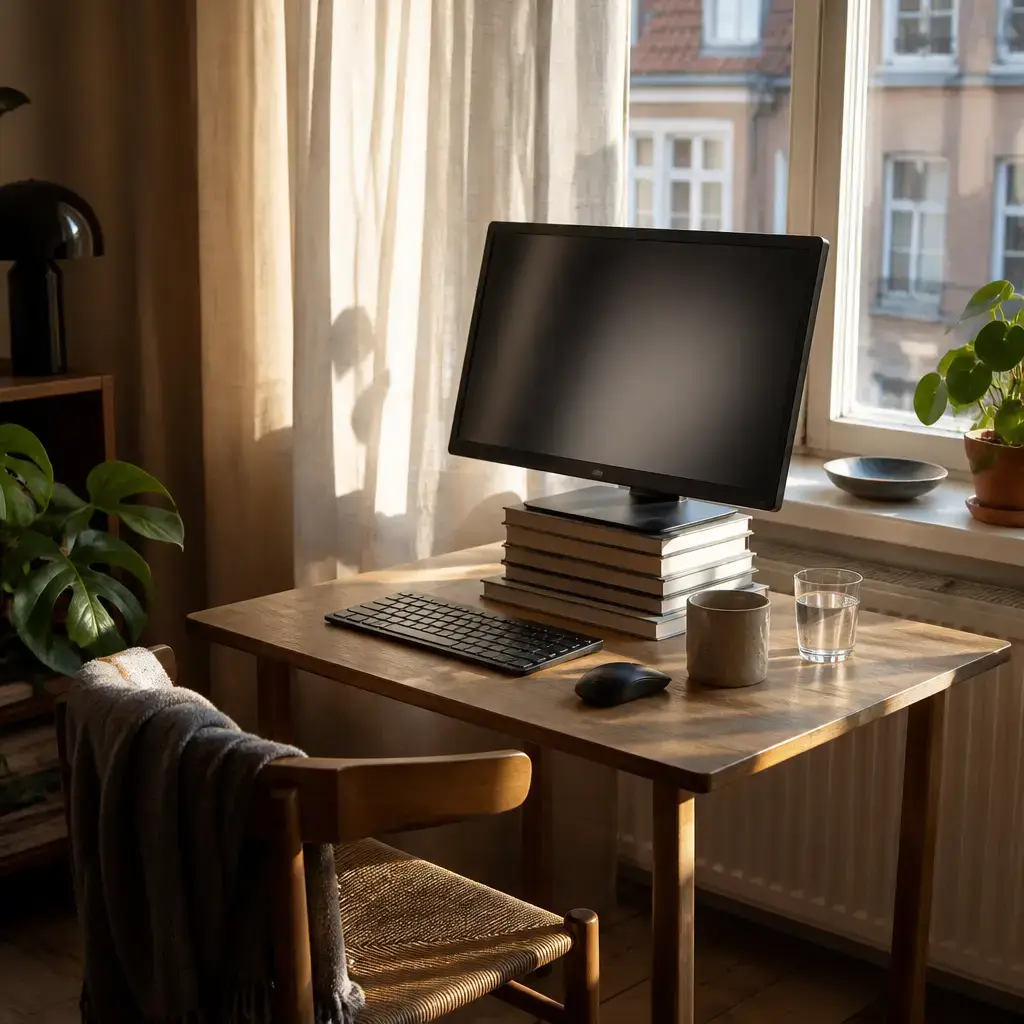
Mine skuldre gør ondt efter at have arbejdet ved dette lille bord hele dagen.
MEE-nuh SKOOL-druh guh OHN ahftuh aht HAY-vuh AR-bai-duh veh DEH-duh LIL-uh bohr HAY-luh DAY-en. My shoulders hurt after working at this small table all day.Din opsætning belaster din krop, især fordi skærmen står så lavt.
Deen OP-sehd-ning beh-LAHS-duh deen KROHB, ee-SAIR for-THEE SGAIR-men sdor soh LAOD. Your setup is hard on your body, especially with the monitor so low.Jeg kan hæve den med bøger, indtil jeg køber et ordentligt stativ.
YAI kan HAY-vuh dehn mehd BUH-uh, EN-deel yai KUH-buh eht OR-den-le sdah-TEE. I could raise it with books until I buy a proper stand.Det ville hjælpe på din kropsholdning.
Deh VIL-uh YEL-buh poh deen KROHSS-hol-ning. That would help your posture.Du bør også undersøge, om genskin fra vinduet påvirker skærmen.
Doo burr OH-soh oon-deh-SOH-uh, ohm GEN-sgeen frah VIN-oo-uh poh-VEER-kuh SGAIR-men. You should also check whether glare from the window is affecting the screen.Eftermiddagssolen gør skærmen svær at læse.
EF-tuh-mid-ahg-SOH-len guh SGAIR-men svair aht LAY-suh. The afternoon sunlight makes the screen difficult to read.Prøv at flytte skrivebordet lidt, eller brug gardinet under dine opkald.
Pruhv aht FLUH-duh SGREE-vuh-bohr-deh leet, EL-uh broo gar-DEE-neh OON-uh deen OP-kahl. Try moving the desk slightly, or use the curtain during calls.Hvis jeg føler mig mere tilpas, burde jeg også kunne arbejde bedre.
Vis yai FUH-luh mayr til-PAHS, BOO-duh yai OH-soh KOO-nuh AR-bai-duh BEH-duh. If I feel more comfortable, I should be able to work better too.Små justeringer betyder noget, når du sidder i den samme stilling i timevis.
Smoh yoo-STAIR-ing-uh beh-TEE-uh NOH-uh, nohr doo SID-uh ee dehn SAH-muh STIL-ing ee TEE-meh-vehss. Small adjustments matter when you repeat the same position for hours.Jeg kan prøve denne opstilling først, før jeg køber noget.
YAI kan PRUH-vuh DEHN-uh OP-stil-ing furst, fur yai KUH-buh NOH-uh. I can try this layout first before buying anything.Det giver mening, fordi den billigste løsning måske er nok.
Deh GEE-vuh MAY-ning, for-THEE dehn BIL-uh-steh LOO-sning MAHS-keh air NOHK. That makes sense, because the cheapest solution may be enough.Sentence explanations
Mine skuldre gør ondt efter at have arbejdet ved dette lille bord hele dagen.
My shoulders hurt after working at this small table all day.
- Mine
- my
- skuldre
- shoulders
- gør ondt
- hurt
- efter at have arbejdet
- after working
- ved
- at; by
- dette
- this
- lille
- small
- bord
- table
- hele dagen
- all day
More detail
Mine means “my” here and is the plural possessive form used with skuldre. Danish possessives vary with the possessed noun’s number and, for singular nouns, often with gender: compare min with a common-gender singular noun, mit with a neuter singular noun, and mine with plural nouns. Example: mine bøger means “my books.” skuldre is the plural of skulder, “shoulder.” The plural form identifies more than one shoulder; the possessive tells us that they belong to the speaker. Example: Min skulder gør ondt means “My shoulder hurts.” gør ondt is the Danish expression for “hurts” or “is painful.” The verb gør is the present-tense form of gøre, “to do/make,” but in this expression it combines with ondt rather than meaning ordinary “do.” The grammatical subject here is skuldre, so the expression describes the shoulders as painful. Example: Mine fødder gør ondt means “My feet hurt.” efter at have arbejdet introduces an action that happened earlier: “after working” or more literally “after having worked.” have is the infinitive of ha[ve], used here in the perfect infinitive construction at have + participle. arbejdet is the past participle of arbejde, “work.” This construction presents the working as completed or extending up to the point when the shoulders hurt. Example: Efter at have spist gik hun en tur means “After eating, she went for a walk.” ved is a location preposition meaning “at” or “by” in this context. With dette lille bord, it places the working at the table; it is not the verb “to know,” which is another Danish word, vide. Example: Han sidder ved bordet means “He is sitting at the table.” dette means “this” and is the neuter singular demonstrative. It matches the neuter noun bord, rather than identifying a person or simply marking plurality. Danish also has denne for common-gender singular nouns and disse for plural nouns. Example: dette hus means “this house.” lille means “small” here. It is the adjective modifying bord; bord is a neuter singular noun, and after a demonstrative Danish uses the form lille in this phrase: dette lille bord. The adjective’s base form is also lille; its comparative is mindre, “smaller,” and its superlative is mindst, “smallest.” Example: et lille bord means “a small table.” bord means “table.” Its plural is borde, as in to borde, “two tables.” The noun is neuter, which is relevant to the demonstrative dette in this sentence. Example: Bordet er lille means “The table is small.” hele dagen means “all day.” hele is the form of hel, “whole/entire,” used with the definite singular noun dagen; dagen is the definite form of dag, “day,” meaning “the day.” Together, the phrase presents the working as lasting throughout that day. Example: Jeg læste hele dagen means “I read all day.” Putting the parts together: Mine skuldre gør ondt says that the speaker’s shoulders hurt. efter at have arbejdet ved dette lille bord gives the earlier activity and its location—working at this small table—and hele dagen says that this lasted all day. The complete meaning is: “My shoulders hurt after working at this small table all day.”
Din opsætning belaster din krop, især fordi skærmen står så lavt.
Your setup is hard on your body, especially with the monitor so low.
- opsætning
- setup
- belaster
- puts a strain on
- krop
- body
- især
- especially
- fordi
- because
- skærmen
- the screen / monitor
- står
- is positioned
- lavt
- low
More detail
opsætning means “setup” here: the arrangement of equipment or furniture. Its base form is opsætning; the definite form is opsætningen (“the setup”). Example: Min opsætning er enkel. — “My setup is simple.” belaster is the present-tense form of belaste, “to put a strain on” or “to burden.” It describes what the setup does to the body in this sentence. Example: Arbejdet belaster ryggen. — “The work puts a strain on the back.” krop means “body.” The form din krop combines the possessive din (“your”) with the noun; kroppen means “the body.” Example: Jeg passer på min krop. — “I take care of my body.” især means “especially” and highlights one particularly relevant point. It can introduce a more specific explanation after a general statement, as it does here. fordi introduces a reason and is commonly translated as “because.” In Danish, a clause introduced by fordi normally has the finite verb after its subject: fordi skærmen står ... — “because the screen is ... .” skærmen is the definite form of skærm, “screen”; in this context, the fixed translation identifies it as the monitor. The ending -en marks definiteness for this noun: en skærm means “a screen,” while skærmen means “the screen.” Example: Skærmen er stor. — “The screen is large.” står is the present-tense form of stå, “to stand.” With an object such as a screen, it can describe its position or placement, not only a person literally standing. Example: Lampen står på bordet. — “The lamp is on the table.” lavt describes a low position or height. Here it is the adverbial form used with står, meaning that the screen is positioned low; it is not the noun skærm that carries this form. The related adjective is lav (“low”), with comparative lavere (“lower”). Example: Skærmen står lavt. — “The screen is positioned low.” Together, Din opsætning belaster din krop says “Your setup puts a strain on your body.” især fordi adds the especially relevant reason, and skærmen står så lavt says that the screen is positioned so low. The whole utterance therefore means: “Your setup is hard on your body, especially with the monitor so low.”
Jeg kan hæve den med bøger, indtil jeg køber et ordentligt stativ.
I could raise it with books until I buy a proper stand.
- Jeg kan
- I can / I could
- hæve
- raise
- den
- it
- bøger
- books
- indtil
- until
- køber
- buy
- ordentligt
- proper
- stativ
- stand
More detail
Jeg kan combines Jeg (“I”) with kan, the present-tense form of kunne (“can; be able to”). Danish modal verbs are followed by an infinitive without an English-style “to”: Jeg kan hæve means “I can raise.” The fixed translation uses “could” for the intended context, but kan itself is not a past-tense form. hæve is the infinitive “raise” or “lift.” It follows the modal kan and describes the action the speaker is able to perform. Example: Jeg kan hæve bordet. — “I can raise the table.” den is a singular definite pronoun meaning “it” here. It is the common-gender form; the neuter counterpart is det. The pronoun’s specific referent is not identified by the sentence itself, so the reusable point is its grammatical form and object role, not a particular noun. bøger means “books.” Its singular base form is bog; bøger is the plural form. Danish commonly has no separate indefinite article before a plural noun, so bøger can mean “books” in a general or nonspecific plural sense. With med, the phrase med bøger means “with books” or “using books.” indtil introduces the time limit “until.” It connects the raising action to the point at which the following event occurs. køber is the present-tense form of købe, “buy,” with jeg as its subject. Danish verbs do not change their form for different persons, so the same present form is used with other subjects as well. In this indtil clause, present tense refers to the future endpoint naturally: “until I buy,” not necessarily “until I am buying.” ordentligt is the neuter singular form of the adjective ordentlig, meaning “proper,” “decent,” or “suitable” in this context. It has this form because it describes the neuter singular noun stativ: et ordentligt stativ. Compare common gender en ordentlig ... and plural or definite ordentlige .... stativ means “stand.” It is a neuter noun, shown by the indefinite article et: et stativ, “a stand.” The article marks an indefinite noun phrase; it does not by itself assert a numerical count beyond presenting one nonspecific instance in this sentence. Together, Jeg kan hæve den med bøger means “I can raise it using books.” indtil jeg køber et ordentligt stativ sets the endpoint: this arrangement is intended to last until the speaker buys a suitable stand. The complete utterance therefore means: “I could raise it with books until I buy a proper stand.”
Det ville hjælpe på din kropsholdning.
That would help your posture.
- Det
- that
- ville
- would
- hjælpe på
- help with
- din
- your
- kropsholdning
- posture
More detail
Det means “that” here and refers to the preceding proposed action as a whole, rather than naming a specific physical object. Danish det is also used as a neuter singular pronoun or demonstrative, but its grammatical form does not by itself identify the referent. ville is the form of ville used for “would” in this sentence. With an infinitive, ville presents a possible or conditional result: ville + infinitive. For example, Det ville være nyttigt means “That would be useful.” hjælpe på is a useful Danish construction meaning “help with” or “improve” something. The lexical verb is hjælpe (“help”); på is part of the construction here, so the result is not simply the general verb “help” with any object. For example, Det hjælper på problemet means “That helps with the problem.” din means “your” before a singular common-gender noun. Danish possessives vary with the noun: din is used with a singular common-gender noun, dit with a singular neuter noun, and dine with a plural noun. The form belongs to the possessive, while the noun determines which form is selected. kropsholdning means “posture.” It is a compound noun: krop means “body” and holdning means “posture” or “bearing,” but the fixed word kropsholdning is the noun used here. It is a common-gender noun, which is why the phrase uses din rather than dit. Together, the pattern Det ville hjælpe på + possessive + noun expresses that the previously mentioned action would improve or benefit the named thing. In this utterance, the meaning is “That would help your posture.”
Du bør også undersøge, om genskin fra vinduet påvirker skærmen.
You should also check whether glare from the window is affecting the screen.
- Du bør
- you should
- også
- also
- undersøge
- check
- om
- whether
- genskin
- glare
- vinduet
- the window
- påvirker
- affects
- skærmen
- the screen
More detail
Du bør means “you should.” bør is the present form of the modal verb burde and is followed directly by an infinitive: Du bør undersøge = “You should check.” The subject Du is “you”; the form of bør does not change for different subjects. også adds “also” or “too.” Here it says that checking this is an additional recommended action. A reusable pattern is også + verb phrase, as in Hun kommer også (“She is coming too”). undersøge is the infinitive “to examine” or “to check.” After the modal bør, Danish uses the infinitive without at: Du bør undersøge, not Du bør at undersøge. The verb is written in its base form here; the present form is undersøger. om introduces an embedded yes/no question and means “whether” here. The pattern undersøge, om ... means “check whether ...”. It is different from direct-question word order: Påvirker genskin skærmen? means “Is glare affecting the screen?”, while the embedded clause has genskin ... påvirker .... genskin means “glare” in this sentence. It is a neuter noun, commonly used without an article when referring to glare as a substance or phenomenon: Der er genskin på skærmen means “There is glare on the screen.” Its definite form is genskinnet (“the glare”); the observed form genskin is not that definite form. vinduet means “the window.” It is the definite singular form of the neuter noun vindue: et vindue → vinduet. In fra vinduet, fra marks the source, so the phrase means “from the window.” påvirker means “affects” here. It is the present form of påvirke, “to affect,” and Danish present-tense verbs do not change according to the subject’s person or number. Thus genskin påvirker and solen påvirker both use påvirker. skærmen means “the screen.” It is the definite singular form of the common-gender noun skærm: en skærm → skærmen. In påvirker skærmen, the screen is the object being affected. Together, om genskin fra vinduet påvirker skærmen means “whether glare from the window is affecting the screen.” The full utterance combines the recommendation Du bør undersøge with også and this embedded question: “You should also check whether glare from the window is affecting the screen.”
Eftermiddagssolen gør skærmen svær at læse.
The afternoon sunlight makes the screen difficult to read.
- Eftermiddagssolen
- the afternoon sunlight
- gør
- makes
- skærmen
- the screen
- svær
- difficult
- læse
- read
More detail
Eftermiddagssolen means “the afternoon sunlight” here. It is a compound noun built from eftermiddag (“afternoon”) and sol (“sun”), with definite marking on the compound’s final element: eftermiddagssol → eftermiddagssolen. In Danish compounds, the first element describes the type or context of the last element. Example: morgensolen er varm — “the morning sun is warm.” gør is the present-tense form of gøre (“to do” or “to make”). In this sentence, the useful pattern is gøre + an object + an adjective + an infinitive: it expresses that one thing causes an object to have a quality or to be in a condition. Gør is the finite verb form used here; its present tense does not by itself mean that the situation exists only at this exact moment. Example: Lyset gør rummet lyst — “The light makes the room bright.” skærmen means “the screen.” It is the definite singular form of skærm: en skærm means “a screen,” while skærmen means “the screen.” The ending -en marks the common-gender definite singular form. Here it is the object affected by the sunlight. svær means “difficult” or “hard.” It is an adjective describing the screen’s condition in the construction gør skærmen svær .... The adjective itself is not the form carrying the noun’s definiteness; skærmen carries that marking. A useful contrast is let (“easy”) versus svær (“difficult”). Example: Opgaven er svær — “The task is difficult.” læse is the infinitive of læse, “to read.” After svær in this pattern, it identifies the activity that is difficult: svær at læse means “difficult to read.” The same infinitive can be used in other patterns, for example Jeg kan læse — “I can read.” Together, Eftermiddagssolen gør skærmen svær at læse has the structure “the afternoon sunlight makes the screen difficult to read.” The sunlight is the cause, skærmen is the affected object, and svær at læse describes the resulting difficulty. The sentence therefore states that the afternoon sunlight makes reading the screen difficult.
Prøv at flytte skrivebordet lidt, eller brug gardinet under dine opkald.
Try moving the desk slightly, or use the curtain during calls.
- Prøv at
- try to
- flytte
- move
- skrivebordet
- the desk
- lidt
- slightly; a little
- brug
- use
- gardinet
- the curtain
- under
- during
- opkald
- calls
More detail
Prøv at introduces an attempt or suggestion: prøv at + infinitive means “try to …”. Here Prøv at flytte means “try moving.” The imperative does not mark whether one person or more than one person is addressed. The at belongs to this infinitive construction; it is not part of the verb’s stem. flytte is the infinitive “to move.” The same form can be reused after other verbs that take at, for example: Jeg prøver at flytte stolen. — “I am trying to move the chair.” skrivebordet means “the desk.” Its base noun is skrivebord; the ending -et marks the definite singular form: et skrivebord — “a desk,” skrivebordet — “the desk.” The ending belongs to the noun, not to flytte. lidt means “a little” or “slightly.” In this sentence it modifies the movement, so the suggested move is only a small amount. It can also modify an adjective or adverb: lidt bedre — “a little better.” eller connects the two alternatives: first trying to move the desk, or instead using the curtain. It does not mean that both actions must be performed. brug means “use” here and is the imperative form of bruge. The imperative gives a direct suggestion or instruction. Compare the infinitive at bruge — “to use” and the present form bruger — “use/am using.” gardinet means “the curtain.” The base noun is gardin; gardinet is its definite singular form. As with skrivebordet, the definite ending is attached to the noun itself. under means “during” in this time expression. Its meaning here is not physical position beneath something. For example, under mødet means “during the meeting.” dine means “your” before a plural noun. It agrees with the plural form that follows, not with the person being addressed: dit opkald — “your call,” but dine opkald — “your calls.” opkald means “calls” here. The form is plural and indefinite after dine; Danish has the same visible form for the singular indefinite noun and the plural indefinite noun in this case, while the surrounding words show the intended plural reading: et opkald — “a call,” opkald — “calls.” Together, Prøv at flytte skrivebordet lidt gives “Try moving the desk slightly.” eller brug gardinet under dine opkald gives the alternative “or use the curtain during your calls.” The complete utterance is therefore: “Try moving the desk slightly, or use the curtain during calls.”
Hvis jeg føler mig mere tilpas, burde jeg også kunne arbejde bedre.
If I feel more comfortable, I should be able to work better too.
- Hvis
- if
- jeg føler mig
- I feel
- mere
- more
- tilpas
- comfortable
- burde jeg
- I should
- også
- too
- kunne
- be able to
- arbejde
- work
- bedre
- better
More detail
Hvis introduces a condition: “if.” It commonly comes before a clause describing the situation on which another clause depends. Example: Hvis jeg har tid, læser jeg. — “If I have time, I read.” jeg føler mig means “I feel.” føler is the present-tense form of føle (“to feel”); Danish present-tense verbs generally keep the same form across subjects. mig is the first-person singular reflexive pronoun, used because the person feeling is also the person affected: jeg føler mig ... — “I feel ...” mere means “more” and makes the following description comparative. Here it forms mere tilpas, “more comfortable/more at ease.” It is not the noun or person being compared; it marks a higher degree of comfort than some understood reference point. tilpas describes being comfortable or at ease in this expression. In føle sig tilpas, the reflexive construction is a reusable way to say that someone feels comfortable. tilpas does not identify a particular object; it describes the subject’s state. burde jeg expresses “I should” in this sentence. burde is the modal form used for an expectation, recommendation, or likely result, and jeg is its subject. The modal is followed by an infinitive: Jeg burde hvile. — “I should rest.” også means “also/too.” It adds this expected ability or result to something else already relevant, without changing who performs the action. kunne means “be able to” here. It is the infinitive of the ability modal kunne; after burde, Danish uses the infinitive: burde kunne ... — “should be able to ...” This combination expresses expected ability, not simply an obligation to perform the action. arbejde is the infinitive “to work.” With kunne, it names the action that the subject is expected to be able to do: kunne arbejde — “be able to work.” bedre means “better” here and modifies how the working is done, so it corresponds to “work better.” It is the comparative form related to godt (“well”); the sentence says that the working is expected to improve relative to an understood baseline, without specifying a precise measurement. Together, Hvis jeg føler mig mere tilpas means “If I feel more comfortable.” The main clause burde jeg også kunne arbejde bedre means “I should also be able to work better.” The conditional clause gives the condition, while burde kunne expresses an expected ability rather than a certainty. Thus the whole utterance means: “If I feel more comfortable, I should be able to work better too.”
Små justeringer betyder noget, når du sidder i den samme stilling i timevis.
Small adjustments matter when you repeat the same position for hours.
- Små
- small
- justeringer
- adjustments
- betyder noget
- matter
- når
- when
- sidder
- sit / are seated
- samme
- same
- stilling
- position / posture
- timevis
- for hours
More detail
Små is the plural form of lille (“small”): lille is used with singular nouns, while små is used with plural nouns. Here it describes justeringer, so both are plural. Example: små ændringer means “small changes.” Justeringer means “adjustments.” Its singular is justering, and its plural is justeringer. The indefinite plural form refers to adjustments without specifying a number. Example: Jeg laver nogle justeringer. — “I am making some adjustments.” Betyder noget is a useful construction meaning “matters” or “makes a difference.” The verb is betyde (“to mean” or, in this construction, “to matter”); betyder is its present-tense form. Noget literally means “something,” but together with betyder it gives the idiomatic meaning “matter.” Example: Det betyder meget. — “It matters a lot.” Når introduces a time clause meaning “when.” It presents the situation in which the main statement applies. Example: Jeg læser, når jeg har tid. — “I read when I have time.” Sidder is the present-tense form of sidde, “to sit” or “to be seated.” With du, it means “you sit” or “you are sitting.” Here, together with i den samme stilling and timevis, it describes sitting in the same position for a prolonged period. Example: Du sidder ved vinduet. — “You are sitting by the window.” Samme means “same.” It marks identity with something already established or understood; it does not merely mean “similar.” Its form does not show the noun’s plural here: in den samme stilling, it is used with the singular noun stilling after the definite determiner den. Example: Vi bruger den samme metode. — “We use the same method.” Stilling means “position” or “posture.” Its plural is stillinger. In this utterance, the fixed translation supports the sense “position,” specifically the position maintained for a long time. Example: Skift stilling. — “Change position.” Timevis means “for hours” or “for hours on end.” It is a duration adverb formed from time (“hour”) with -vis, which expresses an extended amount or repeated stretch of time. It does not state an exact number of hours. Example: Hun ventede timevis. — “She waited for hours.” Together, Små justeringer betyder noget says that small adjustments matter. Når du sidder i den samme stilling i timevis gives the time condition: this applies when you sit in the same position for hours. The complete intended meaning is: “Small adjustments matter when you repeat the same position for hours.”
Jeg kan prøve denne opstilling først, før jeg køber noget.
I can try this layout first before buying anything.
- Jeg kan
- I can
- prøve
- try
- denne
- this
- opstilling
- layout
- først
- first
- før
- before
- køber
- buy
- noget
- anything; something
More detail
Jeg kan combines jeg (“I”) with kan, the present-tense form of kunne (“can; be able to”). A modal such as kan is followed by an infinitive without at: Jeg kan prøve means “I can try.” Kan has the same form with different subjects, for example jeg kan and de kan. prøve is the infinitive “to try” or “to test.” After kan, it remains in the infinitive form. Example: Jeg kan prøve igen. — “I can try again.” denne means “this” and is the singular common-gender form of the demonstrative. Here it accompanies opstilling, a common-gender noun: en opstilling. With a singular neuter noun, Danish uses dette; with a plural noun, it uses disse. opstilling means “layout,” “setup,” or “arrangement” here. It is the indefinite form of the noun; the definite form is opstillingen, “the layout/setup.” først is the adverb “first.” Here it places the trying before the later step of buying. Example: Læs først. — “Read first.” før means “before.” Here it is a conjunction introducing jeg køber noget. A reusable pattern is før + subject + present-tense verb: før vi går means “before we leave.” køber is the present-tense form of købe, “to buy.” Its subject here is jeg, so jeg køber means “I buy.” Danish present-tense verb forms generally do not change for the subject’s person or number: jeg køber and de køber both use køber. noget is an indefinite pronoun meaning “something.” In this clause, the fixed translation naturally renders it as “anything” because the purchase is unspecified: no item is identified. Example: Jeg køber noget. — “I am buying something.” Together, Jeg kan prøve denne opstilling means “I can try this layout,” and før jeg køber noget adds “before I buy anything.” Først emphasizes that trying the layout comes first in the speaker’s plan. The whole utterance means: “I can try this layout first before buying anything.”
Det giver mening, fordi den billigste løsning måske er nok.
That makes sense, because the cheapest solution may be enough.
- Det
- That
- giver mening
- makes sense
- fordi
- because
- billigste
- cheapest
- løsning
- solution
- måske
- perhaps
- er
- is
- nok
- enough
More detail
Det means “that” here and points to the preceding idea or proposition. In Danish, det is the neuter singular form used for a referent of this kind; its grammatical form does not identify a human participant. giver mening is the fixed expression “makes sense.” The verb giver is the present-tense form of give (give → giver), but in this expression it does not mean that someone physically gives an object. A reusable example is: Det giver ikke mening. — “That does not make sense.” fordi introduces the reason for the preceding statement: “because.” It connects the main clause to the explanation that follows. billigste means “cheapest” here. It is the superlative form of billig (“cheap”): billig → billigere (“cheaper”) → billigst/billigste (“cheapest”). In den billigste løsning, the adjective has the -e form because it is part of a definite noun phrase marked by den. løsning means “solution.” It is a noun related to the idea of solving a problem; its plural is løsninger (“solutions”). In this sentence, den and the adjective identify one definite solution: “the cheapest solution.” måske means “perhaps” or “may.” It signals uncertainty about the statement that follows, without making it a firm claim. er is the present-tense form of være, “to be.” Danish uses er with different subjects rather than changing it for person: for example, jeg er means “I am” and den er means “it is.” nok means “enough” here. In er nok, it says that the solution may be sufficient for the relevant purpose. For example, Det er nok. means “That is enough.” Together, Det giver mening says “That makes sense.” fordi introduces the reason, and den billigste løsning måske er nok says that the cheapest solution may be sufficient. The whole utterance therefore means: “That makes sense, because the cheapest solution may be enough.”
Grammar Points
Det gør ondt
Det gør ondt.
Deh guh OHN.It hurts.
Danish uses det as a formal subject in this fixed expression; the body part or person can be left unstated.
den billigste løsning
Den billigste løsning giver mening.
Dehn BIL-uh-steh LOO-sning GEE-vuh MAY-ning.The cheapest solution makes sense.
billigste is the superlative form of billig and comes before the noun; den agrees with the common-gender noun.
Danish Vocabulary
efter at have arbejdet ved dette lille bord
Din opsætning belaster din krop.
Jeg kan hæve den med bøger.
Mine skuldre gør ondt.
Jeg kan hæve den med bøger.
Din opsætning belaster din krop.
skærmen står så lavt
Din opsætning belaster din krop.
et ordentligt stativ
Mine skuldre gør ondt.
skærmen står så lavt
et ordentligt stativ
Quiz
Word Order
Arrange the words in the correct order.
That would help your posture.
Show Answer
Det ville hjælpe på din kropsholdning.The afternoon sunlight makes the screen difficult to read.
Show Answer
Eftermiddagssolen gør skærmen svær at læse.Spelling
Tap the letters to spell the word.
setup
Show Answer
opsætningraise; lift
Show Answer
hævescreen; monitor
Show Answer
skærmenlow