10 minutes free every day
Continue audio lessons in the app
Word explanations appear automatically in sync with the audio.
No login required · synced translations · playback with the screen locked
Choose your learning language and open this lesson in the app.

About This Lesson
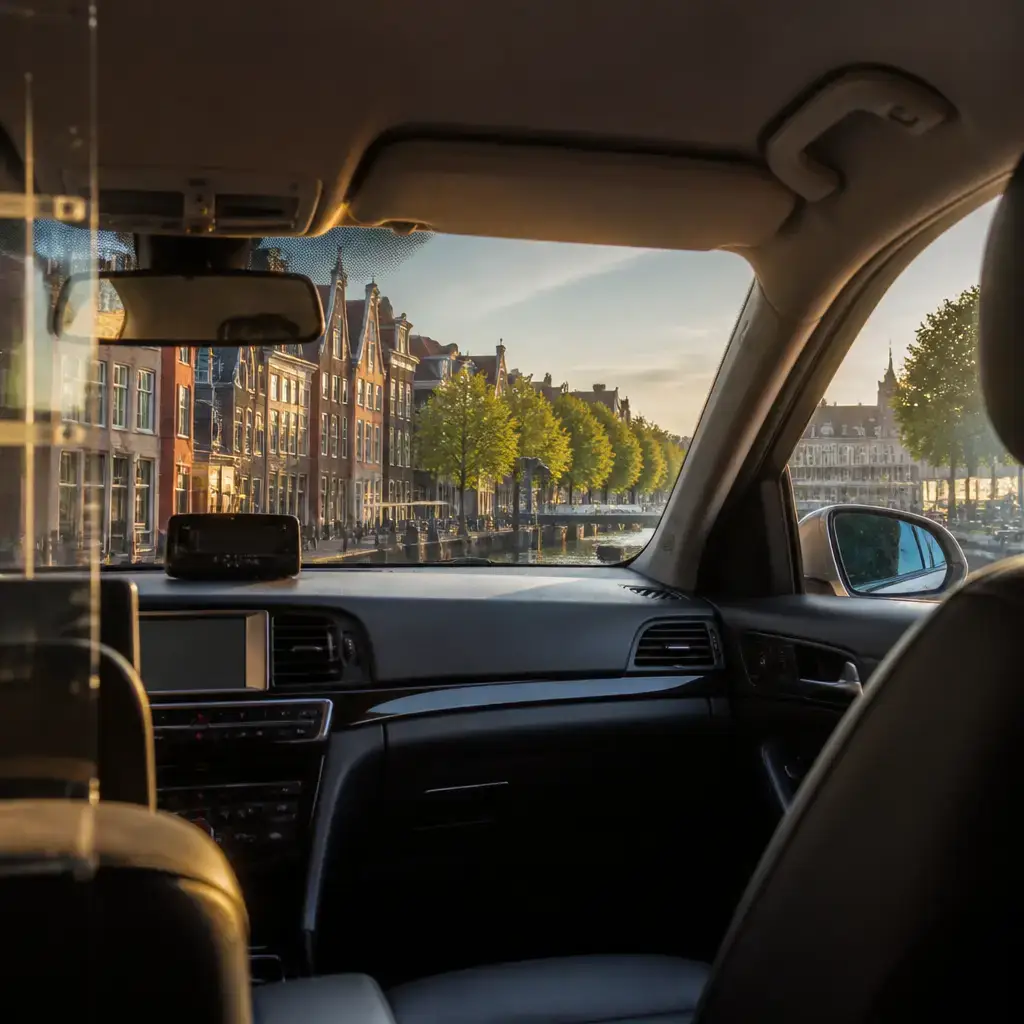
Use Clarifying a taxi route politely to practice Danish conversation, pronunciation, vocabulary, grammar, and quizzes.
Dialogue
Undskyld, kører vi en anden rute på grund af trafikken?
oon-SGUL, KUR-uh vee en AN-den ROO-duh poh GROON ahv trah-FEE-kuhn? Excuse me, are we taking a different route because of traffic?Vejen længere fremme er spærret, så jeg er nødt til at tage en omvej.
VAI-en LENG-uh FREM-uh air SPAIR-uhd, soh yai air NOHDT til ahd TAI-uh en OM-vai. The road ahead is blocked, so I need to take a detour.Jeg spurgte, fordi jeg ikke kan genkende området.
Yai SPOOR-duh, FOR-dee yai IK-kuh kan GEN-ken-uh OM-roh-duh. I was asking because I don't recognize this area.Denne vej er lidt længere, men vi burde kunne komme videre ad den.
DEN-uh vai air lidt LENG-uh, men vee BOOR-duh KUN-uh KOM-uh VEE-uh-ruh ahd den. This way is a little longer, but it should keep us moving.Kan vi blive på større veje, hvis det er muligt?
Kan vee BLEE-uh poh STUR-uh VAI-uh, vis deh air MOO-lee? Could we stay on larger roads if possible?Det kan jeg godt.
Deh kan yai goht. I can do that.Det kan give et par minutter ekstra.
Deh kan GEE-vuh ed par mee-NOO-duh EK-strah. It may add a few minutes.Men så bliver det nemmere at følge den.
Men soh BLEE-uh deh NEM-uh ahd FUL-guh den. But it will be easier to follow.Det fungerer fint. Jeg har ikke travlt.
Deh FONG-uh-ruh fint. Yai har IK-kuh TRAH-wlt. That works. I'm not in a hurry.Jeg vil undgå de små sidegader herfra.
Yai vel oon-GOH deh smoh SEE-uh-gair-uh hair-FRAH. I'll avoid the small side streets from here.Jeg sætter pris på, at du forklarer ruten.
Yai SET-uh prees poh, at doo foh-KLAIR-uh ROO-den. I appreciate you explaining the route.Jeg giver dig besked, hvis jeg skal ændre den igen.
Yai GEE-vuh dai beh-SGAYD, vis yai skal EN-druh den ee-GEN. I'll let you know if I need to change it again.Sentence explanations
Undskyld, kører vi en anden rute på grund af trafikken?
Excuse me, are we taking a different route because of traffic?
- Undskyld
- Excuse me
- kører
- drive; travel by vehicle
- vi
- we
- anden
- different; another
- rute
- route
- på grund af
- because of
- trafikken
- the traffic
More detail
Undskyld means “excuse me” here, a polite way to get someone’s attention before the question. It can also mean “sorry” in other situations; the surrounding utterance determines the use. kører is the present-tense form of køre. Danish verbs such as køre do not change this present-tense form for different persons or numbers, so kører is used with vi (“we”) here. In this sentence, køre means to travel or go by vehicle. Example: Vi kører hjem. — “We are driving home.” vi is the first-person plural pronoun “we”. In kører vi ...?, it is the subject. Danish commonly places the verb before the subject in a direct yes/no question. anden means “different” or “another” and describes a singular noun here. With a common-gender singular noun it appears as anden, as in en anden bus — “another bus”. With a neuter singular noun, use andet, as in et andet sted — “another place”; with a plural noun, use andre. rute is a common-gender noun meaning “route”. Its indefinite form is en rute, while its definite form is ruten (“the route”). In en anden rute, the noun is presented as a different route rather than as an already specified route. på grund af is a fixed prepositional construction meaning “because of” or “due to”. It introduces a cause. Example: Toget er forsinket på grund af sne. — “The train is delayed because of snow.” trafikken means “the traffic”. It is the definite form of trafik: trafik means “traffic”, while trafikken means “the traffic”. Danish marks definiteness on this noun with its ending rather than with a separate word corresponding to “the”. Together, kører vi en anden rute asks whether we are taking a different route, and på grund af trafikken identifies traffic as the reason. With the polite opener, the complete utterance means: “Excuse me, are we taking a different route because of traffic?”
Vejen længere fremme er spærret, så jeg er nødt til at tage en omvej.
The road ahead is blocked, so I need to take a detour.
- Vejen
- the road
- længere fremme
- farther ahead
- spærret
- blocked
- jeg er nødt til at
- I need to
- tage
- take
- omvej
- detour
More detail
Vejen means “the road” here. It is the definite singular form of vej (“road”): en vej → vejen. The ending marks definiteness, not a separate word for “the.” længere fremme describes location: “farther ahead.” Længere is a comparative form used spatially here; compare langt fremme (“far ahead”) and længere fremme (“farther ahead”). It modifies the location phrase, not the noun vejen. spærret means “blocked” here. It is the past participle of spærre (“to block”) and describes the road’s resulting state. With er (“is”), the sentence says that the road is blocked: Vejen er spærret. jeg er nødt til at is a reusable necessity pattern meaning “I need to” or “I have to.” The pattern is være nødt til at + infinitive; jeg er identifies the speaker, and nødt til at introduces the required action. For example, Jeg er nødt til at gå. means “I have to leave/go.” tage is the infinitive of tage, “to take.” Here it follows til at and means taking a route, rather than physically picking up an object. The same verb can be used in tage bussen (“take the bus”) or tage en anden rute (“take another route”). omvej means “detour.” In en omvej, the noun is used with the indefinite article en; the article marks an indefinite noun phrase and does not by itself state a numeric count. En omvej can be reused in phrases such as tage en omvej (“take a detour”). The connector så links the situation to its consequence: “so.” First, Vejen længere fremme er spærret says that the road farther ahead is blocked. Then så jeg er nødt til at tage en omvej says that, as a result, the speaker needs to take a detour. Together, the utterance means: “The road ahead is blocked, so I need to take a detour.”
Jeg spurgte, fordi jeg ikke kan genkende området.
I was asking because I don't recognize this area.
- spurgte
- asked
- fordi
- because
- ikke kan
- cannot
- genkende
- recognize
- området
- the area
More detail
spurgte means “asked” here. It is the past-tense form of spørge (“to ask”): spørge → spurgte. It presents the asking as past; the sentence does not specify exactly when it happened. fordi introduces the reason for what comes before it. The reusable pattern is X, fordi Y (“X because Y”). Here, the reason for asking is the clause that follows. ikke kan combines negation with kan, the present-tense form of kunne (“can, be able to”). ikke makes the clause negative: jeg kan ... means “I can ...,” while jeg kan ikke ... means “I cannot ...”. In this clause, kan comes before the lexical verb. genkende means “recognize,” especially identify something as familiar or known. After kan, Danish uses the infinitive: kan genkende (“can recognize”). Example: Jeg kan genkende stemmen. — “I can recognize the voice.” området means “the area” here. It is the definite singular form of the neuter noun område (“area”): et område (“an area”) → området (“the area”). The definite suffix is -t; the final e belongs to the noun stem, so the written form ends in -et. Together, Jeg spurgte means “I asked,” and fordi jeg ikke kan genkende området gives the reason: “because I cannot recognize the area.” The complete utterance therefore means “I was asking because I don't recognize this area.” In the fixed translation, the definite noun området is rendered as “this area” in the situation.
Denne vej er lidt længere, men vi burde kunne komme videre ad den.
This way is a little longer, but it should keep us moving.
- Denne
- this
- vej
- way; road
- lidt
- a little
- længere
- longer
- vi burde
- we should
- kunne
- be able to
- komme videre
- move on; continue
- ad den
- along it
More detail
Denne means “this” here and is the demonstrative used with a singular common-gender noun such as vej. It identifies the route being talked about; the form itself does not state anything about how many routes there are. vej means “way” or “road.” In this sentence, the fixed translation and context support the route meaning. A useful contrast is vejen, “the road,” with the definite ending attached to the noun. lidt means “a little” and modifies the comparison that follows. It makes the difference small: “a little longer,” not necessarily “short.” længere is the comparative form of the adjective lang, “long”: lang → længere (“longer”) → længst (“longest”). In this sentence it is a predicative adjective after er, describing vej; Danish comparative adjectives such as længere do not take a separate gender or number ending here. vi burde expresses that “we should” do something. vi is the first-person plural subject, and burde is a modal form used here for a recommendation or a reasonable expectation rather than a firm guarantee. For example, Vi burde være der snart. means “We should be there soon.” kunne is the infinitive form of the verb kunne, meaning “be able to.” Its present-tense form is kan; these are forms of the same verb, not an infinitive derived from kan. After the modal burde, it remains in the infinitive: burde kunne = “should be able to.” The combination expresses expected possibility or ability, not certainty. komme videre is a reusable verb construction meaning “move on,” “continue,” or “make further progress.” The verb komme is the infinitive “come,” while videre adds the idea of onward movement. For example, Vi kan komme videre nu. means “We can move on now.” ad den means “along it” in this sentence. ad marks movement along a route, and den is a singular common-gender pronoun referring here to the previously mentioned vej; the route context supports that reading. For example, Vi går ad den. means “We walk along it.” The sentence first identifies the route with Denne vej, then describes it as er lidt længere, “is a little longer.” men connects this comparison to the practical result: vi burde kunne komme videre ad den, “we should be able to continue along it.” Together, the utterance means: “This way is a little longer, but it should keep us moving.”
Kan vi blive på større veje, hvis det er muligt?
Could we stay on larger roads if possible?
- Kan vi
- Could we
- blive
- stay
- større
- larger
- veje
- roads
- hvis det er muligt
- if possible
More detail
Kan vi opens a yes/no request: kan is the present form of kunne, “can/be able to,” and vi means “we.” In this question, the combination is naturally rendered “Could we…?” because it makes a polite proposal. Danish yes/no questions commonly place the finite verb before the subject: Kan vi ...? Compare the reusable pattern Kan vi + verb? — “Can/Could we + verb?” blive means “stay” or “remain.” It is the infinitive after kan; after a modal such as kan, Danish uses the infinitive rather than a present-tense form. Example: Vi kan blive her. — “We can stay here.” Here it expresses remaining on the roads rather than leaving them. større means “larger” here. It is the comparative form of stor (“large”): stor → større (“larger”) → størst (“largest”). The comparative identifies roads that are larger than some relevant alternative or comparison point; the sentence does not specify the exact comparison. større is the adjective, while veje is the noun. In Danish, this comparative form does not change for gender or number. veje means “roads.” It is the indefinite plural form of vej (“road”): en vej — “a road,” veje — “roads.” In på større veje, på means “on,” and veje identifies the roads being discussed in the request. hvis det er muligt means “if possible.” hvis introduces a condition, while det er muligt has the structure “it is possible.” The expression makes the request conditional: the speakers want to stay on larger roads when that can be done. Example: Vi går videre, hvis det er muligt. — “We will continue, if possible.” Together, Kan vi blive på større veje asks whether the speakers can remain on larger roads. Adding hvis det er muligt limits that request to cases where it can be done, giving the complete meaning: “Could we stay on larger roads if possible?”
Det kan jeg godt.
I can do that.
- Det
- that
- kan jeg
- I can
- godt
- indeed; certainly
More detail
Det means “that” here and is the object of the understood action. The fixed translation supports the proposed action as its referent, without identifying a more specific object. Danish det is the neuter singular form of the pronoun; its grammatical form is distinct from its referential role here. kan jeg contains kan, the present-tense form of kunne, “can,” followed by jeg, “I.” Kan expresses ability or possibility with this first-person singular subject. Because Det is placed first, Danish main-clause word order puts the finite verb before the subject: Det kan jeg .... The more neutral order is Jeg kan ... (“I can ...”). godt is an adverb in this construction, not the adjective “good” modifying a noun. With kan, it reinforces the affirmative answer: kan ... godt naturally means “can indeed” or simply “can.” As an adverb here, godt does not change for gender or number. Example: Jeg kan godt hjælpe. — “I can help.” Together, Det (“that”) + kan jeg (“I can”) + godt form the natural Danish response Det kan jeg godt. The fronted Det refers to the proposed action, and kan ... godt confirms the speaker’s ability to carry it out. The complete meaning is “I can do that.”
Det kan give et par minutter ekstra.
It may add a few minutes.
- Det
- it
- kan
- may; can
- give
- add; give
- et par
- a few
- minutter
- minutes
- ekstra
- extra
More detail
Det is a Danish neuter singular pronoun meaning “it” here. The fixed texts do not identify a more specific referent, so learn it as a way to refer to an already understood situation, thing, or action. In other contexts, Danish also uses den and det according to the grammatical form of the noun being referred to; det itself does not identify the referent. kan is the modal verb kunne in the present tense. Here it expresses possibility: “may” or “can.” After a modal such as kan, the next verb normally appears in the infinitive without at: kan give = “may/can add.” Compare the ability reading in Det kan jeg godt.: “I can do that.” The surrounding context determines whether kan is about possibility or ability. give is the infinitive of give, “to give” or, in this context, “to add.” Danish uses the same verb for these related meanings. Example: Det giver mere tid. — “It gives more time.” et par is the compact expression “a few” or “a couple of.” It is followed here by the plural noun minutter. It does not necessarily assert exactly two in ordinary use; the intended meaning here is a small number of minutes. minutter is the plural of the noun minut, “minute.” The singular is et minut; the plural is minutter. Example: Vent et minut. — “Wait a minute.” ekstra means “extra” and describes minutter here, giving “extra minutes.” It is placed after the noun in this phrase. ekstra is also used before nouns in other expressions, such as ekstra tid — “extra time.” Together, Det kan give et par minutter ekstra means “It may add a few minutes.” The structure is det + modal kan + infinitive give + quantity expression et par + plural noun minutter + postposed description ekstra. The sentence presents the adding of a small amount of additional time as possible, without stating that it definitely happens.
Men så bliver det nemmere at følge den.
But it will be easier to follow.
- Men
- but
- så
- then; so
- bliver
- will become; will be
- det
- it
- nemmere
- easier
- følge
- follow
- den
- it; that
More detail
Men introduces a contrast with what came before: “but.” It is a reusable coordinating conjunction, as in Jeg kommer, men jeg bliver ikke længe — “I’m coming, but I won’t stay long.” så here links the consequence to the preceding situation, meaning “then” or “so.” The combination Men så ... can therefore mean “But then ...” or “But in that case ...”; the exact English choice depends on the surrounding context. bliver is the present-tense form of blive, “become” or “be.” In this sentence, the present form refers to a later result: “will be.” Danish commonly uses the present tense for a future situation when the time or consequence is clear from context. Blive can also mean “become,” as in Det bliver koldt — “It is getting cold.” det is the pronoun “it” and is the grammatical subject of the pattern det bliver .... Here it does not identify a separately named participant; it introduces the evaluation that follows. nemmere is the comparative form of nem, “easy”: nem — “easy,” nemmere — “easier,” nemmest — “easiest.” It compares the situation with another way or earlier condition. In Det er nemmere sådan, it means “It is easier this way.” følge is the infinitive of følge, “follow.” The infinitive appears in at følge, “to follow.” Danish uses this form after at in an infinitive clause, for example Det er svært at følge — “It is difficult to follow.” den is a singular common-gender pronoun or demonstrative meaning “it” or “that” here. Its specific referent is understood from the situation, but the supplied sentence does not name it. The form den is distinct from neuter singular det when the pronoun itself refers to a neuter noun. Together, Men så marks a consequence or change of perspective, bliver det nemmere says that the situation will become easier, and at følge den specifies what will be easier: following the understood singular common-gender referent. The complete meaning is: “But then it will be easier to follow it.”
Det fungerer fint. Jeg har ikke travlt.
That works. I'm not in a hurry.
- Det
- that; it
- fungerer
- works; functions
- fint
- well; fine
- Jeg
- I
- har ikke travlt
- am not in a hurry
More detail
Det is the Danish neuter singular form used here as “that” or “it.” The fixed translation establishes the intended meaning as “That,” but the supplied sentence does not uniquely identify what Det refers to. Danish pronouns must match the grammatical properties of their referents when those properties apply; det is also used in several impersonal and anticipatory constructions, so do not treat its form alone as identifying a particular object. Example: Det er godt. — “That is good.” fungerer means “works” here, in the sense of functioning or being effective. Its base form is fungere; fungerer is the present-tense form. In Danish, the present form does not change for person: jeg fungerer, det fungerer, and de fungerer all use fungerer. Example: Planen fungerer. — “The plan works.” fint means “fine” or “well” here and describes the situation expressed by Det fungerer. The form fint is the neuter singular form of the adjective fin; compare en fin plan — “a fine plan” — with et fint resultat — “a fine result.” In this sentence it also contributes to the natural adverb-like expression “works fine.” Jeg means “I” and is the first-person singular subject pronoun. It identifies the speaker as the subject of the following clause. The corresponding object form is mig, as in Hun ser mig. — “She sees me.” har ikke travlt is the Danish pattern for “am not in a hurry.” har is the present form of have, “to have”; Danish uses this possession-based expression for being hurried or having time pressure. ikke is the ordinary negation word, and it negates the state expressed by the rest of the clause. travlt is the neuter form of travl, “busy” or “hurried”; the fixed expression have travlt means “to be busy,” while ikke have travlt means “not to be in a hurry.” Example: Vi har travlt. — “We are in a hurry.” Together, Det fungerer fint says “That works” or, more literally, “That functions fine.” Jeg har ikke travlt says “I’m not in a hurry.” The complete utterance is therefore: “That works. I’m not in a hurry.”
Jeg vil undgå de små sidegader herfra.
I'll avoid the small side streets from here.
- Jeg vil
- I will
- undgå
- avoid
- de
- the
- små
- small
- sidegader
- side streets
- herfra
- from here
More detail
Jeg vil combines Jeg, the first-person singular subject “I,” with vil, the present-tense form of ville. Here vil expresses the speaker’s intention or planned future action, matching “I’ll.” A useful pattern is Jeg vil + infinitive: Jeg vil lære dansk. — “I want to / will learn Danish.” undgå is the infinitive “avoid.” After the modal vil, the following verb stays in the infinitive, so vil undgå means “will avoid” or “intend to avoid.” The infinitive itself does not show person here; Jeg vil undgå and de vil undgå use the same undgå form. de is the definite article used with a plural noun phrase, meaning “the” here. It marks sidegader as a specific definite plural group; it is not the singular definite article. små means “small” in its plural form. Its base form is lille; useful comparison forms are mindre (“smaller”) and mindst (“smallest”). The plural adjective form agrees with the plural noun sidegader. sidegader means “side streets.” It is the plural form of sidegade (“side street”); the definite plural form is sidegaderne (“the side streets”). In this sentence, de små sidegader is the definite plural noun phrase “the small side streets.” herfra is the adverb “from here.” It specifies the starting point of the avoidance: the speaker intends to avoid those streets from the current location. A related directional form is hertil, “to here,” but it expresses movement toward here rather than away from or starting from here. Together, Jeg vil undgå gives the intended action, de små sidegader identifies the definite plural streets being avoided, and herfra gives the starting point. The complete utterance therefore means: “I’ll avoid the small side streets from here.”
Jeg sætter pris på, at du forklarer ruten.
I appreciate you explaining the route.
- sætter pris på
- appreciate
- forklarer
- explain
- ruten
- the route
More detail
sætter pris på is a fixed Danish construction meaning “appreciate” or “value.” In this utterance, sætter is the present-tense form of sætte, used with the subject Jeg; the full construction requires pris på, rather than just the verb by itself. A reusable example is: Jeg sætter pris på hjælpen. — “I appreciate the help.” forklarer comes from forklare, “to explain.” It is the present-tense form inside the clause introduced by at and preceded by du: at du forklarer means “that you explain” or, in this context, “you explaining.” Danish present-tense verb forms generally do not change according to the subject, so du forklarer uses the same verb form as, for example, jeg forklarer. ruten means “the route.” It is the definite singular form of rute; the ending -en marks the definite form here. Compare en rute — “a route” — with ruten — “the route.” Taken together, Jeg identifies the speaker as the one expressing appreciation, sætter pris på supplies the appreciation construction, and the at-clause specifies what is appreciated: du forklarer ruten, “you explaining the route.” The whole utterance therefore expresses appreciation for the other person’s explaining the route.
Jeg giver dig besked, hvis jeg skal ændre den igen.
I'll let you know if I need to change it again.
- Jeg giver dig besked
- I'll let you know
- hvis
- if
- skal
- need to
- ændre
- change
- den
- it
- igen
- again
More detail
Jeg giver dig besked is a reusable Danish construction meaning “I’ll let you know.” Jeg is the first-person singular pronoun “I.” giver is the present form of give (“to give”); in this expression, give someone besked means to inform or let someone know. dig is the object form of the second-person singular pronoun “you,” and besked means “message” or “notice.” The whole construction is more natural here than translating each word literally as “I give you message.” hvis introduces a condition and means “if.” It begins the condition under which the speaker will give the listener information. skal is a present-tense form of the modal verb skulle. Here, with ændre, it expresses the speaker’s need or obligation to do something: “need to change.” Danish skal can also express requirements or planned actions in other contexts, so its exact English rendering depends on the surrounding meaning. ændre is the infinitive “to change.” After the modal skal, the infinitive appears without an English-style infinitive marker: skal ændre corresponds here to “need to change.” For example, Jeg skal ændre planen means “I need to change the plan.” den is a singular common-gender form meaning “it” or “that one.” In this sentence it refers to the thing being changed, but the supplied sentence does not identify what that thing is. Danish pronoun choice depends on the grammatical properties of the noun it replaces; den is not the form used for every possible singular noun. igen means “again,” indicating that the changing is repeated or is being done another time. It modifies the action ændre, rather than naming the thing being changed. Together, hvis jeg skal ændre den igen means “if I need to change it again.” The conditional clause follows Jeg giver dig besked: the speaker says they will inform the listener in the event that another change is needed. Thus the complete utterance means, “I’ll let you know if I need to change it again.”
Grammar Points
være nødt til at + infinitiv
Vi er nødt til at tage en omvej.
Vee air NOHDT til ahd TAI-uh en OM-vai.We have to take a detour.
nødt til at + infinitiv viser, at man er tvunget til at gøre noget.
på grund af + substantiv / fordi + sætning
På grund af trafikken tager vi en omvej, fordi vejen er spærret.
Poh GROON ahv trah-FEE-kuhn TAI-uh vee en OM-vai, FOR-dee VAI-en air SPAIR-uhd.Because of the traffic, we take a detour because the road is blocked.
på grund af følges af et navneord, mens fordi indleder en hel ledsætning.
Danish Vocabulary
Undskyld, kører vi en anden rute på grund af trafikken?
Quiz
Word Order
Arrange the words in the correct order.
I can do that.
Show Answer
Det kan jeg godt.Spelling
Tap the letters to spell the word.
traffic
Show Answer
trafikkento drive; to travel
Show Answer
kørerroad; way
Show Answer
vejenblocked