10 minutes free every day
Continue audio lessons in the app
Word explanations appear automatically in sync with the audio.
No login required · synced translations · playback with the screen locked
Choose your learning language and open this lesson in the app.

About This Lesson
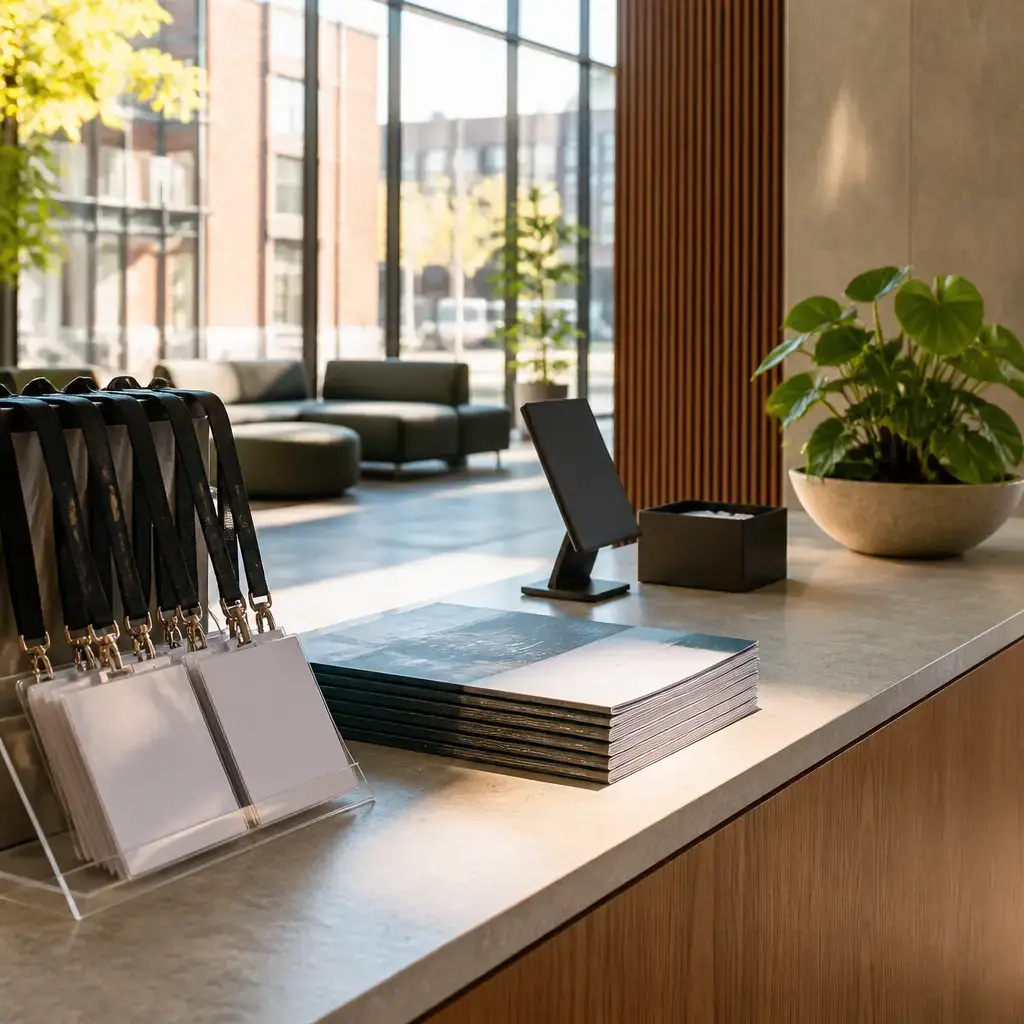
Use Conference check-in and finding the first session to practice Danish conversation, pronunciation, vocabulary, grammar, and quizzes.
Dialogue
Jeg tilmeldte mig online til dagens konference.
yai teel-MEL-də my on-LEE-nə teel DAY-ens kohn-feh-REN-sə. I registered online for today's conference.Jeg kan hjælpe dig med at tjekke ind. Bekræft venligst din tilmelding på denne skærm.
yai kan YEL-bə dai meh at CHEK-ə in. beh-KREFT VEN-lihst deen teel-MEL-ding poh DEN-uh skairm. I can help you check in. Please confirm your registration on this screen.Den viser min tilmelding og den workshop om eftermiddagen, som jeg valgte.
den VEE-sər meen teel-MEL-ding oh den WURK-shop ohm EF-ter-mee-DAH-en, som yai VEL-də. It shows my registration and the afternoon workshop I chose.Jeg kan se den workshop på listen sammen med oplysningerne til dit navneskilt.
yai kan SAY den WURK-shop poh LIS-den sahm-men meh ohp-LYS-ning-er-nə teel dit NAH-nə-skilt. I see that workshop listed with your badge details.Er der en trykt dagsorden, eller skal jeg bruge den online?
air dair en TRYKT DAY-ohs-ən, EL-ər skal yai BWEW-ə den on-LEE-nə? Is there a printed agenda, or should I use the online one?De trykte dagsordener er her, men den online version har de nyeste oplysninger om, hvilke lokaler der er tildelt.
dee TRYK-də DAY-ohs-er-nə air hair, men den on-LEE-nə ver-SHOHN har dee NEW-ə-stə ohp-LYS-ning-er ohm, VIL-kə loh-KAY-lər dair air tee-DELT. Printed agendas are here, but the online version has the latest room assignments.Jeg bruger den online dagsorden, så jeg ikke går glip af opdateringer.
yai BWEW-ər den on-LEE-nə DAY-ohs-ən, soh yai IK-ə goh gleeb ah op-dah-TEER-ing-er. I'll use the online agenda so I don't miss any updates.Her er dine materialer og dit navneskilt.
hair air DEE-nə ma-teh-ree-AH-lər oh dit NAH-nə-skilt. Here are your materials and badge.Hvilket lokale skal jeg gå til først?
VIL-kət loh-KAY-lə skal yai goh teel furst? Which room should I go to first?Åbningssessionen er i hovedsalen, lige ned ad denne gang.
OHB-ning-seh-SHŌN-en air ee HOH-ə-sah-lən, LEE-eh neh ah DEN-uh gahng. The opening session is in the main hall, straight down this corridor.Sentence explanations
Jeg tilmeldte mig online til dagens konference.
I registered online for today's conference.
- Jeg
- I
- tilmeldte mig
- registered
- online
- online
- til
- for
- dagens
- today’s
- konference
- conference
More detail
Jeg means “I” here: the first-person singular subject pronoun. Danish subject pronouns include jeg “I,” du “you” (singular), and vi “we.” Example: Jeg arbejder. — “I work.” tilmeldte mig expresses “registered” in this sentence. The verb is tilmelde “to register,” used with the reflexive pronoun in tilmelde sig; with the first-person subject jeg, that pronoun appears as mig. tilmeldte is the past form, and Danish verbs generally do not change for the subject’s person or number in the past: jeg tilmeldte, vi tilmeldte. Example: Hun tilmeldte sig kurset. — “She registered for the course.” online is the same commonly used adverb in Danish and English, meaning that the registration was carried out over the internet. Its position between the verb phrase and the following prepositional phrase identifies how the registration happened, not what was registered for. Example: Vi købte billetter online. — “We bought tickets online.” til means “for” in the expression naming the event or activity someone registers for. It is a preposition, so its exact English equivalent depends on the relation it marks; here it connects the registration with the conference. Example: Han tilmeldte sig til kurset. — “He registered for the course.” dagens means “today’s.” It is the possessive form of dag “day,” formed with -s; it identifies the conference as belonging to or associated with today. This is distinct from i dag, which means “today” as a time expression. Example: Dagens møde begynder klokken ni. — “Today’s meeting begins at nine.” konference means “conference.” The form shown is singular and indefinite; with the definite article, Danish has konferencen, “the conference.” Example: Konferencen varer to dage. — “The conference lasts two days.” Together, Jeg supplies the speaker as subject, tilmeldte mig places that registration in the past, online states how it happened, and til dagens konference identifies the event: the speaker registered online for today’s conference.
Jeg kan hjælpe dig med at tjekke ind. Bekræft venligst din tilmelding på denne skærm.
I can help you check in. Please confirm your registration on this screen.
- Jeg kan
- I can
- hjælpe
- help
- dig
- you
- tjekke ind
- check in
- Bekræft
- confirm
- venligst
- please
- din
- your
- tilmelding
- registration
- denne
- this
- skærm
- screen
More detail
Jeg kan combines the first-person pronoun Jeg (“I”) with kan, the present-tense form of kunne (“can, be able to”). In Danish, kan is followed by an infinitive without at: Jeg kan hjælpe means “I can help.” Here it expresses the speaker’s ability or offer. hjælpe is the infinitive “to help.” It follows the modal kan, so it stays in the infinitive rather than taking a present-tense ending. Example: Jeg kan hjælpe dig. — “I can help you.” dig is the object form of the second-person pronoun, “you.” Danish distinguishes subject du (“you”) from object dig (“you”): Du hjælper mig means “You help me,” while Jeg hjælper dig means “I help you.” tjekke ind is a reusable verb-plus-particle construction meaning “check in.” tjekke is the infinitive used after kan, and ind adds the “in” part of the construction. Example: Vi skal tjekke ind nu. — “We have to check in now.” Bekræft is the imperative of bekræfte, “to confirm.” It gives a direct instruction to the understood addressee, equivalent here to “Please confirm.” The infinitive is bekræfte; the imperative is formed as Bekræft. venligst is a polite word meaning “please.” It softens the instruction but does not change its grammatical force: Bekræft venligst is “Please confirm.” din means “your” and agrees with the possessed noun, not with the person who possesses it. It is used with a singular common-gender noun such as en tilmelding; with a singular neuter noun, the form is dit, and with a plural noun, dine. tilmelding means “registration” or “sign-up.” It is a noun whose basic form is tilmelding; here din identifies the registration as belonging to the addressee, giving “your registration.” Example: Min tilmelding er klar. — “My registration is ready.” denne means “this” before a singular common-gender noun. It agrees with skærm, which is a common-gender noun: en skærm. The corresponding forms include dette with a singular neuter noun and disse with a plural noun. skærm means “screen.” It is a common-gender noun, so denne skærm means “this screen.” In the full phrase, på denne skærm, the preposition på contributes “on”: “on this screen.” Together, Jeg kan hjælpe dig med at tjekke ind means “I can help you check in.” The pattern hjælpe nogen med at introduces an activity that someone helps another person with, and tjekke ind names that activity. Bekræft venligst din tilmelding på denne skærm means “Please confirm your registration on this screen”: the imperative Bekræft gives the instruction, din tilmelding identifies what to confirm, and på denne skærm identifies where to do it.
Den viser min tilmelding og den workshop om eftermiddagen, som jeg valgte.
It shows my registration and the afternoon workshop I chose.
- Den
- it
- viser
- shows
- min
- my
- tilmelding
- registration
- den
- the
- workshop
- workshop
- om eftermiddagen
- in the afternoon
- som
- that; which
- jeg
- I
- valgte
- chose
More detail
Den means “it” here, as established by the fixed translation. In Danish, den is the singular form used with a common-gender noun; the exact noun referred to by “it” is not identified in the sentence itself. viser means “shows.” Its base form is vise, and viser is the present-tense form. Danish present-tense verbs do not change for the subject: jeg viser means “I show,” while den viser means “it shows.” min means “my” before a singular common-gender noun. Here it agrees with tilmelding, which is en tilmelding. Compare mit before a singular neuter noun and mine before plural nouns. tilmelding means “registration.” The noun can be reused in expressions such as en tilmelding til et kursus, “a registration for a course.” The second den means “the” before the singular common-gender noun workshop. In this sentence it introduces the particular workshop being shown. The demonstrative/definite form does not itself express the afternoon information; that comes in the following time expression. workshop means “workshop.” It is a noun used for a practical class, session, or event. For example, Jeg deltager i en workshop means “I am attending a workshop.” om eftermiddagen means “in the afternoon.” Eftermiddagen is the definite form of en eftermiddag (“an afternoon”): eftermiddag becomes eftermiddagen when referring to the afternoon as a time period. The preposition om is commonly used in Danish time expressions such as om morgenen (“in the morning”) and om aftenen (“in the evening”). som introduces the relative clause describing the workshop. In this sentence it corresponds to “that” or “which,” and it is the object of valgte: the meaning is “the workshop that I chose.” Danish som does not show the gender or number of the noun it relates to. jeg means “I.” It is the subject of the relative clause, so the chooser is the speaker. A useful contrast is du (“you”) in du valgte, “you chose.” valgte means “chose.” Its base form is vælge (“to choose”), and valgte is its past-tense form. The past form is used because the choosing happened before or by the relevant point when the workshop is being shown. For example, Jeg valgte en workshop means “I chose a workshop.” Together, Den viser gives “It shows,” followed by min tilmelding (“my registration”) and den workshop om eftermiddagen (“the afternoon workshop”). The final relative clause, som jeg valgte, identifies that workshop as the one the speaker chose. The complete meaning is: “It shows my registration and the afternoon workshop I chose.”
Jeg kan se den workshop på listen sammen med oplysningerne til dit navneskilt.
I see that workshop listed with your badge details.
- Jeg kan
- I can
- se
- see
- den
- that/the
- workshop
- workshop
- listen
- the list
- sammen med
- together with
- oplysningerne
- the details
- til
- for
- dit
- your
- navneskilt
- name badge
More detail
Jeg kan combines the subject jeg (“I”) with kan, the present-tense form of kunne (“can; be able to”). In this sentence it expresses ability to see something. Danish modal verbs such as kan are followed by the infinitive without at: Jeg kan se means “I can see,” not “I can to see.” Example: Jeg kan hjælpe. — “I can help.” se means “see” here. Its base form is also se; after kan, it stays in the infinitive. Compare Jeg ser workshoppen. — “I see the workshop.” The form ser is present tense without a modal, whereas se is the infinitive selected after kan. den identifies workshop as a particular one, matching the intended “that workshop.” Danish den is used with a common-gender singular noun; it can function as a demonstrative before a noun, as here. The form is not the noun's gender marker itself: the noun determines which demonstrative form is appropriate. Example: den lange liste — “that long list.” workshop is a noun meaning “workshop.” It is a common-gender noun in this use, which is why the preceding form is den. The noun remains unchanged here; its definiteness is expressed by the separate word den rather than by an ending. Example: Jeg deltager i en workshop. — “I am attending a workshop.” listen means “the list.” It is the definite singular form of liste (“list”): en liste → listen. The ending -en marks a definite common-gender singular noun. Example: Listen er kort. — “The list is short.” sammen med is the reusable prepositional construction “together with.” It links the workshop on the list with the details. Example: Hun kom sammen med sin kollega. — “She came together with her colleague.” oplysningerne means “the details” here. It is the definite plural form of oplysninger (“details; information”): oplysninger → oplysningerne. The definite plural ending -ne shows that the speaker means particular details. Example: Oplysningerne står i brevet. — “The details are in the letter.” til is a preposition that can mean “for” when it marks what something is intended for or associated with. In oplysningerne til dit navneskilt, it connects the details with the name badge: “the details for your name badge.” Example: en billet til toget — “a ticket for the train.” dit means “your” before a singular neuter noun. It is the neuter singular form of the second-person singular possessive: din with a common-gender singular noun, dit with a neuter singular noun, and dine with plural nouns. Here it agrees with navneskilt, not with the possessor. Example: dit pas — “your passport.” navneskilt means “name badge.” It is a neuter singular compound noun, built from navn (“name”) and skilt (“sign; badge”), but it functions as one noun. The possessive dit agrees with this noun. Example: Mit navneskilt er blåt. — “My name badge is blue.” Together, Jeg kan se gives “I can see,” den workshop på listen gives “that workshop on the list,” and sammen med oplysningerne til dit navneskilt adds “together with the details for your name badge.” The complete utterance therefore means: “I can see that workshop listed with your badge details.”
Er der en trykt dagsorden, eller skal jeg bruge den online?
Is there a printed agenda, or should I use the online one?
- Er der
- is there
- trykt
- printed
- dagsorden
- agenda
- eller
- or
- skal jeg
- should I
- bruge
- use
- den online
- the online one
More detail
Er der is the Danish existential question pattern meaning “is there …?” It asks whether something exists or is available. Danish places der after the verb in this pattern: Er der en stol? — “Is there a chair?” Here, en marks a singular common-gender noun; it does not by itself assert a numerical count. trykt means “printed” here. It is the past participle of trykke (“to print”) used adjectivally. With the singular common-gender noun dagsorden, the form is trykt; in the plural, the related form is trykte, as in de trykte dagsordener (“the printed agendas”). dagsorden means “agenda.” Its plural is dagsordener: en dagsorden → flere dagsordener. The noun is common gender, which is relevant to the article en and to the form of the demonstrative later in the sentence. eller means “or” and links the two alternatives in the question. The first alternative asks about a printed agenda; the second asks what the speaker should use instead. skal jeg combines the modal verb skal with the subject jeg (“I”). In this question, skal expresses what the speaker ought to do or is expected to do, giving the intended meaning “should I.” Danish questions commonly place the finite verb before the subject: Skal jeg vente? — “Should I wait?” bruge is the infinitive of bruge, “to use.” It follows the modal skal without an infinitive marker: Jeg skal bruge ... means “I should/will use ...,” while Skal jeg bruge ...? asks whether that is the appropriate action. den online means “the online one” in this sentence. den is the common-gender singular form used here as a pronoun referring to the online agenda/version, and online identifies its format. The noun is omitted because it is understood from the comparison with the printed agenda. In the following context, the same choice is made explicit as den online version (“the online version”). Together, Er der en trykt dagsorden asks whether a printed agenda is available. eller skal jeg bruge den online presents the alternative of using the online agenda instead. The whole utterance therefore means: “Is there a printed agenda, or should I use the online one?”
De trykte dagsordener er her, men den online version har de nyeste oplysninger om, hvilke lokaler der er tildelt.
Printed agendas are here, but the online version has the latest room assignments.
- trykte
- printed
- dagsordener
- agendas
- er her
- are here
- men
- but
- online
- online
- version
- version
- har
- has
- nyeste
- latest
- oplysninger
- information
- hvilke
- which
- lokaler
- rooms
- tildelt
- assigned
More detail
trykte means “printed” here. It is the definite/plural form of the adjective trykt, which is related to trykke (“to print/press”). In this sentence, its plural form agrees with dagsordener; the adjective does not itself express who printed them. dagsordener means “agendas.” It is the plural of dagsorden; the plural is formed with -er. Example: to dagsordener means “two agendas.” er her means “are here.” er is the present form of være (“to be”), and her indicates location. The plural subject is why the English translation uses “are,” although Danish er itself does not show a separate plural form here. men introduces a contrast: “but.” It connects the statement about the printed agendas with the different useful feature of the online version. online means “online.” Used before version, it describes the type or medium of the version. Danish commonly leaves this loanword unchanged rather than giving it a special adjective ending. version means “version.” Its plural is versioner; here the singular form is used because the sentence refers to one online version. har means “has” in this sentence. It is the present form of have (“to have”): jeg har means “I have,” while den har means “it has.” Here den is the subject referring to the online version established by the sentence and context. nyeste means “latest” or “newest.” It is the superlative form in the comparison chain ny (“new”), nyere (“newer”), nyest (“newest”); nyeste is the form used before a definite or plural noun such as oplysninger. It describes the information as the most recent available, not merely newer than one other item. oplysninger means “information” here, specifically the information contained in the online version. It is the plural of oplysning (“piece of information” or “information”). Danish often uses this plural form where English uses the usually uncountable word “information.” hvilke means “which” and introduces a clause identifying the relevant rooms. It is the plural form used with the plural noun lokaler; unlike a yes/no question, it asks for a selection or identification from possible items. lokaler means “rooms” or “premises.” It is the plural of lokale; the plural ending is -er. In this sentence, the fixed translation specifies that these are rooms whose assignments are being described. tildelt means “assigned” here. It is the past participle of tildele (“to assign”): tildele → tildelt. With er in the relative clause, the meaning is that the rooms are assigned: lokaler, der er tildelt ... is a reusable pattern for “rooms that are assigned ...”. The form tildelt itself does not show the plural; the plural noun is lokaler, while er is the present form of være. Together, the first part says that the printed agendas are located here. men contrasts this with the online version, which contains the most recent information concerning which rooms have been assigned. Thus the utterance communicates that the printed agendas are available, while the online version is the more current source for room assignments.
Jeg bruger den online dagsorden, så jeg ikke går glip af opdateringer.
I'll use the online agenda so I don't miss any updates.
- Jeg
- I
- bruger
- use
- den
- the
- online
- online
- dagsorden
- agenda
- så jeg ikke
- so I do not
- går glip af
- miss
- opdateringer
- updates
More detail
Jeg means “I.” It is the first-person singular subject pronoun. The corresponding object form is mig, as in Hun ser mig (“She sees me”); Jeg is used for the person performing the action. bruger is the present form of bruge, “to use.” The present form is the same for all persons: jeg bruger, du bruger, de bruger. In this sentence, it describes the intended use of the agenda; Danish present forms can also refer to a planned action when the context supports that reading. den is the definite article used with this noun phrase. dagsorden is a common-gender noun, so its definite form is dagsordenen, while a preceding definite article is den in a phrase such as den online dagsorden. Here den belongs with dagsorden, not with Jeg or bruger. online means “online.” It is an invariable modifier, so it does not take a Danish gender or number ending in this use. It identifies the agenda as the online version, contrasting with de trykte dagsordener (“the printed agendas”) in the previous context. dagsorden means “agenda.” It is a common-gender noun: en dagsorden (“an agenda”), dagsordenen (“the agenda”), and plural dagsordener (“agendas”). In the fixed sentence it is singular and refers to the online agenda. så jeg ikke introduces the purpose of the action: “so that I do not.” så can introduce a result or purpose clause; here the meaning is purpose. jeg is again the subject, and ikke negates the following clause. A reusable pattern is så jeg ikke + verb, for example Jeg skriver det ned, så jeg ikke glemmer det (“I write it down so that I do not forget it”). går glip af is a fixed verb construction meaning “miss” or “fail to get.” Its verb is går, the present form of gå (“go”), but the whole expression—not the literal movement “go”—has the relevant meaning here. The thing missed follows af: Hun går glip af mødet means “She misses the meeting.” opdateringer means “updates.” It is the plural of opdatering; the singular is en opdatering, and the definite plural is opdateringerne (“the updates”). The plural here matches the translation’s general reference to updates rather than one specifically identified update. Together, Jeg bruger den online dagsorden means “I’ll use the online agenda” in the supplied context. så jeg ikke går glip af opdateringer adds the purpose: “so I don’t miss any updates.” The complete utterance therefore means “I’ll use the online agenda so I don’t miss any updates.”
Her er dine materialer og dit navneskilt.
Here are your materials and badge.
- Her er
- Here are
- dine
- your
- materialer
- materials
- og
- and
- dit
- your
- navneskilt
- badge
More detail
Her er introduces something that is being presented or pointed out. In this sentence, the fixed translation uses “Here are” because the first item is plural, but the Danish expression itself is also used with a singular item: Her er bogen means “Here is the book.” The form er is the present form of være (“to be”). dine means “your” before a plural noun. It agrees with the possessed noun’s number, not with the owner: dine materialer means “your materials.” Compare singular forms such as din bog (“your book”) and dit navneskilt (“your badge”), where din and dit are selected according to the noun’s grammatical gender. materialer is the plural of materiale, meaning “material” or “materials.” Here it is a bare plural after the possessive, so Danish does not add a separate plural article. Example: Mine materialer ligger her. — “My materials are here.” og is the conjunction “and.” It links the two presented noun phrases: dine materialer and dit navneskilt. dit means “your” before a singular neuter noun. It agrees with the noun navneskilt, rather than expressing anything about the owner. The corresponding possessive forms include din before a singular common-gender noun and dine before a plural noun. Example: Hvor er dit lokale? — “Where is your room?” navneskilt means “name badge” or “badge.” It is a singular neuter noun; its plural is navneskilte. After dit, the singular noun appears without a separate indefinite article: dit navneskilt means “your badge.” Together, Her er dine materialer og dit navneskilt presents two things to the listener: “Here are your materials and badge.” The first possessive is plural because materialer is plural; the second is neuter singular because navneskilt is a singular neuter noun. The following question about which room to go to supports the same practical orientation context, but it does not change the sentence’s meaning.
Hvilket lokale skal jeg gå til først?
Which room should I go to first?
- Hvilket
- which
- lokale
- room
- skal jeg
- should I
- gå
- go
- til
- to
- først
- first
More detail
Hvilket means “which” when selecting one item from neuter-gender singular nouns. Danish varies the form with the noun: hvilken is used with common-gender singular nouns, hvilket with neuter singular nouns, and hvilke with plural nouns. Here it agrees with lokale. lokale means “room” here. Its plural is lokaler. The same word can also refer to premises or a venue, but “room” is the intended meaning in this utterance. Example: Et lokale — “a room.” skal jeg forms the question’s modal pattern. skal is the present form of skulle; with jeg, it expresses what the speaker is supposed or expected to do, or asks for guidance about what to do. In a question, the finite verb comes before the subject: Skal jeg ...? — “Should I ...?” The form skal does not change here for the subject’s gender or number. gå means “go” and is the infinitive form. After the modal skal, Danish uses the infinitive without an infinitive marker: skal jeg gå — “should I go.” Example: Jeg skal gå nu. — “I have to go now.” til marks the destination, “to.” With a movement verb such as gå, it introduces the place the speaker is going to: gå til et lokale — “go to a room.” først means “first,” indicating the first place in an intended order. It is an adverb and does not inflect for the room. Example: Hvilket lokale skal vi besøge først? — “Which room should we visit first?” Together, Hvilket lokale asks the listener to identify one room, skal jeg gå til asks which destination the speaker should go to, and først places that destination first in the sequence. The whole utterance therefore means: “Which room should I go to first?”
Åbningssessionen er i hovedsalen, lige ned ad denne gang.
The opening session is in the main hall, straight down this corridor.
- Åbningssessionen
- opening session
- er
- is
- hovedsalen
- main hall
- lige ned ad
- straight down
- denne
- this
- gang
- corridor
More detail
Åbningssessionen means “the opening session.” The base noun is session, and åbning specifies its type: an opening session. The ending -en marks singular definite form in this compound, so it refers to the session as an identifiable event here. Danish compounds are written as one word. er is the present-tense form of være (“to be”). Here it links the session with its location. The same form is used with singular and plural subjects in the present: sessionen er (“the session is”), but sessionerne er (“the sessions are”). hovedsalen means “the main hall.” Its base noun is hovedsal; the ending -en marks singular definite form. hoved- specifies the hall’s role or type, while sal means “hall.” Do not treat hovedsalen as an adjective modifying a separately written noun: it is one compound noun. lige ned ad is a reusable directional construction meaning “straight down” or “directly along.” lige adds the idea of a direct route, and ned ad describes movement or direction along a route. For example, Gå lige ned ad gaden. means “Go straight down the street.” denne means “this” and is the common-gender singular form used with gang here. A demonstrative such as denne identifies a nearby or contextually indicated item; it is not itself a quantity marker. Danish also has dette with neuter singular nouns and disse with plural nouns. gang means “corridor” in this sentence. Its form is singular and indefinite, but denne supplies the identifying force in denne gang (“this corridor”), so no separate indefinite article appears. The noun can have other meanings in other contexts, such as “time” in an expression about something happening once, but the fixed translation establishes the corridor meaning here. Together, Åbningssessionen er states that the opening session has a location, i hovedsalen gives that location as the main hall, and lige ned ad denne gang gives a direct route along this corridor. The whole utterance therefore means: “The opening session is in the main hall, straight down this corridor.”
Grammar Points
tilmelde sig → tilmeldte mig
tilmeldte mig online
teel-MEL-də my on-LEE-nəI registered online.
The reflexive pronoun changes with the subject; with “I,” sig becomes mig.
Bestemt form med -en
åbningssessionen
OHB-ning-seh-SHŌN-enthe opening session
Danish adds -en to mark a definite common-gender noun; English uses the separate word “the.”
Danish Vocabulary
Bekræft venligst din tilmelding på denne skærm.
- Gender
- common
Den viser min tilmelding og den workshop om eftermiddagen, som jeg valgte.
Jeg kan hjælpe dig med at tjekke ind.
- Gender
- common
Jeg tilmeldte mig online til dagens konference.
Jeg tilmeldte mig online til dagens konference.
- Gender
- common
Bekræft venligst din tilmelding på denne skærm.
Jeg tilmeldte mig online til dagens konference.
- Gender
- common
Bekræft venligst din tilmelding på denne skærm.
Jeg kan hjælpe dig med at tjekke ind.
Den viser min tilmelding og den workshop om eftermiddagen, som jeg valgte.
Den viser min tilmelding og den workshop om eftermiddagen, som jeg valgte.
- Gender
- common
Den viser min tilmelding og den workshop om eftermiddagen, som jeg valgte.
Quiz
Spelling
Tap the letters to spell the word.
screen
Show Answer
skærmto help
Show Answer
hjælpeonline
Show Answer
onlineregistration