10 minutes free every day
Continue audio lessons in the app
Word explanations appear automatically in sync with the audio.
No login required · synced translations · playback with the screen locked
Choose your learning language and open this lesson in the app.

About This Lesson
Use Planning a group dinner to practice Danish conversation, pronunciation, vocabulary, grammar, and quizzes.
Dialogue
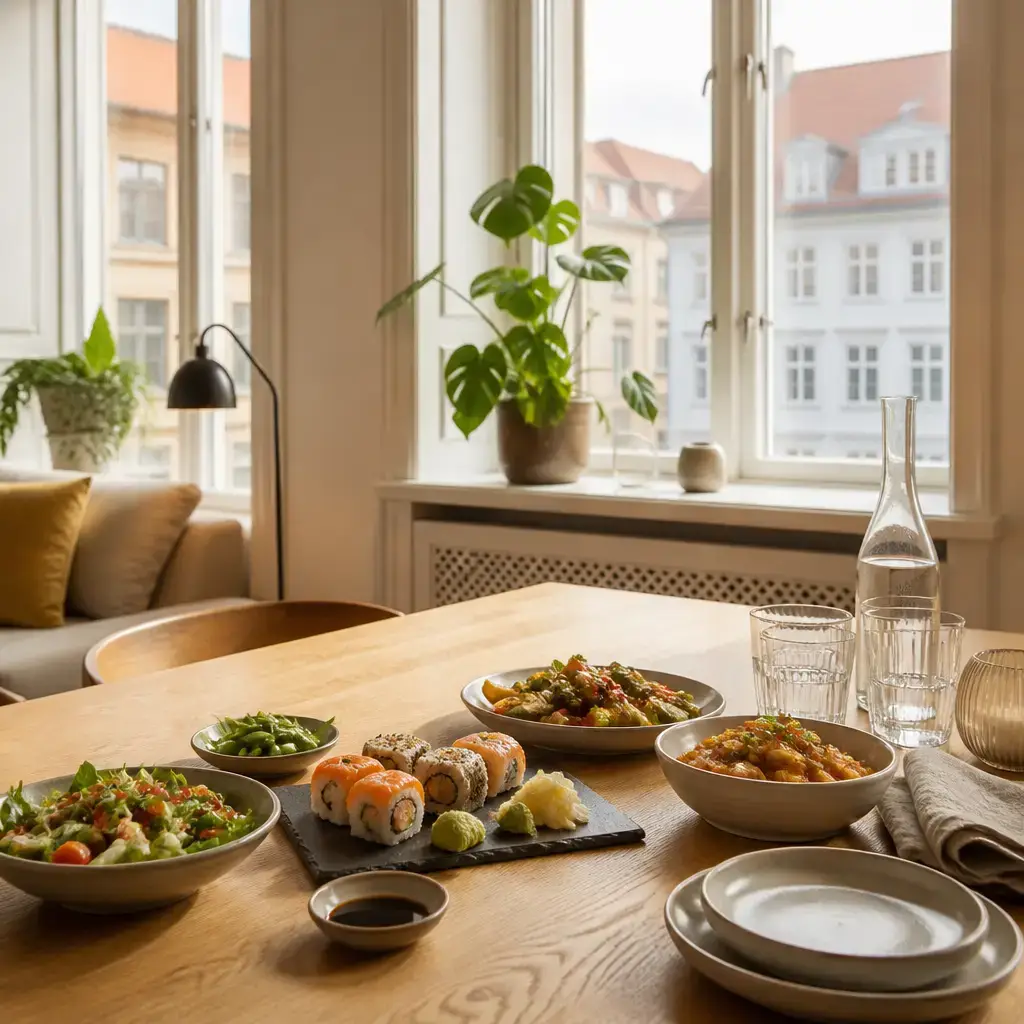
Vi skal vælge en restaurant til vores gruppe på lørdag.
vee skal VEL-yuh uhn res-tuh-RONG teel VOH-uhs GROO-buh poh LUR-dah We need to choose a restaurant for our group on Saturday.Så bør vi tjekke alles madpræferencer, før vi bestiller bord.
soh buhr vee CHEG-uh AL-uhs mah-preh-feh-REN-suh, fuhr vee beh-STEL-uh bohr Then we should check everyone's food preferences before making a reservation.Nogle vil have sushi, men andre foretrækker et varmt måltid.
NOH-luh veel HAY-vuh SOO-shee, men AHN-druh foh-TRAEG-uh ehd VORMT MOHL-teed Some people want sushi, but others prefer a hot meal.Et sted med en varieret menu ville være mere fleksibelt.
ehd stey meh uhn vah-ree-AY-uhd meh-NOO VIL-uh VAIR-uh MAY-uh fleg-see-BELD A place with a varied menu would be more flexible.Jeg har fundet en afslappet restaurant med vegetariske retter og store borde.
yai hah FOON-uhd uhn ow-SLAH-buht res-tuh-RONG meh veh-geh-TAH-ris-kuh RED-uh oh STOH-uh BOH-uh I found a casual restaurant with vegetarian options and big tables.Det lyder som et mere sikkert valg til en blandet gruppe.
deh LOO-uh sohm ehd MAY-uh SEER-guhd valg teel uhn BLAN-uhd GROO-buh That sounds like a safer choice for a mixed group.Skal jeg spørge gruppen, før jeg bestiller bord, eller skal jeg vælge den nu?
skal yai SPUHR-yuh GROO-buhn, fuhr yai beh-STEL-uh bohr, EL-uh skal yai VEL-yuh den noo Should I ask the group before booking, or choose it now?Giv dem to muligheder, og bed dem om et hurtigt svar.
geev dehm toh moo-lee-HAY-thuh, oh behd dehm ohm ehd HOOHR-digt svahr Give them two options and ask for a quick response.Jeg sender en kort afstemning, så vi kan beslutte os i aften.
yai SEN-uh uhn kohrt OW-stem-ning, soh vee kan beh-SLOOT-uh ohs ee AF-tuhn I will send a short poll so we can decide tonight.Det burde holde planen i gang uden at spørge for mange mennesker om deres mening.
deh BOO-uh HOHL-uh PLAY-nuhn ee gang OO-uhn uh SPUHR-yuh foh MAN-yuh MEN-uh-sguh ohm DAY-uhs MAY-ning That should keep the plan moving without asking too many people for opinions.Sentence explanations
Vi skal vælge en restaurant til vores gruppe på lørdag.
We need to choose a restaurant for our group on Saturday.
- Vi skal
- we need to
- vælge
- choose
- restaurant
- restaurant
- gruppe
- group
- lørdag
- Saturday
More detail
Vi skal means “we need to” here. Vi is the first-person plural pronoun “we”. Skal is the present form of skulle; with an infinitive, it expresses a requirement, plan, or intended action. The following infinitive is vælge, so vi skal vælge forms the reusable pattern “we need to choose”. vælge means “to choose” here. It is the infinitive form, used after skal. Example: Vi skal vælge en film. — “We need to choose a film.” restaurant is the noun “restaurant”. The preceding en marks it as an indefinite common-gender noun phrase; it does not by itself state a numerical count. A useful related form is restauranten, “the restaurant”, with the definite ending attached to the noun. gruppe means “group”. In vores gruppe, vores means “our” and identifies the group as belonging to or associated with the speakers. The noun is singular here; the plural is grupper (“groups”), and the definite singular is gruppen (“the group”). lørdag means “Saturday”. In this sentence, på lørdag is the time expression “on Saturday”. Danish commonly uses the weekday name without an article in this expression. Example: Vi mødes på lørdag. — “We are meeting on Saturday.” Putting the parts together: Vi skal vælge = “we need to choose”, en restaurant = “a restaurant”, til vores gruppe = “for our group”, and på lørdag = “on Saturday”. The complete meaning is: “We need to choose a restaurant for our group on Saturday.”
Så bør vi tjekke alles madpræferencer, før vi bestiller bord.
Then we should check everyone's food preferences before making a reservation.
- Så
- then
- bør vi
- we should
- tjekke
- check
- alles
- everyone’s
- madpræferencer
- food preferences
- før
- before
- bestiller bord
- book a table
More detail
Så means “then” here and connects this suggestion to the preceding situation. It can also mean “so” in other contexts; the surrounding clause determines the appropriate English translation. bør vi expresses that “we” ought to do something. bør is the present form of burde; with the infinitive tjekke, the pattern bør + infinitive means “should/ought to do”. In this sentence, Så is placed first, so Danish main-clause word order puts the finite verb bør before the subject vi (V2 word order). Compare: Vi bør vente. — “We should wait.” tjekke means “to check”. It is the infinitive after bør, and it does not take at here: Vi bør tjekke ... means “We should check ...”. The same verb can be used for checking information, items, or arrangements. alles means “everyone’s” or “everybody’s”. It is the possessive/genitive form related to alle (“everyone” or “all [people]”) and marks the following noun phrase as belonging to everyone collectively. Example: alles mening — “everyone’s opinion.” madpræferencer means “food preferences”. It is a compound noun: mad means “food”, and præferencer is the plural of præference (“preference”). The form is an indefinite plural, referring generally to preferences rather than to a specifically definite set. Danish compounds are written as one word. før means “before”. Here it introduces a subordinate time clause: før ... means “before ...”. The subject is stated inside that clause as vi, producing før vi bestiller ... — “before we book ...”. bestiller bord means “book a table” in this context. bestiller is the present form of bestille (“to order/book”), and bord is the singular indefinite noun “table”. Together, bestille bord is the ordinary construction for reserving a table; here it refers to making that reservation, not necessarily to ordering food. Example: Vi bestiller bord til klokken syv. — “We book a table for seven o’clock.” Putting the parts together: Så bør vi tjekke alles madpræferencer means “Then we should check everyone’s food preferences”, and før vi bestiller bord adds “before we book a table”. The complete utterance is: “Then we should check everyone’s food preferences before making a reservation.”
Nogle vil have sushi, men andre foretrækker et varmt måltid.
Some people want sushi, but others prefer a hot meal.
- Nogle
- some people
- vil
- want to
- have
- have
- sushi
- sushi
- andre
- others
- foretrækker
- prefer
- varmt
- hot; warm
- måltid
- meal
More detail
Nogle means “some” and is used here for an unspecified plural group of people. It does not identify exactly who or how many people are included. Compare nogle “some” with alle “everyone/all,” as in Alle kommer — “Everyone is coming.” vil is the present form of ville. With the following infinitive have, it expresses the intended meaning “want to”: vil have — “want to have.” The same form can express future meaning in other contexts, but that is not its meaning here. have is the infinitive “to have.” In vil have sushi, it means wanting sushi as food, naturally “want sushi.” The infinitive follows vil; the form itself does not show who the subject is. sushi is the food name “sushi.” It is unchanged here; the sentence presents it as the food some people want. andre means “others,” referring to a different unspecified part of the people under discussion. Together, Nogle ... andre ... is a reusable contrast pattern: “Some ... others ...” For example, Nogle læser, andre skriver means “Some read, others write.” foretrækker is the present form of foretrække, “to prefer.” It describes the choice made by andre: they prefer one option rather than another. For example, Jeg foretrækker te means “I prefer tea.” varmt is the form of the adjective varm, “hot; warm,” used with the neuter singular noun måltid. Danish adjectives commonly use varm with common-gender singular nouns, varmt with neuter singular nouns, and varme with plural or definite noun phrases: en varm ret, et varmt måltid, varme måltider — “a hot dish,” “a hot meal,” “hot meals.” måltid means “meal.” The noun phrase et varmt måltid means “a hot meal”: et is the neuter singular indefinite article, and varmt agrees with måltid in that form. The complete structure is Nogle vil have sushi, men andre foretrækker et varmt måltid. Nogle vil have sushi says that some people want sushi; men introduces a contrast; andre foretrækker et varmt måltid says that others prefer a hot meal. Thus the whole utterance means: “Some people want sushi, but others prefer a hot meal.”
Et sted med en varieret menu ville være mere fleksibelt.
A place with a varied menu would be more flexible.
- sted
- place
- med
- with
- varieret
- varied
- menu
- menu
- ville være
- would be
- mere fleksibelt
- more flexible
More detail
sted means “place” here. Its base form is sted; the noun is neuter, which is why the sentence uses et sted rather than en sted. Et marks an indefinite singular noun; it does not by itself state a numerical quantity. med means “with” and introduces what the place has or is associated with. This preposition is reusable in patterns such as en restaurant med ... (“a restaurant with ...”). varieret means “varied” here. It describes menu and agrees with that common-gender singular noun in the indefinite phrase en varieret menu. The plural form is varierede, as in the example varierede retter (“varied dishes”). menu is the noun “menu”. Its usual indefinite form is en menu, while the definite form is menuen (“the menu”). ville være expresses “would be”. ville is the form of ville used with an infinitive to express a conditional or hypothetical result, and være is the infinitive meaning “be”. The reusable pattern is [subject] ville være [description], for example: Det ville være praktisk. — “That would be practical.” mere fleksibelt means “more flexible”. mere forms the comparative with fleksibel; the adjective’s comparative phrase is therefore mere fleksibel or, as here, mere fleksibelt. The -t on fleksibelt is the neuter form because the description refers to et sted. The base adjective is fleksibel, and the superlative is commonly mest fleksibel (“most flexible”). Together, Et sted med en varieret menu means “a place with a varied menu”. ville være presents the judgment as a hypothetical result, and mere fleksibelt describes that place as more flexible. The complete utterance therefore means: “A place with a varied menu would be more flexible.”
Jeg har fundet en afslappet restaurant med vegetariske retter og store borde.
I found a casual restaurant with vegetarian options and big tables.
- Jeg har
- I have
- fundet
- found
- afslappet
- casual; relaxed
- restaurant
- restaurant
- med
- with
- vegetariske
- vegetarian
- retter
- options; dishes
- store
- big; large
- borde
- tables
More detail
Jeg har is the Danish present-perfect auxiliary construction: jeg means “I,” and har is the present form of have (“to have”). Together with a following past participle, it commonly presents something as completed with relevance now. Example: Jeg har spist. — “I have eaten.” The construction itself does not mean that the action happened at a specifically stated time. fundet is the past participle of finde (“to find”). The useful chain is finde → fandt (simple past) → fundet (past participle). Here, har fundet means “have found,” not merely “have” or “possess.” Example: Jeg har fundet en løsning. — “I have found a solution.” afslappet means “casual” or “relaxed” here and describes restaurant. It is the adjective form used with this singular common-gender noun: en afslappet restaurant. The adjective can also be afslappede with plural or definite noun phrases, for example afslappede restauranter — “casual restaurants.” restaurant is the noun “restaurant.” Its common-gender form is shown by the indefinite article en; the article identifies the noun phrase as indefinite but does not by itself state a numerical count. Example: Vi besøger en restaurant. — “We are visiting a restaurant.” med is a preposition meaning “with.” It introduces something associated with the restaurant: the restaurant has or offers the following features. Example: en restaurant med en terrasse — “a restaurant with a terrace.” vegetariske means “vegetarian” in this phrase. It is the plural form of the adjective vegetarisk, because it describes plural retter. Danish adjectives commonly take -e with plural nouns: vegetarisk mad — “vegetarian food,” but vegetariske retter — “vegetarian dishes.” retter is the plural of ret, meaning “dish” or, in a menu context, a food option. Its meaning here is best understood as “vegetarian options,” matching the fixed translation; it does not necessarily refer to separate choices in some other sense. Example: Menuen har flere vegetariske retter. — “The menu has several vegetarian dishes.” store means “big” or “large.” It is the plural form of the adjective stor, because it describes plural borde: stor → store. Compare et stort bord — “a big table” with store borde — “big tables.” borde is the plural of bord (“table”). The singular indefinite form is et bord, while the plural is borde; the plural noun does not need an additional plural marker beyond this form. Example: Der er store borde. — “There are big tables.” The sentence is assembled as Jeg har fundet (“I have found”) + en afslappet restaurant (“a casual restaurant”) + med vegetariske retter og store borde (“with vegetarian options and big tables”). The conjunction og links the two features. Thus the whole utterance means: “I found a casual restaurant with vegetarian options and big tables.”
Det lyder som et mere sikkert valg til en blandet gruppe.
That sounds like a safer choice for a mixed group.
- Det lyder
- That sounds
- som
- like
- mere sikkert
- safer
- valg
- choice
- til
- for
- blandet
- mixed
- gruppe
- group
More detail
Det lyder means “That sounds.” Lyder is the present form of lyde (“to sound”); Danish verbs do not change form for person or number, so this same form is used with different subjects. Here det is the “that” being assessed. A reusable pattern is Det lyder ...: Det lyder godt. — “That sounds good.” Som means “like” in the pattern lyde som ..., which connects an impression with the description that follows. For example, Det lyder som en god idé. means “That sounds like a good idea.” Mere sikkert means “safer” here. The adjective is sikker (“safe”); sikkert is its neuter singular form, agreeing with the neuter noun valg. Danish also commonly forms the comparative as sikrere (“safer”), while mere + adjective is another comparative pattern. The relevant forms include sikker, sikrere, and sikrest (“safest”); in this sentence the observed form is the analytic comparative mere sikkert. Valg is the neuter noun “choice.” Its indefinite singular form is et valg, and its plural is also valg, as in flere valg (“several choices”). Here it names the option being assessed. Til means “for” here. In et valg til ..., it can introduce what a choice is intended or suitable for; til en blandet gruppe specifies the group concerned. Blandet means “mixed.” With a common-gender singular noun it has the same form in en blandet gruppe; a plural example is blandede grupper — “mixed groups.” Here it describes the group without specifying what kinds of people make it mixed. Gruppe is the common-gender noun “group”: en gruppe, plural grupper. Thus en blandet gruppe means “a mixed group.” Together, Det lyder som presents an assessment, et mere sikkert valg identifies the option as safer, and til en blandet gruppe states the group for which it is being considered. The complete meaning is: “That sounds like a safer choice for a mixed group.”
Skal jeg spørge gruppen, før jeg bestiller bord, eller skal jeg vælge den nu?
Should I ask the group before booking, or choose it now?
- Skal jeg
- Should I…?
- spørge
- ask
- gruppen
- the group
- før
- before
- bestiller
- book
- bord
- table
- eller
- or
- vælge
- choose
- den
- it
- nu
- now
More detail
Skal jeg combines skal with jeg in a question. Here skal expresses what the speaker should do, so the pattern Skal jeg ...? means “Should I ...?” Danish questions commonly place this verb before the subject. Skal is the present form of skulle; after it, the next verb stays in the infinitive. spørge means “ask”. It is the infinitive used after skal. The present form is spørger, as in: Jeg spørger gruppen. — “I ask the group.” gruppen means “the group”. Its base noun is gruppe; gruppen is the definite singular form, marked by -en. A useful contrast is en gruppe — “a group” and gruppen — “the group.” før means “before” and introduces the action that must happen earlier. In før jeg bestiller ..., it introduces a clause with its own subject, jeg, and verb. bestiller means “book” here. It is the present form of bestille, and the present form is used in the clause after før: før jeg bestiller — “before I book.” The same form can mean “order” in a different context, but booking is the intended meaning here. bord means “table”. The expression bestille bord means “book a table”; Danish does not need an article in this compact expression. The noun's base form is bord. eller links alternatives and means “or”. It connects the two possible actions in this question. The second skal jeg repeats the same “Should I ...?” question pattern for the alternative action. Repeating it makes the two options parallel rather than treating the second action as a separate statement. vælge means “choose”. Like spørge, it is an infinitive after skal. Its present form is vælger: Jeg vælger. — “I choose.” den means “it” here. It is a singular common-gender object pronoun; the fixed material does not identify the exact thing it refers to, so its grammatical form can be explained without assigning it a specific referent. Danish also has det for a singular neuter referent, but the choice between den and det follows the grammatical gender of the intended noun, not simply its meaning. nu means “now”. It places the choosing at the present time: vælge den nu — “choose it now.” Together, Skal jeg spørge gruppen, før jeg bestiller bord asks whether the speaker should ask the group before booking a table. eller skal jeg vælge den nu? adds the alternative of choosing it now. The complete utterance therefore means: “Should I ask the group before booking, or choose it now?”
Giv dem to muligheder, og bed dem om et hurtigt svar.
Give them two options and ask for a quick response.
- Giv
- give
- to
- two
- muligheder
- options
- bed dem om
- ask them for
- hurtigt
- quick
- svar
- response
More detail
Giv is the imperative of give (“to give”). It tells the listener to carry out the action. The present-tense form is giver, as in Jeg giver dem to muligheder (“I give them two options”). to is the numeral “two”. It states the number of options explicitly; the indefinite article is not being used as a number here. muligheder means “options” and is the plural of mulighed (“option, possibility”). The singular indefinite form is en mulighed, and the definite plural is mulighederne (“the options”). bed dem om is the reusable Danish pattern bede nogen om noget: “ask someone for something”. Here bed is the imperative of bede, dem is the object form of the third-person plural pronoun (“them”), and om introduces what is requested. The phrase therefore asks the addressed person to ask them for something; the specific people referred to by dem are not identified in the fixed sentence. hurtigt means “quick” here. It is the neuter singular form of the adjective hurtig, because it describes the neuter noun svar after et: et hurtigt svar (“a quick response”). Compare en hurtig mulighed (“a quick option”) and hurtige svar (“quick responses”). svar means “response” or “answer”. In et svar, it is a neuter singular noun. Its definite singular form is svaret (“the response”), while the plural is also svar in the indefinite form. The first coordinated instruction is Giv dem to muligheder: “Give them two options.” The imperative Giv supplies the action, dem marks the recipients, to gives the number, and muligheder names what is given. After og (“and”), bed dem om et hurtigt svar adds the second instruction: ask them for a quick response. Together, the utterance means: “Give them two options and ask them for a quick response.”
Jeg sender en kort afstemning, så vi kan beslutte os i aften.
I will send a short poll so we can decide tonight.
- sender
- send
- kort
- short
- afstemning
- poll
- beslutte os
- decide
- i aften
- tonight
More detail
sender is the present-tense form of sende, “to send.” Danish present tense can also describe a planned future action when the context makes that clear; here the fixed translation gives that future reading: “I will send.” The related past form is sendte, “sent.” Example: Jeg sender en besked. — “I am sending a message” or, depending on context, “I will send a message.” kort means “short” here and describes afstemning. It is the base form of the adjective; Danish adjectives can change form according to the noun’s grammatical form, but this exact form is the one used in the sentence. Example: en kort besked — “a short message.” afstemning means “poll” or “vote,” and here the fixed translation selects the sense “poll”: a way of collecting people’s choices. It is a noun; its indefinite form is en afstemning, while the definite form is afstemningen, “the poll.” Example: Vi laver en afstemning. — “We are making a poll.” så introduces the purpose or result clause, meaning “so” here. vi is the first-person plural pronoun, “we.” kan is the present form of kunne, “can” or “be able to”; before an infinitive it expresses ability or possibility. beslutte os means “decide.” The verb is beslutte, and os is the first-person plural reflexive pronoun, referring back to the subject vi. The reflexive phrase beslutte sig is the reusable pattern; its pronoun changes with the subject, for example jeg beslutter mig — “I decide,” and de beslutter sig — “they decide.” i aften is the time expression “tonight,” literally using i with aften (“evening”). It places the deciding in the evening of the relevant day. Example: Vi mødes i aften. — “We are meeting tonight.” Together, Jeg sender en kort afstemning means “I will send a short poll.” The clause så vi kan beslutte os i aften gives its purpose: “so we can decide tonight.” Thus the whole utterance means: “I will send a short poll so we can decide tonight.”
Det burde holde planen i gang uden at spørge for mange mennesker om deres mening.
That should keep the plan moving without asking too many people for opinions.
- Det burde
- that should
- holde
- keep
- planen
- the plan
- i gang
- going; in motion
- uden at
- without ...-ing
- spørge
- ask
- for mange
- too many
- mennesker
- people
- mening
- opinion
More detail
Det burde means “that should” here. Det is a pronoun corresponding to “that” in the fixed translation. Its exact referent is not named in this sentence; the preceding context makes an earlier proposal relevant, but it does not establish a more specific grammatical referent. Burde is the modal verb burde, used with an infinitive to express an expected or advisable result. For example, Det burde virke means “That should work.” holde is the infinitive of holde, “to keep” or “to hold.” After the modal burde, the infinitive appears without an added infinitive marker: burde holde. The form holde can also mean “hold” in a physical sense, so its precise meaning comes from the construction that follows. planen is the definite singular form of plan, “plan”: en plan = “a plan,” planen = “the plan.” The ending -en marks definiteness for this noun; it is the noun, not an adjective, that carries this form. i gang is a reusable expression meaning “in motion,” “underway,” or “going.” With holde, holde planen i gang means “keep the plan going.” This is not the same as simply keeping possession of a plan: holde planen would normally mean “hold/keep the plan,” while holde planen i gang adds the idea of maintaining its progress. uden at introduces an action that is not performed: uden at + infinitive is a common Danish pattern corresponding to “without ...-ing.” For example, Hun gik uden at sige noget means “She left without saying anything.” spørge is the infinitive of spørge, “to ask.” In this sentence it follows uden at, so uden at spørge means “without asking.” A useful contrast is svare = “answer”: at spørge is to ask, while at svare is to give an answer. for mange means “too many.” Here for modifies the quantity expressed by mange; it does not mean merely “many.” Compare mange mennesker = “many people” with for mange mennesker = “too many people.” mennesker is the plural of menneske, “person” or “human being.” The plural form has the ending -er: et menneske = “a person,” mennesker = “people.” In this sentence it is the object of spørge in the construction spørge nogen om noget (“ask someone about something” or “ask someone for something,” depending on the complement). mening means “opinion” or “view.” In deres mening, it refers to an opinion associated with the people being asked; the fixed translation renders the phrase naturally as “opinions.” The noun is singular in the observed form. Deres is the possessive form used with a plural possessor here and does not by itself determine whether the people share one opinion or have several individual opinions. The pattern spørge nogen om deres mening means “ask someone for their opinion.” Together, Det burde holde planen i gang says “That should keep the plan moving.” uden at spørge for mange mennesker om deres mening adds that this happens without asking too many people for their opinions. Thus the complete utterance means: “That should keep the plan moving without asking too many people for opinions.”
Grammar Points
varm → varmt
varmt måltid
VORMT MOHL-teedhot; warm meal
Adjectives take -t with neuter nouns, as in måltid: varmt måltid.
beslutte sig
beslutte os
beh-SLOOT-uh ohsdecide
This expression uses a reflexive pronoun that changes with the subject: os means “ourselves”.
Danish Vocabulary
før vi bestiller bord
andre foretrækker et varmt måltid
- Gender
- common
til vores gruppe
- Gender
- common
på lørdag
- Gender
- common
alles madpræferencer
- Gender
- neuter
et varmt måltid
- Gender
- common
Vi skal vælge en restaurant.
- Gender
- neuter
Et sted med en varieret menu
vi bør tjekke alles madpræferencer
en varieret menu
et varmt måltid
Vi skal vælge en restaurant.
Quiz
Spelling
Tap the letters to spell the word.
check
Show Answer
tjekkeprefer
Show Answer
foretrækkerhot; warm
Show Answer
varmtchoose