10 minutes free every day
Continue audio lessons in the app
Word explanations appear automatically in sync with the audio.
No login required · synced translations · playback with the screen locked
Choose your learning language and open this lesson in the app.

About This Lesson
Use Borrowing a Drill Safely to practice Danish conversation, pronunciation, vocabulary, grammar, and quizzes.
Dialogue
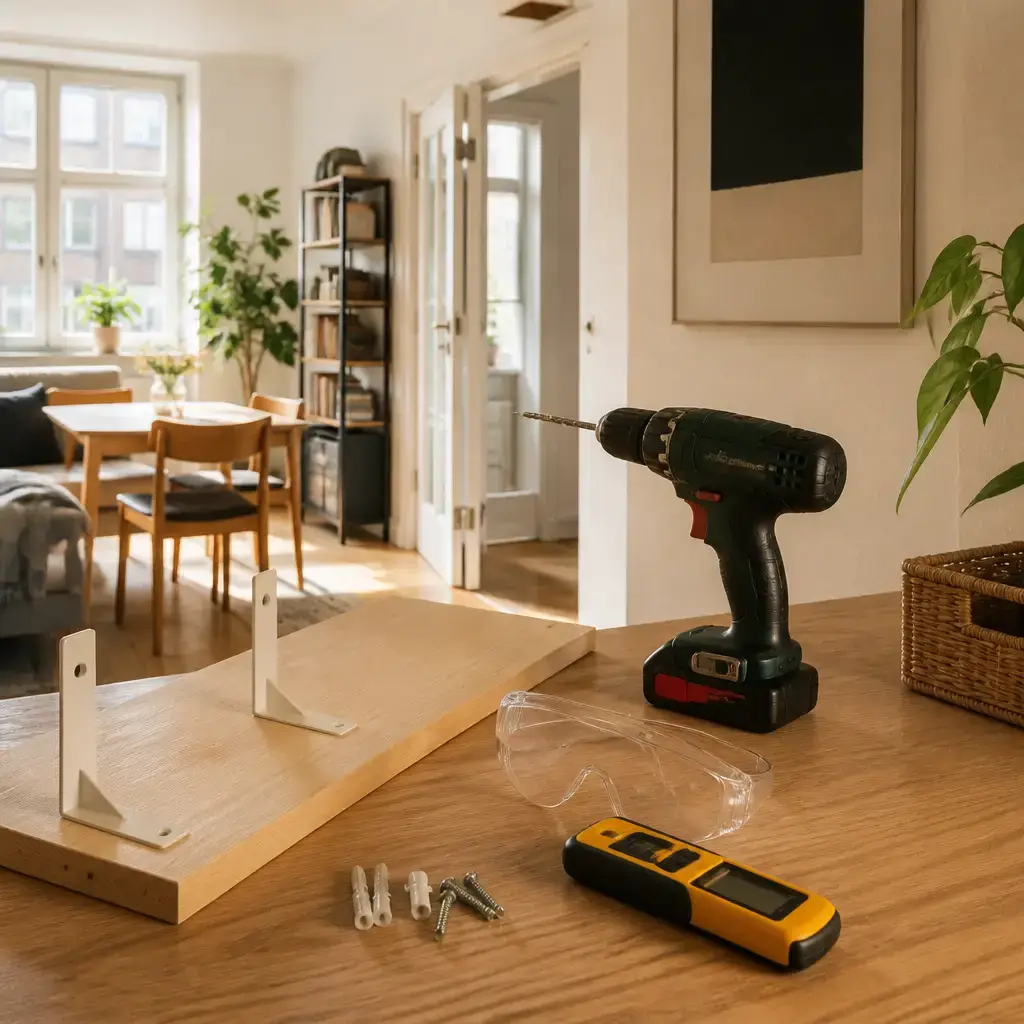
Må jeg låne din boremaskine for at sætte en lille hylde op?
MOH yai LOH-nuh deen BOH-uh-mah-SGHEE-nuh foh uh SEH-duh uhn HYOOL-luh OP? Could I borrow your drill to put up a small shelf?Det kan du. Har du brugt en boremaskine før?
deh kan doo. hah doo BROOT uhn BOH-uh-mah-SGHEE-nuh FUR? You can. Have you used a drill before?Kun én gang, så det ville hjælpe med nogle grundlæggende instruktioner.
KOON EN GANG, soh deh VIL-luh YEL-puh meh NOH-nuh GROON-leh-guh-nuh in-strook-SYOH-nuh. Only once, so basic instructions would help.Find først ud af, hvilken slags væg det er, og tag sikkerhedsbriller på.
FIN-uh FURST oo ah, VEL-kuhn SLEHKS VAI deh air, oh TAI SEE-kuh-heds-BRIL-luh pohn. Check what kind of wall it is first, and wear safety glasses.Jeg er også bekymret for at ramme elektriske ledninger.
yai air OH-soh beh-KYOOM-duh foh uh RAH-muh eh-LEK-drisk-uh LEH-thing-uh. I'm also worried about hitting electrical wires.Brug denne detektor, før du borer nogen steder.
BROO DEN-uh deh-TEK-dohr, FUR doo BOH-uh NOH-uhn STAY-uh. Use this detector before you drill anywhere.Jeg scanner stedet, før jeg markerer hullerne.
yai SKAN-uh STAY-thuh, FUR yai mar-KEH-uh HOOL-uh-nuh. I'll scan the spot before I mark the holes.Husk at tage boremaskinen tilbage sammen med opladeren og borene.
HOOS-kuh tai BOH-uh-mah-SGHEE-nən til-BAI-uh SAH-mən meh OH-play-thuh-run oh BOH-uh-nuh. Please bring the drill back with the charger and bits together.Jeg fjerner støvet, før jeg afleverer den tilbage.
yai FYEH-nuh STURV-uh, FUR yai ahf-LEH-uh den til-BAI-uh. I'll clean off the dust before I return it.Tag dig god tid med det; sikkerhed er vigtigere end fart.
TAI dai gohth TEETH meh deh; SEE-kuh-hed air VEK-dee-uh-ruh en FAHT. Take your time with it; safety matters more than speed.Sentence explanations
Må jeg låne din boremaskine for at sætte en lille hylde op?
Could I borrow your drill to put up a small shelf?
- Må jeg
- Could I …?
- låne
- borrow
- din
- your
- boremaskine
- drill
- for at
- in order to
- sætte … op
- put up
- lille
- small
- hylde
- shelf
More detail
Må jeg is a reusable Danish way to ask for permission: “May/Could I …?” Må is the present form of måtte and expresses permission here; jeg means “I.” The question is polite, but it does not by itself specify how formal the situation is. låne means “borrow,” that is, use something belonging to someone else with the expectation of returning it. It is the infinitive after må: Må jeg låne ...? (“Could I borrow ...?”). Compare låner (“borrow/am borrowing”) in a clause without this modal construction. din means “your” when addressing one person and referring to a singular common-gender noun. Here it agrees with boremaskine, not with the possessor: din boremaskine means “your drill.” Danish also has dit with a singular neuter noun and dine with plural nouns. boremaskine means “drill,” the tool. The following context confirms this intended tool meaning by asking whether the listener has used one before. A useful related compound is maskine (“machine”), but boremaskine is the specific word used here. for at introduces a purpose expressed with an infinitive: “in order to.” The subject of that purpose is understood from the surrounding sentence; here the sentence presents putting up the shelf as the reason for borrowing the drill. sætte ... op is a two-part verb meaning “put up” or “install” in this context. sætte is the infinitive after for at, while op is placed later because this verb has a separable particle. The two parts should be learned together: sætte en hylde op means “put up a shelf.” lille means “small.” It is the adjective modifying hylde; in this phrase it has the form used with a singular common-gender indefinite noun. Its base form is lille; Danish also uses mindre for the comparative “smaller.” hylde means “shelf.” It is singular and indefinite here, as shown by en hylde, “a shelf.” The noun is the object being put up, not the object borrowed. Together, Må jeg låne din boremaskine asks permission to borrow the listener’s drill. for at sætte en lille hylde op gives the purpose: putting up a small shelf. The complete meaning is therefore: “Could I borrow your drill to put up a small shelf?”
Det kan du. Har du brugt en boremaskine før?
You can. Have you used a drill before?
- Det
- it / that
- kan du
- you can
- Har du
- have you
- brugt
- used
- boremaskine
- drill
- før
- before
More detail
Det is a neutral pronoun. Here, supported by the translation and the preceding request, it refers to carrying out the requested action: “that” or “it.” Its specific reference comes from context, not from the pronoun alone. kan du uses kan, the present form of kunne (“can; be able to”), with du (“you”). Because Det comes first, the finite verb kan comes before the subject du: Det kan du = “You can do that.” The same pattern is reusable after another initial element: Det gør du = “You do that.” Har du begins a yes/no question. har is the present form of have, and du is the subject; Danish places the finite verb before the subject in this question pattern. Here har is also the auxiliary for the perfect construction that follows. brugt is the past participle of bruge (“use”). With har, har brugt means “have used.” The useful chain is bruge → brugt; the participle itself does not show the person of the subject, so du supplies the subject here. Example: Jeg har brugt den means “I have used it.” boremaskine is the noun “drill.” It is a compound noun: bor relates to drilling and maskine means “machine,” but boremaskine is the established word for the tool. In this sentence it appears after the participle as the object of “used.” før is a temporal adverb meaning “before” or, in this question, “ever before.” It asks whether the experience has occurred at any earlier time, without specifying when. Example: Har du været her før? means “Have you been here before?” Together, Har du brugt en boremaskine før? forms a perfect-experience question: “Have you used a drill before?” The indefinite article en appears before the noun in the full sentence; it introduces the tool as an unspecified instance and does not by itself assert a numerical count. The opening Det kan du answers the preceding request affirmatively, giving the complete meaning: “You can. Have you used a drill before?”
Kun én gang, så det ville hjælpe med nogle grundlæggende instruktioner.
Only once, so basic instructions would help.
- Kun én gang
- only once
- ville
- would
- hjælpe
- help
- med
- with
- nogle
- some
- grundlæggende
- basic
- instruktioner
- instructions
More detail
Kun én gang means that the event has happened only one time. én is the numeral “one,” and gang means “time” in the sense of an occurrence. Together, the pattern kun én gang is reusable for “only once.” Example: Jeg har set den kun én gang. — “I have seen it only once.” ville is the form of vil used here for “would.” In ville hjælpe, it presents the help as a result that would be useful, rather than as a definite statement that it will happen. Danish places the following infinitive after this modal: ville hjælpe, literally “would help.” Vil can have other meanings in other contexts, including “will” or “want,” so the surrounding construction determines the meaning here. hjælpe is the infinitive “to help.” The construction hjælpe med means “help with” something: Hun hjælper med arbejdet. — “She helps with the work.” The verb is not inflected for this infinitive form after ville. med is the preposition “with.” Here it introduces what the help concerns: hjælpe med nogle instruktioner, “help with some instructions.” nogle means “some” before a plural noun. It indicates an unspecified amount or set; it does not by itself state an exact number. Compare singular en instruktion — “an instruction” — with plural nogle instruktioner — “some instructions.” grundlæggende is the adjective “basic” or “fundamental.” It describes instruktioner here. In this phrase it has the form grundlæggende before a plural noun and does not take a separate plural ending. Example: grundlæggende regler — “basic rules.” instruktioner means “instructions” and is the plural of instruktion, “instruction.” The plural ending is visible in -er: en instruktion → instruktioner. In the fixed utterance, it is the thing that the help would concern. The sentence begins with the time limitation Kun én gang — “Only once.” så then links the result: “so.” The clause det ville hjælpe med nogle grundlæggende instruktioner has det as a subject meaning “it,” ville hjælpe as “would help,” and med nogle grundlæggende instruktioner as “with some basic instructions.” Together, the utterance means: “Only once, so basic instructions would help.”
Find først ud af, hvilken slags væg det er, og tag sikkerhedsbriller på.
Check what kind of wall it is first, and wear safety glasses.
- Find … ud af
- find out
- først
- first
- hvilken slags
- what kind of
- væg
- wall
- tag … på
- put on; wear
- sikkerhedsbriller
- safety glasses
More detail
Find ... ud af is the imperative of finde ud af, meaning “find out” or “determine.” The verb finde becomes find in this command. ud af belongs with the verb; it is not simply the ordinary verb finde meaning “locate.” Example: Find ud af, hvor nøglen er. — “Find out where the key is.” først means “first” here and sets the order of the action: this checking comes before the other instruction. It does not belong inside the meaning of find ud af; it modifies the instruction as a whole. hvilken slags introduces a request to identify a type or category: “what kind of.” In this expression, hvilken is the singular common-gender form of the question determiner and agrees with slags, which is common gender: en slags. A plural version is hvilke slags, as in Hvilke slags værktøj har du? — “What kinds of tools do you have?” væg means “wall.” In hvilken slags væg, it names the thing whose type is being identified. The following det er has the familiar “it is” structure: er is the present form of være (“be”), and det refers to the thing being identified in this construction. The complete embedded clause hvilken slags væg det er therefore means “what kind of wall it is.” tag ... på is the imperative construction from tage ... på, meaning “put on” when clothing or equipment is placed on the body. The verb tage appears as tag in this command, while på is separated and placed after the item in this sentence. Example: Tag jakken på. — “Put on the jacket.” sikkerhedsbriller means “safety glasses.” It is a compound built from sikkerhed (“safety”) and briller (“glasses”), and the compound names protective eyewear. Briller is normally used in the plural, which is why the equipment is expressed with this plural form. Example: Brug sikkerhedsbriller. — “Use safety glasses.” Together, Find først ud af, hvilken slags væg det er gives the first command: determine what type of wall it is. og tag sikkerhedsbriller på adds a coordinated second command: put on safety glasses. The whole utterance is therefore: “Check what kind of wall it is first, and wear safety glasses.”
Jeg er også bekymret for at ramme elektriske ledninger.
I'm also worried about hitting electrical wires.
- Jeg er
- I am
- også
- also
- bekymret
- worried
- for at
- about; to
- ramme
- hit
- elektriske
- electrical
- ledninger
- wires
More detail
Jeg er gives the subject and the present form of “to be”: jeg means “I”, and er is the present form of være. This is a reusable pattern for a present-state sentence: Jeg er ... = “I am ...”. også means “also”. It adds this statement to something else relevant or already understood; the word itself does not identify what that other thing is. bekymret means “worried” here. It describes the speaker’s state in Jeg er bekymret. It is related to the verb bekymre, but it is not the present-tense form of that verb. A useful pattern is være bekymret for ... = “be worried about ...”. In bekymret for at ..., for at introduces the action that is the object of the worry. Together with the following infinitive, it gives the meaning “about ...-ing” here. Danish also uses for at in other constructions with the meaning “in order to”, so the surrounding words determine the interpretation. ramme is the infinitive “to hit”. Here it refers to a possible action, not to an action the speaker says has already happened. Example: Pas på ikke at ramme væggen. — “Be careful not to hit the wall.” elektriske means “electrical” and describes ledninger. Its base form is elektrisk; elektriske is the form used here with a plural noun. Example: elektriske kabler — “electrical cables.” ledninger means “wires” here. It is the plural indefinite form of the noun ledning, “wire”. The plural indefinite form refers to wires without marking them as a particular definite set. Putting the parts together, Jeg er også bekymret says “I am also worried”, for at ramme specifies what action the worry concerns, and elektriske ledninger identifies what might be hit. The complete meaning is: “I'm also worried about hitting electrical wires.”
Brug denne detektor, før du borer nogen steder.
Use this detector before you drill anywhere.
- Brug
- use
- denne
- this
- detektor
- detector
- før
- before
- borer
- drill
- nogen steder
- anywhere
More detail
Brug is the imperative of bruge (“to use”). It gives a direct instruction and does not state the subject; the understood subject is “you.” Compare the present form bruger: Du bruger ... = “You use ...”; Brug ... = “Use ...”. denne means “this” and points to one nearby or contextually identifiable item. It is the common-gender singular form, matching detektor, whose indefinite form is en detektor. Danish demonstratives change with the noun’s gender and number: denne detektor (“this detector”), but dette ... is used with a neuter singular noun and disse ... with plural nouns. detektor means “detector.” It is a noun, and its useful basic pattern is en detektor (singular) / detektorer (plural). Here it is the object of Brug. før introduces a time clause meaning “before.” The pattern før + subject + verb connects one action to an earlier point in time. For example: Vask hænderne, før du spiser. — “Wash your hands before you eat.” borer is the present form of bore, “to drill.” With du, du borer means “you drill” or, in this context, “you drill / are going to drill.” Danish can use the present form in a subordinate clause for an intended future action, so no separate future marker is required here. nogen steder is an indefinite expression meaning “anywhere” in this context. steder is the plural of sted (“place”), while nogen supplies the indefinite meaning. Together they refer generally to any places where drilling might occur, rather than to one specified place. The utterance assembles as Brug denne detektor (“Use this detector”) + før du borer nogen steder (“before you drill anywhere”). The complete meaning is: “Use this detector before you drill anywhere.”
Jeg scanner stedet, før jeg markerer hullerne.
I'll scan the spot before I mark the holes.
- Jeg
- I
- scanner
- scan
- stedet
- the spot
- før
- before
- markerer
- mark
- hullerne
- the holes
More detail
Jeg means “I” and is the subject of both actions in this sentence. It is the first-person singular pronoun; Danish uses jeg for the speaker regardless of the speaker’s gender. scanner means “scan” here. It is the present-tense form of scanne: jeg scanner = “I scan.” Danish present tense commonly has the same form with different subjects, for example jeg scanner and du scanner (“I scan” and “you scan”). The English “I’ll scan” conveys the intended future-oriented action, while the Danish verb itself is present tense. stedet means “the spot.” It is the definite singular form of the neuter noun sted (“place/spot”): et sted = “a place,” stedet = “the place.” The definite ending is part of the noun form rather than a separate word. Here the fixed translation identifies the intended sense as “spot.” før means “before” and introduces the clause that follows. Pattern: før + subject + present-tense verb. For example, Jeg tjekker det, før jeg går. means “I check it before I leave.” markerer means “mark” here. It is the present-tense form of markere: jeg markerer = “I mark.” The repeated jeg after før makes the subject of the second action explicit: the speaker will do the marking. hullerne means “the holes.” It is the definite plural form of hul (“hole”): et hul = “a hole,” hullet = “the hole,” huller = “holes,” and hullerne = “the holes.” The form therefore refers to holes as a definite plural set, matching the fixed translation. Together, Jeg scanner stedet means “I’ll scan the spot,” and før jeg markerer hullerne means “before I mark the holes.” The complete utterance is: “I’ll scan the spot before I mark the holes.”
Husk at tage boremaskinen tilbage sammen med opladeren og borene.
Please bring the drill back with the charger and bits together.
- Husk at
- remember to
- tage
- take; bring
- boremaskinen
- the drill
- tilbage
- back
- sammen med
- together with
- opladeren
- the charger
- borene
- the drill bits
More detail
Husk at begins an instruction: husk is the imperative of huske (“to remember”), and at introduces the following infinitive. The reusable pattern is Husk at + infinitive, meaning “Remember to …”. Example: Husk at lukke døren. — “Remember to close the door.” tage is the infinitive of tage, “to take”; in this sentence, the intended action is bringing something back. Danish uses the same verb here even though English may choose “bring” because the destination or return direction is understood from tilbage. boremaskinen means “the drill”. The base noun is boremaskine; -n marks the singular definite form, “the …”. The noun refers to the drill as the object of tage. tilbage means “back” or “back again”. With tage, tage ... tilbage gives the reusable pattern “take/bring ... back”. It indicates a return, rather than merely taking the object somewhere. sammen med is a fixed prepositional construction meaning “together with” or “along with”. It introduces the additional items that should accompany the drill. opladeren means “the charger”. Its base noun is oplader; the ending -en marks singular definite form. Example: Jeg tager opladeren med. — “I’m taking the charger along.” borene means “the drill bits”. The singular noun is bor, and the plural definite form is borene: “the drill bits”. Here bor is the noun “drill bit”, not the verb form bor (“drills”/“is drilling”) found in another context. Together, Husk at tage boremaskinen tilbage means “Remember to bring the drill back”. sammen med opladeren og borene adds that the charger and the drill bits should come along with it. The complete utterance is therefore: “Please bring the drill back together with the charger and bits.”
Jeg fjerner støvet, før jeg afleverer den tilbage.
I'll clean off the dust before I return it.
- Jeg
- I
- fjerner
- remove; clean off
- støvet
- the dust
- før
- before
- jeg
- I
- afleverer
- return; hand back
- den
- it
- tilbage
- back
More detail
Jeg means “I.” Danish personal pronouns distinguish person and number, and jeg is the first-person singular form. It is the subject of the main clause. fjerner means “remove” here, giving the practical meaning “clean off.” Its base form is fjerne; fjerner is the present-tense form. Danish present-tense verbs generally do not change for person or number: jeg fjerner, du fjerner, and de fjerner use the same verb form. Example: Jeg fjerner mærket. — “I remove the mark.” støvet means “the dust.” Støv is a mass noun meaning “dust,” and støvet is its definite singular form, meaning “the dust.” The ending -et is part of the noun’s definite form; it is not a separate word. Example: Støvet ligger på bordet. — “The dust is on the table.” før introduces the time relation “before.” Here it connects the main clause with a following clause: one action happens before another. A reusable pattern is før + clause, as in Jeg vasker hænder, før jeg spiser. — “I wash my hands before I eat.” The second jeg again means “I.” It is the subject of the clause after før, so the same person carries out both actions in this sentence. Repeating the subject is normal in a full Danish clause. afleverer means “return” or “hand back” in this context. Its base form is aflevere, and afleverer is present tense. The verb can describe handing something back to its owner or returning something to an appropriate place. Example: Jeg afleverer nøglen. — “I return the key.” den means “it” here. It is a third-person singular pronoun used for a common-gender noun; the fixed translation identifies the object as singular without naming it. Its exact referent is not specified by the sentence itself, so the pronoun should not be treated as naming a particular object. tilbage means “back.” With afleverer, it makes the direction or result explicit: the object is handed back or returned. Example: Hun giver bogen tilbage. — “She gives the book back.” Together, Jeg fjerner støvet means “I clean off the dust.” før jeg afleverer den tilbage means “before I return it,” with før placing the returning after the dust-removal action in time. The complete utterance is therefore: “I’ll clean off the dust before I return it.”
Tag dig god tid med det; sikkerhed er vigtigere end fart.
Take your time with it; safety matters more than speed.
- Tag dig god tid
- take your time
- med det
- with it
- sikkerhed
- safety
- vigtigere
- more important
- fart
- speed
More detail
Tag dig god tid is a fixed Danish way to say “take your time.” Tag is the imperative of tage (“to take”); the imperative addresses the listener directly. dig is the reflexive object pronoun referring back to that listener, and god tid is the expression “plenty of time,” not a claim about a specific measured quantity. Example: Tag dig god tid. — “Take your time.” med det means “with it.” Med means “with,” while det is the singular neuter pronoun “it.” Its specific referent is not identified further here; the phrase simply describes what the listener should take time with. Example: Arbejd med det. — “Work on it.” sikkerhed means “safety.” It is a noun; its common definite form is sikkerheden (“the safety”). In this sentence it is the subject of the comparison. Example: Sikkerhed er vigtig. — “Safety is important.” vigtigere means “more important.” It is the comparative form of the adjective vigtig (“important”): vigtig → vigtigere → vigtigst (“most important”). Danish commonly uses vigtigere end for “more important than.” Example: Dette er vigtigere end det andet. — “This is more important than the other one.” fart means “speed.” It is a noun and is the second item in the comparison. Example: Fart er ikke altid målet. — “Speed is not always the goal.” The first part, Tag dig god tid med det, gives the instruction “Take your time with it.” The second part, sikkerhed er vigtigere end fart, uses the pattern X er vigtigere end Y: “X is more important than Y.” Together, the utterance means: “Take your time with it; safety matters more than speed.”
Grammar Points
Imperativ: verbets stamme
Find først ud af
FIN-uh FURST oo AHFirst find out.
Danish commands usually use the verb stem without a subject, like “find out” or “use” in English.
Bestemt flertal: -erne
hullerne
HOOL-uh-nuhthe holes
The ending -erne marks definite plural nouns: “huller” becomes “hullerne” for “the holes”.
Danish Vocabulary
- Gender
- common
- Gender
- common
- Gender
- common
- Gender
- common
- Gender
- common
- Gender
- common
Quiz
Spelling
Tap the letters to spell the word.
borrow
Show Answer
lånedrill
Show Answer
boremaskineshelf
Show Answer
hyldesmall