10 minutes free every day
Continue audio lessons in the app
Word explanations appear automatically in sync with the audio.
No login required · synced translations · playback with the screen locked
Choose your learning language and open this lesson in the app.

About This Lesson
Use Rescheduling safely on icy roads to practice Danish conversation, pronunciation, vocabulary, grammar, and quizzes.
Dialogue
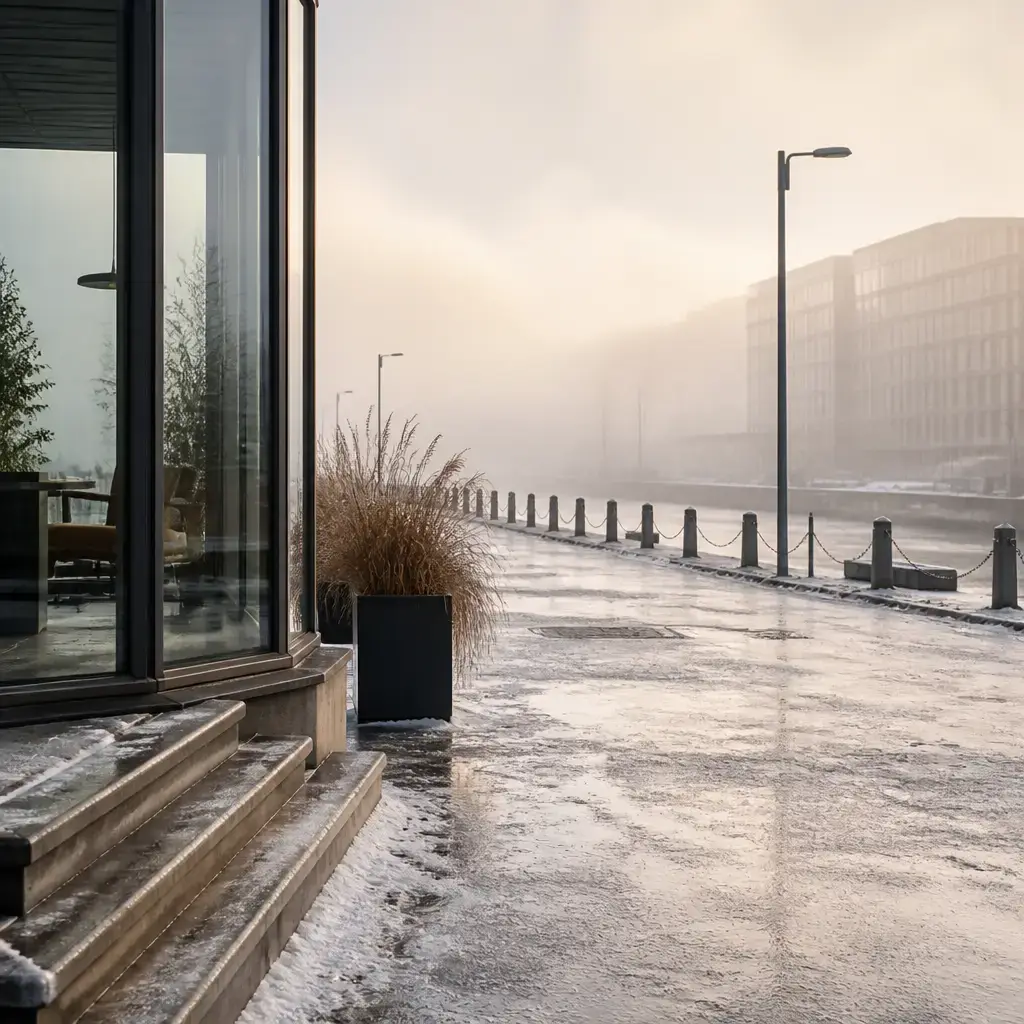
Vejene er isglatte, og sigtbarheden er dårlig i morges.
VY-eh-nuh air ES-glad-uh, oh SEGT-bar-HAY-thehn air DAW-lee ee MOR-uhs. The roads are icy, and visibility is poor this morning.Det lyder risikabelt at køre til mødet.
Deh LOO-ther ree-see-KAH-belt aht KUR-uh tehl MUR-theh. Driving to the meeting sounds risky.Jeg hader at flytte mødet, men sikkerheden bør komme først.
YAI HAY-er aht FLUD-uh MUR-theh, men SEE-ger-hay-thehn bur KOM-uh furst. I hate to reschedule, but safety should come first.Skriv til dem nu, og forklar tydeligt vejforholdene.
SGREEV tehl dem noo, oh for-KLAH-uh TOO-theh-lee VY-foh-hol-theh-nuh. Message them now and explain the road conditions clearly.Skal jeg foreslå, at vi mødes online i stedet for at aflyse helt?
SGEL yai foh-SLAWH, aht vee MUR-thes on-LINE ee STETH for aht AF-loo-suh helt. Should I suggest meeting online instead of canceling completely?Det ville holde arbejdet i gang, uden at nogen behøver at rejse.
Deh VETH-uh HOL-uh AR-bai-theh ee GANG, OO-thehn aht NOH-en beh-HUR-vuh aht RY-suh. That would keep the work moving without anyone traveling.Jeg kan spørge, om det ville fungere for dem at deltage på video.
YAI kan SPUR-uh, om deh VETH-uh fung-GAY-uh for dem aht del-TAH-uh paw VEE-theh-oh. I can ask whether joining by video would work for them.Tilbyd også at mødes fysisk, når vejene er mere sikre.
Tehl-BOOTH oh-SAW aht MUR-thes FOO-sisk, naw VY-eh-nuh air MAY-uh SEE-ger. Offer to meet in person once the roads are safer, too.Hvis de hellere vil vente, passer i morgen også fint for mig.
Ves deh HEL-uh veel VEN-tuh, PASS-er ee MOR-en OH-saw fint for my. If they would rather wait, tomorrow also works for me.Tydelige muligheder burde gøre ændringen lettere at acceptere.
TOO-theh-lee moo-LEE-heh-thuh BOO-uh GUR-uh EN-dring-en LEH-theh-er aht ak-sep-TAY-uh. Clear options should make the change easier to accept.Sentence explanations
Vejene er isglatte, og sigtbarheden er dårlig i morges.
The roads are icy, and visibility is poor this morning.
- Vejene
- the roads
- er
- is/are
- isglatte
- icy
- sigtbarheden
- visibility
- dårlig
- poor
- i morges
- this morning
More detail
Vejene means “the roads” here. It is the definite plural of vej (“road”): vej → veje → vejene. The definite ending identifies particular roads in the situation; it does not itself specify how many roads there are. er is the present-tense form of være (“to be”). Danish uses er with all persons and both singular and plural subjects, so it can mean “am,” “is,” or “are” depending on the subject. Here, Vejene er ... describes the roads’ current condition. isglatte is the adjective isglat (“icy” or “slippery from ice”) in its plural form. The plural subject Vejene requires the adjective to take -e in this predicative description. Compare the reusable pattern Vejen er isglat (“The road is icy”) with Vejene er isglatte (“The roads are icy”). og joins two coordinated statements. It means “and,” linking the condition of the roads with the condition of visibility. sigtbarheden means “visibility” here. Its base noun is sigtbarhed; sigtbarheden is its definite singular form, with -en. Danish definite noun forms can correspond to English “the” in context, but the form does not mean that visibility is being counted as one item. er dårlig describes the visibility as poor. dårlig is the adjective “poor” or “bad” in its common-gender singular form, agreeing with the singular noun sigtbarheden in this construction. Its comparison is dårlig → dårligere (“worse”) → dårligst (“worst”); for example, Sigtbarheden er dårligere i tåge means “Visibility is worse in fog.” i morges is the time expression “this morning.” It places the situation in the morning referred to by the speaker; it does not change er into a past form. Danish can use the present tense for a condition that holds at a stated time such as this morning. Together, Vejene er isglatte says that the roads are icy, and sigtbarheden er dårlig i morges says that visibility is poor this morning. The complete utterance is therefore: “The roads are icy, and visibility is poor this morning.”
Det lyder risikabelt at køre til mødet.
Driving to the meeting sounds risky.
- lyder
- sounds
- risikabelt
- risky
- køre
- drive
- mødet
- the meeting
More detail
lyder means “sounds” here, from at lyde (“to sound”). It is the present-tense form used with the formal subject det: det lyder = “it sounds.” The verb form does not itself identify what “it” refers to; here the following assessment concerns driving to the meeting. risikabelt means “risky” in this sentence. The base adjective is risikabel (“risky”), and the -t form is the neuter singular form. It agrees with det in the construction det lyder risikabelt; the form is not an inflection of the nearby verb. køre means “drive” here. It is the infinitive after at: at køre = “to drive.” The same infinitive pattern is reusable with other verbs, for example Jeg prøver at køre forsigtigt. — “I try to drive carefully.” mødet means “the meeting.” The base noun is møde, and mødet is its singular definite form, formed with the ending -et. The indefinite form is et møde (“a meeting”), while mødet refers to the meeting intended in this context. Together, at køre til mødet means “to drive to the meeting”: til marks the destination, and mødet is the definite destination noun. The pattern Det lyder + adjective + at ... presents an assessment of an activity: Det lyder risikabelt at køre til mødet. means “Driving to the meeting sounds risky.”
Jeg hader at flytte mødet, men sikkerheden bør komme først.
I hate to reschedule, but safety should come first.
- hader
- hate
- flytte
- move; reschedule
- mødet
- the meeting
- sikkerheden
- safety
- bør komme først
- should come first; should take priority
More detail
hader means “hate” here. Its base form is hade, and hader is the present-tense form. Danish present-tense verbs generally do not change for the subject, so the same form can occur with different subjects. In this sentence, Jeg supplies the subject: “I hate …”. flytte is the infinitive after at, giving “to move”. With an event such as mødet, it can mean “to reschedule the meeting”, as it does here; with a physical object, it can instead mean “to move” that object. The pattern at + infinitive is reusable: at ændre planen means “to change the plan”. mødet means “the meeting”. Its base noun is møde, and the ending -et marks the definite singular form of this noun: et møde = “a meeting”, mødet = “the meeting”. The definite form identifies a particular meeting in the situation, rather than introducing a meeting in general. The first part therefore has the structure Jeg hader at ...: “I hate to …”. Here, the activity being disliked is at flytte mødet, “to reschedule the meeting”. The comma introduces the contrasting second part. sikkerheden means “safety” here. Its base noun is sikkerhed; -en marks the definite singular form: en sikkerhed = “a safety/security”, sikkerheden = “the safety/security”. In this sentence, the intended meaning is the general safety that should take priority, not a person’s name or a separate object. bør komme først means “should come first” or “should take priority”. bør is the modal verb corresponding to “should/ought to”; it is followed by the infinitive komme, “come”. Bør does not take a different person ending here. komme først literally presents safety as coming first, while the complete expression naturally means that safety has the highest priority. For example, Sikkerheden bør komme først. means “Safety should come first.” Putting the parts together, Jeg hader at flytte mødet says “I hate to reschedule the meeting”, while men sikkerheden bør komme først says “but safety should come first”. The complete utterance is: “I hate to reschedule, but safety should come first.”
Skriv til dem nu, og forklar tydeligt vejforholdene.
Message them now and explain the road conditions clearly.
- Skriv
- message / write
- til dem
- to them
- nu
- now
- forklar
- explain
- tydeligt
- clearly
- vejforholdene
- the road conditions
More detail
Skriv is the imperative of skrive (“to write”). The imperative gives a direct instruction and normally has no written subject: Skriv! = “Write!” The same form can cover writing a message when the context supplies that purpose. til dem means “to them.” til marks the recipient, while dem is the third-person plural object form used after a preposition. The sentence does not identify who “them” refers to; it only specifies a plural recipient group. Compare til ham (“to him”) and til hende (“to her”). nu means “now” and places the instructed action at the present time. It can be moved for emphasis, for example Skriv nu! (“Write now!”). forklar is the imperative of forklare (“to explain”). It introduces a second direct instruction, coordinated with the first by og (“and”). Forklar det! means “Explain it!” tydeligt means “clearly.” It is an adverb modifying forklar, describing how the explanation should be given. The related adjective is tydelig (“clear”): en tydelig forklaring = “a clear explanation,” whereas forklar tydeligt = “explain clearly.” vejforholdene means “the road conditions.” It is the definite plural form of vejforhold (“road conditions”): vejforhold = “road conditions,” vejforholdene = “the road conditions.” The ending -ene marks definite plural in this noun; it is not an article standing alone. The structure is Skriv til dem nu (“Message them now”) followed by og forklar tydeligt vejforholdene (“and explain the road conditions clearly”). Together, the two imperatives instruct the listener to contact the unspecified plural group immediately and clearly explain the road conditions.
Skal jeg foreslå, at vi mødes online i stedet for at aflyse helt?
Should I suggest meeting online instead of canceling completely?
- Skal jeg
- Should I …?
- foreslå
- suggest
- mødes
- meet
- online
- online
- i stedet for
- instead of
- aflyse
- cancel
- helt
- completely
More detail
Skal jeg combines skal with the subject pronoun jeg. In this question, skal expresses “should” or “shall,” asking whether the speaker ought to do something; in other contexts, skal can express obligation or a planned action. Jeg means “I.” foreslå is the infinitive “to suggest.” After the modal skal, Danish uses the infinitive without at: skal jeg foreslå = “should I suggest.” The verb foreslå can introduce what is being suggested, as it does here with the following clause. mødes means “meet” here. Its base form is mødes; the form itself does not show a person or number change in this construction. Danish also has møde, “meet someone,” while mødes presents the meeting as something the participants do together: Vi mødes i morgen = “We are meeting tomorrow.” online is an adverb meaning “online.” It describes the manner or setting of meeting, not a person or object. i stedet for is the reusable construction “instead of.” Before an action, it is followed here by at plus an infinitive: i stedet for at aflyse = “instead of canceling.” aflyse is the infinitive “to cancel,” commonly used for a planned event, meeting, or arrangement. For example, De aflyser mødet means “They are canceling the meeting.” helt means “completely” or “altogether.” Here it strengthens aflyse: the alternative is not to cancel entirely. It does not itself mean “cancel.” Together, skal jeg foreslå asks whether the speaker should make a suggestion. The suggested action is at vi mødes online, “that we meet online,” and the alternative is i stedet for at aflyse helt, “instead of canceling completely.” Thus the whole utterance means: “Should I suggest meeting online instead of canceling completely?”
Det ville holde arbejdet i gang, uden at nogen behøver at rejse.
That would keep the work moving without anyone traveling.
- Det ville
- That would
- holde
- keep
- arbejdet
- the work
- i gang
- going; in operation
- uden at
- without …ing
- nogen
- anyone
- behøver
- needs to
- rejse
- travel
More detail
Det ville begins a conditional statement. Det is a neuter singular pronoun; here the fixed translation identifies it as “that,” referring to the proposed online arrangement. Ville is the past form of ville, used here as the modal “would” before an infinitive. The same form can also mean “wanted” in another construction, so the following verb and context matter. holde is the infinitive of holde, “keep” or “hold.” With ville, it gives the pattern ville + infinitive: “would keep.” In this sentence, holde ... i gang is the useful combination for keeping an activity operating or underway. Example: Det vil holde planen i gang. — “That will keep the plan moving.” arbejdet means “the work.” Its base form is arbejde; the ending -et marks definite singular for this neuter noun, giving “the work.” Danish definite marking is attached to the noun rather than expressed by a separate word in this form. Example: Arbejdet fortsætter. — “The work continues.” i gang is a fixed expression meaning “underway,” “active,” or “in operation.” Here it completes holde: holde arbejdet i gang means “keep the work moving/underway,” not merely “hold the work” physically. Example: Vi holder mødet i gang. — “We keep the meeting going.” uden at introduces an action that does not occur: uden at + infinitive means “without doing something.” It is followed here by nogen behøver at rejse, so the whole construction means “without anyone needing to travel.” Example: Hun gik uden at sige farvel. — “She left without saying goodbye.” nogen is an indefinite pronoun meaning “anyone” in this negative context. It does not itself specify a particular person or a number of people. Example: Ingen så nogen. — “No one saw anyone.” behøver is the present-tense form of behøve, “need.” Here it expresses necessity: nogen behøver at rejse means “anyone needs to travel.” Danish also commonly uses behøver ikke for “does not need to,” but that negation is not present in the fixed sentence. rejse is the infinitive of rejse, meaning “travel” here. It follows behøver at in the pattern behøve at + infinitive, “need to do something.” In another context, rejse can refer to setting off or leaving, but the fixed translation supports the travel meaning here. Example: De behøver at rejse tidligt. — “They need to travel early.” Together, Det ville holde arbejdet i gang means “That would keep the work moving.” uden at nogen behøver at rejse adds the condition that nobody needs to travel. The complete utterance therefore means: “That would keep the work moving without anyone traveling.”
Jeg kan spørge, om det ville fungere for dem at deltage på video.
I can ask whether joining by video would work for them.
- Jeg kan
- I can
- spørge
- ask
- om
- whether
- det
- it
- ville
- would
- fungere
- work
- for dem
- for them
- at deltage
- to participate
- på video
- by video
More detail
Jeg kan combines Jeg (“I”) with the modal verb kan (“can”). kan is the present form of kunne and expresses ability or possibility here. Danish places the following verb in the infinitive after this modal: Jeg kan spørge = “I can ask.” spørge is the infinitive “to ask.” Its present form is spørger, as in Jeg spørger (“I ask / I am asking”). Here the infinitive is required after kan. om introduces an embedded yes/no question. In this sentence it means “whether,” not the preposition “about.” A reusable pattern is spørge, om ... (“ask whether ...”). det is the neuter-form pronoun used here as the grammatical subject of the following idea. The sentence does not identify a separate concrete thing that det refers to; the relevant question is whether the proposed arrangement would work. Danish also uses det in similar subject patterns such as Det er svært at vente (“It is difficult to wait”). ville is the past form of vil and can express a hypothetical or conditional result. In det ville fungere, it gives “it would work.” Compare det vil fungere (“it will work”), which presents the result more directly as future or expected. fungere is the infinitive “to work” in the sense of being effective or suitable, rather than performing employment. Its present form is fungerer: Det fungerer = “It works / It is working.” After ville, Danish again uses the infinitive: ville fungere. for dem means “for them.” dem is the third-person plural pronoun form used after a preposition; it does not mark the gender of the people referred to. Here the fixed translation supports the meaning “for them,” while it does not identify those people more specifically. at deltage means “to participate” or “to take part.” deltage is the infinitive, introduced by at. The same form can be used after a modal without at, as in De kan deltage (“They can participate”), but an infinitive clause functioning as the activity here uses at: for dem at deltage. på video means “by video” or “via video.” In this context, på presents video as the medium or format of participation. The phrase deltage på video therefore describes participating remotely through video rather than meeting physically. Together, Jeg kan spørge means “I can ask.” The embedded question begins with om: om det ville fungere for dem at deltage på video means “whether it would work for them to participate by video.” Thus the whole utterance is: “I can ask whether joining by video would work for them.”
Tilbyd også at mødes fysisk, når vejene er mere sikre.
Offer to meet in person once the roads are safer, too.
- Tilbyd
- offer
- også
- also; too
- mødes
- meet
- fysisk
- in person
- når
- when
- vejene
- the roads
- mere sikre
- safer
More detail
Tilbyd is the imperative of tilbyde, “to offer.” It addresses one person directly and makes the utterance a suggestion or instruction: Tilbyd ... = “Offer ...”. også means “also” or “too.” Here it adds this option to another possible arrangement; it does not itself specify what the other option is. mødes is the infinitive of mødes, meaning “to meet” or “to meet one another.” The form is built into the expression tilbyd at mødes: after tilbyd, at introduces the proposed action. Example: Vi kan mødes på fredag. — “We can meet on Friday.” fysisk means “physically” or “in person” here. It specifies the manner of meeting, contrasting with meeting through video or another remote method. Danish uses the same form fysisk as an adjective in some contexts and as an adverb here. når introduces a time clause meaning “when” or “once.” The clause after it gives the condition or time at which the main action is presented as taking place: når ... = “when ...”. vejene means “the roads.” Its base form is vej, “road”; vejene is the definite plural form: plural veje plus the definite ending -ne. The definite form presents the roads as identifiable in the situation, without English needing to name them individually. mere sikre means “safer.” sikre is the plural form of the adjective sikker, “safe,” agreeing with plural vejene. mere marks a comparison with an earlier or alternative state. Danish can also use the synthetic comparative sikrere; the fixed utterance uses the form mere sikre instead. The adjective’s superlative forms include sikrest and, before a definite noun, sikreste. Together, Tilbyd også at mødes fysisk means “Offer to meet in person too.” The temporal clause når vejene er mere sikre says when this should happen: “once the roads are safer.” The complete utterance is therefore: “Offer to meet in person once the roads are safer, too.”
Hvis de hellere vil vente, passer i morgen også fint for mig.
If they would rather wait, tomorrow also works for me.
- Hvis
- if
- de
- they
- hellere
- rather
- vil
- want to
- vente
- wait
- i morgen
- tomorrow
- passer
- works; suits
- også
- also
- fint
- fine; well
- for mig
- for me
More detail
Hvis introduces a condition: “if …”. It normally starts a subordinate clause, and the comma here separates that condition from the main clause. Example: Hvis du har tid, kan vi tale. — “If you have time, we can talk.” de means “they” here. It is a third-person plural personal pronoun; its specific referents are not identified in this sentence. Danish de is distinct from singular han (“he”) and hun (“she”). hellere means “rather” in a preference. It is a comparative adverb and commonly occurs in the pattern hellere vil + infinitive, meaning “would rather …” or “prefer to …”. Example: Jeg vil hellere gå. — “I would rather walk.” vil is the present-tense form of ville, used here with vente to express what they prefer to do. In this construction, vil is followed directly by the infinitive, without at: vil vente. The combination hellere vil vente gives the intended meaning “would rather wait,” rather than simply “want to wait.” vente is the infinitive “to wait.” After a modal verb such as vil, Danish uses the infinitive directly: De vil vente. — “They want to wait.” i morgen is the time expression “tomorrow.” It is a fixed two-word expression, not a single inflected word. Example: Vi mødes i morgen. — “We are meeting tomorrow.” passer is the present-tense form of passe, meaning “fit,” “suit,” or, as here, “work” for someone. In this sentence, the time i morgen is presented as an option that suits the speaker. Example: Fredag passer mig. — “Friday works for me.” også means “also” or “too.” It adds this option to another option already under consideration; it does not itself indicate which option was mentioned first. fint means “fine” here and strengthens the idea that the proposed time works well. It is the form used in the expression passer fint, “works fine” or “suits well.” for mig means “for me.” The preposition for marks the person whose schedule or suitability is relevant, and mig is the first-person singular object form corresponding to jeg (“I”). Compare for mig (“for me”) with for dig (“for you”). Together, Hvis de hellere vil vente means “If they would rather wait.” The main clause passer i morgen også fint for mig says that tomorrow is also a suitable option for the speaker. The complete utterance therefore means: “If they would rather wait, tomorrow also works fine for me.”
Tydelige muligheder burde gøre ændringen lettere at acceptere.
Clear options should make the change easier to accept.
- Tydelige
- clear
- muligheder
- options
- burde
- should
- gøre
- make
- ændringen
- the change
- lettere
- easier
- acceptere
- accept
More detail
Tydelige describes muligheder. It is the plural form of tydelig (“clear”). Danish adjectives commonly use this plural form regardless of the grammatical gender of the nouns they describe; the plural noun here is muligheder. Muligheder means “options” here. Its singular base form is mulighed, and its plural is formed with -er: mulighed → muligheder. The definite plural would be mulighederne (“the options”), whereas the form here is indefinite. Burde expresses what is expected, advisable, or likely to have an effect: “should.” It is the form related to bør; after it, Danish uses an infinitive without at, as in burde gøre (“should make”). This sentence presents the result as an expectation, not as a certain fact. Gøre is the infinitive meaning “make” in this construction. The pattern gøre noget + adjective means “make something + adjective,” as in Det gør arbejdet lettere (“It makes the work easier”). Ændringen means “the change.” Its indefinite singular base form is ændring; the ending -en marks the common-gender singular definite form: ændring → ændringen. The definite form presents the change as an identifiable one in this context. Lettere means “easier.” It is the comparative form of let (“easy”): let → lettere (“easier”) → lettest (“easiest”). Here it compares the resulting level of ease with some understood alternative or starting point; the comparison is not specified further. Acceptere is the infinitive “accept.” In lettere at acceptere, the infinitive phrase means “easier to accept.” Danish commonly uses at before an infinitive when it is not directly governed by a modal such as burde; here at acceptere completes the meaning of the adjective lettere. Together, Tydelige muligheder is the subject, burde gøre says that they are expected to produce an effect, and ændringen lettere at acceptere identifies that effect. The complete meaning is: “Clear options should make the change easier to accept.”
Grammar Points
Adjektivets flertalsform: -e
Vejene er isglatte.
VY-eh-nuh air ES-glad-uh.The roads are icy.
Efter flertals-subjektet vejene får adjektivet flertalsformen isglatte.
Imperativ: verbets stamme uden pronomen
Skriv og forklar vejforholdene.
SGREEV oh for-KLAH-uh VY-foh-hol-theh-nuh.Write and explain the road conditions.
I bydeform står verbet først uden et subjektpronomen: skrive bliver Skriv, og forklare bliver forklar.
Danish Vocabulary
I hate to reschedule the meeting.
I hate to reschedule.
The roads are icy this morning.
The roads are icy.
Driving to the meeting sounds risky.
Driving sounds risky.
I hate to reschedule the meeting.
Driving sounds risky.
Visibility is poor.
Safety should come first.
The roads are icy.
Quiz
Spelling
Tap the letters to spell the word.
to sound
Show Answer
lydermeeting
Show Answer
mødetvisibility
Show Answer
sigtbarhedenicy