10 minutes free every day
Continue audio lessons in the app
Word explanations appear automatically in sync with the audio.
No login required · synced translations · playback with the screen locked
Choose your learning language and open this lesson in the app.

About This Lesson
Use Solving a Plant Care Problem to practice Danish conversation, pronunciation, vocabulary, grammar, and quizzes.
Dialogue
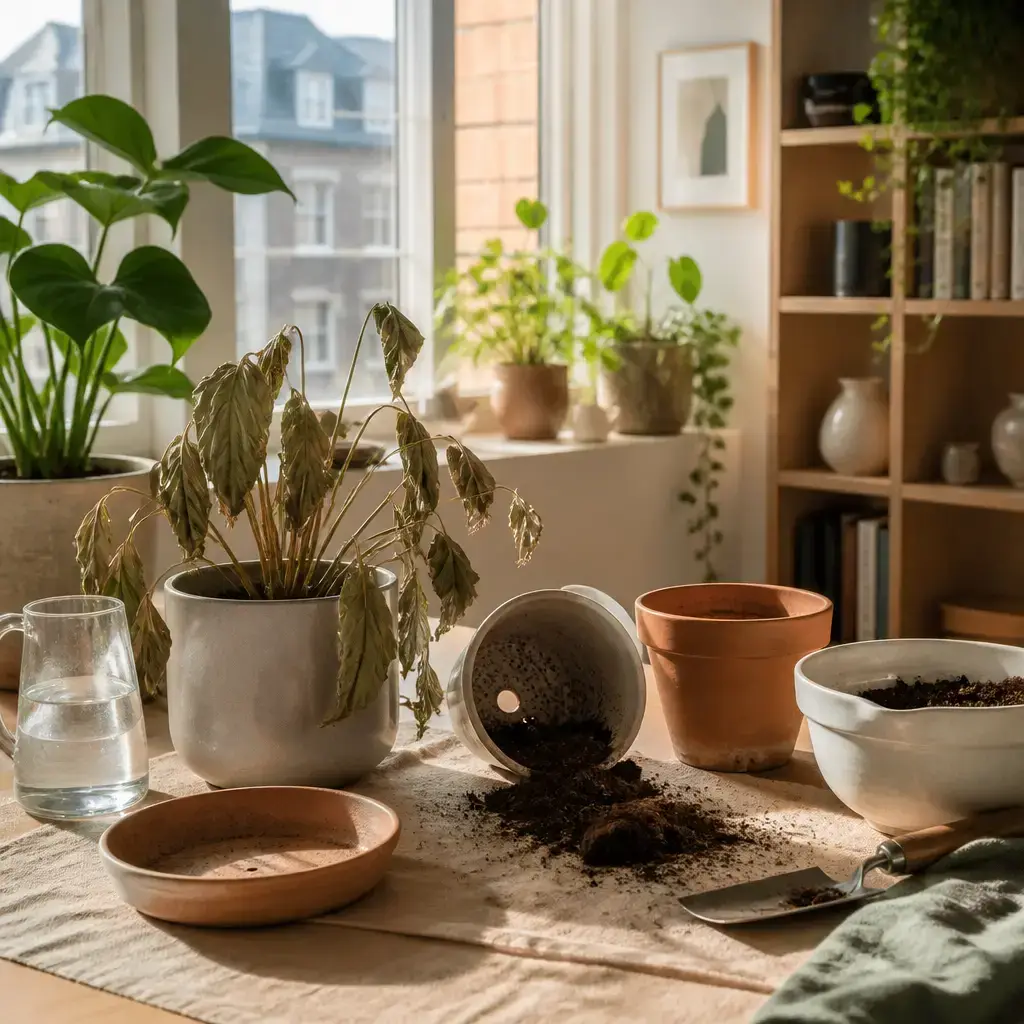
Min plante visner, selv om jeg vander den ofte.
min PLAN-tuh VIS-nuh, selv OHM yai VAN-uh den OFF-tuh. My plant is wilting, even though I water it often.Den har måske fået for meget vand i stedet for for lidt.
den har MOH-skeh FOH-uhd fohr MAY-uh van ee STEH-duh fohr fohr LEED. It may have too much water rather than too little.Jeg troede, at mere vand ville hjælpe den med at komme sig.
yai TROH-uh, at MAY-uh van VIL-uh YEL-buh den med at KOM-uh see. I thought more water would help it recover.Tjek dræningen, og lad jorden tørre lidt.
chek DREH-ning-un, oh LAETH YOR-un TUR-uh leed. Check the drainage and let the soil dry a little.Krukken har ikke noget hul i bunden, og det kan være problemet.
KROO-kuhn har IK-uh NOH-uh HOOL ee BOON-un, oh deh kan VAIR-uh proh-bleh-MEH-duh. The pot has no hole at the bottom, which may be the problem.Rødder kan tage skade, når vandet ikke har nogen steder at løbe ud.
RUR-uh kan tay skay-uh, nohr VAN-uhd IK-uh har NOH-un STAY-uh at lur-buh oo. Roots can suffer when water has nowhere to escape.Skal jeg også flytte den tættere på vinduet?
skel yai OH-soh FLUR-tuh den TEH-duh-ruh poh VIN-oo-uhd? Should I move it closer to the window too?Prøv at ændre én ting ad gangen, så du kan se, hvad der hjælper.
prurv at EN-druh ayn ting ad GANG-un, soh du kan say, vath dair YEL-buh. Try changing one thing at a time so you can tell what helps.Så potter jeg den om og vander den mindre i denne uge.
soh POT-uh yai den OHM oh VAN-uh den MIN-uh ee DEN-uh OO-uh. Then I will repot it and water it less this week.Plantepleje handler mest om at observere og lave små justeringer.
PLAN-tuh-PLYE-uh HAN-uh mest OHM at ob-seh-VAIR-uh oh LAY-vuh smoh yoos-teh-RING-uh. Plant care is mostly observation and small adjustments.Sentence explanations
Min plante visner, selv om jeg vander den ofte.
My plant is wilting, even though I water it often.
- Min
- my
- plante
- plant
- visner
- is wilting
- selv om
- even though
- jeg
- I
- vander
- water
- den
- it
- ofte
- often
More detail
Min plante means “my plant.” Min is the possessive form used with a singular common-gender noun, as in en plante; with a singular neuter noun, the corresponding form is mit, and with plural nouns it is mine. Example: min bog — “my book.” plante means “plant.” Its indefinite singular form is en plante, while the definite singular form is planten — “the plant.” The following visner shows which plant is being discussed here through the surrounding sentence and translation. visner means “is wilting” here. Its base form is visne, and visner is the present-tense form. In Danish, this form can describe an action or process happening now; it does not change for the subject’s person or number. Example: Blomsten visner. — “The flower is wilting.” selv om is a conjunction meaning “even though” or “although.” It introduces a clause that contrasts with, but does not cancel, the main clause. The two words form a construction and should be kept together when reused. Example: Jeg går ud, selv om det regner. — “I am going outside even though it is raining.” jeg means “I” and is the first-person singular subject pronoun. It identifies the speaker as the subject of the following verb. Danish uses jeg for both formal and informal “I.” vander means “water” here, as in watering a plant. Its base form is vande, and vander is the present-tense form. The same present form is used with different subjects: jeg vander — “I water,” and hun vander — “she waters.” Example: Jeg vander blomsterne. — “I water the flowers.” den means “it” here and refers to the plant identified in the fixed translation. It is the singular common-gender object pronoun, matching the common-gender noun plante; it is not the subject of this clause. Danish uses den for a common-gender singular referent and det for a neuter singular referent. Example: Jeg køber en plante og vander den. — “I buy a plant and water it.” ofte means “often.” It is an adverb describing how frequently the watering happens. Example: Hun læser ofte. — “She often reads.” Together, Min plante visner says “My plant is wilting.” selv om jeg vander den ofte adds the contrast “even though I water it often”: the speaker waters the plant frequently, but the plant is nevertheless wilting. The complete utterance is therefore “My plant is wilting, even though I water it often.”
Den har måske fået for meget vand i stedet for for lidt.
It may have too much water rather than too little.
- Den
- it
- har
- has
- måske
- perhaps
- fået
- gotten
- for meget
- too much
- vand
- water
- i stedet for
- instead of
- for lidt
- too little
More detail
Den is the Danish common-gender singular form of the third-person pronoun used here for “it.” In the supplied context, it refers to the plant. Danish also has det for neuter singular referents, while plural “they” is de; the choice follows the referent’s grammatical form, not simply its physical size. har is the present-tense form of have. Here it is an auxiliary: har + the past participle fået forms a perfect construction. The auxiliary agrees with the subject in person and number, but har itself has the same form for singular and plural subjects. Example: Planterne har fået vand. — “The plants have received water.” måske means “perhaps” or “possibly.” It marks the statement as uncertain. Its position here places that uncertainty over the following claim rather than changing the meaning of fået itself. fået is the past participle of få, whose basic meanings include “get” and “receive.” With har, har fået means “has got/gotten” or, in this context, “has received.” The participle is the form required after this auxiliary in the perfect construction. Example: Planten har fået vand. — “The plant has received water.” for meget means “too much”: for expresses excess, and meget expresses a large amount. Together they describe an amount that is greater than suitable or wanted. This is different from meget alone, “much/a lot,” which does not by itself express excess. Example: Der er for meget salt i suppen. — “There is too much salt in the soup.” vand means “water.” It is a mass noun here, so it is used without an indefinite article after the quantity expression for meget. The phrase for meget vand therefore means “too much water,” not a count of separate water items. i stedet for is a reusable comparison construction meaning “instead of” or “rather than.” It introduces the alternative that is being contrasted with the first possibility. Example: Jeg drikker te i stedet for kaffe. — “I drink tea instead of coffee.” for lidt means “too little.” lidt expresses a small amount, while for lidt says that the amount is insufficient or below the suitable level. Here the noun is not repeated: for lidt stands for “too little [water]” because the comparison has already established what amount is being discussed. Example: Planten får for lidt lys. — “The plant gets too little light.” Taken together, Den har måske fået for meget vand says that the plant may have received an excessive amount of water. i stedet for for lidt contrasts that possibility with receiving an insufficient amount. The complete utterance therefore means: “It may have too much water rather than too little.”
Jeg troede, at mere vand ville hjælpe den med at komme sig.
I thought more water would help it recover.
- troede
- thought
- mere
- more
- vand
- water
- ville
- would
- hjælpe
- help
- den
- it
- komme sig
- recover
More detail
troede is the past form of tro (“to think” or “to believe”). Here it presents the speaker’s earlier belief: “I thought …”. The present form is tror; for example, Jeg tror, det hjælper. means “I think it helps.” mere means “more” and is used here with an uncounted amount. It is the comparative form related to meget (“much/a lot”): meget vand = “a lot of water”, mere vand = “more water”. vand means “water”. Danish commonly uses this noun without an indefinite article when referring to water as an uncounted substance. In mere vand, vand is the substance being increased, not a stated number of separate items. ville is the past form of the modal verb vil (“will/want”, depending on context). With an infinitive, it can express what was expected or would happen from an earlier viewpoint. Here ville hjælpe means “would help”; it is not a command. A useful pattern is Jeg troede, at ... ville ... = “I thought that ... would ...”. hjælpe is the infinitive of hjælper (“helps”) and means “to help”. After the modal ville, Danish uses the infinitive: ville hjælpe. For example, Det kan hjælpe. means “It can help.” den is a singular common-gender pronoun. In this sentence, the fixed translation identifies its intended meaning as “it”; the specific referent is the thing being discussed, without needing to name it here. Danish uses det for a singular neuter-gender referent, but pronoun choice follows the grammatical gender of the referent, not simply its English translation. komme sig is a reflexive expression meaning “recover” or “get better”. Its first word is the infinitive of komme (“come”), while sig is the reflexive pronoun used with the subject. In hjælpe den med at komme sig, den is the one that is to recover. The pattern hjælpe nogen med at + infinitive means “help someone/something to …”; for example, Hun hjælper barnet med at falde i søvn. means “She helps the child fall asleep.” Together, Jeg troede sets up an earlier belief. at mere vand ville hjælpe den med at komme sig says what that belief was: more water would help the thing referred to by den recover. Thus the whole utterance means, “I thought more water would help it recover.”
Tjek dræningen, og lad jorden tørre lidt.
Check the drainage and let the soil dry a little.
- Tjek
- check
- dræningen
- the drainage
- lad
- let
- jorden
- the soil
- tørre
- dry
- lidt
- a little
More detail
Tjek is the imperative of tjekke, “to check.” Danish imperatives commonly give a direct instruction without stating the subject: Tjek ... = “Check ...”. Example: Tjek døren. — “Check the door.” dræningen means “the drainage” here. It is the definite singular form of en dræning; the ending -en marks a specific singular noun. In this sentence, it is the thing being checked. lad is the imperative of lade, “to let” or “to allow.” A highly reusable Danish pattern is lad + object + infinitive: Lad planten vokse. — “Let the plant grow.” The object comes between lad and the infinitive. jorden means “the soil.” It is the definite singular form of en jord, with -en marking a specific singular noun. Here it is the object of lad and the understood subject of tørre: the soil is what is allowed to dry. tørre is the infinitive of tørre, “to dry.” After the imperative construction lad ..., the infinitive names the action that is permitted. Lad tøjet tørre. — “Let the clothes dry.” lidt means “a little” and limits the extent of the drying. It is placed after tørre here, giving the phrase “dry a little.” Together, Tjek dræningen gives the first instruction, and lad jorden tørre lidt uses the pattern “let the soil dry a little.” The conjunction og joins the two instructions, so the whole utterance means: “Check the drainage and let the soil dry a little.”
Krukken har ikke noget hul i bunden, og det kan være problemet.
The pot has no hole at the bottom, which may be the problem.
- Krukken
- the pot
- har
- has
- ikke noget
- no / not any
- hul
- hole
- bunden
- bottom
- det
- it / that
- være
- be
- problemet
- the problem
More detail
Krukken means “the pot” here. It is the definite singular form of krukke (“pot”): krukke is an indefinite form, while krukken identifies a specific pot. Example: En krukke står her. — “A pot is standing here.” har is the present-tense form of have (“have”). In this sentence it states what the pot does or does not contain: Krukken har et hul. — “The pot has a hole.” ikke noget means “no” or “not any” in the following noun phrase. Together with the negation ikke, noget contributes the idea of “any” in a negative statement; it does not by itself assert a particular numerical count. The pattern ikke noget + noun is reusable: Jeg har ikke noget svar. — “I do not have an answer.” hul means “hole.” It is the indefinite singular noun in ikke noget hul; the noun is not marked as definite because the sentence says that there is no hole of this kind. Example: Der er et hul i muren. — “There is a hole in the wall.” bunden means “the bottom.” It is the definite form of bund (“bottom”), used in the phrase i bunden (“at/in the bottom”). The preposition i and the definite noun together identify the relevant part of the pot. Example: Der ligger vand i bunden. — “There is water at the bottom.” det means “it” or “that” here and refers to the situation just described: the pot having no hole at the bottom. Danish det is a neuter singular pronoun, but the pronoun’s grammatical form does not by itself identify a noun referent; the fixed translation presents it as “which” referring to that situation. være means “be.” It is the infinitive form of være, and it follows the modal verb kan (“can/may”) in kan være. This combination expresses a possibility: Det kan være vigtigt. — “It may be important.” problemet means “the problem.” It is the definite singular form of problem (“problem”). The definite form presents the problem as an identifiable one in this situation, rather than merely introducing an unspecified problem. Example: Det er problemet. — “That is the problem.” Together, Krukken har ikke noget hul i bunden says that the pot does not have any hole at its bottom. og det kan være problemet adds that this just-mentioned situation may be the problem. The complete meaning is: “The pot has no hole at the bottom, which may be the problem.”
Rødder kan tage skade, når vandet ikke har nogen steder at løbe ud.
Roots can suffer when water has nowhere to escape.
- Rødder
- roots
- kan
- can
- tage skade
- suffer harm
- når
- when
- vandet
- the water
- ikke
- not
- har
- has
- nogen steder
- anywhere
- at løbe ud
- to escape
More detail
Rødder means “roots” here. It is the plural form of rod (“root”); rødder is an irregular plural, so it is not formed by simply adding a regular plural ending. Example: En rod vokser. — “A root grows.” kan expresses ability or possibility: “can.” It is the present-tense form of kunne and does not change according to the subject’s number or gender. Here it says that suffering damage is possible, not that it is certain. Example: Planter kan dø. — “Plants can die.” tage skade is a reusable expression meaning “suffer damage” or “be harmed.” Tage is the infinitive of tage (“take”), but in this expression it does not mean physically taking something; skade supplies the idea of harm. After kan, Danish uses the infinitive without at: kan tage, not kan at tage. når introduces a time condition: “when.” It links the main statement to the situation that follows. Example: Jeg vander planten, når jorden er tør. — “I water the plant when the soil is dry.” vandet means “the water.” It is the definite form of the mass noun vand (“water”): vand → vandet. The ending -et marks definiteness for this noun; it is not a separate word for “the.” ikke is the ordinary Danish negation “not.” It negates the clause har nogen steder at løbe ud, so the sentence says that the water does not have any places available for escape. har is the present form of have (“have”). Danish uses the same present form har with different subjects; the form does not show a singular/plural distinction here. Example: Rødderne har brug for vand. — “The roots need water.” nogen steder means “anywhere” in this negative context. Steder is the plural of sted (“place”), and nogen means “any/some” according to context. With ikke, the combination gives the absence of any available places, rather than asserting a particular number of places. at løbe ud means “to run out” or, for liquid, “to flow out/escape.” Løbe is the infinitive of løbe (“run”), and at marks the infinitive here. The particle ud adds the direction “out.” In har ... at løbe ud, the water is the understood thing that would flow out: there are no places for it to escape to. Example: Vandet løber ud. — “The water flows out.” The sentence assembles as Rødder kan tage skade (“Roots can suffer damage”) + når (“when”) + vandet ikke har nogen steder at løbe ud (“the water has nowhere to escape”). The full meaning is: “Roots can suffer when water has nowhere to escape.”
Skal jeg også flytte den tættere på vinduet?
Should I move it closer to the window too?
- Skal jeg
- Should I
- også
- too
- flytte
- move
- den
- it
- tættere
- closer
- vinduet
- the window
More detail
Skal jeg is a reusable Danish way to ask whether the speaker should or is supposed to do something. Skal is the present form of skulle, followed here by the subject jeg and an infinitive. In a question, this verb-first order gives the pattern Skal jeg + infinitive? Example: Skal jeg vente? — “Should I wait?” også means “too” or “also” and adds this action to something already relevant. Its position can vary, but here it comes before the main verb phrase: Skal jeg også flytte ...? flytte is the infinitive “to move.” After the modal skal, Danish uses the infinitive without an extra infinitive marker. Example: Jeg skal flytte stolen. — “I have to move the chair.” den is a singular common-gender object pronoun meaning “it” here. The fixed translation identifies it as the thing being moved, but the supplied text does not identify that thing more specifically. Danish object pronouns include den for common-gender singular referents and det for neuter singular referents; the choice follows the grammatical gender of the referent, not simply its physical type. tættere is the comparative form of the adjective tæt, “close.” The comparison chain is tæt — “close,” tættere — “closer,” tættest — “closest.” With movement, flytte ... tættere på means “move ... closer to.” Example: Sæt planten tættere på lyset. — “Place the plant closer to the light.” vinduet means “the window.” It is the definite singular form of the noun vindue: et vindue — “a window,” vinduet — “the window.” The ending -et marks definite singular for this neuter noun. på introduces the reference point in tættere på vinduet, “closer to the window.” Together, Skal jeg også flytte den tættere på vinduet? asks whether the speaker should additionally move the unspecified object so that it is nearer to the window: “Should I move it closer to the window too?” The question expresses a request for guidance or confirmation about that action.
Prøv at ændre én ting ad gangen, så du kan se, hvad der hjælper.
Try changing one thing at a time so you can tell what helps.
- Prøv
- try
- at ændre
- to change
- én ting
- one thing
- ad gangen
- at a time
- så du kan
- so you can
- se
- see
- hvad
- what
- hjælper
- helps
More detail
Prøv is the imperative of prøve, “to try.” It addresses one or more people directly and gives a suggestion or instruction. Example: Prøv igen. — “Try again.” at ændre is the infinitive “to change.” Danish commonly uses at before an infinitive: prøve at ændre means “try to change.” The infinitive remains unchanged here; ændre is not a tense-marked form. én ting means “one thing.” én emphasizes the number one, while ting is the singular noun “thing”; its plural is ting as well. The phrase therefore selects a single change, rather than several changes at once. ad gangen is a reusable expression meaning “at a time.” Together with én ting, én ting ad gangen means “one thing at a time.” Example: Tag én opgave ad gangen. — “Take one task at a time.” så du kan means “so you can.” så introduces the intended result here, du is the second-person singular pronoun “you,” and kan is the present form of the modal verb kunne, “can/be able to.” After a modal verb, Danish uses the infinitive without at, as in kan se (“can see”). se is the infinitive “to see” and follows kan without at. In this sentence it means being able to observe or determine something, not merely looking at it. Example: Du kan se forskellen. — “You can see the difference.” hvad is the question word “what.” Inside hvad der hjælper, it introduces an embedded question or an unknown thing: “what helps.” Unlike a direct question such as Hvad hjælper? (“What helps?”), this clause is embedded under se. hjælper means “helps” here. It is the present-tense form of hjælpe, “to help.” Danish verbs do not change their form for different persons in the present tense: jeg hjælper, du hjælper, and de hjælper all use hjælper. In hvad der hjælper, der is a subject relative pronoun within the clause, linking hvad to the thing or factor that helps. The sentence builds as Prøv at ændre (“Try to change”) + én ting ad gangen (“one thing at a time”) + så du kan se (“so you can see”) + hvad der hjælper (“what helps”). The complete meaning is: “Try changing one thing at a time so you can tell what helps.”
Så potter jeg den om og vander den mindre i denne uge.
Then I will repot it and water it less this week.
- Så
- then
- potter … om
- repot
- jeg
- I
- den
- it
- vander
- water
- mindre
- less
- denne
- this
- uge
- week
More detail
Så means “then” here. It connects this planned action with the preceding situation or decision. Example: Så går vi. — “Then we’ll go.” potter is the present-tense form of potte, “to repot.” With jeg, it means “I repot”; Danish present tense can also describe a planned future action when the context makes that clear. The separate particle om completes the reusable construction potte ... om, meaning “repot ...”. Example: Jeg potter planten om. — “I repot the plant.” jeg is the first-person singular subject pronoun, “I.” It identifies the speaker as the person carrying out both actions. Danish verb forms do not change for person and number in the way some languages do, so the subject pronoun supplies this information here. den is a singular object pronoun meaning “it” here. Its form is used for a singular common-gender referent. The fixed texts support its role as the thing being repotted and watered, without uniquely identifying that referent. Example: Jeg vander den. — “I water it.” vander is the present-tense form of vande, “to water.” Here it has the same planned-action reading as potter: jeg vander can mean “I water” or, in this context, “I will water.” Example: Hun vander planten. — “She waters the plant.” mindre is the comparative form meaning “less” here. It modifies the amount of watering. Its base form is lidt, “a little”; the useful contrast is mere (“more”) versus mindre (“less”). Example: Jeg vander den mindre. — “I water it less.” denne means “this” and is a demonstrative determiner here. It agrees with the singular common-gender noun uge. This is distinct from the object pronoun den earlier. Example: denne dag — “this day.” uge means “week.” In denne uge, it forms the time expression “this week.” Example: i næste uge — “next week.” Together, Så potter jeg den om means “Then I will repot it.” The following og vander den mindre adds a second coordinated action: jeg is shared from the first clause, so Danish does not repeat it after og; the visible order is og vander den mindre, not og vander jeg den mindre. i denne uge sets the time for the planned actions. The whole utterance means: “Then I will repot it and water it less this week.”
Plantepleje handler mest om at observere og lave små justeringer.
Plant care is mostly observation and small adjustments.
- Plantepleje
- plant care
- handler mest om
- is mostly about
- observere
- observe
- lave
- make or do
- små
- small
- justeringer
- adjustments
More detail
Plantepleje means care of plants. It is a compound noun: plante means “plant” and pleje means “care,” but the complete compound is the relevant form here. Danish compounds are normally written as one word. handler mest om expresses “is mostly about.” The verb handler is the present-tense form of handle in this use; handle om means “be about” or “concern.” mest means “mostly” here and limits the claim rather than making it absolute. Example: Bogen handler om dyr. — “The book is about animals.” observere means “to observe.” It is an infinitive, introduced here by at: at observere means “to observe.” The same infinitive can be reused after other constructions that require at, for example Jeg prøver at observere planten. — “I try to observe the plant.” lave means “to make” or “to do.” It is also an infinitive after at: at lave means “to make/do.” In this sentence, it combines with justeringer to mean “make adjustments,” rather than referring to a specific physical object being made. Example: Vi skal lave ændringer. — “We have to make changes.” små means “small.” It is the form used with the plural noun justeringer; Danish adjectives generally show a plural form with plural nouns, and små is also the form used with common-gender or neuter plural nouns. Its basic singular form is lille, while små is the plural form. Example: små ændringer — “small changes.” justeringer means “adjustments.” It is the plural indefinite form of justering, “adjustment.” The ending -er marks this noun’s plural form. Example: flere justeringer — “several adjustments.” Together, handler mest om at observere says that plant care is mainly concerned with observing, and lave små justeringer adds making small adjustments. The full utterance therefore means: “Plant care is mostly observation and small adjustments.”
Grammar Points
selv om + helsætning
Selv om planten visner, hjælper plantepleje.
selv OHM PLAN-tun VIS-nuh, YEL-buh PLAN-tuh-PLYE-uh.Even though the plant wilts, plant care helps.
“Selv om” introduces a contrast or condition that does not prevent the main clause.
lade + infinitiv
Lad jorden tørre.
LAY-th YOR-un TUR-uh.Let the soil dry.
After “lad” (let/allow), use the infinitive without “at”.
Danish Vocabulary
- Gender
- common
- Gender
- common
Quiz
Spelling
Tap the letters to spell the word.
wilt
Show Answer
visnerplant
Show Answer
planteget; receive
Show Answer
fåethelp