10 minutes free every day
Continue audio lessons in the app
Word explanations appear automatically in sync with the audio.
No login required · synced translations · playback with the screen locked
Choose your learning language and open this lesson in the app.

About This Lesson
Use Checking ingredients and substitutions to practice Danish conversation, pronunciation, vocabulary, grammar, and quizzes.
Dialogue
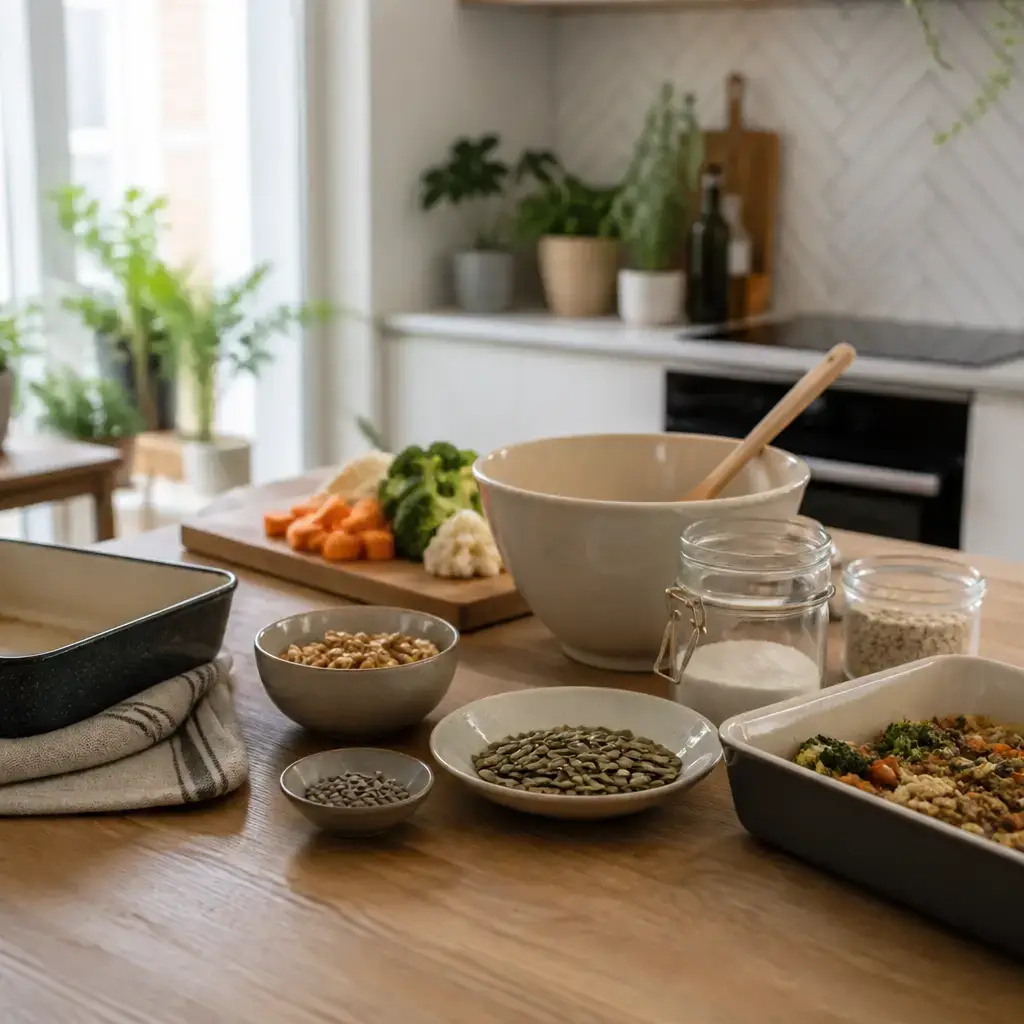
Før vi begynder at lave mad, lad os tjekke ingredienserne og eventuelle erstatninger.
fuhr vee beh-GUN-uh tuh LAH-vuh math, lah oss CHEK-uh en-greh-DEE-uh-nuh uh eh-VEN-too-EL-uh AIR-sdahd-ning-uh. Before we start cooking, let's check the ingredients and any substitutions.Opskriften kræver valnødder, og en gæst har nøddeallergi.
OPS-gref-den KREH-vuh VAL-nuh-thuh, uh en GEST hair NUH-duh-ah-lair-GEE. The recipe calls for walnuts, and one guest has a nut allergy.Så bør vi helt udelade valnødderne.
soh buhr vee helt oo-DEH-lah-thuh VAL-nuh-thuh-nuh. Then we should leave the walnuts out completely.Ristede frø vil stadig give retten lidt knas.
RES-duh fruh vil STEH-lee GEE-vuh REH-den lit knass. Toasted seeds would still give the dish some crunch.Lad os bruge frø i stedet, og holde notatet om allergien synligt, mens vi laver mad.
lah oss BROO-uh fruh ee STETH, uh HOL-uh noh-TEHTH om ah-lair-GEE-un SUNG-lit, mens vee LAH-vuh math. Let's use seeds instead, and keep the allergy note visible while we cook.Da det er en ret, der skal bages, bør vi stadig følge målene nøje.
deh deh air en red, dair sgal BEH-gus, buhr vee STEH-lee FUH-luh MOH-luh-nuh NOY-uh. Since this is a baked dish, we should still follow the measurements closely.Har vi nok mælk, eller skal jeg købe mere?
hah vee nock melk, EL-uh sgal yigh KUH-buh MEH-uh? Do we have enough milk, or should I buy more?Vi har nok, men tjek datoen, før du bruger den.
vee hah nock, men CHEK DEH-toh-un, fuhr doo BROO-uh den. We have enough, but check the date before using it.Ingredienserne ser sikre ud og er klare til brug nu.
en-greh-DEE-uh-nuh sair SEE-gruh ooth uh air KLAIR-uh tell broo noo. The ingredients look safe and ready now.Dette tjek bør hjælpe os med at undgå allergirisici og få retten til at smage rigtigt.
DEH-duh CHEK buhr YEL-buh oss meh uh UN-goh ah-lair-gee-REE-see uh foh REH-den tell uh SMEH-uh REG-dit. This check should help us avoid allergy risks and keep the dish tasting right.Sentence explanations
Før vi begynder at lave mad, lad os tjekke ingredienserne og eventuelle erstatninger.
Before we start cooking, let's check the ingredients and any substitutions.
- Før vi begynder
- before we begin
- lave
- make; cook
- mad
- food
- lad os
- let’s
- tjekke
- check
- ingredienserne
- the ingredients
- eventuelle
- any; possible
- erstatninger
- substitutions
More detail
Før vi begynder means “before we begin.” Før introduces a time clause, and vi is the first-person plural pronoun “we.” begynder is the present-tense form of begynde (“begin”) with vi; the same form is also used with other plural subjects and with jeg in Danish. Example: Vi begynder nu. — “We begin now.” lave is the infinitive of lave. In lave mad, it means “cook” or “prepare food,” rather than simply “make” in the most general sense. After lad os, Danish uses an infinitive: lad os lave mad means “let’s cook.” mad is the noun “food.” In this expression it refers generally to food as something being prepared, not to a specified individual portion. Example: Jeg laver mad. — “I am cooking.” lad os is a reusable construction meaning “let’s.” Literally it contains lad, the imperative of lade (“let”), and os, “us,” but the whole construction is followed by an infinitive: lad os tjekke — “let’s check.” tjekke is the infinitive “check.” It is a common, relatively informal verb; its present form is tjekker. Example: Vi tjekker listen. — “We check the list.” ingredienserne means “the ingredients.” It is the definite plural form of ingrediens: ingredienser means “ingredients,” while ingredienserne marks those ingredients as definite. Example: Ingredienserne står på bordet. — “The ingredients are on the table.” eventuelle means “any” or “possible” in the sense of items that may be present or relevant. It modifies the plural noun erstatninger; the adjective form is plural here. Compare en eventuel erstatning (“a possible substitution”) with eventuelle erstatninger (“possible substitutions”). erstatninger is the indefinite plural of erstatning, meaning “substitutions” or “replacements.” Its definite plural would be erstatningerne, “the substitutions.” In this sentence it refers to substitutions that might be used, without presenting them as a known, specified set. Together, Før vi begynder at lave mad sets the time—“before we start cooking.” The infinitive at lave follows begynder; at is the ordinary infinitive marker after this verb. Then lad os tjekke ingredienserne og eventuelle erstatninger gives the proposed action: “let’s check the ingredients and any substitutions.” The complete utterance is therefore: “Before we start cooking, let’s check the ingredients and any substitutions.”
Opskriften kræver valnødder, og en gæst har nøddeallergi.
The recipe calls for walnuts, and one guest has a nut allergy.
- Opskriften
- the recipe
- kræver
- requires; calls for
- valnødder
- walnuts
- gæst
- guest
- har
- has
- nøddeallergi
- nut allergy
More detail
Opskriften means “the recipe.” It is the definite singular form of opskrift (“recipe”): en opskrift is “a recipe,” while opskriften is “the recipe.” The ending -en marks definiteness for this common-gender noun. kræver means “requires” or, with ingredients, “calls for.” It is the present-tense form of kræve; Danish present-tense verbs do not change for person, so jeg kræver and opskriften kræver both use kræver. Example: Opskriften kræver olie. — “The recipe calls for oil.” valnødder means “walnuts.” It is the plural of valnød (“walnut”); the form changes from valnød to valnødder in the plural. Example: Jeg køber valnødder. — “I am buying walnuts.” gæst means “guest.” In en gæst, the noun is indefinite and singular. The fixed translation identifies the intended participant as one guest, but the article en itself marks grammatical indefiniteness and singularity rather than independently asserting a numerical count. har means “has” here. It is the present-tense form of have (“to have”) and does not change for grammatical person: jeg har is “I have,” and han har is “he has.” Example: Hun har en billet. — “She has a ticket.” nøddeallergi means “nut allergy.” It is a compound noun referring to an allergy to nuts. The combination har nøddeallergi expresses having that condition; it does not mean merely having a nut. Example: Barnet har nøddeallergi. — “The child has a nut allergy.” The first clause combines the definite subject Opskriften with the present verb kræver and its object valnødder: “The recipe calls for walnuts.” After og (“and”), en gæst is the subject of the second clause, and har nøddeallergi says that this guest has a nut allergy. Together, the utterance means: “The recipe calls for walnuts, and one guest has a nut allergy.”
Så bør vi helt udelade valnødderne.
Then we should leave the walnuts out completely.
- Så
- Then
- bør vi
- we should
- helt
- completely
- udelade
- leave out
- valnødderne
- the walnuts
More detail
Så means “then” here: it links this proposal to what has just been established. It can also mean “so” in other contexts, but this sentence uses it to mark a consequence. bør vi expresses “we should.” bør is the present-tense form of burde, a modal verb expressing recommendation or what is advisable; vi is the first-person plural pronoun “we.” Danish modal verbs are followed by an infinitive without at: Vi bør vente. — “We should wait.” The subject vi identifies the group making the recommendation; the form bør itself does not mark that plural subject. helt means “completely” and intensifies the following action. It makes clear that the walnuts are to be left out altogether, rather than only reduced. udelade means “to leave out” or “to omit.” It is the infinitive after the modal bør; the infinitive has no at here. The related opposite is medtage, “to include,” though the two verbs are not interchangeable in this sentence. valnødderne means “the walnuts.” The noun is valnød (“walnut”); valnødder is its plural, and the ending -ne marks the definite plural, “the walnuts.” The definite form presents these as the walnuts already identified in the situation, rather than walnuts in general. Danish plural and definiteness are expressed in the noun form here, not by changing udelade. Together, Så bør vi gives the consequence and recommendation, helt udelade says to omit entirely, and valnødderne identifies what is omitted. The whole utterance therefore means: “Then we should leave the walnuts out completely.”
Ristede frø vil stadig give retten lidt knas.
Toasted seeds would still give the dish some crunch.
- Ristede
- toasted
- frø
- seeds
- vil
- would
- stadig
- still
- give
- give
- retten
- the dish
- lidt
- some
- knas
- crunch
More detail
Ristede means “toasted” here and describes frø. It is the plural form of the adjective/participle ristet, from riste (“to toast”). Danish adjectives normally use -e with plural nouns: ristet frø (“toasted seed”) but ristede frø (“toasted seeds”). frø means “seeds” here. The form can also be singular: et frø means “a seed”, while the plural is also frø; the definite forms are frøet (“the seed”) and frøene (“the seeds”). The translation and surrounding context support the plural reading here. vil followed by the infinitive give expresses the intended “would give” in this sentence. The same modal can express other future-oriented meanings in other contexts, so its meaning here comes from the fixed translation and conditional proposal. A reusable pattern is X vil give Y ... — “X would give Y ...”. stadig means “still”. It signals that the result remains the same despite the change under discussion: the seeds would continue to provide crunch. Example: Det regner stadig. — “It is still raining.” give is the infinitive of give (“to give”), and it follows vil. Its present-tense form is giver: Frø giver knas. — “Seeds give crunch.” retten means “the dish” here. It is the definite singular form of ret: en ret (“a dish”) becomes retten (“the dish”). The ending marks definiteness; it does not itself indicate that the dish is plural. lidt means “some” or “a little” when referring to an amount, as with the mass-like texture noun knas. It is different from lille, which describes small size: lidt knas means “some crunch”, whereas en lille ret means “a small dish”. knas means “crunch” here: the crunchy texture added to food. It is used as an uncounted substance or quality in lidt knas. Example: Frø giver salaten knas. — “Seeds give the salad some crunch.” Together, Ristede frø identifies toasted seeds, vil ... give expresses the proposed result, retten is the dish receiving that result, and lidt knas is the amount of crunchy texture. The complete meaning is: “Toasted seeds would still give the dish some crunch.”
Lad os bruge frø i stedet, og holde notatet om allergien synligt, mens vi laver mad.
Let's use seeds instead, and keep the allergy note visible while we cook.
- Lad os
- let's
- bruge
- use
- frø
- seeds
- i stedet
- instead
- holde
- keep
- notatet
- the note
- allergien
- the allergy
- synligt
- visible
- mens
- while
- vi laver
- we make
- mad
- food
More detail
Lad os is the Danish way to propose a joint action: literally “let us,” followed by an infinitive. It does not identify a specific number of people beyond the speaker and at least one other participant. Example: Lad os begynde. — “Let’s begin.” bruge is the infinitive of bruge, “to use.” After Lad os, the following verb stays in the infinitive: Lad os bruge ... — “Let’s use ...”. The same verb can also appear as bruger in the present tense, as in Vi bruger frø. — “We use seeds.” frø means “seeds” here. This form is also used for the singular indefinite form “a seed,” so number is understood from context; the definite singular is frøet, while the plural form remains frø. Example: Et frø kan spire. — “A seed can sprout.” i stedet is a reusable adverbial meaning “instead” or “in its place.” Here it contrasts using seeds with the previously considered option without stating that option again. Example: Vi vælger ris i stedet. — “We choose rice instead.” holde is another infinitive of holde, “to keep” or “to hold.” It is coordinated with bruge after Lad os, so both verbs belong to the proposal: Lad os bruge ... og holde ... — “Let’s use ... and keep ...”. Example: Lad os holde døren lukket. — “Let’s keep the door closed.” notatet means “the note.” It is the definite singular form of the neuter noun notat: et notat — “a note,” notatet — “the note.” The definite ending identifies a particular note in this context, namely the allergy note specified by the following phrase. allergien means “the allergy.” It is the definite singular form of the common-gender noun allergi: en allergi — “an allergy,” allergien — “the allergy.” Together, notatet om allergien means “the note about the allergy.” synligt means “visible” in this sentence. It is the neuter singular form of the adjective synlig, agreeing with the neuter noun notatet; the adjective is not derived from notat. Compare en synlig besked — “a visible message” and et synligt notat — “a visible note.” In holde ... synligt, the adjective describes the state in which the note is to remain. mens introduces an overlapping time clause meaning “while.” It connects the keeping of the note in a visible state with the cooking activity, so the two situations occur during the same period. Example: Læs opskriften, mens du laver mad. — “Read the recipe while you cook.” vi laver means “we make” or “we are making” here, with vi as the subject and laver as the present-tense form of lave, “to make/do.” Danish present tense does not mark a separate progressive form here; the context supplies the ongoing meaning. Example: Vi laver suppe. — “We are making soup.” mad means “food” here and, in laver mad, forms the common expression “cook” or “prepare food.” It is normally used without an indefinite article when referring to food as an activity or substance. Example: Hun laver mad. — “She is cooking.” Putting the parts together, Lad os bruge frø i stedet proposes using seeds instead, and og holde notatet om allergien synligt adds the coordinated action of keeping the allergy note visible. mens vi laver mad places both actions during the time when the participants are cooking. The complete meaning is: “Let’s use seeds instead, and keep the allergy note visible while we cook.”
Da det er en ret, der skal bages, bør vi stadig følge målene nøje.
Since this is a baked dish, we should still follow the measurements closely.
- Da
- since
- det
- this/it
- en ret
- a dish
- skal bages
- is to be baked
- bør vi
- we should
- stadig
- still
- følge
- follow
- målene
- the measurements
- nøje
- closely
More detail
Da introduces the reason or background clause here: “since.” It is a conjunction, so the clause beginning with it explains why the main clause applies. Example: Da det regner, bliver vi hjemme. — “Since it is raining, we are staying home.” det is the Danish neuter singular pronoun used here for “this/it.” In det er en ret, it presents the thing being identified; the sentence and translation support “this,” but they do not require a more specific referent. Danish det can also refer to a previously mentioned neuter noun, depending on context. en ret means “a dish” in this utterance. ret is the base noun; its definite singular is retten, and its plural is retter. The article en marks an indefinite common-gender noun; it does not by itself assert a numerical count. Example: Det er en enkel ret. — “It is a simple dish.” skal bages expresses that the dish is to be baked. skal is a form of skulle, used here with an infinitive to express what is required or scheduled. bages is the passive form of bage (“bake”), marked with -s; the dish is the thing receiving the baking rather than the baker. The relative clause der skal bages means “that is to be baked” and describes en ret. bør vi expresses the recommendation “we should.” bør is the present form of burde; it is a modal verb, and vi is the first-person plural pronoun “we.” Danish normally places the modal before the subject in this main-clause question-like word order after an initial clause: Da ..., bør vi .... Example: Vi bør vente. — “We should wait.” stadig means that the recommendation remains in force: “still.” It commonly marks continuation of a situation or expectation. Here it modifies the following action, so the measuring should continue to be done carefully despite the preceding context. følge is the infinitive of følge, “follow.” After the modal bør, Danish uses the infinitive without an infinitive marker: bør vi følge. The verb can describe following instructions, a route, or a plan; here it means following the measurements or quantities given for the dish. Example: Vi følger opskriften. — “We follow the recipe.” målene is the definite plural of mål, meaning “the measurements” in this context. The ending -ene marks definite plural for this noun: mål → målene. The fixed translation identifies the intended cooking sense, rather than another possible sense of mål such as “goal” or “target.” nøje is an adverb meaning “closely” or “carefully.” It tells how følge is carried out. It is related in meaning to careful attention, but it is not an adjective modifying målene; it modifies the action of following. Example: Læs vejledningen nøje. — “Read the instructions carefully.” Together, Da det er en ret, der skal bages gives the reason: “Since this is a dish that is to be baked.” The main clause bør vi stadig følge målene nøje says that, because of that baking requirement, “we should still follow the measurements closely.” The complete utterance is therefore: “Since this is a baked dish, we should still follow the measurements closely.”
Har vi nok mælk, eller skal jeg købe mere?
Do we have enough milk, or should I buy more?
- Har vi
- do we have
- nok
- enough
- mælk
- milk
- eller
- or
- skal jeg
- should I
- købe
- buy
- mere
- more
More detail
Har vi uses the present-tense form har of have with the subject vi (“we”). In a yes/no question, Danish places the finite verb before the subject: Har vi ...? means “Do we have ...?” The same form har can also occur in a statement, as in Vi har nok. — “We have enough.” nok means “enough” here. It indicates that the quantity of milk may meet the need; it does not itself specify an exact amount. A useful pattern is have nok + noun, for example Vi har nok tid. — “We have enough time.” mælk means “milk.” It is a mass noun in this sentence, so the question concerns an unspecified amount rather than a counted number of individual items. Mælk remains the same form whether it is the subject or object; the surrounding sentence shows its role here as the object of har. eller joins alternatives and means “or.” Here it connects the question about having enough milk with the alternative question about buying more. skal jeg contains the present-tense modal form skal of skulle and the subject jeg (“I”). In this context, skal expresses what the speaker ought to do or is expected to do, so skal jeg ...? is the reusable question pattern “should I ...?” Danish again places the finite verb before the subject in the question. For example, Skal jeg åbne vinduet? — “Should I open the window?” købe is the infinitive “buy.” It follows the modal skal, which makes the modal carry the tense and leaves the following verb in the infinitive: skal jeg købe means “should I buy.” The infinitive is also the base form used after other modal verbs, for example Jeg kan købe brød. — “I can buy bread.” mere means “more” in this sentence. It is the quantity comparison associated with meget (“much”): meget → mere (“much” → “more”). Here it stands without repeating the noun, so the intended meaning is “more [milk].” For example, Vil du have mere? — “Do you want more?” Together, Har vi nok mælk? asks whether the available amount of milk is sufficient. Eller skal jeg købe mere? offers the alternative of the speaker buying more milk. The complete utterance therefore means: “Do we have enough milk, or should I buy more?”
Vi har nok, men tjek datoen, før du bruger den.
We have enough, but check the date before using it.
- Vi
- we
- har
- have
- nok
- enough
- tjek
- check
- datoen
- the date
- før
- before
- du
- you
- bruger
- use
- den
- it
More detail
Vi har nok: Vi means “we” and is the first-person plural pronoun. Har is the present-tense form of have (“to have”); the same form is used with vi, I, and de. Together, vi har means “we have.” Nok means “enough” here: it indicates that the amount already available is sufficient, without stating a numerical quantity. tjek: This is the imperative of tjekke, “to check.” The imperative gives a direct instruction to the addressee; its subject is understood rather than expressed in tjek. The later du is the explicit subject of the clause after før, not part of the imperative form itself. datoen: This means “the date.” Dato is the base noun, and datoen is its definite singular form, “the date,” rather than an unspecified date. Danish marks definiteness on the noun here; the ending -en belongs to datoen. før: This is the subordinating conjunction “before.” It introduces an event that happens earlier than the event in the main clause. A reusable pattern is før + a clause, as in før du går (“before you leave”). du: This is “you,” specifically the second-person singular pronoun in this sentence. Danish uses I for second-person plural “you,” so du and I contrast in number. bruger: This is the present-tense form of bruge, “to use.” Danish present-tense verbs generally keep the same form across personal subjects: jeg bruger, du bruger, and de bruger. Example: Du bruger en kniv means “You use a knife.” den: This is a common-gender singular object pronoun, “it” in this context. In this sentence, it is naturally understood as referring back to datoen; the English translation keeps the reference as “it” without showing Danish grammatical gender. Den is used for a common-gender singular referent, while det is used for a neuter-gender singular referent. The sentence first states Vi har nok (“We have enough”). Men connects that statement to a contrasting instruction: “but check the date.” The clause før du bruger den adds the time relation “before you use it,” with du as the subject of bruger and den understood as referring to the date. Thus the whole utterance means: “We have enough, but check the date before using it.”
Ingredienserne ser sikre ud og er klare til brug nu.
The ingredients look safe and ready now.
- Ingredienserne
- the ingredients
- ser … ud
- look / seem
- sikre
- safe
- klare
- ready
- til brug
- for use
- nu
- now
More detail
Ingredienserne means “the ingredients.” The base noun is ingrediens (“ingredient”); ingredienser is its plural, and the ending -ne marks the definite plural: “the ingredients.” ser ... ud is a split construction meaning “look” or “seem.” ser is the present form of se (“see”), while ud is a particle; together here they describe how something appears, not simply the act of seeing. Example: Det ser godt ud. — “It looks good.” sikre means “safe” here. It is the form used with the plural subject ingredienserne; the singular indefinite form is commonly sikker, as in en sikker ingrediens (“a safe ingredient”). The adjective describes the ingredients’ apparent condition because it follows ser ... ud. er is the present form of være (“be”). It links the same subject to a second description, so the sentence says that the ingredients both appear safe and are ready. klare means “ready” here. It is the plural form of the adjective klar; klar can also mean “clear” in other contexts, but “ready” is the supported meaning in this utterance. Example: Vi er klar til at begynde. — “We are ready to begin.” til brug means “for use.” til introduces the intended purpose, and brug is the noun “use.” The pattern klar til + noun means “ready for + noun”; with an activity, Danish commonly uses klar til at plus a verb, as in klar til at spise — “ready to eat.” nu means “now” and places the described readiness in the present moment. Together, Ingredienserne ser sikre ud says “The ingredients look safe,” while er klare til brug nu adds “and are ready for use now.” The full utterance therefore means: “The ingredients look safe and ready now.”
Dette tjek bør hjælpe os med at undgå allergirisici og få retten til at smage rigtigt.
This check should help us avoid allergy risks and keep the dish tasting right.
- Dette
- this
- tjek
- check
- bør
- should
- hjælpe
- help
- os
- us
- med at
- with; in helping to
- undgå
- avoid
- allergirisici
- allergy risks
- og
- and
- få
- get; keep
- retten
- the dish
- smage
- taste
- rigtigt
- right; properly
More detail
Dette means “this” and points to a singular neuter noun. In this sentence it agrees with tjek, whose indefinite form is et tjek and whose definite form is tjekket. Danish demonstratives agree with the noun’s grammatical gender and number; singularity alone does not determine the gender. tjek is a check or inspection. The compound et sikkerhedstjek (“a safety check”) shows how the noun can be reused. Here, Dette tjek refers to the check itself, not to an action expressed by a verb. bør expresses what is expected, advisable, or supposed to happen: “should.” It is a present-tense modal form related to burde. A modal such as bør is followed directly by an infinitive, without at: bør hjælpe (“should help”). hjælpe is the infinitive “to help.” Danish infinitives commonly follow modal verbs directly, as in kan hjælpe (“can help”) and vil hjælpe (“will want to help” / “will help,” depending on context). The form hjælpe itself does not show the subject’s person or number. os is the first-person plural object form, “us.” The corresponding subject form is vi (“we”): Vi hjælper os is grammatically possible but means “We help ourselves,” whereas Det hjælper os means “It helps us.” Here os is the group that receives the help. med at introduces an activity that the help supports. The reusable pattern is hjælpe nogen med at + infinitive, “help someone to do something”: Hun hjælper mig med at læse means “She helps me read.” The at belongs with the following infinitive, not with the modal bør. undgå means “avoid” or “prevent oneself from encountering.” It is an infinitive after at in med at undgå. For example, Vi prøver at undgå fejl means “We try to avoid mistakes.” allergirisici is the plural indefinite form of the compound noun meaning “allergy risks.” The singular is en allergirisiko; the plural ending is -risici. The compound combines allergi (“allergy”) with risiko (“risk”), but the whole compound functions as one noun here. og joins two coordinated activities. It links undgå allergirisici with få retten til at smage rigtigt; the second activity is another thing the check should help the group do. få is the infinitive “get” and can also form a causative pattern: få noget til at + infinitive, “get something to do something” or “make it so that something does something.” In this sentence, it presents the dish as being kept or brought into the state described by the following clause. retten is the definite form of ret, here meaning “the dish” or “the prepared course.” The same surface form can have other meanings in other contexts, including “the right,” but the fixed translation identifies the dish meaning here. en ret is an indefinite dish; retten is “the dish.” smage is the infinitive “taste.” In få retten til at smage ..., the noun retten is the understood subject of smage: the construction means to get the dish to taste in a certain way. This is different from smage retten, which means “taste the dish,” with the dish as the object. rigtigt means “right” or “properly” in this expression. It is the form used here with the verb phrase smage rigtigt, describing how the dish tastes. Danish also has rigtig as the common-gender adjective form, while rigtigt can be the neuter adjective form and is also used adverbially; the exact function is determined by the surrounding construction. Together, bør hjælpe os med at undgå allergirisici means “should help us avoid allergy risks.” The coordinated part og få retten til at smage rigtigt means “and keep or get the dish tasting right.” Thus the whole utterance says that this check is expected to help the group avoid allergy risks and ensure that the dish tastes right. The pattern bør + infinitive and the pattern få + noun + til at + infinitive are both reusable in practical explanations and instructions.
Grammar Points
Bestemt form med endelserne -en, -et og -ene
Tjek ingredienserne og opskriften.
CHEK en-greh-DEE-uh-nuh uh OPS-gref-den.Check the ingredients and the recipe.
Danish often marks “the” by adding an ending to the noun: -en, -et or -ene.
i stedet for + substantiv
Brug frø i stedet for valnødderne.
BROO fruh ee STETH foh VAL-nuh-thuh-nuh.Use seeds instead of the walnuts.
Use “i stedet for” to say that one thing replaces another.
Danish Vocabulary
Quiz
Word Order
Arrange the words in the correct order.
Then we should leave the walnuts out completely.
Show Answer
Så bør vi helt udelade valnødderne.Spelling
Tap the letters to spell the word.
substitutions
Show Answer
erstatningerrequires; calls for
Show Answer
kræverstarts
Show Answer
begynderthe recipe