10 minutes free every day
Continue audio lessons in the app
Word explanations appear automatically in sync with the audio.
No login required · synced translations · playback with the screen locked
Choose your learning language and open this lesson in the app.

About This Lesson
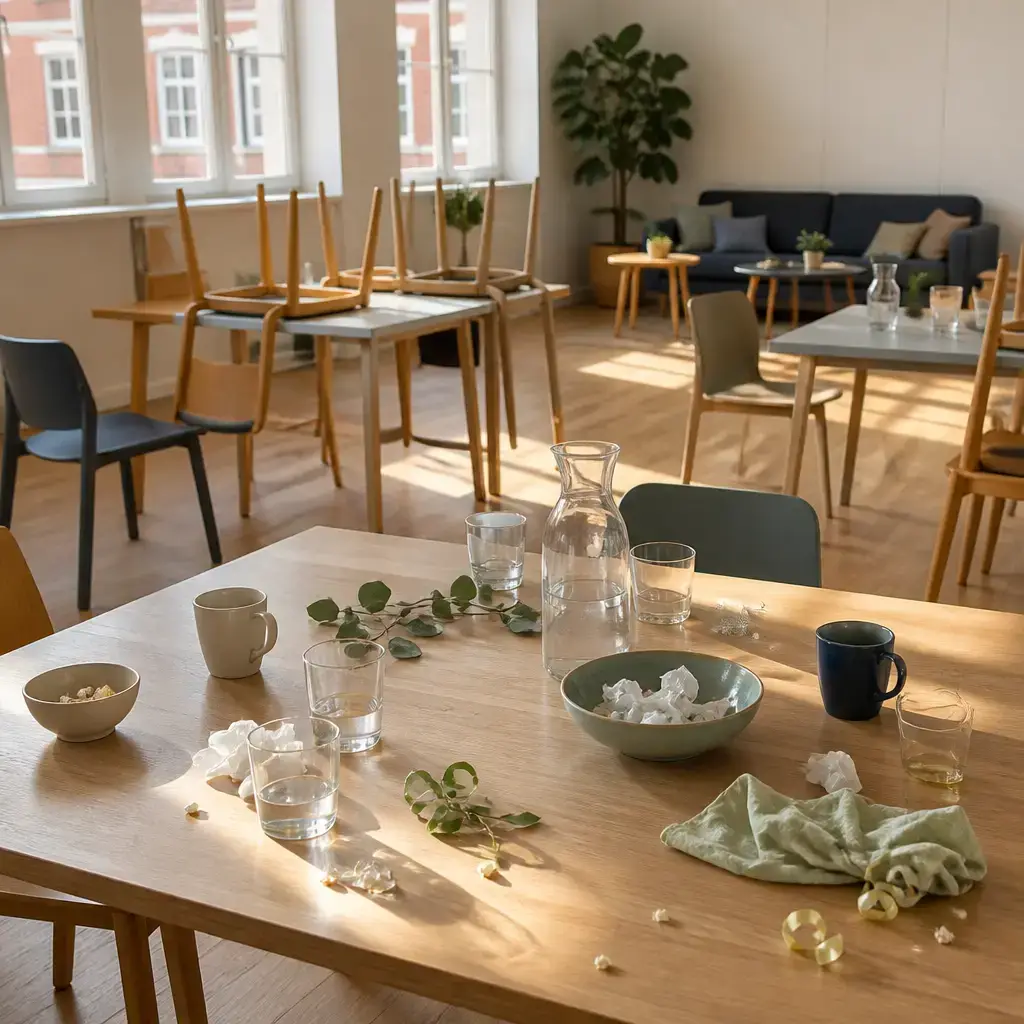
Use Cleaning and resetting a common room to practice Danish conversation, pronunciation, vocabulary, grammar, and quizzes.
Dialogue
Fællesrummet ser rodet ud efter arrangementet.
FEL-uhs-room-uth sair ROH-thuh ooth EF-tuh ah-ran-zheh-MAH-nuhd. The common room looks messy after the event.Vi skal gøre rent, fordi vi har reserveret det.
vee skal GUR-uh RENT, for-THEE vee hah ray-sair-VAIR-uhd deh. We need to clean it because we reserved it.Lad os bruge en tjekliste, så vi ikke glemmer noget.
lah ohs BROO-uh en CHEK-lees-tuh, soh vee IK-uh GLEM-uh NOH-uth. Let's use a checklist so we don't miss anything.Jeg kan samle skraldet sammen, og du kan sætte stolene på plads igen.
yay kan SAM-luh SKRAL-uh-thuh SAM-un, oh doo kan SET-uh STOH-luh-nuh poh PLAS ee-GAIN. I can collect the trash, and you can put the chairs back.Skal bordene stå, som de stod før?
skahl BOR-nuh STOH, som dee STOHD FUR? Should the tables go back the way they were?Den næste gruppe forventer, at rummet er sat op som normalt.
den NEST-uh GROO-buh for-VEN-tuh, at ROOM-uh air sat oh som nor-MAHL. The next group will expect the usual setup.Jeg vil også tjekke, om nogen har efterladt personlige ting.
yay vil OH-soh CHEK-uh, om NOH-un hah EF-ter-LAHT pair-SOHN-lee-uh TENG. I'll also check whether anyone left personal items behind.Opladere og notesbøger er nemme at glemme.
oh-PLAH-thuh-ruh oh NOHTS-BUR-uh air NEM-uh at GLEM-uh. Chargers and notebooks are easy to forget.Rummet ser klart ud nu.
ROOM-uh sair KLAHRD ooth noo. The room looks ready now.Det bør være nemmere at reservere rummet igen, når vi efterlader det rent.
deh bur VAIR-uh NEM-uh-ruh at ray-sair-VAIR-uh ROOM-uh ee-GAIN, nor vee EF-ter-LAIR-uh deh RENT. Leaving it clean should make it easier to book again.Sentence explanations
Fællesrummet ser rodet ud efter arrangementet.
The common room looks messy after the event.
- Fællesrummet
- the common room
- ser … ud
- looks
- rodet
- messy
- efter
- after
- arrangementet
- the event
More detail
Fællesrummet means “the common room.” It is the definite singular form of fællesrum (“common room”); the noun is an et-word, and its definite form ends in -et with the spelling fællesrummet. The compound combines fælles (“common/shared”) with rum (“room”). Example: Vi mødes i fællesrummet. — “We are meeting in the common room.” ser ... ud is the reusable Danish pattern for “looks/seems ...” Here, ser is the present form of se (“see”), while ud completes the construction; together they mean “looks.” The quality being judged comes between the two parts: Det ser godt ud. — “It looks good.” rodet means “messy” or “untidy” here. It describes the room’s appearance and has the neuter singular form because fællesrummet is an et-word. The adjective’s base form is rodet; in attributive use, plural and definite noun phrases commonly use rodede, as in rodede værelser (“messy rooms”) and det rodede værelse (“the messy room”). However, a definite noun does not by itself require rodede in this predicative pattern: Rummet ser rodet ud. — “The room looks messy.” efter means “after” and introduces a time relation. It can be followed by a noun phrase: efter mødet — “after the meeting.” arrangementet means “the event.” Its base form is arrangement, and the ending -et makes it definite singular: et arrangement (“an event”) becomes arrangementet (“the event”). This is a different noun from fællesrummet, even though both forms end in -et. Putting the parts together, Fællesrummet ser rodet ud says that the common room has a messy appearance, and efter arrangementet specifies that this is the case after the event. The complete meaning is: “The common room looks messy after the event.”
Vi skal gøre rent, fordi vi har reserveret det.
We need to clean it because we reserved it.
- Vi skal
- we need to
- gøre rent
- clean
- fordi
- because
- reserveret
- reserved
- det
- it
More detail
Vi skal means “we need to” here. vi is the first-person plural subject, “we.” skal is the present-tense form of skulle; in this sentence it expresses a need or requirement. Danish modal verbs such as skal are followed by an infinitive without at: Vi skal arbejde means “We need to work.” The form skal does not change for different subjects. gøre rent is the reusable Danish expression “to clean.” gøre is the infinitive corresponding to the present-tense form gør; in this expression, rent completes the meaning rather than describing a particular noun. Example: De gør rent hver fredag. — “They clean every Friday.” fordi introduces a reason and means “because.” It connects the need to clean with its explanation. In the following clause, vi is the subject and har reserveret det is the verb phrase: fordi vi har reserveret det — “because we have reserved it.” reserveret is the past participle of reservere, “to reserve.” It appears with har, forming the perfect har reserveret, “have reserved.” The participle itself does not show the subject’s person or number here; har is the finite verb. Example: Vi har reserveret et bord. — “We have reserved a table.” det is a third-person singular neuter object pronoun, “it.” Here it has the intended object meaning shown by the fixed translation; the supplied wording does not identify that object more specifically. Danish uses det for a neuter singular referent, while den is used for a common-gender singular referent. Example: Jeg har reserveret det. — “I have reserved it.” Together, Vi skal gøre rent states the need to clean, and fordi vi har reserveret det gives the reason. The complete meaning is: “We need to clean it because we reserved it.”
Lad os bruge en tjekliste, så vi ikke glemmer noget.
Let's use a checklist so we don't miss anything.
- Lad os
- let's
- bruge
- use
- tjekliste
- checklist
- så vi ikke
- so that we do not
- glemmer
- forget
- noget
- anything
More detail
Lad os is the Danish construction for a suggestion involving the speaker and others: “let’s …”. Here, lad is the imperative of lade (“let/allow”), followed by os (“us”). It is a fixed reusable pattern: Lad os + infinitive. Example: Lad os begynde. — “Let’s begin.” bruge means “use” here. It is the infinitive form of bruge; after Lad os, Danish uses the infinitive: Lad os bruge … (“Let’s use …”). The same verb can appear in the present tense as bruger: Vi bruger en app. — “We use an app.” tjekliste is a compound noun meaning “checklist”: a list used for checking that tasks or items have been covered. The noun is common gender, so the indefinite article is en: en tjekliste. Example: Jeg skriver en tjekliste. — “I am writing a checklist.” så vi ikke introduces the intended result or purpose: “so that we do not …”. vi means “we,” and ikke is the ordinary Danish negation placed before the lexical verb in this clause. This does not itself specify how successful the result will be; it presents avoiding the following event as the goal. Example: Vi skriver det ned, så vi ikke glemmer det. — “We write it down so that we do not forget it.” glemmer means “forget” in this sentence. It is the present-tense form of glemme. Danish present-tense verbs do not change according to the subject’s person or number, so jeg glemmer, vi glemmer, and de glemmer use the same verb form. Example: Jeg glemmer aldrig navnet. — “I never forget the name.” noget means “anything” in this negative clause. In a non-negative context, the same form commonly means “something”: Jeg har noget. — “I have something.” Here, ikke glemmer noget means “do not forget anything,” with noget functioning as the object of glemmer. Together, Lad os bruge en tjekliste proposes using a checklist. så vi ikke glemmer noget states the purpose: avoiding forgetting anything. The whole utterance therefore means: “Let’s use a checklist so we don’t miss anything.”
Jeg kan samle skraldet sammen, og du kan sætte stolene på plads igen.
I can collect the trash, and you can put the chairs back.
- Jeg kan
- I can
- samle
- collect
- skraldet
- the trash
- sammen
- together
- du kan
- you can
- sætte
- put
- stolene
- the chairs
- på plads igen
- back in place
More detail
Jeg kan means “I can.” Jeg is the first-person singular pronoun “I”. kan is the present form of kunne (“can/be able to”) and is used with different subjects: jeg kan = “I can”, while du kan = “you can”. After this modal verb, the next verb appears in the infinitive. samle means “collect” here. It is the infinitive of samle, so its form does not show the subject in this construction. The verb can also mean “gather” when things are brought together. Example: Jeg samler papirerne. — “I collect the papers.” skraldet means “the trash”. skrald is the noun “trash”; skraldet is its definite singular form, marked by -et. Here it refers to the trash as the material to be collected. Example: Skraldet står udenfor. — “The trash is outside.” sammen means “together”. With samle, samle sammen describes gathering things into a collection or group. In this sentence, samle skraldet sammen means “collect the trash”, with sammen emphasizing the gathering-together action. du kan means “you can”. du is the second-person singular pronoun “you”, and kan is again the present form of kunne. The following verb is therefore an infinitive: du kan sætte = “you can put”. sætte means “put” or “set” here. It is the infinitive used after kan. Danish distinguishes this action of placing something from sidde, “sit/be seated”, and stå, “stand/be standing”. Example: Du kan sætte koppen på bordet. — “You can put the cup on the table.” stolene means “the chairs”. stol is the singular noun “chair”; stole is its plural, and stolene is the definite plural, “the chairs”. The definite ending identifies a particular set of chairs in this utterance. på plads igen means “back in place”. på plads is a fixed placement expression meaning “in its/their proper place”, and igen means “again”. Together, they show that the chairs are to be put back where they belong or were previously located; the phrase does not itself specify an exact location. The first coordinated part is Jeg kan samle skraldet sammen: “I can collect the trash.” The conjunction og means “and”, linking this with du kan sætte stolene på plads igen: “you can put the chairs back in place.” Thus the whole utterance is: “I can collect the trash, and you can put the chairs back.”
Skal bordene stå, som de stod før?
Should the tables go back the way they were?
- Skal
- should
- bordene
- the tables
- stå
- stand; be placed
- som de stod
- the way they were
- før
- before; previously
More detail
Skal is the present-tense form of skulle, used here with an infinitive to ask whether something should happen: skal + infinitive. For example, Skal vi gå? means “Should we go?” or, depending on context, “Are we going to go?” Here the intended meaning is a question about the appropriate arrangement. bordene means “the tables.” Its base noun is bord (“table”); borde is the plural, and bordene is the definite plural. The ending -ene marks “the” with this plural noun. This form identifies the tables as known in the situation; it does not itself state how many tables there are. stå is the infinitive of står / stod, “stand” or “be positioned.” With objects such as tables, it can describe their position or arrangement, not only literal standing. After the modal skal, Danish uses the infinitive: bordene skal stå ... (“the tables should be ...”). som de stod means “the way they were.” som introduces the manner or arrangement being compared with. de is a plural pronoun, matching the plural tables in this sentence. stod is the past form of stå; the past places the earlier arrangement in the past. A reusable pattern is som [something] var/stod (“the way [something] was/was positioned”), with the verb chosen to match the meaning. før means “before” or “previously.” Here it refers to an earlier arrangement, so stod før means “were positioned previously.” It is not the noun “before”; it functions as a time adverb. Together, Skal bordene stå asks whether the tables should be positioned in a certain way, and som de stod før specifies that the way should match their earlier position. The complete meaning is: “Should the tables go back the way they were?”
Den næste gruppe forventer, at rummet er sat op som normalt.
The next group will expect the usual setup.
- næste
- next
- gruppe
- group
- forventer
- expects
- rummet
- the room
- er sat op
- is set up
- som normalt
- as usual
More detail
næste means “next” here. It is used before a noun in forms such as den næste gruppe (“the next group”), det næste rum (“the next room”), and de næste grupper (“the next groups”). The form næste itself does not change for common gender, neuter, or plural in these examples. Example: næste uge — “next week.” gruppe is a common-gender noun meaning “group.” Its definite singular form is gruppen (“the group”), while the plural is grupper and the definite plural is grupperne. Example: En gruppe kommer. — “A group is coming.” forventer means “expects” in this sentence. It is the present-tense form of forvente (“to expect”); Danish present forms do not change between third-person singular and plural, so gruppen forventer and grupperne forventer both use forventer. The present form can refer to a future situation when the context supports that reading, as it does here; the form itself is not a special future tense. Example: Hun forventer et svar. — “She expects an answer.” rummet means “the room.” It is the definite singular form of the neuter noun rum (“room”): et rum becomes rummet. The ending belongs to the noun, not to næste or another nearby word. Example: Rummet er stort. — “The room is large.” er sat op expresses that the room is set up. sat is the past participle of sætte (“to put” or “to set”), and sætte op is the verb construction meaning “to set up.” With er, this construction presents the setup as a state or result: Rummet er sat op. — “The room is set up.” It is distinct from står, which describes something standing or being positioned rather than the act or result of setting it up. som normalt means “as usual” or “in the usual way.” Here normalt functions adverbially and modifies how the room is set up; it is not a noun meaning “the setup.” Example: Alt går som normalt. — “Everything is going as usual.” Together, Den næste gruppe means “the next group.” forventer takes the following clause as what the group expects: at rummet er sat op som normalt means “that the room is set up as usual.” The complete utterance therefore means “The next group will expect the usual setup.” The Danish verb is present tense, while the fixed English translation uses will to express the future expectation supplied by the context.
Jeg vil også tjekke, om nogen har efterladt personlige ting.
I'll also check whether anyone left personal items behind.
- Jeg vil
- I will
- også
- also
- tjekke
- check
- om
- whether
- nogen
- anyone
- efterladt
- left behind
- personlige
- personal
- ting
- items
More detail
Jeg vil expresses the speaker’s intention or planned action here: “I will.” vil is the present form of ville; with a subject such as jeg and an infinitive, Jeg vil + infinitive commonly expresses “I will …” or “I want to …”, with context deciding between those readings. Example: Jeg vil vente. — “I will wait.” også means “also” and adds this check to something else the speaker intends to do. Its position can change for emphasis, but here it comes directly after Jeg vil. tjekke is the infinitive “to check.” After the modal verb vil, Danish uses the infinitive without an English-style “to”: Jeg vil tjekke — “I will check.” om introduces an indirect yes/no question, so om ... means “whether …” here. It is different from a direct question word such as hvad (“what”): Jeg ved, om han kommer. — “I know whether he is coming.” nogen is an indefinite pronoun meaning “anyone” in this question-like context. It refers to an unspecified person, without identifying who that person is. In om nogen ..., it introduces the possible actor of the following clause. efterladt is the past participle of efterlade, “to leave behind.” In the complete form har efterladt, it combines with har to describe a completed act: “has left behind.” The observed word is the participle; har is not included in this phrase entry but appears later in the subordinate clause. personlige is an inflected form of the adjective personlig, “personal.” The ending -e is used here because the adjective modifies plural ting; it can also occur with a definite noun phrase. Example: personlige oplysninger — “personal information.” ting means “items” or “things” here. It is the plural indefinite form of ting; notably, the singular indefinite form is also ting, while the definite forms are tingen (“the item”) and tingene (“the items”). Together, Jeg vil også tjekke means “I’ll also check.” The subordinate clause om nogen har efterladt personlige ting means “whether anyone has left personal items behind.” The full utterance therefore means: “I’ll also check whether anyone left personal items behind.”
Opladere og notesbøger er nemme at glemme.
Chargers and notebooks are easy to forget.
- Opladere
- chargers
- notesbøger
- notebooks
- nemme
- easy
- at glemme
- to forget
More detail
Opladere means “chargers” here. It is the plural indefinite form of oplader (“charger”): en oplader → opladeren (the charger) and oplader(e) is used for the plural, with the spelling opladere. notesbøger means “notebooks.” It is the plural indefinite form of notesbog (“notebook”): en notesbog → notesbøger. The plural ending changes the form of the noun; it is not an adjective ending. nemme means “easy” here. The adjective is nem; nemt is the neuter singular form, while nemme is used with a plural subject and in definite noun phrases. Because opladere og notesbøger is a coordinated plural subject, the predicate adjective is nemme. at glemme means “to forget.” at marks the infinitive, and glemme is the infinitive form of the verb. A useful pattern is være nem at + infinitive, meaning that something is easy to do: Det er nemt at forstå. — “It is easy to understand.” The adjective is nemt in that example because det is singular neuter; in the fixed sentence, the plural subject requires nemme. Together, Opladere og notesbøger is the plural subject, er nemme says that they are easy, and at glemme specifies the action. The complete meaning is “Chargers and notebooks are easy to forget.” The sentence presents this as a general property of those items, without stating that any particular charger or notebook was actually forgotten.
Rummet ser klart ud nu.
The room looks ready now.
- Rummet
- the room
- ser … ud
- looks
- klart
- ready
- nu
- now
More detail
Rummet means “the room” here. rum is the base noun; rummet is its definite singular form, formed with the ending -et. Danish uses this ending with neuter nouns such as et rum (“a room”), so the form identifies one specific room in this sentence. ser ... ud is a reusable Danish construction meaning “looks” or “appears.” ser is the present form of se (“to see”), but with ud it describes how something appears rather than what someone sees. The two parts belong together even though they are separated here by klart. Example: Hun ser træt ud. — “She looks tired.” klart means “ready” in this sentence. It is the neuter singular form of the adjective klar, agreeing with the neuter noun rummet in the construction rummet ser klart ud. The same adjective can have other meanings in other contexts, including “clear,” so the fixed translation establishes the intended meaning here. For comparison, klar can describe a common-gender singular noun, while klart is used with a neuter singular noun; the adjective’s form changes, not the noun’s base form. nu means “now” and places the situation at the present time. Example: Vi starter nu. — “We are starting now.” Together, Rummet ser klart ud nu. means “The room looks ready now.” The structure is [subject] + ser + adjective + ud + time word: the room appears ready at the present time. In ordinary use, ser ... ud presents this as an appearance or impression rather than as a direct statement that the room has definitively been declared ready.
Det bør være nemmere at reservere rummet igen, når vi efterlader det rent.
Leaving it clean should make it easier to book again.
- Det bør være
- It should be
- nemmere
- easier
- reservere
- to book
- rummet
- the room
- igen
- again
- når
- when
- vi
- we
- efterlader
- leave behind
- det
- it
- rent
- clean
More detail
Det bør være introduces the prediction or expectation. Here, the first Det is a formal subject: it does not name the room. bør is the present form of burde and expresses “should” or what is expected to be the case. være is the infinitive “to be,” used after this modal verb. A useful pattern is det bør være + adjective: “it should be …”. nemmere means “easier” here. It is the comparative form of nem (“easy”): nem → nemmere → nemmest (“easiest”). The comparison concerns the action that follows, introduced by at. reservere is the infinitive “to reserve/book.” After at, Danish commonly uses the infinitive: at reservere = “to book.” For example, Det er nemt at reservere online. means “It is easy to book online.” rummet means “the room.” It is the definite singular form of rum: et rum = “a room,” rummet = “the room.” The ending -et marks the neuter definite singular form of this noun. igen means “again.” It indicates that the booking is being done another time, so reservere rummet igen means “book the room again.” når introduces a time condition or circumstance: “when.” The clause after it explains when the expected improvement applies. vi is the first-person plural pronoun “we.” It is the subject of the subordinate clause. Danish pronouns distinguish person and number here: vi refers to a plural group including the speaker. efterlader means “leave behind” or “leave.” It is the present form of efterlade. The form is used with vi in the present-tense clause: vi efterlader = “we leave.” The second det is different from the formal subject at the beginning. Here it is a third-person singular neuter object pronoun, translated as “it”; in this context, the fixed translation and the preceding room context identify it as the room. Danish uses det both as a neuter pronoun and as a formal subject, so its role must be understood from the construction. rent means “clean.” It is the neuter singular form of the adjective ren. It agrees with the neuter singular referent of det in efterlader det rent: “leave it clean.” The adjective describes the result or condition in which the object is left. Together, når vi efterlader det rent means “when we leave it clean.” This subordinate clause supplies the condition, while Det bør være nemmere at reservere rummet igen says that booking the room again should be easier. The complete utterance therefore means: “Leaving it clean should make it easier to book again.”
Grammar Points
nem → nemmere
Det er nemmere at gøre rent.
deh air NEM-uh-ruh at GUR-uh RENT.It is easier to clean.
The adjective nem forms the comparative nemmere, meaning “easier.”
sætte noget på plads igen
At sætte bordene på plads igen.
at SET-uh BOR-nuh poh PLAS ee-GAIN.To put the tables back in place.
The fixed expression på plads igen means returning something to its proper position.
Danish Vocabulary
- Gender
- neuter
- Gender
- neuter
- Gender
- neuter
- Gender
- common
Quiz
Word Order
Arrange the words in the correct order.
The common room looks messy after the event.
Show Answer
Fællesrummet ser rodet ud efter arrangementet.The room looks ready now.
Show Answer
Rummet ser klart ud nu.Spelling
Tap the letters to spell the word.
to collect, to gather
Show Answer
samleto reserve, to book
Show Answer
reserveretto forget
Show Answer
glemmerchecklist