10 minutes free every day
Continue audio lessons in the app
Word explanations appear automatically in sync with the audio.
No login required · synced translations · playback with the screen locked
Choose your learning language and open this lesson in the app.

About This Lesson
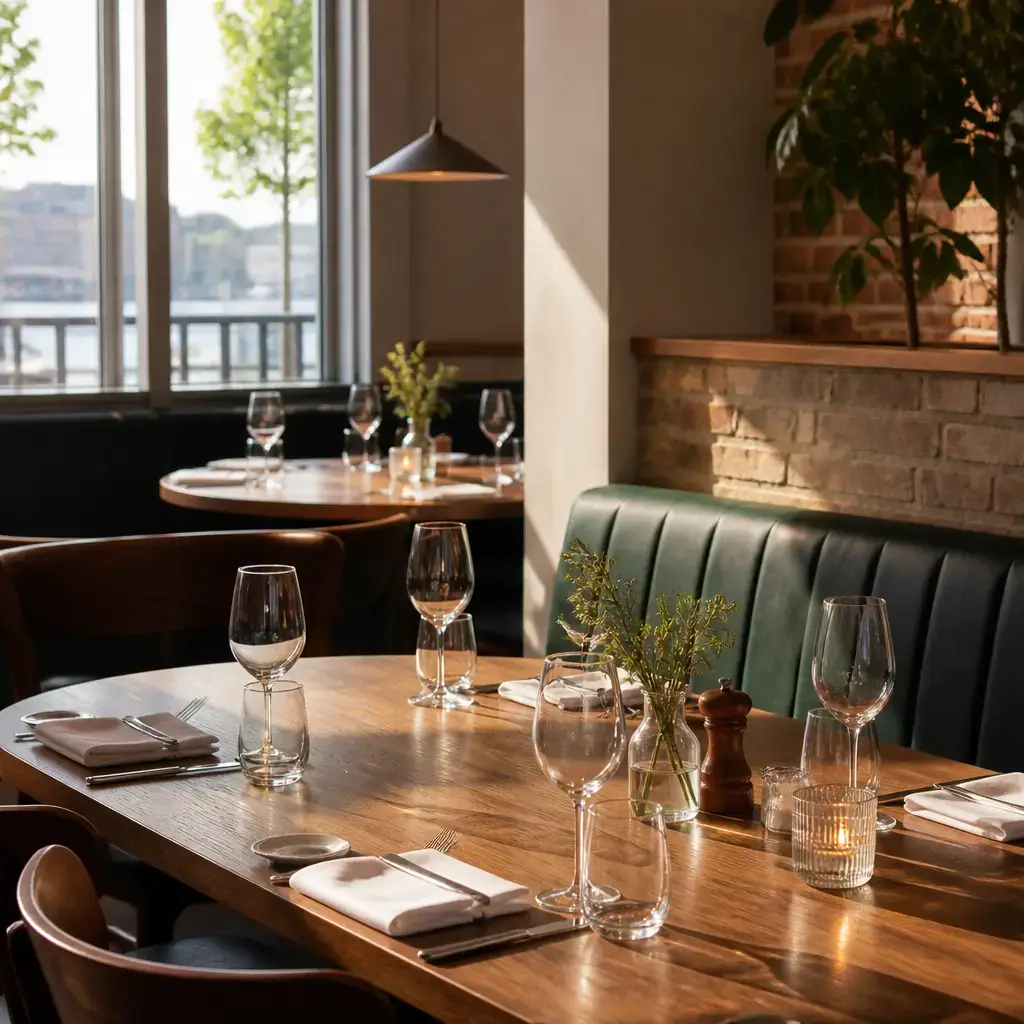
Use Handling a seating issue politely to practice Danish conversation, pronunciation, vocabulary, grammar, and quizzes.
Dialogue
Vi reserverede et stille bord, men dette område er meget mere støjende end forventet.
Vee reh-zehr-VEH-uh-deh ehd STEL-uh bohr, men DEH-duh OH-moh-rthuh air MEH-uh STOY-uh-nuh en foh-VENT-uhd. We reserved a quiet table, but this area is much louder than expected.Det beklager jeg; den del blev fyldt op tidligere, end vi havde forventet.
Deh beh-KLEH-uh yai; den del blehv filt OHP TEE-theh-lee-uh, en vee HAH-thuh foh-VENT-uhd. I'm sorry; that section filled up earlier than we expected.Det bliver svært for vores gruppe at høre hinanden ved dette bord.
Deh BLEE-uh SVAIRD fohr VOH-uhs GROO-beh ehd HUR-uh hee-NAHN-en behd DEH-duh BOHR. This table will make it hard for our group to hear each other.Jeg kan flytte jer til et hjørnebord, hvor der er mere plads omkring det.
Yai kan FLUR-tuh yair til ehd YUR-nuh-BOHR, vohr dah air MEH-uh pless ohm-KRAYNG deh. I can move you to a corner table that has more space around it.Det ville hjælpe, så længe vores tjener stadig kan følge med os.
Deh VEL-uh YEL-beh, soh LANG-uh VOH-uhs CHAY-nuh STETH-ee kan FURL-guh mehth ohs. That would help, as long as our server can still keep up with us.Den samme tjener dækker det hjørne, så betjeningen burde stadig gå som planlagt.
Den SAM-uh CHAY-nuh DEK-uh deh YUR-nuh, soh beh-CHAY-neh-ngen BOO-uh-thuh STETH-ee goh som plan-LAHGT. The same server covers that corner, so service should stay on track.Så lad os flytte os, før alle sætter sig.
Soh lahd ohs FLUR-tuh ohs, fur AL-uh SET-uh sai. Then let's move before everyone sits down.Jeg får bordet gjort klar igen nu.
Yai fohr BOHR-ehd yohrt klair ee-GAYN noo. I'll have the table reset now.Sentence explanations
Vi reserverede et stille bord, men dette område er meget mere støjende end forventet.
We reserved a quiet table, but this area is much louder than expected.
- Vi
- we
- reserverede
- reserved
- stille
- quiet
- bord
- table
- dette
- this
- område
- area
- meget
- much
- mere støjende
- louder
- end forventet
- than expected
More detail
Vi means “we” here and is the subject of the first clause. Danish vi is the first-person plural pronoun; the verb form does not itself identify who the members of “we” are. reserverede is the past-tense form of reservere, “to reserve.” Danish commonly forms the past of many verbs with -ede, as in reserverede. The form states that the reservation happened before the current evaluation. Together, vi reserverede means “we reserved.” stille describes the table as quiet or calm. In et stille bord, the adjective has the neuter singular form stille, agreeing with bord, which is a neuter noun introduced by et. The same adjective can also be used in other forms or positions, but this sentence uses it before the noun. bord means “table.” Its indefinite singular form is et bord; the article is not itself a claim about a numerical count. A reusable example is Vi reserverede et bord. — “We reserved a table.” dette means “this” and points to a nearby or contextually relevant neuter singular noun. Here it agrees with område, which is neuter singular: dette område, “this area.” The demonstrative marks the area as the one being identified, while the following context explains that this area was filled up earlier than expected. område means “area” or “section.” Its indefinite form is et område, and its definite form is området, “the area.” In this sentence it is the noun identified by dette. meget means “very” or “much,” and here it strengthens the comparative expression that follows. It does not mean that the area is “many” in number. In comparisons, meget mere corresponds to “much more.” mere støjende means “louder” or literally “more noisy.” støjende is the adjective “noisy,” and mere forms its comparative: støjende → mere støjende. The comparison is about the area’s noise level, not about the number of noises. For example, Dette rum er mere støjende. — “This room is noisier.” end forventet introduces the comparison standard: “than expected.” end is used here for “than,” while forventet is the past participle of forvente, “to expect.” The expression leaves the person who formed the expectation unexpressed; it does not by itself identify that person. A similar example is Det var lettere end forventet. — “It was easier than expected.” The first clause, Vi reserverede et stille bord, says that the speakers reserved a quiet table. men then contrasts that reservation with the current description: dette område er meget mere støjende end forventet, “this area is much louder than expected.” The whole utterance therefore means: “We reserved a quiet table, but this area is much louder than expected.”
Det beklager jeg; den del blev fyldt op tidligere, end vi havde forventet.
I'm sorry; that section filled up earlier than we expected.
- Det beklager jeg
- I’m sorry
- den
- that/the
- del
- section; part
- blev fyldt op
- was filled up
- tidligere
- earlier
- end
- than
- vi
- we
- havde forventet
- had expected
More detail
Det beklager jeg is a reusable Danish way to apologize: literally, “I regret that,” but here it means “I’m sorry.” det is a neuter singular pronoun referring to the situation as a whole; the sentence does not identify a more specific noun as its referent. The order is notable: the object det comes first, while jeg (“I”) comes after the verb. Example: Det forstår jeg. — “I understand that.” den is the singular common-gender form used with the following noun in den del, giving the meaning “that/the.” Its form is selected by the noun’s grammatical gender and number here, not by the identity of the section. del means “part” or “section.” Its indefinite form is en del, and its definite form is delen; with demonstrative den, Danish uses den del for “that section.” blev fyldt op means “was filled up.” fylde op is the reusable verb construction “fill up”; in this passive past form, blev is the past tense of blive (“become/be”), and fyldt is the past participle of fylde, while op remains part of the construction. The passive presents the section as the thing that became full, without stating who filled it. Example: Flasken blev fyldt op. — “The bottle was filled up.” tidligere means “earlier” here. It is the comparative form related to tidlig (“early”): tidlig / tidligere / tidligst — “early” / “earlier” / “earliest.” As an adverb, it compares the time of one event with another. end introduces the comparison “than.” Together, tidligere end ... means “earlier than ...”; end is not a standalone time word. vi means “we,” the first-person plural subject. It identifies the people included in the group making the expectation, but the sentence does not specify the group’s size or membership. havde forventet means “had expected.” havde is the past form of have used as an auxiliary, and forventet is the past participle of forvente (“expect”). This is the Danish pluperfect: the expectation is placed before another past event. The pattern vi havde forventet is therefore “we had expected,” while vi forventede would be the simple past “we expected.” The chunks combine as Det beklager jeg; den del blev fyldt op tidligere, end vi havde forventet. The speaker apologizes and says that the section became full sooner than the group had expected. The comparison clause after tidligere end supplies the reference point for “earlier.”
Det bliver svært for vores gruppe at høre hinanden ved dette bord.
This table will make it hard for our group to hear each other.
- Det
- it
- bliver
- becomes; will be
- svært
- difficult
- vores
- our
- gruppe
- group
- høre
- hear
- hinanden
- each other
- dette
- this
- bord
- table
More detail
Det is a formal or anticipatory subject here; it does not identify a particular object. The content that is difficult comes later: at høre hinanden. bliver is the present-tense form of blive, “to become” or “to be.” In this sentence, the intended situation is future, as shown by the fixed translation: the situation will become difficult. Danish present forms can express a future situation when the context makes the time clear. The past form is blev; in the preceding context, blev fyldt op uses blev as part of a passive expression meaning “was filled up,” not simply “became.” svært is the neuter singular form of the adjective svær, “difficult.” It agrees with the formal subject det; the same adjective has svær with common-gender singular nouns, svært with neuter singular nouns, and svære in plural contexts. Its comparison forms are sværere “more difficult” and sværest “most difficult.” vores means “our.” It is a possessive form and does not change for the gender or number of the noun it accompanies here: vores gruppe means “our group.” gruppe means “group.” It is a singular common-gender noun in Danish. The plural is grupper. høre is the infinitive “to hear.” The pattern at + infinitive expresses an action, and here at høre hinanden is the content described as difficult. Example: Det er let at høre hende. — “It is easy to hear her.” hinanden is a reciprocal pronoun meaning “each other.” It presents the hearing as mutual within the group: the group members need to hear one another. It is used for a plural set of participants; it is different from a singular reflexive form such as sig, which refers back to one participant. dette means “this” and is the neuter singular form used with the following neuter noun. It points to something near or contextually identified, but the word itself supplies the demonstrative meaning rather than naming the object independently. bord means “table.” It is a neuter singular noun, which is why the phrase uses dette bord rather than the common-gender demonstrative form denne. The phrase ved dette bord means “at this table”; ved contributes the location, while dette bord identifies the table. Together, Det bliver svært for vores gruppe at høre hinanden ved dette bord uses the reusable pattern Det bliver svært for [person or group] at [action] [place]: “It will become difficult for [someone] to [do something] [somewhere].” Thus the utterance means, “This table will make it hard for our group to hear each other.”
Jeg kan flytte jer til et hjørnebord, hvor der er mere plads omkring det.
I can move you to a corner table that has more space around it.
- Jeg kan
- I can
- flytte
- move
- jer
- you (plural)
- hjørnebord
- corner table
- hvor der er
- where there is
- mere
- more
- plads
- space
- omkring det
- around it
More detail
Jeg kan: This is “I can.” kan is the present form of kunne (“can, be able to”) and expresses ability or possibility here. After kan, Danish uses the infinitive without at: Jeg kan hjælpe. — “I can help.” flytte: This is the infinitive “move.” It follows the modal kan, so kan flytte means “can move.” The same infinitive can be used after other modal verbs, for example Jeg vil flytte. — “I want to move / I will move,” depending on context. jer: This is the plural form of “you” used as an object. The singular object form is dig, while jer addresses or refers to more than one person. Example: Jeg kan hjælpe jer. — “I can help you.” hjørnebord: This compound noun means “corner table.” Danish commonly combines nouns into one word; here hjørne specifies the type of bord. In the sentence, et hjørnebord means “a corner table”: et is the indefinite article used with this noun’s neuter grammatical class. The article does not by itself establish a numerical count beyond introducing one unspecified instance. hvor der er: This introduces the clause “where there is.” hvor means “where” or, with a place-like noun such as a table, “in which.” der er is the Danish existential pattern for saying that something is present: Der er plads. — “There is space.” The der here is a grammatical placeholder, not the specific object being referred to. mere: This means “more” and is the comparative form related to meget (“much, a lot”): meget → mere → mest (“most”). Here it compares the available space with the space at the current table; it does not itself specify an exact amount. plads: This noun means “space” or “room.” In mere plads, it is used as an uncountable amount, so the phrase means “more space,” not a particular number of spaces. Example: Vi har brug for mere plads. — “We need more space.” omkring det: This means “around it.” omkring is the preposition “around,” and det is a neuter singular pronoun referring here to the corner table, as reflected by the fixed translation’s “it.” The pronoun’s form is grammatical; its specific referent comes from this sentence’s meaning. Example: Der er plads omkring bordet. — “There is space around the table.” Together, Jeg kan flytte jer says “I can move you,” with jer identifying the people being moved. til et hjørnebord adds the destination, “to a corner table.” The relative clause hvor der er mere plads omkring det describes that table as a place where there is more space around it. The complete meaning is therefore: “I can move you to a corner table that has more space around it.”
Det ville hjælpe, så længe vores tjener stadig kan følge med os.
That would help, as long as our server can still keep up with us.
- Det
- that; it
- ville
- would
- hjælpe
- help
- så længe
- as long as
- vores
- our
- tjener
- server
- stadig
- still
- kan
- can
- følge med
- keep up
- os
- us
More detail
Det is the neuter singular form of the Danish demonstrative/pronoun meaning “that” or “it.” Here it corresponds to “that” in the fixed translation and points to an already discussed situation or proposal; the supplied sentence does not identify a more specific referent. Compare den for common-gender singular nouns and de for plural nouns. ville is the past-tense form of the modal verb vil/ville and gives the conditional meaning “would” here. A reusable pattern is ville + infinitive: Det ville hjælpe = “That would help.” In other contexts, ville can also express past intention, so the fixed translation establishes the conditional reading here. hjælpe is the infinitive “to help.” After a modal such as ville, Danish uses the infinitive without an English-style “to”: ville hjælpe means “would help.” The present-tense form is hjælper, as in Det hjælper (“That helps”). så længe introduces a condition and means “as long as.” It connects the main statement with the condition that follows it. Example: Jeg bliver, så længe du er her. — “I’ll stay as long as you are here.” vores means “our” and identifies something as belonging to or associated with the speaker and at least one other person. It does not change for the gender or number of the noun it accompanies: vores bord and vores borde both use vores. tjener means “server” here. It is a singular common-gender noun, normally used with en: en tjener; its plural is tjenere. The context and fixed translation select the restaurant-service meaning in this sentence. stadig means “still,” indicating that the situation continues to hold at the relevant time. It modifies the clause rather than changing the meaning of tjener: Han arbejder stadig. — “He is still working.” kan is the present-tense form of the modal verb kunne, meaning “can” here. A modal is followed by an infinitive, so kan følge means “can keep up.” The past form is kunne, as in Han kunne følge med (“He could keep up”). følge med is a reusable expression meaning “keep up” in this context. The verb følge is the infinitive after kan, while med completes the expression. It can also describe accompanying someone in other contexts, but the fixed translation selects the “keep up” sense here. Example: Kan du følge med? — “Can you keep up?” os is the first-person plural object form, “us.” The corresponding subject form is vi: Vi følger med. — “We keep up.” In this sentence, os is the group with whom the server must keep up. Taken together, Det ville hjælpe means “That would help.” så længe introduces the condition, and vores tjener stadig kan følge med os means “our server can still keep up with us.” The complete utterance is therefore: “That would help, as long as our server can still keep up with us.”
Den samme tjener dækker det hjørne, så betjeningen burde stadig gå som planlagt.
The same server covers that corner, so service should stay on track.
- Den
- the
- samme
- same
- tjener
- server
- dækker
- covers
- det
- that
- hjørne
- corner
- så
- so
- betjeningen
- service
- burde
- should
- stadig
- still
- gå
- go
- som planlagt
- as planned
More detail
Den marks a singular common-gender noun phrase as definite. In den samme ..., it belongs with the following noun phrase; it is not a separate claim about quantity. Danish also uses det for singular neuter-gender noun phrases, as in det hjørne later. samme means “same” here: it identifies the server as the previously identified or otherwise intended same one. The form is useful because it stays samme across the relevant genders and numbers: for example, samme bog means “the same book,” while samme bøger means “the same books.” With an attributive adjective, Danish commonly uses a definite marker such as den or det before the adjective. tjener is the noun “server” in this restaurant-related meaning. It is a common-gender singular form; useful forms include tjenere “servers” and tjeneren “the server.” The fixed translation supports the restaurant-service sense here. dækker means “covers” here, in the sense of being responsible for or serving an area. It is the present-tense form of dække “to cover.” Danish finite verbs do not change for person or number, so the same present form can occur with different subjects. Example: Han dækker området. — “He covers the area.” det means “that” here and points to a singular neuter-gender noun phrase. Its grammatical form is determined by hjørne, whose gender is neuter; this does not by itself identify what physical corner is meant. hjørne means “corner.” It is the singular neuter-gender form; hjørner is the plural “corners,” and hjørnet is the definite singular “the corner.” In the fixed utterance, det hjørne gives “that corner.” så is the conjunction “so,” linking the coverage statement to its result or consequence. Example: Det regner, så vi bliver hjemme. — “It is raining, so we stay home.” betjeningen means “the service” in this context, referring to the service being provided. It is the definite singular form of betjening; the ending -en marks this noun’s definiteness. Example: Betjeningen er god. — “The service is good.” burde expresses “should” as an expectation or reasonable outcome here. It is the form related to bør, and it can refer to a present or future expectation even though its form is historically associated with the past. It is followed directly by an infinitive: Det burde virke. — “It should work.” Compared with skal, burde is generally less forceful and more expectation-based. stadig means “still,” showing that the situation is expected to continue. In this sentence it says that service remains on its intended course. Example: Hun arbejder stadig. — “She still works.” gå is the infinitive “go.” After the modal burde, it appears without at. In the pattern gå som planlagt, it means “proceed” rather than specifically “walk.” Its common present form is går, as in Planen går godt. — “The plan is going well.” som planlagt is the reusable pattern “as planned.” Planlagt is the past participle of planlægge “to plan”; here it forms a compact comparison with the intended plan. Example: Mødet gik som planlagt. — “The meeting went as planned.” Together, the first part identifies the same server as covering that corner. så introduces the consequence, and betjeningen burde stadig gå som planlagt says that service is expected to continue on track. The complete utterance therefore means: “The same server covers that corner, so service should stay on track.”
Så lad os flytte os, før alle sætter sig.
Then let's move before everyone sits down.
- Så
- then
- lad os
- let’s
- flytte
- move
- os
- ourselves
- før
- before
- alle
- everyone
- sætter sig
- sits down
More detail
Så means “then” here and links this proposal to what has just been said. It can also mean “so” in other contexts; the intended reading here is the time/sequence sense. lad os is the reusable Danish pattern for “let’s …”. lad is the imperative of lade (“let” or “allow”), and os means “us” in this construction. The following verb stays in the infinitive: Lad os vente. — “Let’s wait.” flytte is the infinitive of flytte, “move”. After lad os, it names the proposed action. The phrase flytte os means that the people included in “us” move themselves; os is the object/reflexive pronoun corresponding to the understood group doing the moving. Example: Vi flytter os. — “We move.” før introduces a clause that must happen earlier: “before …”. It is followed here by a complete clause with its own subject and verb. Example: Gå, før det bliver mørkt. — “Go before it gets dark.” alle means “everyone” or “all [people]” and is the subject of the clause after før. It refers to the people covered by the context, without naming a particular individual. As a pronoun, it is not itself marked for grammatical gender. sætter sig means “sits down”. sætter is the present-tense form of sætte (“put” or “set”); with the reflexive sig, the construction means that the subject takes a seated position. sig is the reflexive form used when the subject is third person, as in Han sætter sig. — “He sits down.” With vi, the corresponding form is os: Vi sætter os. — “We sit down.” Together, Så lad os flytte os gives “Then let’s move,” and før alle sætter sig adds the time condition “before everyone sits down.” The complete utterance therefore means: “Then let’s move before everyone sits down.”
Jeg får bordet gjort klar igen nu.
I'll have the table reset now.
- Jeg
- I
- får
- get / have
- bordet
- the table
- gjort klar
- made ready
- igen
- again
- nu
- now
More detail
Jeg means “I” here: the speaker is the person arranging the action. It is the first-person singular subject pronoun. For example, Jeg kommer nu. means “I’m coming now.” får is the present-tense form of få, “get” or “have.” In the pattern få + object + past participle, it expresses arranging for something to be done: Jeg får bilen repareret. means “I’ll have the car repaired.” The English “I’ll” in the fixed translation reflects the intended arrangement in this context; får itself is the present form. bordet means “the table.” The base form is bord, and bordet is its definite singular form, “the table.” The ending -et belongs to this noun; it is not an ending on the verb or adjective. For an indefinite singular reference, Danish uses et bord, “a table.” gjort klar means “made ready.” gjort is the irregular past participle of gøre, “do” or “make,” and klar means “ready.” Together they form the result arranged by får: the table is caused to become ready. In the reusable pattern få noget gjort, the thing named by noget is arranged to undergo the action, as in Hun får arbejdet gjort. — “She gets the work done.” igen means “again,” indicating that the table is being made ready another time. It modifies the event gjort klar, not the noun bordet. nu means “now” and places the arranging in the present time. For example, Vi begynder nu. means “We’re starting now.” The sentence follows the pattern Jeg får [object] [result/action] [again] [now]. Thus Jeg is the arranger, får introduces the causative arrangement, bordet is the object affected, and gjort klar states the resulting condition. The complete meaning is: “I’ll have the table made ready again now.”
Grammar Points
sætter sig
Gruppen sætter sig ved hjørnebordet.
GROO-ben SET-uh sai vehd YUR-nuh-bohr-ehd.The group sits down at the corner table.
sætter sig is a reflexive verb: the subject does the action to itself, so sig is required.
så længe + ledsætning
Så længe der er plads, sætter gruppen sig.
Soh LANG-uh dah air pless, SET-uh GROO-ben sai.As long as there is space, the group sits down.
så længe introduces a condition. In the subordinate clause, the subject comes before the verb: der er.
Danish Vocabulary
- Gender
- neuter
- Gender
- common
- Gender
- common
- Gender
- neuter
- Gender
- neuter
meget mere støjende
- Gender
- neuter
Quiz
Spelling
Tap the letters to spell the word.
expected
Show Answer
forventetam sorry; regret
Show Answer
beklagerreserved
Show Answer
reserveredearea