10 minutes free every day
Continue audio lessons in the app
Word explanations appear automatically in sync with the audio.
No login required · synced translations · playback with the screen locked
Choose your learning language and open this lesson in the app.

About This Lesson
Use Reporting a Lost Item with Useful Details to practice Danish conversation, pronunciation, vocabulary, grammar, and quizzes.
Dialogue
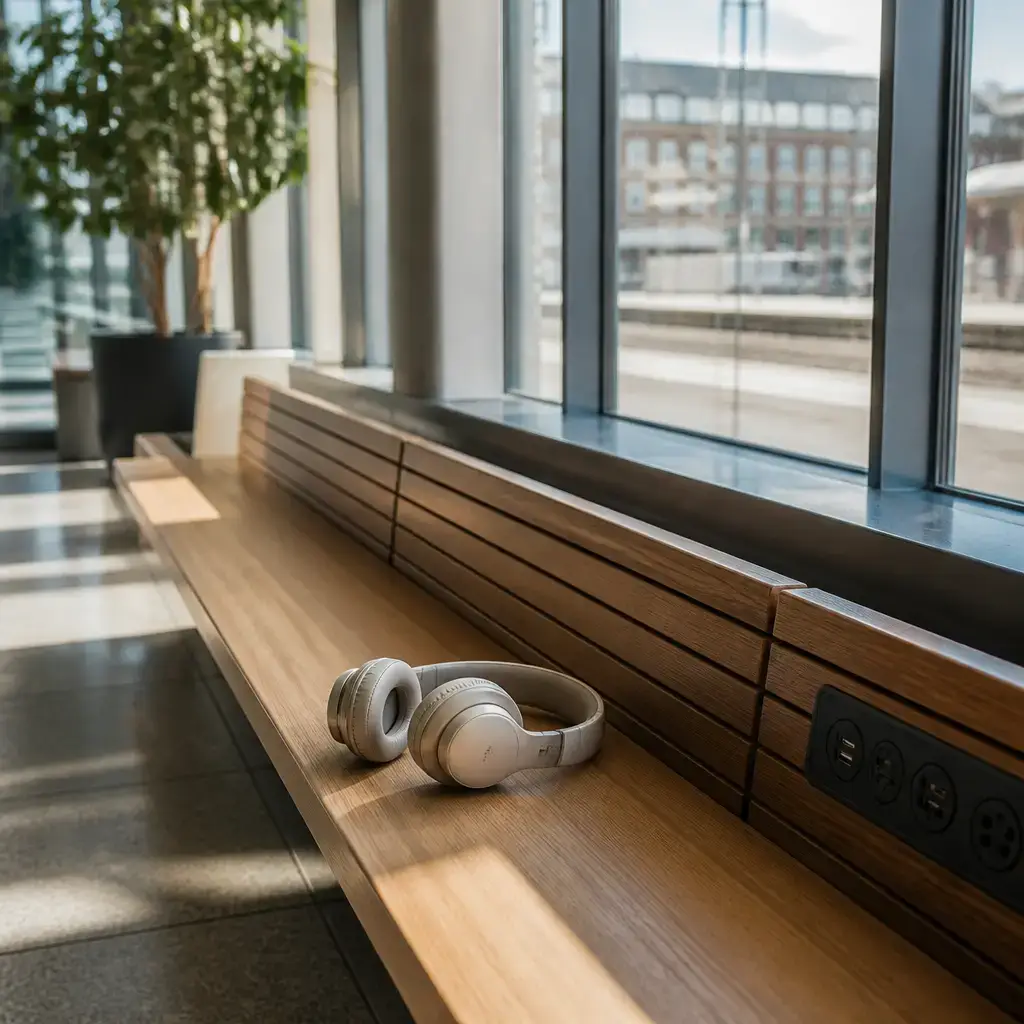
Jeg tror, jeg glemte mine høretelefoner i venteområdet.
yigh TROHR, yigh GLEM-tuh MEE-nuh HUR-uh-teh-LOH-nuh in VEN-tuh-OR-uh. I think I left my headphones in the waiting area.Kan du huske, hvor du sad?
kan doo HOOS-kuh, vohr doo SAH? Do you remember where you were sitting?Jeg sad nær vinduet ved opladningspunkterne.
yigh SAH NAIR VIN-oo-uh vehd OH-plahd-nings-poong-TER-nuh. Near the window, by the charging points.Det gør søgeområdet mindre for personalet.
deh GUR SUR-uh-OR-uh MIN-druh fohr pehr-soh-NAH-luh. That narrows it down for the staff.Jeg er mere bekymret for at miste de gemte indstillinger end for prisen.
yigh air MAY-ruh beh-KOOM-ruhd fohr uh MIS-duh dee GEM-duh IN-stil-ling-uh end fohr PREE-sun. I am more worried about losing the saved settings than the cost.Så lad os melde det, før området bliver tømt.
soh lah ohs MEL-uh deh, fur OR-uh-deh BLEE-uh TOHMD. Then let us report it before the area gets cleared.Hvad skal jeg tage med i rapporten om den bortkomne genstand?
vah skal yigh TAH meh in rah-POR-ten ohm den bohrt-KOM-nuh yeh-STAN? What should I include in the lost item report?Beskriv farven, typen og alt, der er usædvanligt ved etuiet.
beh-SKREEV FAR-vun, TIE-bun oh ALD, dair air oo-SAY-vahn-lit vehd eh-TOO-ee-uhd. Describe the color, the type, and anything unusual about the case.Sentence explanations
Jeg tror, jeg glemte mine høretelefoner i venteområdet.
I think I left my headphones in the waiting area.
- tror
- think
- glemte
- forgot / left behind
- mine
- my
- høretelefoner
- headphones
- venteområdet
- the waiting area
More detail
tror means “think” here. It is the present-tense form of tro, “to think/believe”: jeg tror = “I think.” Danish commonly uses this pattern to introduce a belief or uncertain conclusion, followed by a clause: Jeg tror, hun kommer. = “I think she is coming.” glemte means “forgot” here, with the intended result “left behind.” It is the past-tense form of glemme, “to forget.” The same past form is used with different subjects: jeg glemte = “I forgot,” and de glemte = “they forgot.” In this sentence, the forgotten thing is understood to have been left in the waiting area. Example: Jeg glemte min taske. = “I forgot my bag.” mine means “my” before a plural noun. Danish possessive forms distinguish number here: min is used with a singular common-gender noun, mit with a singular neuter noun, and mine with a plural noun. Mine does not itself state how many items there are; it marks possession of the plural noun that follows. høretelefoner means “headphones.” It is a plural noun; the singular is høretelefon, “headphone.” With the possessive, mine høretelefoner means “my headphones.” Example: Mine høretelefoner virker ikke. = “My headphones do not work.” venteområdet means “the waiting area.” It is the definite singular form of venteområde, “waiting area”: the ending -t marks definiteness because område is a neuter noun. The compound venteområde combines the idea of waiting with område, “area.” Danish often places the definite marker at the end of the noun phrase rather than using a separate word for “the.” Together, Jeg tror (“I think”) introduces the speaker’s belief, and jeg glemte mine høretelefoner i venteområdet states what the speaker forgot and where: i means “in,” linking the forgotten headphones to the waiting area. The complete utterance means: “I think I left my headphones in the waiting area.”
Kan du huske, hvor du sad?
Do you remember where you were sitting?
- Kan du
- can you
- huske
- remember
- hvor
- where
- sad
- were sitting
More detail
Kan du combines kan, the present form of kunne (“can/be able to”), with du (“you”). In this question, the combination asks whether the listener remembers, so the intended meaning is “do you remember…?” Danish places the subject after the finite verb in this kind of direct question: Kan du ...?. huske is the infinitive “to remember.” After the modal kan, Danish uses the infinitive without at: Du kan huske det = “You can remember it.” Without a modal, at huske is used after a verb such as prøve: Jeg prøver at huske det = “I am trying to remember it.” hvor is the question word “where.” It introduces the embedded question hvor du sad, meaning “where you were sitting.” In that embedded clause, the subject du comes before the finite verb, unlike the word order in the opening direct question. sad is the past-tense form of sidde, “to sit.” The infinitive is sidde, while the present-tense form is sidder: Jeg sidder ved vinduet = “I am sitting by the window.” The past form is sad: Jeg sad ved vinduet = “I was sitting by the window.” Sad marks past time; it does not change according to the subject’s person or number. Together, Kan du huske asks whether the listener remembers something, and hvor du sad specifies what is remembered: the place where the listener was seated. The whole utterance means, “Do you remember where you were sitting?”
Jeg sad nær vinduet ved opladningspunkterne.
Near the window, by the charging points.
- Jeg sad
- I was sitting
- nær
- near
- vinduet
- the window
- ved
- by; at
- opladningspunkterne
- the charging points
More detail
Jeg sad means “I was sitting” here. jeg is the first-person singular subject, and sad is the past-tense form of sidde (“to sit”). Example: Jeg sad ved døren. — “I was sitting by the door.” nær expresses physical closeness and means “near” or “close to.” It can introduce a noun phrase: nær stationen — “near the station.” ved can also locate someone or something by or at a place, but it is a separate preposition. vinduet means “the window.” The base noun is vindue; this neuter noun has the indefinite form et vindue (“a window”) and the definite singular form vinduet (“the window”), with -et marking definiteness here. ved means “by” or “at” here and introduces the location ved opladningspunkterne. Example: Hun står ved døren. — “She is standing by the door.” opladningspunkterne means “the charging points.” The noun opladningspunkt means “charging point”; its plural is opladningspunkter, and its definite plural is opladningspunkterne. Here the plural form ends in -er, and the definite plural adds -ne, producing -erne at the end of the full word. The -er is part of the plural form; it is not itself the definite marker. Together, Jeg sad states that the speaker was sitting, nær vinduet places the speaker near the window, and ved opladningspunkterne gives the location by the charging points. The complete meaning is: “I was sitting near the window, by the charging points.”
Det gør søgeområdet mindre for personalet.
That narrows it down for the staff.
- gør
- makes
- søgeområdet
- the search area
- mindre
- smaller
- personalet
- the staff
More detail
gør is the present-tense form of gøre, “to do/make.” Here it is causative: it says that something makes the search area become smaller. A reusable pattern is gøre + object + adjective, meaning “make something [adjective].” Example: Det gør arbejdet lettere. — “That makes the work easier.” søgeområdet means “the search area.” It is a compound noun built from søge (“search”) and område (“area”), with the definite ending in -et: søgeområde = “a search area,” søgeområdet = “the search area.” The observed form is singular and definite; the ending belongs to this noun, not to mindre. mindre is the comparative form of lille (“small”): lille → mindre (“smaller”) → mindst (“smallest”). In this sentence it describes the reduced size or scope of the search area. Example: Dette gør valget mindre. — “This makes the choice smaller.” personalet means “the staff.” It is the definite singular form of the collective noun personale (“staff”): personale → personalet. In the sentence, for personalet identifies the people for whom the narrowing is relevant; for means “for” here. The sentence starts with Det, “that/it,” followed by gør (“makes”). søgeområdet is what is affected, and mindre describes the result: “makes the search area smaller.” The final phrase for personalet adds who this is relevant to. Together, the fixed utterance means: “That narrows it down for the staff.”
Jeg er mere bekymret for at miste de gemte indstillinger end for prisen.
I am more worried about losing the saved settings than the cost.
- Jeg er
- I am
- mere bekymret
- more worried
- for
- about
- at
- to
- miste
- lose
- de
- the
- gemte
- saved
- indstillinger
- settings
- end
- than
- prisen
- the price; the cost
More detail
Jeg er means “I am.” Jeg is the first-person singular pronoun “I”, and er is the present-tense form of være (“to be”). This is the ordinary way to state a present condition or feeling. mere bekymret means “more worried.” Bekymret is the adjective “worried”, and mere forms its comparative: bekymret → mere bekymret (“worried” → “more worried”). In this sentence, the comparison is completed by end later on. for connects bekymret with what causes the worry or what the worry concerns: bekymret for X = “worried about X”. Here it introduces the first concern, the act of losing the settings. at marks the infinitive in at miste, “to lose”. Danish commonly uses at before an infinitive when an action is presented as a complement, as in Jeg prøver at forstå det — “I try to understand it.” miste is the infinitive “to lose”. Its base form is miste; for example, Jeg vil ikke miste den means “I do not want to lose it.” de is the definite article used here with a plural noun: “the”. It signals that the settings are a specific set, while the plural noun carries the number. gemte means “saved” here. It is the attributive form related to gemme (“to save, store”), and it describes the settings as already saved. In de gemte indstillinger, the form agrees with the definite/plural noun phrase; it is not the form of indstillinger. indstillinger means “settings”. It is the plural of indstilling (“setting”). The plural is appropriate because the sentence refers to settings as a set rather than to one setting. end means “than” and introduces the second side of the comparison. The parallel expression after it is for prisen, so the structure is mere bekymret for X end for Y — “more worried about X than about Y.” prisen means “the price” or, in this fixed translation, “the cost”. It is the definite singular form of pris (“price”): pris → prisen. The definite ending marks a specific price; it does not itself mean that there is a numerical amount. Together, Jeg er mere bekymret for at miste de gemte indstillinger end for prisen says: “I am more worried about losing the saved settings than the cost.” The first concern is expressed by for at miste de gemte indstillinger; mere ... end ... compares it with the second concern, for prisen. The sentence therefore ranks losing the saved settings as the greater worry.
Så lad os melde det, før området bliver tømt.
Then let us report it before the area gets cleared.
- Så
- then
- lad os
- let us
- melde
- report
- det
- it
- før
- before
- området
- the area
- bliver tømt
- gets cleared
More detail
Så means “then” here and links this utterance to what has just been said. It can also mean “so” in other contexts, but “then” fits this sentence. lad os is the reusable Danish pattern for “let us …” or “let’s …”. lad is the imperative of lade (“let/allow”), and os is the object form meaning “us”. With an infinitive after it, lad os + infinitive proposes a joint action: Lad os vente. — “Let’s wait.” melde means “report” here. It is the infinitive, the form used after lad os; the pattern is lad os melde ... (“let’s report ...”). The sentence does not specify a particular reporting method. det is a neuter singular pronoun meaning “it” in this utterance. The fixed translation confirms this object meaning, but the supplied material does not uniquely identify what det refers to. The pronoun itself does not name its referent. Danish pronouns must match relevant grammatical features of their referents, and det is the neuter singular form. før introduces a time clause meaning “before”. It places the event in the main clause before the event described in the following clause. For example, Ring, før du går. means “Call before you leave.” området means “the area”. The base noun is område; området is its definite singular form, the form used for “the area”. Danish also has the indefinite singular form et område (“an area”), but the indefinite article does not by itself assert a numerical count here. bliver tømt means “gets cleared” here. bliver is the present form of blive (“become/get/remain”), and tømt is the past participle of tømme (“empty/clear”). Together they form a passive construction: the area undergoes the clearing, while the sentence does not identify who clears it. bliver tømt presents that process or change as taking place; it differs from er tømt, “is empty/has been cleared,” which describes a resulting state. Combining the parts, Så lad os melde det means “Then let’s report it”, and før området bliver tømt means “before the area gets cleared”. The whole utterance is therefore: “Then let us report it before the area gets cleared.”
Hvad skal jeg tage med i rapporten om den bortkomne genstand?
What should I include in the lost item report?
- Hvad
- what
- skal jeg
- should I
- tage med
- include
- i
- in
- rapporten
- the report
- om
- about
- den
- the
- bortkomne
- lost
- genstand
- item
More detail
Hvad asks for the thing or content to be included: “what.” In this sentence it is the object of tage med, not the person performing the action. A reusable contrast is hvem (“who”) for a person and hvor (“where”) for a place. skal jeg combines skal with the subject jeg. Here skal expresses what the speaker should do, so the question asks for guidance or a recommended action. Danish questions commonly place the finite verb before the subject: Skal jeg ...? means “Should I ...?” The form skal is used with different subjects; the subject is shown separately by jeg (“I”). tage med is a reusable verb construction meaning to take something along, and in this context to include something in a report. The verb’s base form is tage; med adds the idea of along or with. Example: Jeg tager dokumentet med. — “I am taking the document along.” i means “in” here and introduces the report as the place or document receiving the content. Its exact English translation can vary with context, but the construction tage noget med i en rapport is naturally understood as “include something in a report.” rapporten means “the report.” The noun is rapport, and the ending -en marks the definite singular form: en rapport is “a report,” while rapporten is “the report.” The form here refers to the report being discussed, without adding a separate numeric claim. om means “about” and introduces the subject matter of the report. en rapport om X is a reusable pattern meaning “a report about X.” den is the definite article used with a singular common-gender noun phrase in this construction. It helps make bortkomne genstand definite: “the lost item.” It does not by itself identify which real-world item beyond the noun phrase and context. bortkomne describes something that has been lost or gone missing. It is related to the verb bortkomme (“to go missing”); the observed form is an adjective-like participle. In this definite noun phrase, the adjective has the form bortkomne. Example: den bortkomne taske — “the lost bag.” genstand means “item” or “object.” It is a singular common-gender noun; its indefinite form is en genstand. In the phrase den bortkomne genstand, definiteness is marked by den before the adjective, so the noun itself remains genstand rather than taking the definite ending. Together, Hvad skal jeg tage med asks what content the speaker should include. i rapporten identifies the report as the destination for that content, and om den bortkomne genstand specifies that the report concerns the lost item. The complete meaning is: “What should I include in the lost item report?”
Beskriv farven, typen og alt, der er usædvanligt ved etuiet.
Describe the color, the type, and anything unusual about the case.
- Beskriv
- describe
- farven
- the color
- typen
- the type
- alt
- anything
- der er
- that is
- usædvanligt
- unusual
- etuiet
- the case
More detail
Beskriv is the imperative of beskrive, meaning “describe.” It is the form used to give a direct instruction to one or more listeners. Example: Beskriv billedet. — “Describe the picture.” farven means “the color” here. Its base noun is farve; farven is the definite singular form, marked by -n. Example: Jeg kan lide farven. — “I like the color.” typen means “the type.” The base noun is type, and typen is its definite singular form. Example: Hvilken type er det? — “What type is it?” alt means “anything” in this construction. It is the neuter singular form of the pronoun meaning “all/everything,” and the English choice “anything” comes from its use inside the clause describing what is unusual. Example: Fortæl mig alt. — “Tell me everything.” der er is the relative-clause pattern “that is.” Der introduces the clause and functions as its subject here; er is the present-tense form of være (“be”). This pattern can connect a noun or pronoun to information about it. Example: alt, der er nyt — “everything that is new.” usædvanligt means “unusual” here. The base adjective is usædvanlig; usædvanligt is its neuter singular form, agreeing with alt. The adjective has the forms usædvanlig (common gender), usædvanligt (neuter), and usædvanlige (plural or definite contexts). Example: Et problem er usædvanligt. — “A problem is unusual.” etuiet means “the case.” The base noun is etui, a neuter noun with the indefinite form et etui; etuiet is the definite singular form. Example: Etuiet er sort. — “The case is black.” Together, Beskriv farven, typen gives the instruction “Describe the color and the type.” og alt, der er usædvanligt ved etuiet adds “and anything unusual about the case.” The complete utterance therefore means: “Describe the color, the type, and anything unusual about the case.” Here ved connects the unusual features with the case and means “about” in this context.
Grammar Points
Bestemt form med endelse: -et, -en eller -erne
venteområdet, vinduet, opladningspunkterne
VEN-tuh-OR-uhd, VIN-oo-uhd, OH-plahd-nings-poong-TER-nuhthe waiting area, the window, the charging points
Danish often marks definiteness by adding an ending to the noun, unlike English, which normally uses a separate word: “the”.
Intetkønsadjektiv med -t
usædvanligt etui
oo-SAY-vahn-lit eh-TOO-eean unusual case
Adjectives before neuter nouns often take -t. “Etui” is neuter, so “usædvanlig” becomes “usædvanligt”.
Danish Vocabulary
jeg glemte mine høretelefoner
- Gender
- common
- Gender
- neuter
- Gender
- neuter
- Gender
- neuter
Jeg tror
- Gender
- neuter
- Gender
- neuter
Quiz
Word Order
Arrange the words in the correct order.
Do you remember where you were sitting?
Show Answer
Kan du huske, hvor du sad?Near the window, by the charging points.
Show Answer
Jeg sad nær vinduet ved opladningspunkterne.That narrows it down for the staff.
Show Answer
Det gør søgeområdet mindre for personalet.Spelling
Tap the letters to spell the word.
think
Show Answer
trorforget; leave behind
Show Answer
glemtewindow
Show Answer
vinduetremember