10 minutes free every day
Continue audio lessons in the app
Word explanations appear automatically in sync with the audio.
No login required · synced translations · playback with the screen locked
Choose your learning language and open this lesson in the app.

About This Lesson
Use Handling a Noise Issue Calmly to practice Danish conversation, pronunciation, vocabulary, grammar, and quizzes.
Dialogue
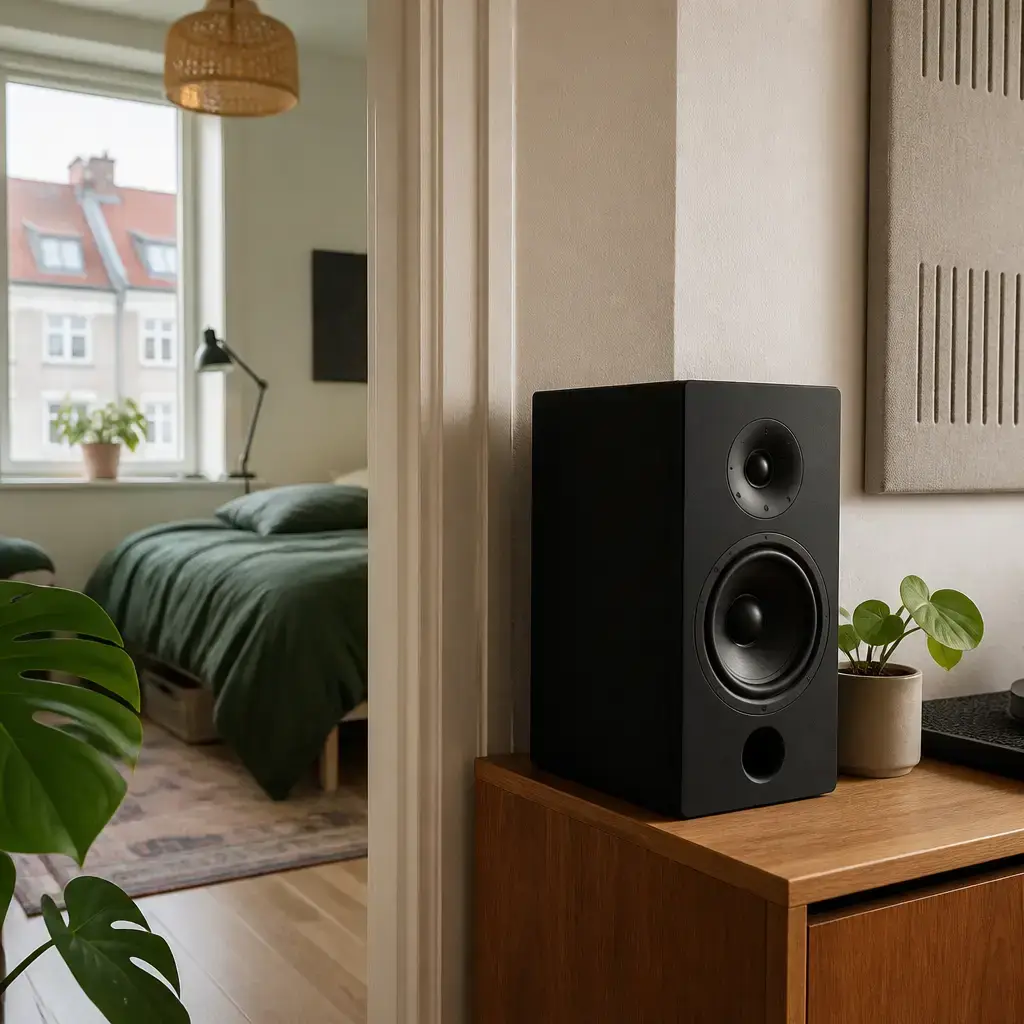
Jeg ville lige nævne, at din musik tydeligt kan høres gennem væggen.
yai VIL-uh lee-uh NEH-oo-nuh, ad deen moo-SEEK TOO-thuh-lee kan hoh-res guh-NEM VEH-gun. I wanted to mention that your music carries clearly through the wall.Jeg var ikke klar over, at den kunne høres hos dig.
yai vah EH-guh klar OH-uh, ad den KOO-nuh hoh-res hohs dai. I did not realize it was reaching your side.Det er mest tydeligt sent om aftenen, når der er stille i bygningen.
deh eh MAYST TOO-thuh-lee SEND om AF-duh-nun, nor deh eh STEL-uh ee BEW-ning-un. It is mostly noticeable late at night, when the building is quiet.Jeg kan skrue ned for bassen og flytte højttalerne væk fra væggen.
yai kan SKROO-uh NAYTH foh BAS-un oh FLEW-duh HOY-tay-luh-nuh VEH frah VEH-gun. I can lower the bass and move the speakers away from the wall.Det ville hjælpe, især på hverdagsaftener.
deh VIL-uh YEL-buh, ee-SEH-uh poh VAIR-dahgs-AF-duh-nuh. That would help, especially on work nights.Sig endelig til, hvis ændringen ikke er nok.
sai EN-uh-lee tel, ves EN-dring-un IK-uh eh NOHK. Please tell me if the change is not enough.Jeg sætter pris på, at du er villig til at tale om det.
yai SEH-duh PREES poh, ad doo eh VEL-uh tel ad TAY-luh om deh. I appreciate you being willing to talk about it.Det er bedre at få det her løst, før det udvikler sig til spændinger.
deh eh BEH-thruh ad FOH deh hair LURST, fur deh OO-thvik-luh sai tel SPEN-ning-uh. It is better to sort this out before it turns into tension.Sentence explanations
Jeg ville lige nævne, at din musik tydeligt kan høres gennem væggen.
I wanted to mention that your music carries clearly through the wall.
- Jeg ville
- I wanted to
- lige
- just; briefly
- nævne
- mention
- musik
- music
- tydeligt
- clearly
- kan høres
- can be heard
- gennem
- through
- væggen
- the wall
More detail
Jeg ville uses ville, the past form of vil, with the infinitive nævne that follows. Here it presents the speaker’s intention in a softened way: “I wanted to mention…”. The present form vil can mean “want” or, in other contexts, “will”; the surrounding infinitive and sentence meaning establish the intended use here. Example: Jeg vil spørge. — “I want to ask.” lige literally has uses related to “just” or “right,” but here it is a small discourse adverb that makes the act of mentioning sound brief or lightly introduced. It does not mean that the speaker mentions something at a precise time. nævne is the infinitive “to mention.” Danish commonly uses an infinitive after modal verbs such as vil, as in Jeg vil nævne det. — “I want to mention it.” musik means “music.” It is a noun; the possessive din before it means “your,” so din musik is “your music.” The noun is not marked for number in this form; the context presents it as the music belonging to the addressee. tydeligt is the adverb “clearly.” It is related to the adjective tydelig (“clear”) and describes how the music can be heard, rather than describing the wall. Danish adjective forms can also function as adverbs; the adverb here ends in -t. Example: Hun taler tydeligt. — “She speaks clearly.” kan høres combines kan, “can,” with høres, the passive form of høre, “hear.” Together, the construction means “can be heard”: the music is presented as audible, without saying who hears it. kan is the present form of kunne (“can, be able to”), and the verb after it is in the infinitive. Example: Stemmen kan høres udenfor. — “The voice can be heard outside.” gennem means “through” and introduces the route or medium through which the sound travels. In this sentence it connects the sound with the wall as the thing it passes through. væggen means “the wall.” Its base form is væg (“wall”); -en marks the definite singular form, “the wall.” This is a noun inflection, not an adjective ending. Example: Jeg ser væggen. — “I see the wall.” Putting the parts together: Jeg ville lige nævne introduces a brief, softened intention to mention something. din musik identifies the sound source, tydeligt kan høres says that it is clearly audible, and gennem væggen specifies that the sound comes through the wall. The complete meaning is: “I wanted to mention that your music carries clearly through the wall.”
Jeg var ikke klar over, at den kunne høres hos dig.
I did not realize it was reaching your side.
- Jeg
- I
- var ikke klar over
- did not realize
- den
- it
- kunne høres
- could be heard
- hos dig
- at your place; on your side
More detail
Jeg is the first-person singular pronoun, “I.” It is the subject of the sentence. Danish uses jeg for the speaker regardless of the speaker’s gender. var ikke klar over expresses “was/did not realize” or “was not aware.” var is the past form of være (“be”); ikke negates the clause; and klar over is a fixed expression meaning “aware of” or “realize,” rather than simply “clear over.” The past-time pattern is reusable: Jeg var klar over det means “I was aware of it,” while Jeg var ikke klar over det means “I was not aware of it.” den is a singular common-gender pronoun. Here the fixed translation supports “it,” and the surrounding context concerns something audible. The pronoun’s grammatical form is singular common gender; its exact referent is supplied by the context rather than by the pronoun itself. Danish also has det for a singular neuter referent, so the choice between den and det depends on the grammatical gender of the referent. kunne høres combines kunne, the past form of the modal verb kan (“can”), with høres, the passive form of høre (“hear”). In this sentence, kunne presents audibility as a possibility or capability in the past: something could be heard. høre means “hear” when someone is the hearer; høres shifts the focus to what is audible, meaning “be heard” or “be audible.” For example, Musikken kunne høres udenfor means “The music could be heard outside.” hos dig means “at your place” or, in this context, “on your side.” dig is the object form of the second-person singular pronoun du (“you”). The preposition hos commonly locates someone or something with a person or at that person’s place; it is different from a general physical-location preposition such as i (“in”) or på (“on/at,” depending on the expression). Together, Jeg var ikke klar over states that the speaker had not realized something. den kunne høres identifies that something as being audible, and hos dig places the hearing on the listener’s side. The complete meaning is: “I did not realize it was reaching your side.”
Det er mest tydeligt sent om aftenen, når der er stille i bygningen.
It is mostly noticeable late at night, when the building is quiet.
- Det er
- it is
- mest tydeligt
- mostly noticeable
- sent
- late
- aftenen
- the evening
- når
- when
- der er
- there is / there are
- stille
- quiet
- bygningen
- the building
More detail
Det er presents the situation as “it is.” Here, the phenomenon is supported by the fixed translation and surrounding context; the pronoun alone does not identify it. Er is the present form of være (“to be”). Example: Det er vigtigt. — “It is important.” mest tydeligt means “mostly noticeable” here. Tydeligt is the neuter singular form of the adjective tydelig, used with det, and mest marks a high degree. The useful comparison chain is tydelig → tydeligere → tydeligst (“clear” → “clearer” → “clearest”); the fixed sentence instead uses the form mest tydeligt. Example: Det er tydeligere om aftenen. — “It is more noticeable in the evening.” sent is an adverb meaning “late.” It specifies the time when the phenomenon is noticeable. Example: Det bliver sent. — “It is getting late.” aftenen is the definite singular form of the noun aften, “evening”: aften → aftenen. With om, om aftenen means “in the evening.” Example: Jeg arbejder om aftenen. — “I work in the evening.” når introduces a time condition or recurring time relationship, meaning “when.” It begins the clause that states when the situation is noticeable. Example: Jeg læser, når der er ro. — “I read when it is quiet.” der er is an existential pattern meaning “there is” or “there are.” Here, der is a grammatical placeholder, and er is the present form of være. Example: Der er kaffe på bordet. — “There is coffee on the table.” stille means “quiet.” In der er stille i bygningen, it describes quiet conditions inside the building. The adjective has the same written form in common-gender, neuter, and plural contexts: en stille gade, et stille rum, stille rum. Example: Der er stille i rummet. — “It is quiet in the room.” bygningen is the definite singular form of the noun bygning, “building”: bygning → bygningen. The ending -en marks definite singular in this noun's form. Example: Bygningen er gammel. — “The building is old.” The utterance combines Det er mest tydeligt (“it is mostly noticeable”) with sent om aftenen (“late in the evening”) and the time clause når der er stille i bygningen (“when it is quiet in the building”). Together, using the fixed translation, it means: “It is mostly noticeable late at night, when the building is quiet.”
Jeg kan skrue ned for bassen og flytte højttalerne væk fra væggen.
I can lower the bass and move the speakers away from the wall.
- Jeg kan
- I can
- skrue ned
- turn down
- bassen
- the bass
- flytte
- move
- højttalerne
- the speakers
- væk fra
- away from
- væggen
- the wall
More detail
Jeg kan means “I can” here: kan is the present-tense form of kunne (“can, be able to”). After a modal such as kan, Danish uses the infinitive without at, as in Jeg kan komme (“I can come”). The subject is Jeg (“I”), and the same modal applies to both actions joined by og (“and”); it expresses ability or possibility, not a promise that the actions will definitely happen. skrue ned means “turn down” or “reduce.” It is a reusable verb pattern for lowering a setting or level. With a thing being reduced, Danish commonly uses skrue ned for + noun; here, for connects the action to bassen. The form skrue is the infinitive after kan. Example: Kan du skrue ned for musikken? — “Can you turn down the music?” bassen means “the bass.” The noun is bas, and -en marks the definite singular form: bas = “a bass/bass” and bassen = “the bass.” In this sentence it refers to the bass level or bass sound being lowered, as specified by the fixed translation. flytte means “move.” It is also an infinitive after kan; Jeg kan flytte ... is “I can move ...”. The verb can describe changing the position of an object, as here. Example: Jeg kan flytte stolen. — “I can move the chair.” højttalerne means “the speakers.” The noun is højttaler (“speaker”), and -ne marks the definite plural: højttalere = “speakers” and højttalerne = “the speakers.” The definite plural form shows that the object being moved is a specific set of speakers, while the form itself does not identify how many. væk fra means “away from.” This construction expresses movement that increases the distance from a reference point. Here it introduces væggen, the reference point for the speakers’ movement. Example: Flyt cyklen væk fra døren. — “Move the bicycle away from the door.” væggen means “the wall.” The noun is væg, and -en marks its definite singular form: væg = “a wall” and væggen = “the wall.” In this utterance it is the reference point from which the speakers are moved away. Taken together, Jeg kan skrue ned for bassen means “I can lower the bass,” and og flytte højttalerne væk fra væggen means “and move the speakers away from the wall.” The modal kan governs both infinitives, so the complete utterance is: “I can lower the bass and move the speakers away from the wall.”
Det ville hjælpe, især på hverdagsaftener.
That would help, especially on work nights.
- Det
- That; it
- ville
- would
- hjælpe
- help
- især
- especially
- på
- on; during
- hverdagsaftener
- work nights
More detail
Det means “that” here and points to the proposed adjustment described in the fixed context. It is a neuter singular pronoun; its form is not a general marker of who performs the action. Danish can also use det as an anticipatory subject, but that is not the use in this sentence. ville is the form used for “would” in this conditional meaning. It is related to vil (“will” or “want”) and places the help in a hypothetical or expected-result frame rather than stating simple present help. Example: Det ville være godt. — “That would be good.” hjælpe means “to help.” After a modal such as ville, Danish uses the infinitive: ville hjælpe, “would help,” rather than a finite present-tense form. Example: Det kan hjælpe. — “That can help.” især means “especially” and singles out one circumstance as particularly relevant. It modifies the following time expression here. Example: Jeg kan især lide vinteren. — “I especially like winter.” på is the preposition used here for a time period or recurring occasion: “on” or “during.” Its meaning depends on the expression that follows; in this sentence it introduces the evenings when the help would be especially useful. hverdagsaftener means “work nights” or “weekday evenings.” It is the plural indefinite form of hverdagsaften (“weekday evening”): hverdagsaften → hverdagsaftener. The compound combines hverdags- (“weekday/everyday”) with aften (“evening”). Example: Vi mødes på hverdagsaftener. — “We meet on weekday evenings.” Together, Det ville hjælpe means “That would help,” and især på hverdagsaftener adds “especially on work nights.” The complete utterance is therefore: “That would help, especially on work nights.”
Sig endelig til, hvis ændringen ikke er nok.
Please tell me if the change is not enough.
- Sig endelig til
- please let me know
- hvis
- if
- ændringen
- the change
- ikke
- not
- er
- is
- nok
- enough
More detail
Sig endelig til is a polite way to say “please let me know.” Sig is the imperative of sige (“to say/tell”); the imperative is used for a request. In this construction, til is a particle completing the expression, so the phrase means “let me know,” rather than simply “say.” Endelig adds an encouraging “please/do” nuance here. Hvis introduces a condition: “if.” A reusable pattern is hvis + clause, as in Hvis du har tid, ... (“If you have time, ...”). Ændringen means “the change.” It is the definite singular form of the common-gender noun ændring: en ændring (“a change”) → ændringen (“the change”). The ending -en marks definiteness here; it does not itself express a separate quantity. Ikke is the negation word “not.” In this sentence it negates the following description of the change’s sufficiency. Er is the present-tense form of være (“to be”). Danish uses er with all persons in the present: for example, jeg er (“I am”) and de er (“they are”). Nok means “enough” here. It describes sufficiency: something is enough for the relevant purpose. For example, Det er nok. means “That is enough.” Together, Sig endelig til gives the request “please let me know,” and hvis ændringen ikke er nok gives the condition “if the change is not enough.” The complete utterance therefore means: “Please tell me if the change is not enough.”
Jeg sætter pris på, at du er villig til at tale om det.
I appreciate you being willing to talk about it.
- Jeg
- I
- sætter pris på
- appreciate; value
- du
- you
- villig
- willing
- tale om
- talk about
- det
- it
More detail
Jeg means “I” and is the first-person singular subject. Danish uses jeg for this subject regardless of the speaker’s gender. sætter pris på is a fixed Danish construction meaning “appreciate” or “value” something. sætter is the present-tense form of sætte, but the full construction—not sætter alone—has the meaning “appreciate.” The reusable pattern is at sætte pris på + noun or clause. Example: Jeg sætter pris på din hjælp. — “I appreciate your help.” du means “you” and is the second-person singular subject form in this sentence. Danish uses I for “you” when addressing more than one person. Here du is the subject of the following clause, not the person expressing the appreciation. villig means “willing.” It appears with er in er villig til at ..., a pattern for being willing or prepared to do something. villig is the singular common-gender form of the adjective; the plural form is villige, while the neuter singular form is villigt. The form here agrees with the singular subject du, but it does not identify the person’s gender. Example: Hun er villig til at vente. — “She is willing to wait.” tale om means “talk about.” tale is the infinitive form, introduced here by at; om connects the talking with its topic. The reusable pattern is at tale om + topic. Example: Vi taler om problemet. — “We are talking about the problem.” det is a Danish neuter singular pronoun corresponding here to “it.” Its specific referent is not named in this sentence; it refers to the matter being discussed. The pronoun’s grammatical form and its contextual referent are separate facts. The sentence is assembled as Jeg sætter pris på (“I appreciate”) + at du er villig til at tale om det (“that you are willing to talk about it”). Together, it means: “I appreciate you being willing to talk about it.” The clause introduced by at expresses what the speaker appreciates.
Det er bedre at få det her løst, før det udvikler sig til spændinger.
It is better to sort this out before it turns into tension.
- bedre
- better
- få
- get
- det her
- this
- løst
- sorted out
- før
- before
- udvikler sig
- develops
- til
- into
- spændinger
- tensions
More detail
bedre means “better” here. It is the comparative form of god (“good”): god → bedre → bedst (“best”). The comparison is expressed by the context: resolving the matter is presented as preferable to leaving it unresolved. Example: Det er bedre at vente. — “It is better to wait.” få is the verb “get” in the construction få + object + past participle. Here it helps express causing or arranging a matter to reach a result, rather than simply obtaining an object. Example: Jeg fik bilen repareret. — “I got the car repaired.” det her means “this” and refers to the matter being discussed. det is the neuter singular form used with a neuter referent, while her adds the sense “here,” making the demonstrative explicitly “this” rather than “that.” The phrase is a demonstrative expression; its grammatical form does not by itself identify exactly what the matter is. løst comes from løse, “to solve” or “resolve.” As a past participle, it agrees here with the neuter singular object det: løst. Together with få, få det her løst means “get this sorted out” or “arrange for this to be resolved.” The participle is not the past tense of the main action; it describes the result to be achieved. før introduces a time clause meaning “before.” The clause after it gives the event that should not be allowed to happen first. Example: Ring, før du går. — “Call before you leave.” udvikler sig comes from udvikle sig, “develop” or “evolve.” udvikler is the present-tense form of udvikle; Danish present-tense verbs generally do not change for person, so the same form can be used with different subjects. sig is the reflexive pronoun belonging to the subject: det udvikler sig literally presents something as developing itself, naturally translated here as “it develops” or “it turns.” til marks the result or state into which something changes: “into.” In this sentence it links the development process to its resulting form, til spændinger — “into tensions.” spændinger is the plural indefinite form of spænding, “tension.” The singular is en spænding; the plural is spændinger. The plural presents tension as tensions or strained relations developing, rather than asserting one specifically identified tension. The sentence combines the recommendation Det er bedre at ... (“It is better to ...”) with the result construction få det her løst (“get this sorted out”). The time clause før det udvikler sig til spændinger says that this should happen before the matter develops into tensions. Together: “It is better to sort this out before it turns into tension.”
Grammar Points
Adjektiv som adverbium: tydelig → tydeligt
Musikken høres tydeligt gennem væggen.
moo-SEE-gun HUR-uhs TEW-thuh-lee guh-NEM VEH-gun.The music can be heard clearly through the wall.
Når et adjektiv beskriver, hvordan en handling udføres, får det ofte endelsen -t: tydelig → tydeligt.
Danish Vocabulary
- Gender
- common
- Gender
- common
Quiz
Word Order
Arrange the words in the correct order.
That would help, especially on work nights.
Show Answer
Det ville hjælpe, især på hverdagsaftener.Spelling
Tap the letters to spell the word.
hear
Show Answer
høresmusic
Show Answer
musikmention
Show Answer
nævnemostly; most