10 minutes free every day
Continue audio lessons in the app
Word explanations appear automatically in sync with the audio.
No login required · synced translations · playback with the screen locked
Choose your learning language and open this lesson in the app.

About This Lesson
Use Handling a misdelivered package politely to practice Danish conversation, pronunciation, vocabulary, grammar, and quizzes.
Dialogue
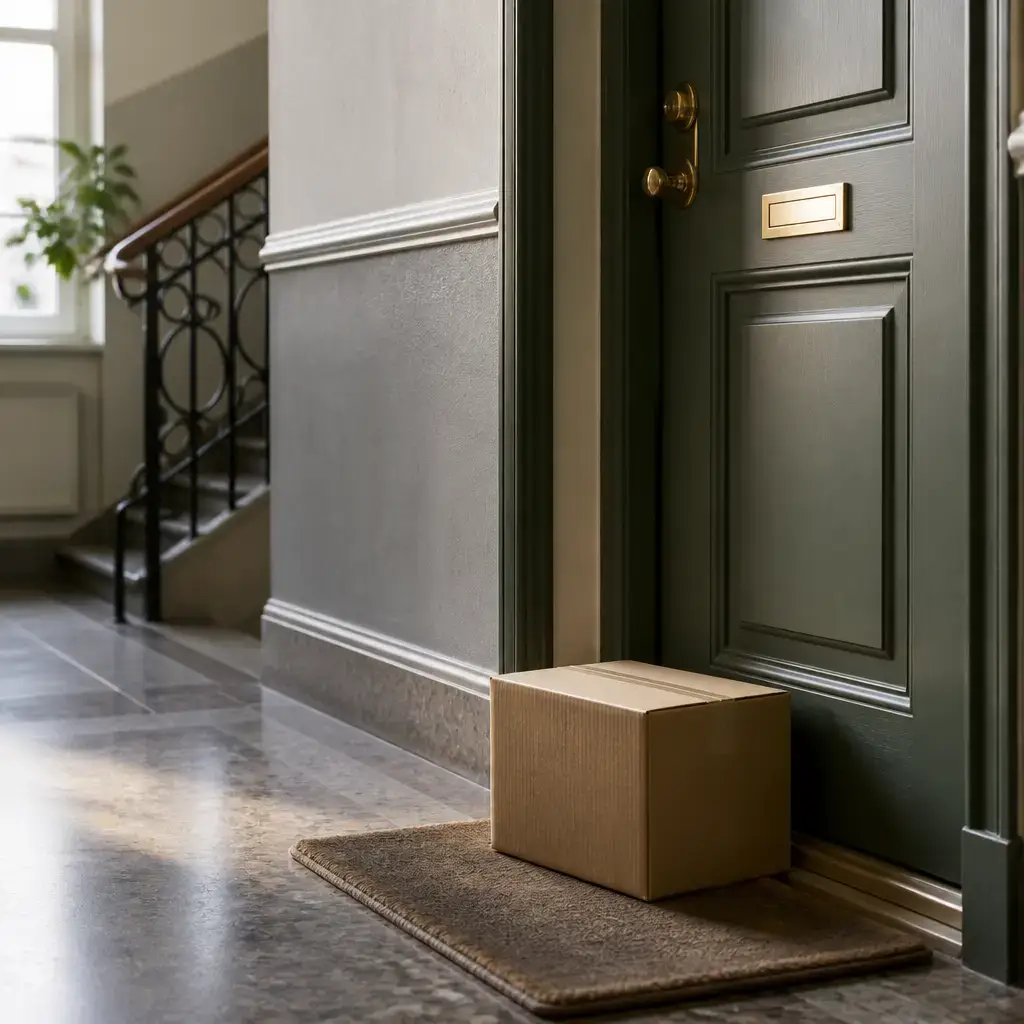
En pakke til min lejlighed blev stillet uden for din dør.
uhn PAH-kuh teel meen LYE-lee-hehth blehv STEE-luhd OO-then foh deen duhr. A package for my apartment was left outside your door.Jeg opdagede den og lod den stå ved døren til dig.
yai ob-DAI-uh-thuh dehn oh loh dehn stoh veh duhr-uhn teel dye. I noticed it and kept it by the door for you.Jeg håbede, at den ikke var blevet væk.
yai HOH-buh-thuh, ad dehn IK-uh var BLEH-vuhth vek. I was hoping it had not gone missing.Det var sandsynligvis bare en forveksling af etiketterne.
deh var SAN-soon-lee-viss BAIR uhn FOHR-veks-ling ahv eh-tee-KEH-duh-nuh. It was probably just a label mix-up.Jeg kan komme forbi om et par minutter og hente den.
yai kan KOH-muh foh-BEE ohm ed par mee-NOO-duh oh HEN-uh dehn. I can come by in a few minutes to pick it up.Jeg kan komme over med den, hvis det er nemmere for dig.
yai kan KOH-muh OH-vuh mayth dehn, viss deh air NEM-uh-uh foh dye. I can bring it over if that is easier for you.Det sætter jeg pris på, men jeg er allerede lige i nærheden.
deh SED-uh yai PREES poh, men yai air AL-uh-RAY-thuh LEE-uh ee NAIR-uh-HAY-thun. I appreciate that, but I am nearby already.Jeg stiller den ved min dør, indtil du kommer.
yai STEE-luh dehn veh meen duhr, EN-teel doo KOM-uh. I'll leave it by my door until you get here.Sentence explanations
En pakke til min lejlighed blev stillet uden for din dør.
A package for my apartment was left outside your door.
- pakke
- package
- til
- for; to
- min
- my
- lejlighed
- apartment
- blev stillet
- was left; was placed
- uden for
- outside
- din
- your
- dør
- door
More detail
pakke means “package” here. It is a common-gender noun: en pakke, plural pakker. The form pakke is the singular indefinite form used after en; the article does not by itself need to be explained as a numerical count. til links something to a destination, recipient, or intended purpose. In til min lejlighed, it identifies the apartment the package is intended for. Example: En gave til ham — “A gift for him.” min is the possessive form “my” used with a singular common-gender noun. Its forms contrast as min + common-gender singular, mit + neuter singular, and mine + plural. Here it agrees with lejlighed, not with the package. lejlighed means “apartment.” It is a common-gender noun: en lejlighed, plural lejligheder. Example: Jeg bor i en lejlighed — “I live in an apartment.” blev stillet is a past passive construction meaning that something was placed or left, without naming the person who placed it. blev is the past form of blive (“become” or, in passive constructions, “be”), while stillet is the past participle of stille (“place/set”). Together, blev stillet presents the package as the thing affected by the action. Example: Bogen blev stillet på bordet — “The book was placed on the table.” uden for is a two-word preposition meaning “outside.” It describes the location of something relative to a place. Example: Cyklen står uden for huset — “The bicycle is outside the house.” din means “your” with a singular common-gender noun. Its related forms are dit with a singular neuter noun and dine with a plural noun. Here it agrees with dør, not with the person who owns the door. dør means “door.” It is a common-gender noun: en dør, plural døre. Example: Døren er åben — “The door is open.” Assembled in order, En pakke til min lejlighed identifies a package intended for the speaker’s apartment. blev stillet says that it was placed or left, using the past passive. uden for din dør gives its location: outside the addressee’s door. The whole utterance therefore means: “A package for my apartment was left outside your door.”
Jeg opdagede den og lod den stå ved døren til dig.
I noticed it and kept it by the door for you.
- opdagede
- noticed; discovered
- den
- it
- lod
- let; caused to remain
- stå
- stand; remain standing
- døren
- the door
- til dig
- for you
More detail
opdagede is the past-tense form of opdage, “to notice” or “to discover.” The ending -ede is used here for the past form. Example: Jeg opdagede en fejl. — “I noticed an error.” den is the singular object pronoun “it” here, referring to the item already being discussed. In Danish, den is used for a singular common-gender noun; the corresponding neuter form is det. Its form marks the grammatical gender and number of the noun it replaces, not the natural gender of a person. lod is the past-tense form of lade, “to let” or “to leave.” In the construction lade + infinitive, it means allowing or causing something to remain in a state or perform an action. Example: Hun lod døren stå åben. — “She left the door open.” stå is the infinitive “to stand.” With lod, it describes the state the item was left in: it remained standing or positioned there. The infinitive follows lod without an infinitive marker in this construction. døren means “the door.” It is the definite singular form of dør: en dør — “a door,” døren — “the door.” The nearby preposition ved means “by” or “beside,” so ved døren means “by the door.” til dig means “for you” in this sentence. dig is the object form of du, “you,” and til can mark the intended recipient or beneficiary. Example: Det er til dig. — “It is for you.” Together, Jeg opdagede den means “I noticed it.” Then lod den stå ved døren says that the speaker left it standing or remaining by the door. Finally, til dig identifies the person for whom the item was intended: “for you.” The complete utterance is therefore: “I noticed it and kept it by the door for you.”
Jeg håbede, at den ikke var blevet væk.
I was hoping it had not gone missing.
- Jeg
- I
- håbede
- hoped
- den
- it
- ikke
- not
- var blevet væk
- had gone missing
More detail
Jeg means “I” and is the first-person singular subject pronoun. It identifies the speaker as the person who had the hope. Example: Jeg kommer. — “I am coming.” håbede is the past-tense form of håbe, “to hope.” Here it describes the speaker’s hope as existing in the past; English can naturally express this as “was hoping.” Danish past tense does not itself mark whether the situation was completed or ongoing. Example: Jeg håbede på godt vejr. — “I hoped for good weather.” den is a third-person singular pronoun for a common-gender referent in Danish. In this sentence it means “it,” with the specific referent supplied by the surrounding context rather than by the pronoun alone. Danish contrasts den with det, which is used for a neuter-gender singular referent. Example: Jeg fandt den. — “I found it.” ikke is the ordinary Danish negation word, “not.” It negates the following situation here: the thing had not gone missing. var blevet væk expresses “had gone missing.” It is built from var, the past form of være (“to be”), blevet, the participle of blive (“to become”), and væk, meaning “away” or, in this expression, “missing.” Together, blive væk means “go missing” or “disappear”; with past var plus blevet, the event is presented as anterior to the past point expressed by håbede. Example: Min nøgle er blevet væk. — “My key has gone missing.” The whole utterance combines the subject Jeg, the past-tense verb håbede, and the subordinate clause at den ikke var blevet væk (“that it had not gone missing”). Thus it means: “I was hoping it had not gone missing.”
Det var sandsynligvis bare en forveksling af etiketterne.
It was probably just a label mix-up.
- Det
- it
- var
- was
- sandsynligvis
- probably
- bare
- just
- forveksling
- mix-up
- etiketterne
- the labels
More detail
Det is a neuter singular subject pronoun. Here it corresponds to “it,” while the sentence itself does not identify a more specific referent. Danish subject pronouns include det for neuter singular and den for common-gender singular; the choice follows the grammatical gender of the noun when the pronoun refers to a noun. var is the past-tense form of være, “to be.” The useful chain is er “is” → var “was” → været “been.” Example: Det var en fejl. — “It was a mistake.” sandsynligvis is an adverb meaning “probably.” It marks the statement as likely rather than certain. Example: Hun kommer sandsynligvis senere. — “She will probably come later.” bare is an adverb meaning “just” here, making the description sound limited to a mix-up. Its meaning depends on context; it can also mean “only” or “simply.” Example: Det er bare et spørgsmål. — “It is just a question.” forveksling is the noun “mix-up” or “confusion,” from the verb forveksle, “to mistake one thing for another.” Its common-gender indefinite form is en forveksling; the definite singular form is forvekslingen. Example: Det var en forveksling. — “It was a mix-up.” etiketterne means “the labels.” The noun is etiket “label”; its forms are en etiket (indefinite singular), etiketten (definite singular), etiketter (indefinite plural), and etiketterne (definite plural). The ending -ne marks definite plural here. In af etiketterne, af connects the mix-up with the labels: “of the labels” or, naturally, “involving the labels.” Together, Det var gives “It was,” sandsynligvis bare gives “probably just,” and en forveksling af etiketterne gives “a mix-up of the labels.” The complete meaning is: “It was probably just a label mix-up.”
Jeg kan komme forbi om et par minutter og hente den.
I can come by in a few minutes to pick it up.
- Jeg kan
- I can
- komme forbi
- come by
- et par minutter
- a few minutes
- hente
- pick up
- den
- it
More detail
Jeg kan means “I can.” Jeg is the first-person singular pronoun “I”. Kan is the present-tense form of kunne, “can/be able to”; it is a modal verb and is followed by an infinitive without an English-style “to”: Jeg kan komme = “I can come.” komme forbi means “come by.” Komme is the infinitive of komme, “come”. Forbi adds the idea of passing by or stopping by a place or person. Together, komme forbi is a reusable way to say that the speaker will come by. et par minutter means “a few minutes” here. Minutter is the plural of minut, “minute”. Et par is a common expression for a small number, often approximately two, but the translation here does not require an exact count. The word et agrees with the singular neuter noun par; it is not itself a statement that there is exactly one minute. The separate word om before this phrase means “in” when referring to a future amount of time: om et par minutter = “in a few minutes.” This time expression tells when the coming and picking up will happen. hente means “pick up” in this sentence. It is the infinitive of hente. Because kan governs the coordinated actions, both komme and hente remain infinitives: kan komme ... og hente = “can come ... and pick up.” Hente can also mean “fetch” or “go and get” when the context involves obtaining or collecting something. den means “it” here. It is a Danish third-person singular object pronoun for a common-gender referent; the form itself does not identify exactly what the item is. The fixed translation establishes that the intended object is “it,” while the supplied sentence does not specify that object's identity. The structure is Jeg kan + komme forbi + om et par minutter + og hente den: “I can come by in a few minutes and pick it up.” The modal kan applies to both coordinated infinitives, while den is the object of hente. The full utterance therefore expresses the speaker's ability or availability to come by after a short interval and collect the item.
Jeg kan komme over med den, hvis det er nemmere for dig.
I can bring it over if that is easier for you.
- Jeg kan
- I can
- komme over
- come over
- med
- with
- den
- it
- hvis
- if
- det
- that
- er
- is
- nemmere
- easier
- for dig
- for you
More detail
Jeg kan: Jeg means “I”. kan is the present-tense form of kunne, “can/be able to”, and expresses ability or possibility here. The pattern Jeg kan + infinitive is reusable: Jeg kan hjælpe. — “I can help.” komme over: komme means “come”; its infinitive follows kan. over adds the sense of coming over to another place. In this sentence, komme over med den is understood as bringing the item over. Example: Jeg kommer over senere. — “I’m coming over later.” med: med means “with”. Here it connects the movement with the item being brought: komme over med ... means “come over with ...”. den: den is a Danish singular common-gender form used here for “it”, referring to the item already understood from the exchange. It is a pronoun, not an article in this use. Danish also has det for singular neuter reference, so the choice depends on the grammatical gender of the noun being replaced; the translation identifies the intended referent here but does not state the noun’s gender. hvis: hvis introduces a condition and means “if”. It begins the conditional clause hvis det er nemmere for dig. det: In det er nemmere, det supplies the subject meaning “that” in the fixed translation. It refers to the proposed arrangement or action as a whole; the sentence does not identify a separate concrete noun for it. er: er is the present-tense form of være, “be”. It links det with the description nemmere: “that is easier”. nemmere: nemmere is the comparative form of the adjective nem, “easy”. The comparison is relevant because the speaker presents this option as easier than an alternative understood from the situation. The useful chain is nem “easy” → nemmere “easier” → nemmest “easiest”. Example: Denne vej er nemmere. — “This way is easier.” for dig: for means “for”, and dig is the object/prepositional form of du, “you”. Together they identify the person for whom the option is easier. Compare for mig — “for me”; dig and mig are used after a preposition, while du and jeg are subject forms. Together, Jeg kan komme over med den means “I can bring it over”: the speaker presents coming over while carrying the understood item. hvis det er nemmere for dig adds the condition “if that is easier for you”. The complete utterance therefore means: “I can bring it over if that is easier for you.”
Det sætter jeg pris på, men jeg er allerede lige i nærheden.
I appreciate that, but I am nearby already.
- Det sætter jeg pris på
- I appreciate that
- allerede
- already
- lige i nærheden
- nearby
More detail
Det sætter jeg pris på is a fixed Danish expression meaning “I appreciate that.” Here det refers to the action or offer already under discussion; it is not necessary to identify a specific noun. The expression uses sætter, the present-tense form of sætte, but in this idiom the combined meaning is “appreciate,” not the ordinary physical meaning “put” or “set.” Example: Jeg sætter pris på din hjælp. — “I appreciate your help.” The word order also illustrates Danish verb-second order. Because Det is placed first as the object, the finite verb sætter comes before the subject jeg: Det sætter jeg .... This is a word-order pattern, not a change in the meaning of jeg. allerede means “already.” It places the situation before the relevant expected or contrasting point in time. Example: Hun er allerede hjemme. — “She is already home.” lige i nærheden means “nearby” or “right nearby.” nærheden is the definite form of nærhed, “nearness/proximity,” and i nærheden is the usual expression for being in the vicinity. lige strengthens the expression here, giving the sense “right nearby”; it does not mean that the speaker is moving. Example: Butikken ligger lige i nærheden. — “The shop is right nearby.” After men (“but”), jeg er states the speaker’s situation directly: jeg is “I,” and er is the present form of være, “to be.” The adverb allerede comes before the location expression lige i nærheden, so the sentence presents being nearby as an already true situation. Together, Det sætter jeg pris på, men jeg er allerede lige i nærheden. means “I appreciate that, but I am already nearby.” The first clause acknowledges the other person’s offer; the second contrasts it with the speaker’s current location.
Jeg stiller den ved min dør, indtil du kommer.
I'll leave it by my door until you get here.
- Jeg
- I
- stiller
- leave; put
- den
- it
- ved
- by; near
- min
- my
- dør
- door
- indtil
- until
- du
- you
- kommer
- come; get here
More detail
Jeg is the first-person singular subject pronoun, “I.” It is the person doing the placing. For example, Jeg kommer. means “I’m coming.” stiller is the present form of stille, used here for putting or leaving something in a place. Danish present tense can also describe a planned action, so the fixed translation naturally uses “I’ll leave.” The useful pattern is Jeg stiller + object (“I put/leave + object”). den is a singular common-gender object pronoun, meaning “it” here. The fixed text and translation do not identify what “it” is, so its referent should remain unspecified. A related form is det, used for a singular neuter referent; den itself does not name the object. ved is a preposition meaning “by” or “near.” In ved min dør, it places the object next to or near the speaker’s door. For example, Bogen ligger ved døren. means “The book is by the door.” min means “my” before a singular common-gender noun. Its form agrees with the possessed noun, not with the possessor: min is used with common gender, mit with neuter singular, and mine with plural nouns. dør means “door.” It is the singular indefinite form of the common-gender noun; the definite form is døren (“the door”). Here min dør means “my door,” with the possessive making the intended door definite in meaning. indtil means “until” and introduces the time limit for the main action. The pattern indtil + clause means that the main action continues or remains the case up to the event in that clause. du is the second-person singular subject pronoun, “you.” It is the person whose arrival sets the time limit. Danish subject pronouns distinguish person and number, so du is different from plural I (“you”). kommer is the present form of komme, “come.” With du, it means “you come”; in this context, the fixed translation gives the intended endpoint as “you get here.” Danish verbs generally do not change their present form for person or number: jeg kommer and du kommer both use kommer. Together, Jeg stiller den means “I’ll leave it,” and ved min dør specifies the location, “by my door.” Indtil du kommer supplies the time limit, “until you get here.” The complete meaning is: “I’ll leave it by my door until you get here.”
Grammar Points
Pakken er sandsynligvis væk.
Pakken er sandsynligvis væk.
PAH-kuhn air SAN-soon-lee-viss vek.The package is probably gone.
sandsynligvis er et adverbium. I en hovedsætning står det normalt efter det finitte verbum: er sandsynligvis.
være blevet + perfektum participium
Pakken er blevet stillet uden for døren.
PAH-kuhn air BLEH-vuhth STEE-luhd OO-then foh DUHR-uhn.The package has been left outside the door.
er blevet stillet danner passiv i perfektum: noget er blevet placeret af en ukendt person.
Danish Vocabulary
Jeg håbede, at den ikke var blevet væk.
- Gender
- common
En pakke til min lejlighed blev stillet uden for din dør.
Jeg håbede, at den ikke var blevet væk.
- Gender
- common
En pakke til min lejlighed blev stillet uden for din dør.
Jeg opdagede den og lod den stå ved døren til dig.
Jeg opdagede den og lod den stå ved døren til dig.
- Gender
- common
En pakke til min lejlighed blev stillet uden for din dør.
Det var sandsynligvis bare en forveksling af etiketterne.
En pakke til min lejlighed blev stillet uden for din dør.
Jeg opdagede den og lod den stå ved døren til dig.
En pakke til min lejlighed blev stillet uden for din dør.
Jeg håbede, at den ikke var blevet væk.
Quiz
Spelling
Tap the letters to spell the word.
noticed; discovered
Show Answer
opdagedepackage
Show Answer
pakkeleft; placed
Show Answer
stilletapartment