10 minutes free every day
Continue audio lessons in the app
Word explanations appear automatically in sync with the audio.
No login required · synced translations · playback with the screen locked
Choose your learning language and open this lesson in the app.

About This Lesson
Use Gym equipment etiquette to practice Danish conversation, pronunciation, vocabulary, grammar, and quizzes.
Dialogue
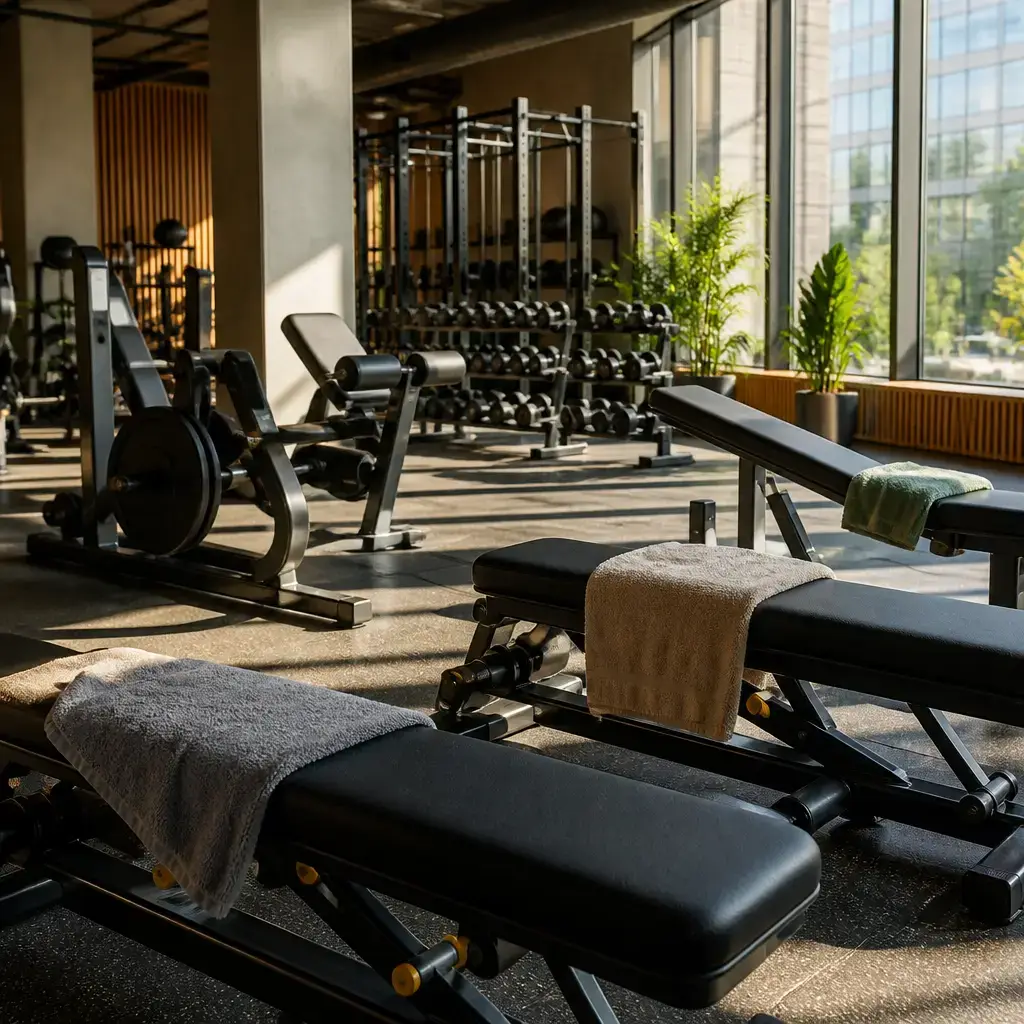
Jeg lagde mærke til, at flere maskiner blev reserveret med håndklæder i lang tid.
yai LAIR-thuh MAIR-guh til, eh FLAY-uh mah-SKEE-nuh bleh reh-seh-VAIR-uhd meh HAWN-klay-thuh in long tee I noticed several machines were being reserved with towels for a long time.Det kan være frustrerende, især når fitnesscentret er travlt.
deh kan VAIR froo-streh-REHN-uh, ee-SAIR nor FED-ness-SEN-druh air trawlt That can be frustrating, especially when the gym is busy.Jeg ville ikke konfrontere nogen direkte.
yai VIL-uh IK-uh kohn-fron-TEH-ruh NOH-en dee-REHG-tuh I did not want to confront anyone directly.Personalet kan give en generel påmindelse uden at udpege nogen.
peh-soh-NAH-leh kan GHEE-vuh en geh-neh-REHL POH-mine-el-suh OO-en eh OOTH-pai-uh NOH-en Staff can give a general reminder without singling anyone out.Det ville føles mindre aggressivt.
deh VIL-uh FUR-luhs MIN-druh ah-greh-SEEFT That would feel less aggressive.Jeg kan komme med en meddelelse og holde øje med træningsområdet oftere.
yai kan KOM-uh meh en meh-THAYL-suh oh HOL-uh OY-uh meh TRAY-nes-om-RAW-duh OFF-tuh-reh I can make an announcement and monitor the gym floor more often.Det burde forbedre adgangen uden at skabe spændinger.
deh BOOR-thuh for-BED-ruh AH-thang-en OO-en eh SKAY-buh SPEN-ning-uh That should improve access without creating tension.Meld det venligst igen, hvis det samme bliver ved med at ske.
MEL deh VEN-lest ee-GEN, vis deh SAM-uh BLEE-uh vay meh eh SKAY Please report it again if the same thing keeps happening.Sentence explanations
Jeg lagde mærke til, at flere maskiner blev reserveret med håndklæder i lang tid.
I noticed several machines were being reserved with towels for a long time.
- Jeg lagde mærke til
- I noticed
- flere
- several
- maskiner
- machines
- blev reserveret
- were reserved
- håndklæder
- towels
- i lang tid
- for a long time
More detail
Jeg lagde mærke til is a fixed Danish expression meaning “I noticed” or “I observed.” The observed form lagde is the past tense of lægge in this expression; the literal verb lægge also has other uses, such as “to put” or “to lay,” so learn lægge mærke til as a unit. The subject Jeg means “I.” Example: Jeg lagde mærke til fejlen. — “I noticed the mistake.” flere means “several” here. It is used with a plural noun and indicates more than one without stating an exact number. A related contrast is få (“few”): flere maskiner means “several machines,” while få maskiner means “few machines.” maskiner means “machines.” Its singular form is maskine, and maskiner is the plural form. Example: Maskinerne virker. — “The machines work.” The ending -ne in maskinerne marks definite plural; that ending is not present in the form used here. blev reserveret means “were reserved.” blev is the past form of blive (“become,” or an auxiliary used in passive constructions), and reserveret is the past participle of reservere (“reserve”). Together they form a past passive: the machines are presented as receiving the action, while the person who reserved them is not specified. Example: Billetterne blev reserveret online. — “The tickets were reserved online.” håndklæder means “towels.” Its singular form is håndklæde, and håndklæder is the plural form. Example: Der ligger håndklæder på hylden. — “There are towels on the shelf.” i lang tid means “for a long time.” lang describes the duration, and tid means “time”; this is a common Danish duration expression. Example: Hun ventede i lang tid. — “She waited for a long time.” Together, Jeg lagde mærke til introduces what the speaker noticed. flere maskiner identifies several machines, and blev reserveret presents them as the recipients of a past reserving action. med håndklæder adds the circumstance “with towels,” while i lang tid gives the duration. The whole utterance therefore means: “I noticed several machines were being reserved with towels for a long time.”
Det kan være frustrerende, især når fitnesscentret er travlt.
That can be frustrating, especially when the gym is busy.
- Det
- That
- kan
- can
- være
- be
- frustrerende
- frustrating
- især
- especially
- når
- when
- fitnesscentret
- the gym
- er
- is
- travlt
- busy
More detail
Det means “that” here and refers to the frustrating situation just mentioned. Danish det can also be used for a neuter noun or as a grammatical subject, so its exact role depends on the sentence; here the fixed translation supports the reference to the situation. kan is the present-tense form of kunne, “can” or “may.” With an infinitive, it expresses possibility: kan være means “can be.” The modal comes before the infinitive, and the infinitive does not take a personal ending. være is the infinitive of the verb meaning “be”; its present-tense form is er. After a modal such as kan, Danish uses the infinitive: kan være, not the present form kan er. frustrerende is the adjective “frustrating.” It describes something that causes frustration, rather than a person’s feeling of being frustrated. In this sentence it describes the situation introduced by Det. især means “especially” and highlights the following condition. It can be placed before the part that is being emphasized, as here before the når-clause. når introduces a condition or recurring time situation and commonly corresponds to “when.” It starts the subordinate clause når fitnesscentret er travlt. fitnesscentret means “the gym.” It is the definite singular form of fitnesscenter: et fitnesscenter “a gym” → fitnesscentret “the gym.” The ending belongs to the noun, not to a separate word for “the.” er is the present-tense form of være, “be.” Here it links the subject fitnesscentret with the describing adjective travlt. travlt means “busy” here. Its base form is travl; the -t form is used with a neuter singular noun such as et fitnesscenter. For comparison, travle is used in relevant plural or definite attributive forms, but travlt is the form required here by fitnesscentret. Together, Det kan være frustrerende says “That can be frustrating.” The subordinate clause når fitnesscentret er travlt adds the condition “when the gym is busy.” The complete utterance therefore means: “That can be frustrating, especially when the gym is busy.”
Jeg ville ikke konfrontere nogen direkte.
I did not want to confront anyone directly.
- Jeg ville
- I wanted to
- ikke
- not
- konfrontere
- confront
- nogen
- anyone
- direkte
- directly
More detail
Jeg ville means “I wanted to” here. Jeg is the first-person singular pronoun “I”. ville is the past form of vil; with an infinitive, ville can express a past wish or intention, as in the fixed translation. In other contexts, the same form can express “would”, so the surrounding meaning matters. Example: Jeg ville hjælpe. — “I wanted to help.” ikke is the ordinary Danish negation “not”. It negates the intention expressed by Jeg ville konfrontere, producing “I did not want to confront”. Its position before konfrontere is important for the meaning of this clause. konfrontere is an infinitive meaning “to confront”. After the modal-like form ville, Danish uses the infinitive without an extra infinitive marker: ville konfrontere — “wanted to confront”. Example: Hun vil konfrontere problemet. — “She wants to confront the problem.” nogen means “anyone” in this negative context. It is an indefinite pronoun referring to an unspecified person, not a stated individual. In a non-negative sentence, nogen can commonly correspond to “someone”: Jeg så nogen. — “I saw someone.” direkte is an adverb meaning “directly”. It describes how the confronting would take place. The related adjective is direkte as well, but here its adverbial use modifies the verb rather than a noun. Example: Tal direkte med hende. — “Speak directly with her.” Together, Jeg ville ikke konfrontere nogen direkte states that the speaker did not want to confront any unspecified person directly. The structure is Jeg ville ikke + infinitive konfrontere + object nogen + manner adverb direkte: “I did not want to confront anyone directly.”
Personalet kan give en generel påmindelse uden at udpege nogen.
Staff can give a general reminder without singling anyone out.
- Personalet
- the staff
- kan
- can
- give
- give
- generel
- general
- påmindelse
- reminder
- uden at
- without doing
- udpege
- single out
- nogen
- anyone
More detail
Personalet means “the staff” here. personale is a neuter noun, and -t marks its definite singular form: personale → personalet. The form can refer to a staff as a group; it does not by itself specify how many individual people are involved. kan is the modal verb “can” and expresses ability or possibility here. It is followed directly by an infinitive, without at: kan give = “can give.” The form kan does not change for the subject; compare jeg kan and de kan. give is the infinitive “to give.” Its present-tense form is giver, as in Personalet giver en påmindelse (“The staff gives a reminder”). After a modal such as kan, Danish uses the infinitive give, not giver and not at give. generel means “general” in this sentence. It is the common-gender singular indefinite form agreeing with påmindelse, an en-noun. The corresponding neuter form is generelt, for example et generelt råd (“a general piece of advice”); the plural/definite form is generelle. påmindelse means “reminder.” It is an en-noun: en påmindelse (“a reminder”), påmindelsen (“the reminder”), and påmindelser (“reminders”). In the sentence, en introduces one unspecified reminder; it does not alone add a special emphasis on the number one. uden at introduces an action that does not occur: uden at + infinitive means “without doing …”. For example, Hun gik uden at sige noget means “She left without saying anything.” udpege means “to single out” or “to point out/designate.” In uden at udpege nogen, it is the infinitive required after uden at. A useful contrast is pege på, “point at,” whereas udpege can mean identifying or singling out a person or thing. nogen means “anyone” in this negative-style uden at context. The same pronoun can mean “someone” in an affirmative context, for example Jeg så nogen (“I saw someone”). Its exact English translation therefore depends on the surrounding construction. Together, Personalet kan give en generel påmindelse says “The staff can give a general reminder.” The construction uden at udpege nogen adds that this happens without singling anyone out. The complete meaning is: “Staff can give a general reminder without singling anyone out.”
Det ville føles mindre aggressivt.
That would feel less aggressive.
- Det
- that
- ville
- would
- føles
- feel
- mindre
- less
- aggressivt
- aggressive
More detail
Det means “that” here and functions as the subject. Danish det is the neuter singular form of this pronoun; the fixed translation supports the demonstrative reading, but the supplied sentence does not identify exactly what it refers to. ville is the past form of vil, used here as the modal “would.” A modal is followed by an infinitive. Vil can also mean “want” in other constructions, but that is not its meaning here. føles means “feel” in this sentence. It is the s-form of føle; after the modal, this s-infinitive appears in ville føles. In this utterance, det føles ... means that the subject has a particular felt quality, rather than being an impersonal claim with an unidentified subject. For example, Det føles godt means “It feels good.” mindre means “less” here, reducing the degree of the following adjective. In this degree/amount use, it is the comparative form related to lidt (“little”); mindre can also be the comparative of lille (“small”) when size is being compared. For example, Det føles mindre mærkeligt means “It feels less strange.” aggressivt means “aggressive” here. Its base form is aggressiv; aggressivt is its neuter singular form, agreeing with neuter det in this construction. The comparative meaning comes from mindre, not from a special comparative form of aggressiv. Together, Det ville føles mindre aggressivt follows the pattern det ville føles + mindre + neuter singular adjective and means “That would feel less aggressive.” It presents a hypothetical evaluation of whatever det refers to.
Jeg kan komme med en meddelelse og holde øje med træningsområdet oftere.
I can make an announcement and monitor the gym floor more often.
- Jeg kan
- I can
- komme med
- make/give
- meddelelse
- announcement
- holde øje med
- monitor; keep an eye on
- træningsområdet
- the gym floor
- oftere
- more often
More detail
Jeg kan expresses “I can.” kan is the present-tense form of kunne and is used with an infinitive to express ability or possibility. The subject is Jeg (“I”); kan does not change for the subject in this construction. komme med is a reusable expression meaning to bring, provide, or make a contribution such as an announcement. Here, komme is the infinitive after kan, and med is part of the expression rather than the ordinary preposition meaning simply “with.” meddelelse means “announcement” here. It is a common-gender noun: en meddelelse is “an announcement,” while meddelelsen is “the announcement.” The indefinite article identifies one unspecified announcement, not necessarily a numerical count being emphasized. holde øje med is an idiomatic expression meaning “keep an eye on” or “monitor.” holde is the infinitive form of the verb holde and follows the coordinated structure after kan: the same modal applies to both komme and holde. The preposition med is required in this expression. træningsområdet means “the gym floor” in this sentence. It is the definite form of træningsområde: et træningsområde means “a training area,” and træningsområdet means “the training area.” The ending -et marks singular definite form for this neuter noun; the compound’s first part, trænings-, specifies the type of area. oftere means “more often.” It is the comparative form of ofte (“often”): ofte → oftere. It modifies the monitoring action, so the sentence says that the monitoring will happen with greater frequency, without specifying how frequently. Together, Jeg kan komme med en meddelelse means “I can make an announcement,” and og holde øje med træningsområdet oftere adds a second coordinated action: “and monitor the gym floor more often.” The full utterance therefore means “I can make an announcement and monitor the gym floor more often.”
Det burde forbedre adgangen uden at skabe spændinger.
That should improve access without creating tension.
- Det burde
- that should
- forbedre
- improve
- adgangen
- access
- uden at
- without
- skabe
- create
- spændinger
- tensions
More detail
Det burde expresses the source’s “that should”: det is a neuter singular pronoun, while burde is the modal form corresponding to bør and expresses an expected or advisable outcome here. The form burde is followed by an infinitive without at, as in burde forbedre (“should improve”). forbedre means “improve” here. It is the infinitive, whose base form is also forbedre; after the modal burde, Danish uses this bare infinitive. For example, Det burde hjælpe means “That should help.” adgangen means “access” here. It is the definite singular form of en adgang: adgang is “access,” and adgangen is “the access” or “access” when the context treats it as a specific, known kind or area of access. The ending -en marks definite singular for this common-gender noun. uden at introduces an action that does not occur: “without” plus an infinitive. The pattern uden at + infinitive is reusable, as in uden at vente (“without waiting”). skabe means “create” here. It is an infinitive after at; in the construction uden at skabe, it forms the meaning “without creating.” spændinger means “tensions” here. It is the indefinite plural of en spænding (“a tension”); the singular definite form is spændingen, and the plural definite form is spændingerne. In this sentence, the plural refers generally to tensions rather than identifying a particular set. Together, Det burde forbedre adgangen means “That should improve access.” The following uden at skabe spændinger adds the condition “without creating tension(s),” so the complete utterance is: “That should improve access without creating tension.” The modal burde presents this as an expected or intended result, not a guaranteed one.
Meld det venligst igen, hvis det samme bliver ved med at ske.
Please report it again if the same thing keeps happening.
- Meld
- report
- det
- it
- venligst
- please
- igen
- again
- hvis
- if
- det samme
- the same thing
- bliver ved med at ske
- keeps happening
More detail
Meld is the imperative of melde, used here for a direct request: “report” or “let [someone] know.” The imperative addresses the listener directly and does not state who the listener is. A useful related form is melder for present-tense statements, as in Hun melder det — “She reports it.” det is the object pronoun meaning “it” here. It is the neuter singular form; its grammatical form does not identify the specific thing being reported beyond what the fixed meaning supplies. In this sentence, it is the thing that should be reported again. venligst is a polite marker meaning “please.” It softens the imperative without changing its basic request. It is commonly placed with a request, as in Vent venligst — “Please wait.” igen means “again.” It indicates that the reporting should happen another time, so Meld det igen means “report it again.” It does not by itself specify how many earlier reports there were. hvis introduces a condition and means “if.” The material after it states the condition under which the request applies. For example, Ring, hvis du har brug for hjælp means “Call if you need help.” det samme means “the same thing” in this utterance. det is the neuter form of “that/it,” and samme means “same”; together they refer to the same thing or event as the relevant earlier one. Samme is not a comparative form; it identifies sameness rather than expressing “more similar.” bliver ved med at ske means “keeps happening.” This is the reusable Danish pattern blive ved med at + infinitive, expressing continuation of an activity or event. Here, bliver is the present form of blive, while ske is the infinitive “to happen”; at marks the infinitive in this construction. For example, Det bliver ved med at regne means “It keeps raining.” Together, Meld det igen gives the imperative request “Please report it again,” and hvis det samme bliver ved med at ske adds the condition “if the same thing keeps happening.” The complete utterance therefore means: “Please report it again if the same thing keeps happening.”
Grammar Points
bliver ved med at + infinitiv
bliver ved med at ske
BLEE-uh vay meh eh SKAYkeeps happening
Efter “bliver ved med at” står verbet i infinitiv: “ske”.
lægge mærke til
lagde mærke til flere maskiner
LAIR-thuh MAIR-guh til FLAY-uh mah-SKEE-nuhnoticed several machines
“Lægge mærke til” er et fast udtryk, der betyder at bemærke noget.
Danish Vocabulary
Jeg lagde mærke til
Quiz
Word Order
Arrange the words in the correct order.
I did not want to confront anyone directly.
Show Answer
Jeg ville ikke konfrontere nogen direkte.That would feel less aggressive.
Show Answer
Det ville føles mindre aggressivt.Spelling
Tap the letters to spell the word.
frustrating
Show Answer
frustrerendeseveral
Show Answer
flerereserved
Show Answer
reserveretbusy