10 minutes free every day
Continue audio lessons in the app
Word explanations appear automatically in sync with the audio.
No login required · synced translations · playback with the screen locked
Choose your learning language and open this lesson in the app.

About This Lesson
Use Basic Home Actions to practice German conversation, pronunciation, vocabulary, grammar, and quizzes.
Dialogue
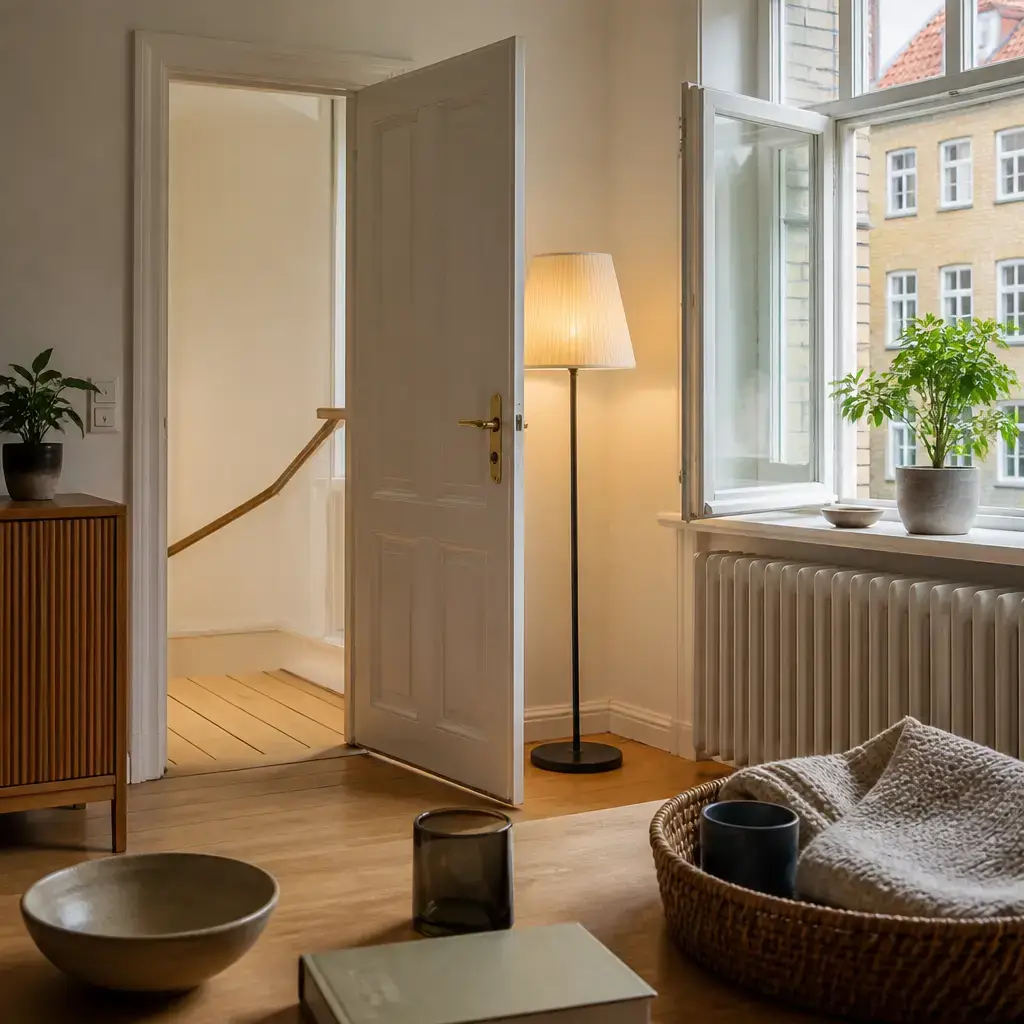
Bitte mach die Tür auf.
BIT-tuh mahkh dee TEWR owf. Please open the door.Bitte mach das Fenster zu.
BIT-tuh mahkh dahss FEN-stuh tsoo. Please close the window.Bitte mach es an.
BIT-tuh mahkh ess AHN. Please turn it on.Bitte mach es aus.
BIT-tuh mahkh ess OWSS. Please turn it off.Bitte gib mir das.
BIT-tuh gip meer dahss. Please give me this.Ich nehme das.
ikh NAY-muh dahss. I will take this.Sentence explanations
Bitte mach die Tür auf.
Please open the door.
- Bitte
- please
- mach … auf
- open
- Tür
- door
More detail
Bitte is the polite word “please.” It can be placed at the beginning of a request, as here. Example: Bitte warten. — “Please wait.” die Tür means “the door.” Tür is a feminine noun, so its nominative and accusative singular definite article is die; the article here marks the specific object being opened. German nouns are capitalized. Example: Die Tür ist offen. — “The door is open.” mach ... auf is the informal singular imperative of the separable verb aufmachen, “to open.” In this form, mach comes from machen, and the separable prefix auf moves to the end: Mach die Tür auf! The imperative is addressed to one person informally. Example: Mach das Fenster auf! — “Open the window!” Together, Bitte mach die Tür auf. is a polite request addressed informally to one person: “Please open the door.”
Bitte mach das Fenster zu.
Please close the window.
- Bitte
- please
- mach … zu
- close …
- Fenster
- window
More detail
Bitte means “please” here. It is a common polite marker for a request and can also appear at the end of a German request. mach … zu is the separable verb zumachen, “to close.” Here, mach is the informal singular imperative form of machen, while zu is the separable particle placed at the end. The object comes between them: Mach + object + zu. Example: Mach die Tür zu. — “Close the door.” Fenster means “window.” Its singular and plural forms are both Fenster; an article or another determiner can show the number in context. In this sentence, das Fenster means “the window”: das is the definite article for this neuter singular noun. Because the window is the direct object of zumachen, the phrase is in the accusative; for this neuter article, the accusative form is also das. Putting the parts together, Bitte mach das Fenster zu. means “Please close the window.” The imperative addresses one person informally.
Bitte mach es an.
Please turn it on.
- Bitte
- please
- mach … an
- turn on
- es
- it
More detail
Bitte means “please” here. It is a common politeness word and can be used with a request: Bitte warten. — “Please wait.” mach ... an is the reusable command pattern for switching something on. mach is the singular informal imperative of machen (“to do/make”). In this construction, an belongs with the separable verb anmachen (“to switch on/turn on”): in a main-clause command, the verb part mach comes first and the separable part an appears at the end. Example: Mach das Licht an. — “Turn on the light.” es means “it” here. It is the accusative form of the neuter personal pronoun, used for the thing being switched on; the supplied sentence does not identify that thing more specifically. Example: Ich sehe es. — “I see it.” Together, Bitte makes the request polite, mach ... an expresses the informal singular command “turn on,” and es identifies the object as “it.” Thus Bitte mach es an. means “Please turn it on.” The contextual contrast Mach es aus. uses ausmachen and means “turn it off.”
Bitte mach es aus.
Please turn it off.
- Bitte
- please
- mach … aus
- turn ... off
- es
- it
More detail
Bitte means “please” and marks the request as polite. It can be used with an imperative: Bitte komm. — “Please come.” mach ... aus is the separable verb construction ausmachen here, meaning “to turn off.” mach is the singular informal imperative of machen (“to do/make”), while aus is the separable prefix placed at the end of the clause. In a command, the reusable pattern is Mach [object] aus! — “Turn [object] off!” The contrasting construction in the supplied context, mach es an, uses an to mean “turn it on.” es is an accusative third-person singular pronoun meaning “it” here. The sentence does not identify what it refers to; its grammatical form is neuter singular, but that form alone does not specify the referent. Together, Bitte mach es aus. has the structure “Please + turn + it + off,” yielding “Please turn it off.” The imperative addresses one person informally. The polite request can also be written with an exclamation mark: Bitte mach es aus!
Bitte gib mir das.
Please give me this.
- Bitte
- please
- gib
- give
- mir
- me
- das
- this
More detail
Bitte is a polite request marker meaning “please.” It can also be used as a standalone response to thanks, but here it softens the request. gib is the informal singular imperative of geben (“to give”). The imperative addresses one person directly. The related forms are geben (base form), du gibst (present tense), and gib! (imperative). The vowel change in gibst and gib belongs to the verb geben. mir means “to me.” It is the first-person singular pronoun in the dative case. With verbs such as geben, the recipient is commonly expressed in the dative: Gib mir das. — “Give me that.” Its base pronoun is ich; the form changes according to its grammatical role: ich (“I”), mich (“me,” accusative), mir (“to me,” dative). das means “this” in the intended translation. Here it is a demonstrative pronoun functioning as the thing being given, so it is the direct object. In this use, das is the neuter accusative form; it has the same shape as the neuter nominative form. The specific referent is not identified by the sentence itself. The word order is a direct request: Bitte + imperative gib + recipient mir + thing das. Together, Bitte gib mir das. means “Please give me this.”
Ich nehme das.
I will take this.
- Ich
- I
- nehme
- take
- das
- this
More detail
Ich is the first-person singular pronoun: it refers to the speaker. It is useful in the reusable pattern Ich + verb for statements about what the speaker does or will do. nehme is the first-person singular present form of nehmen (“to take”): ich nehme. The present form can describe an action happening now or, as in the fixed translation, a decision or intention about the near future. Other useful forms are du nimmst (“you take”) and the infinitive nehmen (“to take”). The vowel change in nimmst belongs to the verb; nehme is the form used with ich. das is a demonstrative pronoun meaning “this” here. It stands as the object of nehme, pointing to the item intended in the context. Its specific referent is not named in the sentence. As a demonstrative, das can also occur in other grammatical roles; its form here is das, and the surrounding sentence determines how it functions. Together, Ich nehme das. follows the reusable pattern Ich + first-person verb form + object: “I will take this.” In this context, the German present form nehme conveys the speaker’s choice or intention to take the indicated item.
Grammar Points
mach ... auf / zu / an / aus
Mach die Tür auf.
MAHkh dee TEWR owf.Open the door.
With separable verbs, the prefix moves to the end in a simple command: mach ... auf.
gib + mir + das
Gib mir das.
GIP meer dahss.Give me this.
The person receiving something comes directly after the verb: gib mir das.
German Vocabulary
Bitte mach es an.
Bitte mach die Tür auf.
Bitte mach es aus.
Bitte mach das Fenster zu.
Quiz
Word Order
Arrange the words in the correct order.
Please open the door.
Show Answer
Bitte mach die Tür auf.Please close the window.
Show Answer
Bitte mach das Fenster zu.Please turn it on.
Show Answer
Bitte mach es an.Spelling
Tap the letters to spell the word.
to take
Show Answer
nehmeI
Show Answer
ichthis; that
Show Answer
dasit