10 minutes free every day
Continue audio lessons in the app
Word explanations appear automatically in sync with the audio.
No login required · synced translations · playback with the screen locked
Choose your learning language and open this lesson in the app.

About This Lesson
Use Prices, weather, and discoveries to practice German conversation, pronunciation, vocabulary, grammar, and quizzes.
Dialogue
Wie viel kostet das?
vee FEEL KOSS-tuht dahss How much is this?Wo wohnst du?
voh VOHNTST doo Where do you live?Das Wetter ist schön.
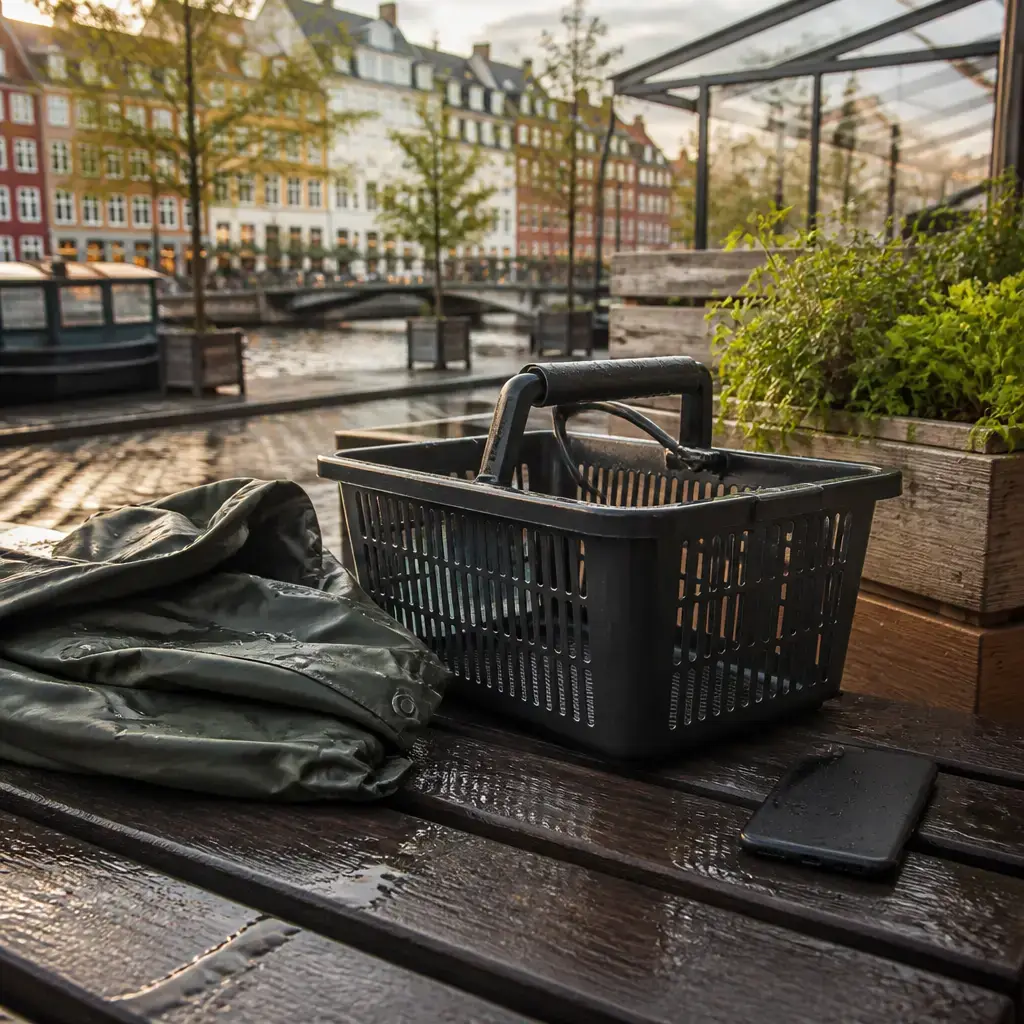
dahss VET-tuh ihst shurn The weather is nice.Jetzt regnet es.
yetst RAYG-nuht ess It is raining now.Ich habe mein Handy vergessen.
ikh HAH-buh mine HEN-dee fuh-GESS-un I forgot my phone.Ich habe es gefunden.
ikh HAH-buh ess guh-FOON-den I found it.Sentence explanations
Wie viel kostet das?
How much is this?
- Wie viel
- how much
- kostet
- costs
- das
- this
More detail
Wie viel asks for an amount, especially an unspecified price or quantity. In this sentence it means “how much.” Example: Wie viel kostet das Buch? — “How much does the book cost?” kostet is the present-tense third-person singular form of kosten (“to cost”). The subject here is das, so the singular form kostet is used. Compare Die Bücher kosten viel. — “The books cost a lot.” das is a demonstrative pronoun meaning “this” here. It is a neuter singular form; the specific thing it refers to is not named in the sentence. As a pronoun, it stands for that thing rather than modifying a following noun. Together, Wie viel + kostet + das forms a German question asking for the price of the indicated thing: “How much does this cost?” In this question, the question phrase comes first, the finite verb follows it, and the subject das comes after the verb.
Wo wohnst du?
Where do you live?
- Wo
- where
- wohnst
- live
- du
- you
More detail
Wo asks about a place: “where.” It is a question word and can be reused for locations, as in Wo ist das? — “Where is that?” wohnst means “live” here, specifically “reside.” It is the second-person singular present-tense form of wohnen (“to live”): ich wohne, du wohnst, er/sie wohnt. The ending -st marks the present-tense du form for this verb. du is the informal singular “you.” It refers to the person being addressed; German uses Sie instead for formal “you.” In the sentence, the question word comes first, followed by the finite verb and then the subject: Wo + wohnst + du? This word order is typical for a question asking for information. Together, the sentence means “Where do you live?”
Das Wetter ist schön.
The weather is nice.
- Wetter
- weather
- ist
- is
- schön
- nice; beautiful
More detail
Wetter means “weather.” Its useful base form is das Wetter; Wetter is a neuter noun, so the definite article here is das. German nouns are capitalized. Example: Das Wetter ist kalt. — “The weather is cold.” ist is the present-tense third-person singular form of sein (“to be”). The subject Das Wetter is singular, so German uses ist; with a plural subject, the form is sind, as in Die Tage sind lang. — “The days are long.” schön means “nice” or “beautiful” here. It is a descriptive adjective used after sein as a predicate, so it remains schön rather than taking an ending. Before a noun, adjective endings can differ: ein schöner Tag means “a nice day.” Together, Das Wetter + ist + schön produces the complete meaning “The weather is nice.” The reusable pattern is [subject] ist [predicate adjective], for example Der Tag ist schön. — “The day is nice.”
Jetzt regnet es.
It is raining now.
- Jetzt
- now
- regnet
- is raining
- es
- it
More detail
Jetzt means “now” and places the event in the present time. It is a time adverb and can appear in other positions, for example: Jetzt lerne ich Deutsch. — “Now I am learning German.” regnet is the present-tense form of regnen (“to rain”) for the third-person singular. German weather statements commonly use regnen with the formal subject es: Es regnet. — “It is raining.” The form regnet expresses the current event here; regnen is the base form. es is the formal, nonreferential subject used in this weather expression. It does not identify a person or thing in the supplied sentence. This use is different from es as a pronoun referring to a specific neuter noun, whose referent must be established by context. Together, Jetzt regnet es. places the weather event in the present and means “It is raining now.” The reusable pattern is Jetzt + [present-tense weather expression], while Es regnet. is the basic weather statement.
Ich habe mein Handy vergessen.
I forgot my phone.
- Ich habe
- I have
- mein
- my
- Handy
- phone
- vergessen
- forgotten
More detail
Ich habe is the first- and singular form of haben, “to have”: ich habe = “I have.” Here habe is also the auxiliary used to build the German perfect tense. The meaningful pattern is Ich habe ... vergessen = “I forgot ...” / literally “I have ... forgotten.” mein means “my.” It is a possessive determiner agreeing with the possessed noun, not with the owner. With neuter singular Handy in the accusative, the form is mein; compare masculine accusative meinen in Ich habe meinen Schlüssel vergessen (“I forgot my key”). Handy is the noun for “mobile phone” or “cell phone.” Its plural is Handys. In this sentence, mein Handy means “my phone.” vergessen is the past participle of vergessen (“to forget”); the infinitive and participle have the same spelling here. In the perfect, haben is conjugated for the subject and vergessen goes to the end: Ich habe den Termin vergessen = “I forgot the appointment.” Together, Ich habe + mein Handy + vergessen gives “I forgot my phone.” The sentence uses the German perfect construction: the subject is Ich, the object is mein Handy, and the auxiliary habe combines with final vergessen to express the completed forgetting.
Ich habe es gefunden.
I found it.
- Ich habe
- I have
- es
- it
- gefunden
- found
More detail
Ich habe uses haben, whose base form is haben. Here habe is its present-tense first-person singular form, matching Ich (“I”). In this sentence, haben is also the auxiliary used to build the perfect tense; it does not mean possession. es is an accusative singular neuter pronoun meaning “it” here. Its grammatical form is neuter singular, but the supplied sentence and translation do not uniquely identify what it refers to. The pronoun’s grammatical class and its actual referent are separate matters. gefunden is the past participle of finden (“to find”). The useful form chain is finden → gefunden. With present-tense habe, this forms the German perfect: habe gefunden, referring to a completed finding. The participle appears at the end of this main clause. The reusable pattern is subject + haben-form + object pronoun + past participle. Thus Ich habe es gefunden combines “I,” the perfect auxiliary, “it” as the object, and “found” to mean “I found it.”
Grammar Points
W-Frage: Fragewort + Verb + Subjekt
Wo wohnst du?
voh VOHNTST dooWhere do you live?
In German, the conjugated verb comes before the subject in a question beginning with a question word.
Possessivartikel: mein + Nomen
mein Handy
mine HEN-deemy mobile phone
mein means “my” and comes before the noun; the noun is capitalized in German.
German Vocabulary
How much is this?
Where do you live?
Quiz
Word Order
Arrange the words in the correct order.
How much is this?
Show Answer
Wie viel kostet das?Where do you live?
Show Answer
Wo wohnst du?The weather is nice.
Show Answer
Das Wetter ist schön.Spelling
Tap the letters to spell the word.
now
Show Answer
jetztweather
Show Answer
Wetterto cost
Show Answer
kostetto live