10 minutes free every day
Continue audio lessons in the app
Word explanations appear automatically in sync with the audio.
No login required · synced translations · playback with the screen locked
Choose your learning language and open this lesson in the app.

About This Lesson
Use Buying a train ticket at the machines to practice German conversation, pronunciation, vocabulary, grammar, and quizzes.
Dialogue
Hast du schon eine Fahrkarte?
HAST doo SHOHN EYE-nuh FAHR-kar-tuh? Do you already have a train ticket?Noch nicht. Ich muss eine kaufen.
NOHKH nikht. ikh moos EYE-nuh KOW-fen. Not yet. I need to buy one.Neben dem Eingang gibt es Fahrkartenautomaten.
NAY-ben daym EYE-ngahng gipt ess FAHR-kar-ten-ow-toh-MAH-ten. There are ticket machines by the entrance.Ich kaufe meine dort.
ikh KOW-fuh MY-nuh DOHRT. I'll get mine there.Ich habe meine Fahrkarte auf meinem Handy.
ikh HAH-buh MY-nuh FAHR-kar-tuh owf MY-nem HEN-dee. I have my ticket on my phone.Dann treffe ich dich hier wieder, nachdem ich meine gekauft habe.
DAHN TREF-fuh ikh dikh heer VEE-dur, nahkh-DAYM ikh MY-nuh guh-KOWFT HAH-buh. Then I'll meet you back here after I buy mine.Ich warte bei den Automaten.
ikh VAR-tuh by dayn ow-toh-MAH-ten. I'll wait near the machines.Such mich neben den Automaten.
ZOO-kh mikh NAY-ben dayn ow-toh-MAH-ten. Look for me beside them.Sentence explanations
Hast du schon eine Fahrkarte?
Do you already have a train ticket?
- Hast du
- do you have
- schon
- already
- Fahrkarte
- train ticket
More detail
Hast du is the yes/no question pattern formed from haben (“to have”) and du (“you,” singular informal). The verb haben changes to hast with du: ich habe, du hast, er/sie hat. In a German yes/no question, the finite verb comes first, followed here by the subject: Hast du ...? Example: Hast du Zeit? — “Do you have time?” schon means “already” here. It asks whether the situation is true by the relevant point in time. Compare noch nicht (“not yet”), as in the following response: Noch nicht. — “Not yet.” eine is an indefinite article. It introduces the feminine noun Fahrkarte; by itself, it does not assert a numerical count. German articles reflect grammatical gender, case, and number, so the form used with this noun in this question is eine. Fahrkarte is a feminine noun meaning “train ticket” in this context. Its parts are Fahr- (“travel/ride”) and Karte (“ticket/card”), but learn the full compound as the noun used here. German nouns are capitalized. The related verb kaufen means “to buy,” as in Ich muss eine kaufen. — “I need to buy one.” In that sentence, eine refers to a ticket understood from the conversation. Together, Hast du schon eine Fahrkarte? asks whether the other person already has a train ticket. The word order is finite verb + subject + schon + indefinite article + noun. The fixed translation therefore means, “Do you already have a train ticket?”
Noch nicht. Ich muss eine kaufen.
Not yet. I need to buy one.
- Noch nicht
- Not yet
- Ich muss
- I need to
- eine
- one
- kaufen
- buy
More detail
Noch nicht means “not yet.” noch marks a situation that has not changed up to the relevant time; nicht negates it. This compact pattern is reusable: Noch nicht. = “Not yet.” Ich muss contains ich, “I,” and muss, the first-person singular present form of müssen, “must” or “need to.” With an action, müssen normally places the other verb in the infinitive at the end: Ich muss warten. = “I need to wait.” The form changes with the subject: ich muss, but sie muss and wir müssen. eine means “one” here as a substitute for an understood feminine noun. In the preceding question, that noun is Fahrkarte (“train ticket”), so eine is the feminine accusative form matching the omitted Fahrkarte: eine Fahrkarte → eine. This is not an independent claim that the number is literally one; it refers back to one ticket of the relevant kind. Example: Ich nehme eine. = “I’ll take one,” when a feminine noun is understood. kaufen is the infinitive “to buy.” After the modal verb muss, it stays in the infinitive and appears at the end: Ich muss eine kaufen. = “I need to buy one.” The finite verb is muss; kaufen names the action. Together, Noch nicht says the ticket has not been obtained yet. Ich muss eine kaufen says that the speaker needs to buy a train ticket, with eine standing for eine Fahrkarte. The complete utterance is therefore “Not yet. I need to buy one.”
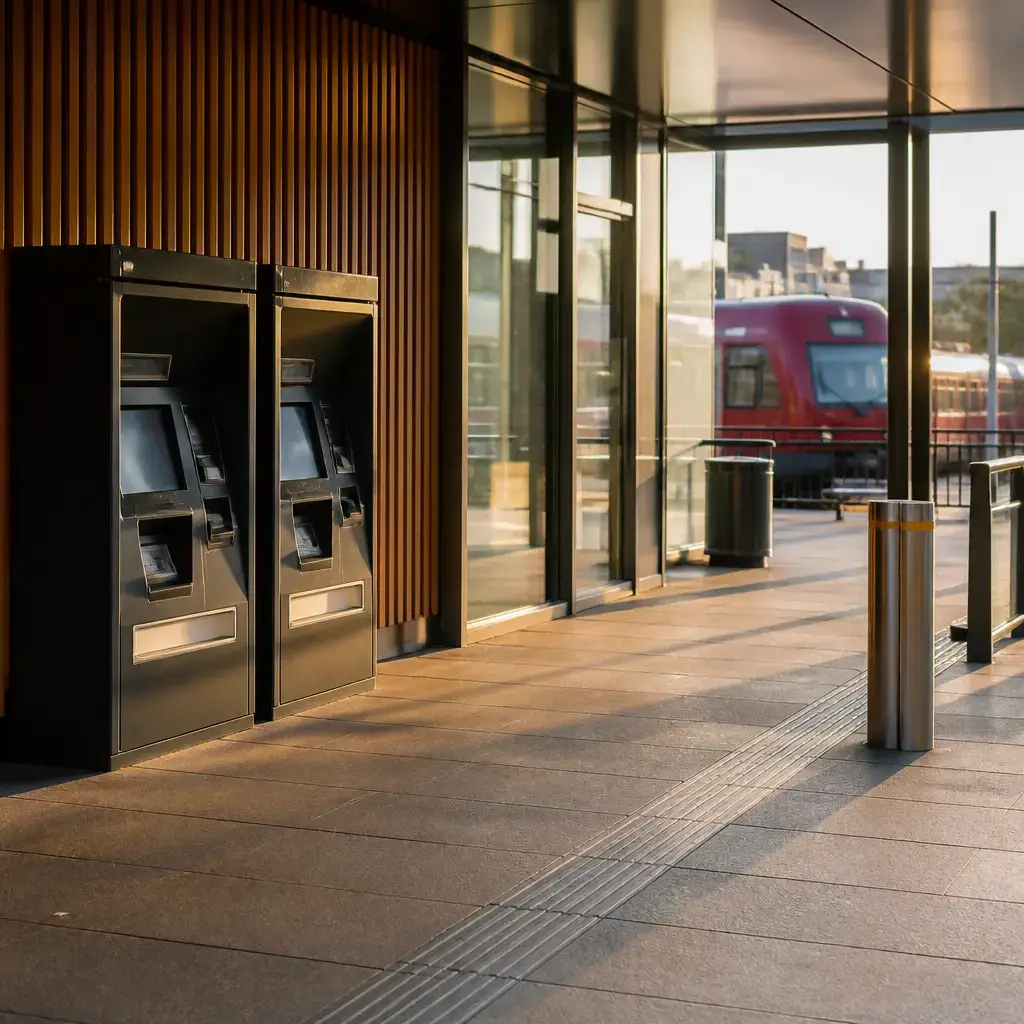
Neben dem Eingang gibt es Fahrkartenautomaten.
There are ticket machines by the entrance.
- Neben
- beside; by
- Eingang
- entrance
- gibt es
- there is / there are
- Fahrkartenautomaten
- ticket machines
More detail
Neben means “beside” or “by” here. It describes a fixed location, so German uses the dative after this two-way preposition: dem Eingang. With movement toward a position beside something, neben can instead take the accusative. Example: Neben dem Bahnhof ist ein Café. — “There is a café beside the station.” Eingang is the noun “entrance.” Its base form is der Eingang; in this sentence, dem Eingang is its masculine singular dative form. Its plural is die Eingänge. gibt es is the German existential construction meaning “there is” or “there are.” gibt is the third-person singular present form of geben. In this construction, gibt remains singular even when the thing introduced is plural: Es gibt Automaten. — “There are machines.” Fahrkartenautomaten means “ticket machines.” It is the plural of der Fahrkartenautomat; the singular is Fahrkartenautomat. This compound combines Fahrkarte (“ticket”) with Automat (“machine”), and as a whole it names a machine for tickets. Together, Neben dem Eingang gives the location, gibt es introduces what is present there, and Fahrkartenautomaten identifies the plural items: “There are ticket machines by the entrance.”
Ich kaufe meine dort.
I'll get mine there.
- kaufe
- buy / get
- meine
- mine
- dort
- there
More detail
kaufe is the first-person singular present form of kaufen, “to buy.” The subject Ich supplies the “I”; German present tense can also refer to a planned or expected future event, which fits “I’ll get…” here. The verb takes the thing bought as its object: Ich kaufe ein Ticket. — “I’m buying a ticket.” meine is a standalone possessive form meaning “mine” here. Its form is based on mein (“my/mine”) and agrees with the omitted thing that is possessed, not with the person who owns it. The nearby context identifies that thing as Fahrkarte, a feminine singular noun, so meine is the accusative form used for “my ticket/mine” after kaufe; the noun is left unspoken because it is understood. Compare Ich kaufe mein Ticket. — “I’m buying my ticket.” dort means “there,” pointing to a place away from the speaker. It is an adverb, so it does not change for gender, number, or case. Ich kaufe das dort. — “I’m buying that there.” Together, Ich kaufe meine dort means “I’ll get mine there.” Ich is the buyer, kaufe expresses the buying, meine stands for the speaker’s ticket, and dort gives the place where the purchase will happen. The sentence is concise because the understood noun after meine is omitted.
Ich habe meine Fahrkarte auf meinem Handy.
I have my ticket on my phone.
- Ich habe
- I have
- meine
- my
- Fahrkarte
- ticket
- auf
- on
- meinem
- my
- Handy
- phone
More detail
Ich habe means “I have.” habe is the first-person singular present form of haben (“to have”): ich habe, du hast, er/sie/es hat. Here it expresses possession or having something available, not an obligation. meine means “my” here and agrees with Fahrkarte. The possessed noun is feminine singular, and it is the direct object of habe, so it is in the accusative: meine Fahrkarte. Compare mein Handy for a neuter singular noun in the nominative or accusative, but meinem Handy below for dative. Fahrkarte means “ticket,” specifically a ticket for travel or transport. It is a feminine noun: die Fahrkarte. In the sentence it appears as the accusative object of habe. Example: Ich brauche eine Fahrkarte. — “I need a ticket.” auf means “on” in the location expressed here. With two-way prepositions such as auf, a stationary location normally takes the dative, while movement toward a location takes the accusative. Compare Das Handy liegt auf dem Tisch. — “The phone is on the table” with Ich lege das Handy auf den Tisch. — “I put the phone on the table.” meinem means “my” in the dative masculine or neuter singular. Here it agrees with the neuter noun Handy in the dative phrase auf meinem Handy; the phrase describes where the ticket is stored or available. The dative form contrasts with mein Handy in the nominative or accusative and meines Handys in the genitive. Handy means “mobile phone” or “cell phone.” It is neuter: das Handy. The dative singular form of the possessive determiner is meinem, giving auf meinem Handy. Together, meine Fahrkarte is the thing the speaker has, and auf meinem Handy specifies its location or form: the speaker has their ticket on their phone. Thus the whole utterance means, “I have my ticket on my phone.”
Dann treffe ich dich hier wieder, nachdem ich meine gekauft habe.
Then I'll meet you back here after I buy mine.
- Dann
- then
- treffe
- meet
- dich
- you
- hier
- here
- wieder
- again; back
- nachdem
- after
- meine
- mine
- gekauft
- bought
More detail
Dann means “then” and is placed first to connect this action with an earlier point in time. Because it occupies the first position, the finite verb comes next: Dann treffe ich ... (“Then I meet ...”). Example: Dann gehe ich nach Hause. — “Then I go home.” treffe is the first-person singular present form of treffen (“to meet”). The subject is ich, so the form is treffe; the present tense can describe a planned future meeting when the time is clear. Example: Ich treffe dich morgen. — “I’ll meet you tomorrow.” dich is the second-person singular accusative form of du (“you”). treffen takes the person met as its direct object: Ich treffe dich — “I meet you.” The form contrasts with nominative du, as in Du triffst mich — “You meet me.” hier means “here,” identifying the place of the meeting. It is a location adverb and does not change form. wieder means “again” or, with a return to a place, “back.” Here it says that the speaker will meet the listener at this place again. Example: Wir sehen uns hier wieder. — “We’ll see each other here again.” nachdem introduces a subordinate time clause meaning “after.” The action in that clause happens before the main-clause action. German places the finite auxiliary at the end of this subordinate clause: nachdem ich ... gekauft habe. meine is a standalone possessive form meaning “mine” here. The omitted item is understood from the context as the speaker’s ticket; meine therefore avoids repeating Fahrkarte. Its form agrees with that omitted feminine singular noun, while its role in this clause is the object of gekauft. Example: Ich nehme meine. — “I’ll take mine.” gekauft is the past participle of kaufen (“to buy”). With the auxiliary habe, it forms the perfect: ich habe gekauft — “I have bought.” In this sentence, gekauft habe appears at the end because it is inside the nachdem subordinate clause. Together, Dann treffe ich dich hier wieder means “Then I’ll meet you back here.” The time clause nachdem ich meine gekauft habe means “after I buy mine.” Thus the complete utterance is: “Then I’ll meet you back here after I buy mine.”
Ich warte bei den Automaten.
I'll wait near the machines.
- Ich
- I
- warte
- wait
- bei
- near; at
- Automaten
- machines
More detail
Ich means “I” and is the first-person singular subject pronoun. It identifies the speaker as the person who waits. Compare du (“you,” singular) and wir (“we”); the verb form changes with these subjects. warte is the present-tense form of warten (“to wait”) for ich: ich warte. German present tense can refer to a future action when the context makes the future time clear. Here, the surrounding exchange supports the meaning “I’ll wait,” but the observed form itself is present tense. Example: Ich warte hier. — “I’ll wait here.” bei means “near” or “at” in this location phrase. It normally takes the dative case, so the following noun phrase has dative marking. This differs from neben, which can mean “beside”; the next sentence uses that other preposition, while bei here expresses being near the machines. Automaten means “machines” here. Its base form is the singular noun der Automat; its plural is die Automaten. After bei, the plural noun phrase is dative: bei den Automaten (“near the machines”). The form den marks the dative plural here, while Automaten shows the plural form. Together, Ich warte bei den Automaten. has the pattern subject + verb + location preposition + dative location phrase: “I’ll wait near the machines.” The speaker is the one who waits, and the machines are the location used as the reference point; the sentence does not specify what kind of machines they are.
Such mich neben den Automaten.
Look for me beside them.
- Such
- look for
- mich
- me
- neben
- beside; next to
- Automaten
- machines; vending machines
More detail
Such is the imperative singular of suchen (“to look for”): du suchst is “you look for,” while Such! addresses one person directly. The verb takes the person or thing being sought as its object. Example: Such den Schlüssel! — “Look for the key!” mich means “me” here and is the accusative form of the first-person pronoun. Compare ich (“I”) when the person is the subject and mich (“me”) when the person is the object: Du suchst mich. — “You are looking for me.” neben means “beside” or “next to.” With a location that answers “where?”, it normally takes the dative. In this sentence, den Automaten is dative plural; Automaten has the same visible form in the plural nominative, accusative, and dative, while the article den marks the dative plural here. With movement toward a position, neben can instead take the accusative: Stell dich neben den Automaten. — “Stand next to the machine.” Automaten is the plural of Automat, meaning “machine”; in this context, the fixed translation identifies the relevant machines as the ones beside which the listener should look. The noun’s plural form is Automaten, and its dative plural is also Automaten. Example: Die Automaten stehen dort. — “The machines are over there.” Together, Such mich gives the imperative “Look for me,” and neben den Automaten specifies the location “beside the machines.” The complete utterance therefore means “Look for me beside the machines.”
Grammar Points
neben + Dativ: neben dem
neben dem Eingang
NAY-ben daym EYE-ngahngnext to the entrance
After neben, use the dative when describing a fixed location. Eingang becomes dem Eingang.
German Vocabulary
Dann treffe ich dich hier wieder.
Ich kaufe meine dort.
Neben dem Eingang gibt es Fahrkartenautomaten.
Ich muss eine kaufen.
Noch nicht.
Hast du schon eine Fahrkarte?
Quiz
Word Order
Arrange the words in the correct order.
Do you already have a train ticket?
Show Answer
Hast du schon eine Fahrkarte?Not yet. I need to buy one.
Show Answer
Noch nicht. Ich muss eine kaufen.There are ticket machines by the entrance.
Show Answer
Neben dem Eingang gibt es Fahrkartenautomaten.Spelling
Tap the letters to spell the word.
buy
Show Answer
kaufenthere
Show Answer
dortgive; there is/are
Show Answer
gibtalready