10 minutes free every day
Continue audio lessons in the app
Word explanations appear automatically in sync with the audio.
No login required · synced translations · playback with the screen locked
Choose your learning language and open this lesson in the app.

About This Lesson
Use Preparing for a walking event to practice German conversation, pronunciation, vocabulary, grammar, and quizzes.
Dialogue
Ich habe das Formular ausgefüllt.
ikh HAH-buh dahs for-moo-LAHR owss-guh-fuelt I finished the form.Können wir am nächsten Walking-Event teilnehmen?
KER-nen veer ahm NEKH-sten WAW-king ee-VENT TYLE-nay-men Can we join the next walking event?Ja, Sie können am nächsten Walking-Event teilnehmen.
yah, zee KER-nen ahm NEKH-sten WAW-king ee-VENT TYLE-nay-men Yes, you can join the next walking event.Sollen wir etwas mitbringen?
ZOL-len veer ET-vahs MIT-bring-en? Should we bring anything?Bitte bringen Sie eine Wasserflasche mit.
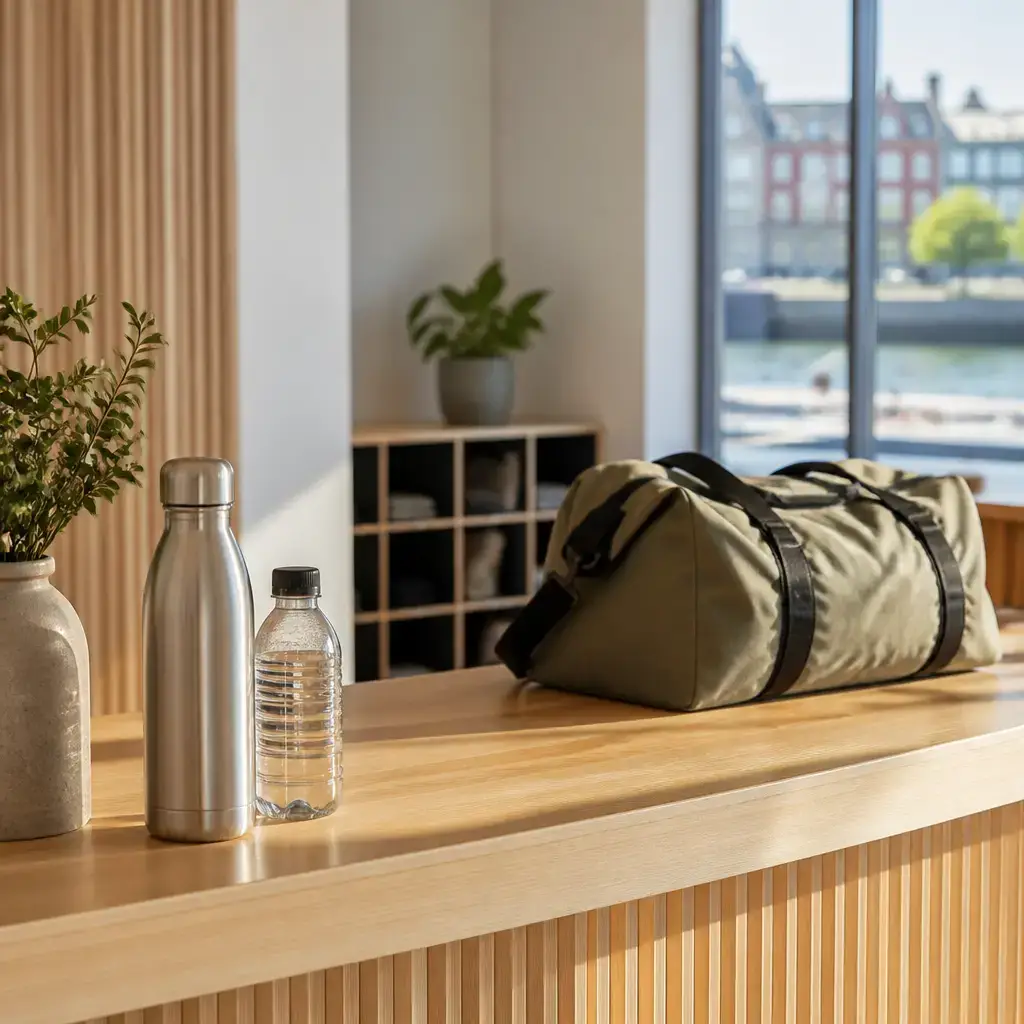
BIT-tuh BRING-en zee EYE-nuh VAH-ser-FLAH-shuh mit. Please bring a water bottle.Sie können eine große Tasche am Schalter lassen.
zee KER-nen EYE-nuh GROH-suh TAH-shuh ahm SHAL-ter LAHS-sen. You can leave a large bag at the desk.Ich habe eine kleine Wasserflasche dabei.
ikh HAH-buh EYE-nuh KLY-nuh VAH-ser-FLAH-shuh dah-BYE. I have a small water bottle with me.Ich lasse meine Tasche hier, bevor wir anfangen.
ikh LAHS-suh MY-nuh TAH-shuh heer, beh-FOR veer AHN-fang-en. I will leave my bag here before we start.Ich freue mich darauf.
ikh FROY-uh mikh dah-ROWF. I am looking forward to it.Sentence explanations
Ich habe das Formular ausgefüllt.
I finished the form.
- Ich habe
- I have
- Formular
- form
- ausgefüllt
- filled out
More detail
Ich habe is a reusable first-person singular construction: ich means “I,” and habe is the present-tense form of haben for ich. Here, habe is the auxiliary used with ausgefüllt to form the German perfect. In this pattern, the auxiliary is in the main-clause position and the participle comes later: Ich habe ... ausgefüllt. Formular means “form.” It is a neuter noun: das Formular; its plural is die Formulare. The noun names the document that was completed here. ausgefüllt means “filled out” here. It is the past participle of the separable verb ausfüllen (“to fill out”): present ich fülle ... aus, perfect ich habe ausgefüllt. The participle combines with habe to express a completed action in the past. Together, Ich habe das Formular ausgefüllt. means “I finished the form.” More literally, it says “I have filled out the form,” with the German perfect presenting the form as completed.
Können wir am nächsten Walking-Event teilnehmen?
Can we join the next walking event?
- Können wir
- Can we
- nächsten
- next
- Walking-Event
- walking event
- teilnehmen
- participate; join
More detail
Können wir combines the modal verb können (“can, be able to”) with wir (“we”). In a yes/no question, the conjugated modal comes first and the subject follows: Können wir ...? means “Can we ...?” Here it asks whether the group is able or allowed to join; the fixed translation supports the general possibility of joining. können keeps the same form with wir in the present tense. The lexical verb goes to the end in its infinitive form. nächsten means “next” here and describes Walking-Event. Its base form is nächst-; the ending is part of German adjective inflection. In am nächsten Walking-Event, am is the contraction of an dem, so the noun phrase is dative; the adjective has the dative neuter ending -en. The adjective is not the noun’s base form. A related contrast is letzten (“last”) in a phrase such as am letzten Termin (“at the last appointment”). Walking-Event is a compound noun meaning “walking event.” The borrowed element Walking specifies the type of Event; the whole compound is treated as a neuter noun, as shown by dem in the contraction am and by the adjective form nächsten. The noun itself is not a verb meaning “to walk.” teilnehmen means “to participate” or, in this context, “to join.” It is the infinitive after the modal können. German commonly uses an with this verb: an etwas teilnehmen (“participate in something”), and an takes the dative here, giving am before dem. The infinitive is also separable in finite clauses: Wir nehmen an einem Event teil means “We participate in an event.” Together, Können wir forms the yes/no question, am nächsten Walking-Event identifies the event as the next walking event, and teilnehmen expresses participation. The complete utterance therefore means “Can we join the next walking event?”
Ja, Sie können am nächsten Walking-Event teilnehmen.
Yes, you can join the next walking event.
- Ja
- yes
- Sie können
- you can
- nächsten
- next
- Walking-Event
- walking event
- teilnehmen
- join
More detail
Ja directly confirms the proposition that follows. It is the ordinary German word for “yes.” Example: Ja, ich komme. — “Yes, I’m coming.” Sie können combines the formal or plural second-person pronoun Sie with the modal verb können (“can; be able to”). In this sentence, können expresses ability or permission in the intended context: “you can.” The modal verb is conjugated as können with Sie; the same form is also used with wir (“we can”), while singular informal du takes kannst. With a modal verb, the other verb normally goes to the end in its infinitive form, as teilnehmen does here. nächsten means “next” here, referring to the event that comes next in the relevant sequence or schedule. Its ending is not carried by Walking-Event: nächsten is the inflected adjective. In am nächsten ..., am is the contraction of an dem, so the phrase is in the dative; with the definite article, this adjective has the ending -en. Example: Wir treffen uns am nächsten Montag. — “We’ll meet next Monday.” Walking-Event is a compound noun meaning a walking event. Event is a neuter noun in German (das Event), and the compound is treated as neuter as well. The noun is written with a capital letter, as German nouns are. Example: Das Event beginnt um zehn Uhr. — “The event begins at ten o’clock.” teilnehmen means “to take part” or “to participate”; “join” is the natural translation in this sentence. It is used with an plus the relevant thing or event: an einem Kurs teilnehmen means “to take part in a course.” In the sentence, an dem is contracted to am, giving am nächsten Walking-Event teilnehmen. Teilnehmen is a separable verb in finite clauses, but after the modal können it remains as the infinitive at the end. Example: Sie können an dem Kurs teilnehmen. — “You can take part in the course.” Together, Ja confirms the answer, Sie können says that the addressed person or people are able or permitted to do something, and am nächsten Walking-Event teilnehmen specifies that activity. The complete meaning is: “Yes, you can join the next walking event.”
Sollen wir etwas mitbringen?
Should we bring anything?
- Sollen wir
- Should we
- etwas
- anything
- mitbringen
- bring along
More detail
Sollen wir combines sollen with wir to ask whether the speakers are expected or advised to do something: “Should we …?” Here sollen is the form for wir; the infinitive comes later in the question. Compare Soll ich gehen? — “Should I go?” etwas usually means “something,” but in this question it is naturally translated as “anything.” It refers generally to an unspecified thing; the question does not identify what that thing is. Example: Möchtest du etwas trinken? — “Would you like something to drink?” mitbringen is an infinitive meaning “to bring along” or “to bring with you.” It is a separable verb: in a finite main clause, the parts can separate, as in Wir bringen Wasser mit. — “We are bringing water along.” After a modal verb such as sollen, the infinitive stays together at the end: Wir sollen Wasser mitbringen. — “We are supposed to bring water along.” Together, Sollen wir etwas mitbringen? asks whether the speakers should bring anything along. The pattern is reusable as Sollen wir + [thing] + [infinitive]?, with the infinitive placed at the end: Sollen wir die Getränke mitbringen? — “Should we bring the drinks along?”
Bitte bringen Sie eine Wasserflasche mit.
Please bring a water bottle.
- Bitte
- please
- bringen … mit
- bring along
- Sie
- you (polite)
- Wasserflasche
- water bottle
More detail
Bitte means “please” here and makes the request polite. It can also occur in other polite requests, for example: Bitte warten Sie. — “Please wait.” bringen ... mit is the separable verb mitbringen, “to bring along.” In this sentence, bringen carries the imperative form and mit appears at the end of the clause. The pronoun Sie is placed between them. In a main-clause statement, the same verb separates in the same way: Sie bringen eine Tasche mit. — “You bring a bag along.” Sie is the formal second-person pronoun “you.” Its capitalization distinguishes it from lowercase sie, which has other grammatical uses. With formal Sie, the verb form is the same as the third-person plural form: Sie bringen ... — “You bring ...” The fixed translation identifies the addressee as “you,” but does not specify an individual’s identity or number beyond this formal pronoun’s grammatical usage. Wasserflasche is a feminine noun meaning “water bottle.” It is a compound of Wasser (“water”) and Flasche (“bottle”), but the whole compound names the bottle. Its article is eine here: eine Wasserflasche. In this form, eine marks the noun phrase as feminine and accusative after bringen; it does not by itself establish a numerical count beyond the singular grammar of the noun phrase. Example: Ich kaufe eine Wasserflasche. — “I am buying a water bottle.” Together, Bitte politely frames the request, bringen ... mit expresses bringing something along, Sie identifies the formal addressee, and eine Wasserflasche is the item to be brought. The complete meaning is: “Please bring a water bottle.”
Sie können eine große Tasche am Schalter lassen.
You can leave a large bag at the desk.
- Sie können
- you can
- eine
- a/an
- große
- large
- Tasche
- bag
- Schalter
- desk/counter
- lassen
- leave
More detail
Sie können: This is the formal “you can” construction. können is the present-tense form of können for formal Sie; as a modal verb, it is followed by an infinitive, which appears at the end of the clause. Formal Sie can address one person or several people; German uses the same form for both. eine: This is the indefinite article for a feminine singular noun in the accusative case here, because Tasche is the direct object of lassen. It means “a/an,” not a stated numerical count. The feminine nominative form is also eine, while masculine accusative uses einen. große: This means “large” here and modifies Tasche. Its base form is groß; große carries the adjective ending required after eine with this feminine singular accusative noun. A useful comparison is größer (“larger”) and am größten (“largest”). Tasche: This feminine noun means “bag.” Its basic form is die Tasche; the plural is die Taschen. In this sentence, eine große Tasche is the thing being left. Schalter: This noun means “desk” or “counter” in this context, such as a service desk. Its basic form is der Schalter. In am Schalter, am is the contraction of an dem; the dative phrase gives the location, “at the desk/counter.” lassen: This means “leave” here: the bag remains at the desk. Its infinitive is lassen, required at the end because it follows the modal verb können. In other contexts, lassen can also mean “let” or “have something done,” so the surrounding object and location establish the meaning here. Together, Sie können expresses ability or permission as “you can,” eine große Tasche identifies a large bag as the direct object, and am Schalter identifies the location. The final infinitive lassen completes the modal construction, giving: “You can leave a large bag at the desk.”
Ich habe eine kleine Wasserflasche dabei.
I have a small water bottle with me.
- Ich habe
- I have
- kleine
- small
- Wasserflasche
- water bottle
- dabei
- with me
More detail
Ich habe means “I have” here. habe is the first-person singular present form of haben (“to have”): ich habe, du hast, er/sie hat. In this sentence, haben expresses possession or carrying something with oneself. Example: Ich habe einen Schlüssel. — “I have a key.” kleine describes the bottle as small. Its base form is klein (“small”); the ending changes because the adjective stands before the feminine noun Wasserflasche after the indefinite article eine: eine kleine Wasserflasche. The comparative is kleiner (“smaller”), and the superlative is am kleinsten (“smallest”). Example: eine kleine Tasche — “a small bag.” Wasserflasche is the noun “water bottle,” formed from Wasser (“water”) and Flasche (“bottle”). German compounds are written as one word, and the final part determines the noun’s grammatical gender: die Flasche, so die Wasserflasche is feminine. Example: Die Wasserflasche ist leer. — “The water bottle is empty.” dabei means “with me” in this context. With haben, etwas dabei haben is a reusable pattern meaning “to have something with oneself,” often referring to something currently carried or available. Example: Hast du deinen Ausweis dabei? — “Do you have your ID with you?” Together, Ich habe eine kleine Wasserflasche dabei. means “I have a small water bottle with me.” The pattern is Ich habe [object] dabei: the speaker states that they possess or are carrying the object at the relevant time. Here, eine introduces the feminine noun phrase, kleine agrees with Wasserflasche, and dabei adds the meaning “with me.”
Ich lasse meine Tasche hier, bevor wir anfangen.
I will leave my bag here before we start.
- Ich
- I
- lasse
- leave
- meine
- my
- Tasche
- bag
- hier
- here
- bevor
- before
- wir
- we
- anfangen
- start
More detail
Ich means “I” here. It is the first-person singular subject pronoun: ich is used for the speaker as the actor. Example: Ich lerne. — “I am learning.” lasse is the first-person singular present form of lassen. In this sentence, lassen means “leave” in the sense of not taking the bag away. The German present tense can refer to a future action when the time is clear; here the English translation therefore uses “will leave.” Example: Ich lasse das Buch hier. — “I will leave the book here.” meine means “my” and belongs to the speaker. It is the possessive form agreeing with the feminine singular noun Tasche in this noun phrase. Possessive forms also change with the noun phrase’s grammatical case; with a feminine singular accusative noun, meine has this same visible form. Example: meine Flasche — “my bottle.” Tasche means “bag.” Its base form is the noun Tasche; the phrase meine Tasche identifies the bag as belonging to the speaker. Example: Die Tasche ist hier. — “The bag is here.” hier means “here,” indicating the place where the bag will be left. It is an adverb, so it does not change to agree with Tasche. bevor means “before” and introduces a subordinate clause describing an event that has not yet happened at the relevant time. A clause introduced by bevor normally places its finite verb at the end. wir means “we,” the first-person plural subject pronoun. In this sentence it is the subject of the subordinate clause; the fixed translation identifies the group as the people who will start. Example: Wir lernen. — “We are learning.” anfangen means “start” or “begin.” Its base form is the separable verb anfangen, whose present forms include ich fange an and wir fangen an. Here anfangen is the finite first-person plural present form in the subordinate clause, and it appears at the end because German subordinate clauses normally put the finite verb there. In a main clause, the corresponding form is split: Wir fangen morgen an. — “We start tomorrow.” Together, Ich lasse meine Tasche hier means “I will leave my bag here.” bevor wir anfangen adds the time relation “before we start.” The complete utterance is therefore: “I will leave my bag here before we start.”
Ich freue mich darauf.
I am looking forward to it.
- Ich
- I
- freue mich darauf
- look forward to it
More detail
Ich is the first-person singular pronoun: “I.” It identifies the speaker as the subject. The corresponding plural form is wir, “we”; for example, Wir freuen uns. means “We are looking forward to it.” freue mich darauf is the reusable German construction sich auf etwas freuen, meaning “to look forward to something.” In the sentence, freue is the first-person singular present form of freuen, so it agrees with Ich. mich is the reflexive pronoun required with this first-person singular form; it is not a separate object meaning “me” in the English construction. Compare Ich freue mich with Wir freuen uns: the reflexive form changes with the subject. darauf is a pronominal adverb referring to the thing or event being anticipated. Here it corresponds to “it,” as in “look forward to it.” The related pattern is sich auf etwas freuen when a noun is stated: Ich freue mich auf den Urlaub. — “I am looking forward to the vacation.” With a previously understood thing or event, darauf replaces the longer auf ... phrase. Together, Ich + freue mich darauf gives Ich freue mich darauf. — “I am looking forward to it.” German uses the present form freue for the speaker’s current feeling, even though the anticipated thing or event may lie in the future.
Grammar Points
bevor + Nebensatz
Bevor wir anfangen, bringe ich eine Wasserflasche.
beh-FOR veer AHN-fang-en, BRING-uh ikh EYE-nuh VAH-ser-FLAH-shuh.Before we start, I bring a water bottle.
Nach „bevor“ steht das konjugierte Verb am Ende des Nebensatzes: „bevor wir anfangen“.
sich auf etwas freuen: freue mich darauf
Ich freue mich darauf.
ikh FROY-uh mikh dah-ROWF.I am looking forward to it.
„darauf“ verweist auf etwas, das bereits erwähnt wurde. Das Verb steht mit dem Reflexivpronomen „mich“.
German Vocabulary
Ich habe das Formular ausgefüllt.
Bitte bringen Sie eine Wasserflasche mit.
Sollen wir etwas mitbringen?
Ich habe das Formular ausgefüllt.
eine große Tasche
Sollen wir etwas mitbringen?
am nächsten Walking-Event
am Schalter
Sie können eine große Tasche am Schalter lassen.
Können wir am nächsten Walking-Event teilnehmen?
am nächsten Walking-Event
Bitte bringen Sie eine Wasserflasche mit.
Quiz
Word Order
Arrange the words in the correct order.
I finished the form.
Show Answer
Ich habe das Formular ausgefüllt.Can we join the next walking event?
Show Answer
Können wir am nächsten Walking-Event teilnehmen?Should we bring anything?
Show Answer
Sollen wir etwas mitbringen?Spelling
Tap the letters to spell the word.
bring along
Show Answer
mitbringentake part; participate
Show Answer
teilnehmenbring
Show Answer
bringensomething; anything