10 minutes free every day
Continue audio lessons in the app
Word explanations appear automatically in sync with the audio.
No login required · synced translations · playback with the screen locked
Choose your learning language and open this lesson in the app.

About This Lesson
Use Choosing a quiet break spot to practice German conversation, pronunciation, vocabulary, grammar, and quizzes.
Dialogue
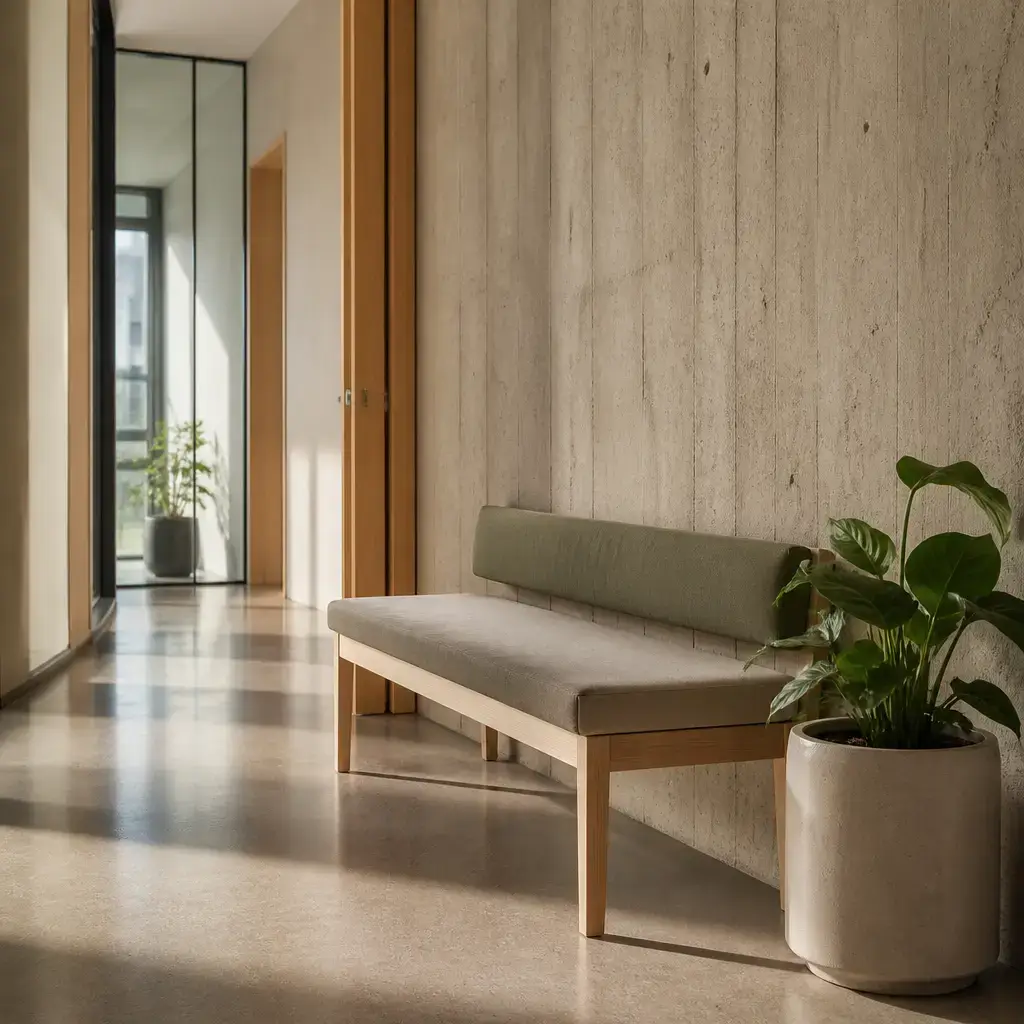
Wo können wir eine Pause machen?
voh KUR-nən veer EYE-nə POW-zə MAKH-ən? Where can we take a break?Im Flur gibt es einen ruhigen Platz.
im FLOOR geept ess EYE-nən ROO-ee-gən PLAHTS. There's a quiet spot in the hall.Gibt es dort eine Bank?
geept ess dort EYE-nə bahngk? Is there a bench there?An der Wand steht eine Bank.
ahn dair vahnt shtayt EYE-nə bahngk. There is one by the wall.Ich möchte sitzen und mich ausruhen.
ikh MURKH-tə ZIT-sən oont mikh OWS-roo-ən. I want to sit and rest.Setzen wir uns dort zusammen.
ZET-sən veer oons dort tsoo-ZAH-mən. Let's sit there together.Hier ist es ruhig.
heer ist ess ROO-ikh. This spot feels quiet.Das ist ein guter Ort für eine kurze Pause.
dahs ist EYE-n GOO-tər ohrt fyoor EYE-nə KURT-sə POW-zə. This is a good place for a short break.Sentence explanations
Wo können wir eine Pause machen?
Where can we take a break?
- Wo
- where
- können wir
- can we
- eine Pause
- a break
- machen
- make or do
More detail
Wo means “where” and asks about a place. It is a question word, not a request for a person or a thing. For example: Wo ist der Schlüssel? — “Where is the key?” können wir combines können (“can/be able to”) with wir (“we”). können is the form used with wir: wir können. In a question, the conjugated verb comes before the subject: Können wir gehen? — “Can we go?” Here, können expresses possibility or availability, while wir identifies the people asking. eine Pause means “a break.” Pause is a feminine noun, so the indefinite article is eine in this form. The phrase refers to taking or having a break; eine does not by itself state a numerical count. For example: Wir brauchen eine Pause. — “We need a break.” machen means “make” or “do,” but in eine Pause machen it is the usual verb in the fixed expression “take/have a break.” Its base form is machen; after the modal verb können, it stays in the infinitive and appears at the end of the question. Compare: Wir machen eine Pause. — “We are taking a break.” Together, Wo asks for the location, können wir asks whether the group has the possibility to do something, and eine Pause machen means “take a break.” The whole question is therefore: “Where can we take a break?”
Im Flur gibt es einen ruhigen Platz.
There's a quiet spot in the hall.
- Flur
- hall
- gibt es
- there is / there are
- ruhigen
- quiet
- Platz
- spot
More detail
Flur means “hall” here. Its base form is der Flur; after in meaning location, im is the contraction of in dem, so im Flur means “in the hall.” Example: Die Schuhe stehen im Flur. — “The shoes are in the hall.” gibt es is the reusable German construction for saying that something exists or is present: “there is” or “there are.” It is not best understood here as the ordinary verb geben (“to give”). The thing that exists follows this construction. Example: Gibt es hier einen Aufzug? — “Is there an elevator here?” ruhigen means “quiet” in this sentence. The base adjective is ruhig. The ending -en appears because the adjective describes masculine Platz in the accusative phrase einen ruhigen Platz; the adjective is not derived from Platz. Compare ein ruhiger Platz (“a quiet spot,” nominative) with einen ruhigen Platz (“a quiet spot,” accusative). Example: Wir suchen einen ruhigen Raum. — “We are looking for a quiet room.” Platz means “spot” or “place” here. Its base form is der Platz, a masculine noun. In einen ruhigen Platz, einen and the adjective ending show the masculine accusative form required for the place that is being identified. Example: Dort ist noch ein Platz frei. — “There is still a spot free there.” Together, Im Flur sets the location, gibt es introduces something present there, and einen ruhigen Platz identifies that thing. The complete utterance means: “There’s a quiet spot in the hall.”
Gibt es dort eine Bank?
Is there a bench there?
- Gibt es
- is there
- dort
- there
- Bank
- bench
More detail
Gibt es is the question form of the German existence pattern es gibt (“there is/are”). gibt is the third-person singular present form of geben; here it is part of this fixed expression, not the ordinary meaning “gives.” In a question, the finite verb comes first: Gibt es ...? — “Is there ...?” The thing that exists follows es gibt in the accusative. With feminine eine Bank, the article looks the same in the nominative and accusative, so its form does not visibly show the case here. dort means “there,” referring to a place understood from the situation. It is a location adverb and does not change for gender or number. Compare hier (“here”) and dort (“there”). Example: Gibt es dort einen ruhigen Platz? — “Is there a quiet spot there?” Bank means “bench” in this utterance. Its base form is the feminine noun die Bank; after eine, it appears as eine Bank. German nouns are capitalized. Bank can also mean “bank” as a financial institution in another context, but the fixed translation and surrounding context support “bench” here. Together, Gibt es dort eine Bank? asks whether a bench exists at that place: “Is there a bench there?” The reusable pattern is Gibt es [place] [thing]? — “Is there [thing] [there/place]?”
An der Wand steht eine Bank.
There is one by the wall.
- An der Wand
- by/on the wall
- steht
- stands; is located
- Bank
- bench
More detail
An der Wand means “by/on the wall.” For a stationary location, German uses an with the dative: die Wand becomes der Wand. The phrase can be reused with other locations, for example: Das Bild hängt an der Wand. — “The picture is hanging on the wall.” steht is the third-person singular present form of stehen (“to stand”). With an object such as a bench, German can use stehen to describe its position: it is standing or located somewhere. The subject is eine Bank, so the form is singular. Example: Der Tisch steht am Fenster. — “The table is by the window.” Bank means “bench” here. Its basic dictionary form is feminine die Bank; after the indefinite article in this sentence, it appears as eine Bank in the nominative singular. Bank can also mean “bank” as a financial institution in other contexts, but the preceding question and the following statement about sitting support the “bench” meaning here. Together, An der Wand gives the location, steht describes the bench’s position, and eine Bank identifies what is there. The whole utterance means: “There is a bench by the wall.” In the fixed translation, “one” refers back to that bench; the German article eine introduces the bench rather than independently asserting a numerical count.
Ich möchte sitzen und mich ausruhen.
I want to sit and rest.
- Ich möchte
- I want
- sitzen
- sit
- mich ausruhen
- rest
More detail
Ich möchte expresses the speaker’s wish: “I want to …”. möchte is the first-person singular form used here from mögen; with an infinitive, it forms a common way to express wanting to do something. The subject is Ich, and it is shared by both coordinated actions. sitzen is the infinitive “to sit”. After möchte, German uses the infinitive without zu: Ich möchte sitzen means “I want to sit.” The same pattern works with other verbs, for example: Ich möchte lernen. — “I want to study.” mich ausruhen means “to rest”. ausruhen is a reflexive verb here, so the first-person reflexive pronoun is mich: Ich ruhe mich aus. — “I am resting.” In the infinitive construction, the separable verb appears as the single form ausruhen; in a finite clause, it separates as ruhe ... aus. The conjunction und links the two infinitives. The structure is Ich möchte [sitzen] und [mich ausruhen]: the speaker wants to sit and also wants to rest. Thus the complete utterance means “I want to sit and rest.”
Setzen wir uns dort zusammen.
Let's sit there together.
- Setzen wir uns
- let’s sit down
- dort
- there
- zusammen
- together
More detail
Setzen wir uns means “let’s sit down.” setzen is the base verb; here its first-person plural form is used in a suggestion with wir (“we”). The reflexive pronoun uns refers back to wir, so sich setzen means to sit down or take a seat. This differs from sitzen, which describes already being seated: Wir sitzen hier. — “We are sitting here.” dort means “there,” pointing to a place identified by the situation. It contrasts with hier (“here”). Example: Wir setzen uns dort hin. — “We’ll sit down there.” zusammen means “together.” It indicates that the participants sit as a group, rather than separately. Example: Wir lernen zusammen. — “We study together.” Together, Setzen wir uns dort zusammen. forms a first-person-plural suggestion: “Let’s sit down there together.”
Hier ist es ruhig.
This spot feels quiet.
- Hier
- here
- ist es
- it is
- ruhig
- quiet
More detail
Hier means “here,” referring to the place relevant in the situation. It is a location adverb and can be moved for emphasis: Hier ist es ruhig and Es ist hier ruhig both express that it is quiet here, though the focus can differ. ist es contains ist, the present-tense form of sein (“to be”) for a third-person singular subject, and es, a neuter third-person singular pronoun/form. In this environmental description, es works as the grammatical subject of the description; the sentence does not identify a particular object that is quiet. The reusable pattern is Hier ist es + adjective. ruhig means “quiet” here. It is an adjective used after sein, so it remains in its basic form rather than taking an attributive ending. Its opposite is laut (“loud”): Hier ist es laut. — “It is loud here.” Together, Hier sets the location, ist es forms the present-tense “it is” frame, and ruhig describes the conditions there. The whole utterance means “This spot feels quiet,” or more literally, “It is quiet here.”
Das ist ein guter Ort für eine kurze Pause.
This is a good place for a short break.
- Das ist
- This is
- guter
- good
- Ort
- place
- kurze
- short
- Pause
- break
More detail
Das ist means “This is.” Das is a demonstrative pronoun in the neuter singular form; here it points to the place being identified, without naming a more specific referent. ist is the third-person singular present form of sein (“to be”): sein → ist. German uses this pattern to identify or describe something: Das ist ein Buch. — “This is a book.” guter means “good” here. Its base form is the adjective gut; guter is not a noun form. In ein guter Ort, the masculine singular noun is nominative, and the indefinite article ein has no visible masculine nominative ending, so the adjective shows the ending -er. Compare: ein guter Ort — “a good place,” but eine gute Pause — “a good break.” Ort means “place” or “spot.” Its plural is Orte. In this sentence, Ort is masculine singular and is the subject complement after ist, so it appears in the nominative: ein guter Ort. The words between Ort and kurze form the useful pattern für eine ...: für means “for” and takes the accusative case. eine is the feminine singular accusative form of the indefinite article; it does not itself state a numerical count. The phrase introduces the purpose or suitability of the place. kurze means “short.” Its base form is kurz. Here it describes the feminine noun Pause in the accusative phrase für eine kurze Pause. Because eine already shows the feminine accusative ending, the adjective has the ending -e: eine kurze Pause. For comparison, ein kurzer Weg means “a short path,” where the masculine form is kurzer. Pause means “break.” It is a feminine noun, so it is capitalized in German. The phrase eine kurze Pause means “a short break”; the adjective comes before the noun and agrees with it in gender, number, and case. Together, Das ist identifies something, ein guter Ort describes it as a good place, and für eine kurze Pause states what the place is suitable for. The complete meaning is: “This is a good place for a short break.”
Grammar Points
Wo + Verb + Subjekt
Wo machen wir Pause?
voh MAKH-ən veer POW-zə?Where are we taking a break?
In German questions with Wo, the verb comes before the subject: Wo machen wir …?
German Vocabulary
Quiz
Word Order
Arrange the words in the correct order.
Where can we take a break?
Show Answer
Wo können wir eine Pause machen?Is there a bench there?
Show Answer
Gibt es dort eine Bank?There is one by the wall.
Show Answer
An der Wand steht eine Bank.Spelling
Tap the letters to spell the word.
spot; place
Show Answer
Platzthere
Show Answer
dorthallway
Show Answer
Flurquiet