10 minutes free every day
Continue audio lessons in the app
Word explanations appear automatically in sync with the audio.
No login required · synced translations · playback with the screen locked
Choose your learning language and open this lesson in the app.

About This Lesson
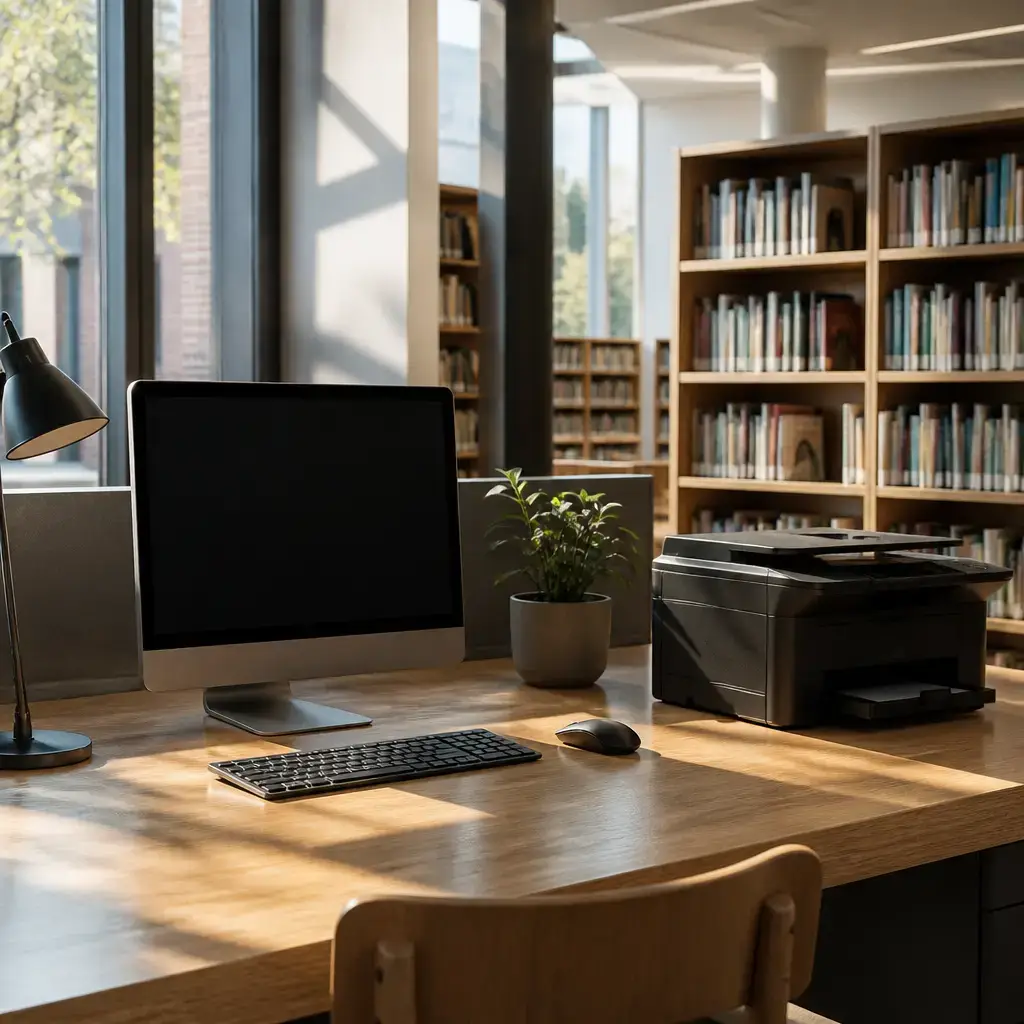
Use Using a Computer and Printer in a Quiet Library to practice German conversation, pronunciation, vocabulary, grammar, and quizzes.
Dialogue
Kann ich diesen Computer benutzen?
KAHN ikh DEE-zən kum-PYOO-ter beh-NOOT-sən? Can I use this computer?Der Computer ist frei.
Dair kum-PYOO-ter ist fry. That computer is free.Der Bildschirm ist sehr hell.
Dair BILT-sheerm ist zair hell. The screen is very bright.Du kannst die Helligkeit hier niedriger stellen.
Doo KAHNST dee HELL-ikh-kite heer NEE-dree-ger SHTELL-en. You can lower the brightness here.Kann ich auch den Drucker benutzen?
KAHN ikh owkh dehn DROOK-er beh-NOOT-sən? Can I use the printer too?Du kannst den Drucker in der Nähe vom Schreibtisch benutzen.
Doo KAHNST dehn DROOK-er in dair NAY-uh fohm SHRITE-tish beh-NOOT-sən. You can use the printer near the desk.Ich werde Kopfhörer benutzen, wenn ich Audio abspiele.
Ikh VAIR-duh KOPF-hur-er beh-NOOT-sən, ven ikh OW-dee-oh AHP-shpee-luh. I'll use headphones if I play any audio.Das hält den Raum ruhig.
Dahs helt dehn ROWM ROO-ikh. That will keep the room quiet.Sentence explanations
Kann ich diesen Computer benutzen?
Can I use this computer?
- Kann ich
- Can I …?
- diesen
- this
- Computer
- computer
- benutzen
- use
More detail
Kann ich is the question pattern “Can I …?” Here kann is the first-person singular present form of the modal verb können (“to be able to; can”), and ich is the subject. In a yes/no question, the modal verb comes first: Kann ich …? Compare the statement Ich kann … (“I can …”). diesen means “this” for the masculine singular accusative form. It belongs to the demonstrative determiner dieser and agrees with the masculine noun Computer in this sentence; the accusative form is required because the computer is the direct object of benutzen. Example: Ich kaufe diesen Computer. — “I am buying this computer.” Computer is the noun “computer.” It is masculine in German, so its definite article is der Computer; after a direct-object verb here, the corresponding demonstrative form is diesen Computer. The plural is also Computer: die Computer (“the computers”). benutzen is the infinitive “to use.” It follows the modal verb kann, and the modal carries the finite verb marking while benutzen remains in the infinitive at the end of the clause. Its first-person singular present form without a modal is ich benutze: Ich benutze den Computer. — “I use the computer.” Together, Kann ich asks for permission or possibility, diesen Computer identifies the object as this particular computer, and benutzen supplies the action. The German question therefore means “Can I use this computer?”
Der Computer ist frei.
That computer is free.
- Computer
- computer
- ist
- is
- frei
- free; available
More detail
Computer is a masculine German noun meaning “computer.” German nouns are capitalized. Its plural is also Computer: ein Computer = “a computer,” zwei Computer = “two computers.” ist is the third-person singular present form of sein, “to be.” The useful present-tense chain is ich bin, du bist, er/sie/es ist; here ist agrees with the singular subject Der Computer. frei is an adjective meaning “free” here in the sense of “available,” not occupied or in use. Its comparison forms are freier (“freer/more available”) and am freiesten (“the freest/most available”). For example: Der Platz ist frei. — “The seat is available.” The sentence begins with Der, the masculine singular definite article, followed by Computer, so Der Computer means “that computer” in the fixed translation. The linking verb ist connects this subject with the adjective frei: Der Computer ist frei. literally describes the computer as available. Together, the whole utterance means “That computer is free.”
Der Bildschirm ist sehr hell.
The screen is very bright.
- Der Bildschirm
- the screen
- ist
- is
- sehr
- very
- hell
- bright
More detail
Der Bildschirm means “the screen” here. Bildschirm is a masculine noun, so its singular definite article in the nominative is der: der Bildschirm. In the plural, both the article and noun change: die Bildschirme (“the screens”). ist is the present-tense third-person singular form of sein (“to be”). It is used because the subject is singular: Der Bildschirm ist ... (“The screen is ...”). For comparison, Die Bildschirme sind ... uses sind, the present form for a plural subject. sehr means “very” and strengthens the adjective that follows. It does not itself mean “bright”; it increases the degree of hell. hell means “bright” here. As a predicate adjective after sein, it has no ending: Der Bildschirm ist hell. The useful comparison chain is hell (“bright”), heller (“brighter”), and am hellsten (“brightest”). Example: Der zweite Bildschirm ist heller. — “The second screen is brighter.” Together, Der Bildschirm supplies the singular subject, ist links that subject to a description, and sehr hell describes a high degree of brightness. The whole utterance means: “The screen is very bright.”
Du kannst die Helligkeit hier niedriger stellen.
You can lower the brightness here.
- Du kannst
- you can
- Helligkeit
- brightness
- hier
- here
- niedriger
- lower
- stellen
- set; adjust
More detail
Du kannst means “you can” here: kannst is the second-person singular present form of können, used with du to express ability or permission. The infinitive belonging to it comes at the end of the clause: Du kannst ... stellen (“You can ... set”). Helligkeit means “brightness.” It is a feminine noun, used here in the accusative form die Helligkeit because it is the thing being adjusted. The related adjective hell means “bright,” as in Der Bildschirm ist hell. — “The screen is bright.” hier means “here” and identifies the location relevant to the suggested adjustment. niedriger is the comparative form of niedrig (“low”): niedrig → niedriger (“lower”). With a setting, the pattern etwas niedriger stellen means “set something lower,” so this form describes a reduction of the current brightness level. stellen basically means “put” or “set.” In die Helligkeit niedriger stellen, it means “adjust/set the brightness to a lower level.” After the modal verb können, it stays in the infinitive form stellen. Together, Du kannst die Helligkeit hier niedriger stellen says: “You can lower the brightness here.” Du kannst supplies the possibility or permission, die Helligkeit is what is adjusted, hier gives the location, and niedriger stellen expresses moving the setting to a lower level.
Kann ich auch den Drucker benutzen?
Can I use the printer too?
- Kann ich
- Can I
- auch
- too
- Drucker
- printer
- benutzen
- use
More detail
Kann ich means “Can I” here. kann is the first-person singular present form of können (“can, be able to”): ich kann, du kannst, sie kann. In a yes/no question, the conjugated modal verb comes first, followed by the subject: Kann ich ...? The following main verb stays in the infinitive. auch means “too” or “also.” It adds this action to something already relevant; here, the speaker asks whether using the printer is possible as well. Its position can affect emphasis, but this placement naturally connects it with the proposed action. Drucker means “printer” here. The noun is masculine: der Drucker; after benutzen, it appears as accusative den Drucker, because the printer is the direct object. The plural has the same visible form, die Drucker, but the article distinguishes it here: den Drucker is singular masculine accusative. benutzen means “to use.” It is the infinitive, with the base form benutzen, and it remains at the end after the modal kann: Ich kann den Drucker benutzen. — “I can use the printer.” Together, Kann ich ... benutzen? forms a reusable yes/no question asking for permission or possibility: “Can I use ...?” Adding auch gives “too,” and den Drucker names the object. Thus the whole utterance means: “Can I use the printer too?”
Du kannst den Drucker in der Nähe vom Schreibtisch benutzen.
You can use the printer near the desk.
- Du kannst
- you can
- Drucker
- printer
- in der Nähe
- nearby
- Schreibtisch
- desk
- benutzen
- use
More detail
Du kannst means “you can” here. kannst is the second-person singular present form of können (“can, be able to”): ich kann, du kannst, er/sie kann. With du, the verb form is kannst; the following lexical verb remains in the infinitive. Drucker means “printer.” Its base noun is der Drucker; in this sentence, den Drucker is the accusative form because it is the direct object of benutzen. The article changes from der to den in the masculine accusative. Example: Ich sehe den Drucker. — “I see the printer.” in der Nähe is a reusable way to say “near” or “in the vicinity.” Nähe is feminine (die Nähe), and the location phrase uses der here: in der Nähe. The complete location expression is in der Nähe vom Schreibtisch, where vom is the contraction of von dem. Schreibtisch means “desk.” The noun is masculine: der Schreibtisch. After von, it appears in the dative: von dem Schreibtisch, commonly contracted as vom Schreibtisch. Example: Die Tasche steht neben dem Schreibtisch. — “The bag is next to the desk.” benutzen means “to use.” It is the infinitive of the verb and follows the modal verb kannst; German places this infinitive at the end of the clause. Example: Du kannst mein Telefon benutzen. — “You can use my phone.” Together, Du kannst + den Drucker + in der Nähe vom Schreibtisch + benutzen means: “You can use the printer near the desk.” The modal expresses ability or permission in this context, den Drucker is what can be used, the location phrase identifies which nearby area is meant, and benutzen supplies the main action.
Ich werde Kopfhörer benutzen, wenn ich Audio abspiele.
I'll use headphones if I play any audio.
- Ich werde
- I will
- Kopfhörer
- headphones
- benutzen
- use
- wenn
- if
- Audio
- audio
- abspiele
- play
More detail
Ich werde combines the subject Ich (“I”) with werde, the first-person singular present form of werden. With an infinitive later in the clause, werden forms the future: Ich werde ... benutzen = “I will use ...”. The subject form Ich is the first-person singular pronoun; its form does not change because of the following noun. Kopfhörer means “headphones” here. This noun has the same spelling in singular and plural: der Kopfhörer can mean “the headphone” or “the headphones” when context determines the number. In this sentence, the fixed translation identifies the intended meaning as headphones. The noun appears without an article, which presents it directly as the equipment being used rather than stating a numeric count. benutzen is the infinitive “to use.” It is the verb selected by werde in the future construction. The related verb verwenden can also mean “to use,” but benutzen is especially common for using an object or device. Example: Ich benutze den Drucker. — “I use the printer.” wenn introduces the condition “if” here. It starts a subordinate clause, and German places the conjugated verb at the end of that clause. The pattern is reusable as wenn + subject + ... + conjugated verb. Audio is the noun “audio” or “audio content.” German capitalizes it because it is a noun. The word itself does not add a separate equivalent of “any”; the fixed translation expresses the intended general reference as “any audio.” abspiele is the first-person singular present form of the separable verb abspielen, “to play” audio or another recording. In a main clause, the prefix separates: Ich spiele Audio ab. In the subordinate clause after wenn, the parts remain together at the end: wenn ich Audio abspiele. The form abspiele agrees with ich and is present tense; here the present tense describes the condition for the future action. Together, Ich werde Kopfhörer benutzen means “I will use headphones,” and wenn ich Audio abspiele supplies the condition “if I play any audio.” The complete utterance therefore means: “I’ll use headphones if I play any audio.”
Das hält den Raum ruhig.
That will keep the room quiet.
- Das
- that
- hält
- keeps
- Raum
- room
- ruhig
- quiet
More detail
Das is a demonstrative pronoun meaning “that” here. In this sentence it points to the relevant situation or action already under discussion; its exact referent is not independently named in the sentence. The form is neuter singular, and it is also used for referring to a whole preceding idea, not only to a physical noun. Compare Das ist gut. — “That is good.” hält is the third-person singular present form of halten, “to keep” or “to hold”: halten → er/sie/es hält. The vowel changes from a to ä in this form. Here halten has the reusable pattern jemanden/etwas ruhig halten, “to keep someone/something quiet.” German present tense can describe a future result when the context makes that reading clear; the fixed translation therefore uses “will keep.” Raum is the masculine noun “room.” In den Raum, it is the direct object of hält, so the masculine definite article appears in the accusative: nominative der Raum, accusative den Raum. The noun itself does not change in these two forms. Example: Ich betrete den Raum. — “I enter the room.” ruhig is the adjective “quiet” or “calm.” Here it describes the state in which the room is kept. In the pattern etwas ruhig halten, the adjective follows the object and remains uninflected because it is a predicative complement, rather than an adjective placed directly before a noun. Example: Die Musik hält das Baby ruhig. — “The music keeps the baby quiet.” Together, Das is the thing or situation being referred to as the cause, hält expresses keeping something in a state, den Raum is the thing affected, and ruhig names that state. Thus Das hält den Raum ruhig. means “That will keep the room quiet.”
Grammar Points
in der Nähe von + Dativ
Der Drucker ist in der Nähe vom Schreibtisch.
Dair DROOK-er ist in dair NAY-uh fohm SHRITE-tish.The printer is near the desk.
Nach „in der Nähe von“ steht der Dativ: „von dem“ wird zu „vom“.
abspielen: trennbares Verb
Ich spiele Audio ab.
Ikh SHPEE-luh OW-dee-oh AHP.I play audio.
Bei trennbaren Verben steht „ab“ im Hauptsatz am Satzende.
German Vocabulary
Kann ich diesen Computer benutzen?
Der Bildschirm ist sehr hell.
Kann ich diesen Computer benutzen?
Kann ich auch den Drucker benutzen?
Der Computer ist frei.
Der Bildschirm ist sehr hell.
Du kannst die Helligkeit hier niedriger stellen.
Du kannst den Drucker in der Nähe vom Schreibtisch benutzen.
Ich werde Kopfhörer benutzen, wenn ich Audio abspiele.
Du kannst die Helligkeit hier niedriger stellen.
Du kannst den Drucker in der Nähe vom Schreibtisch benutzen.
Du kannst die Helligkeit hier niedriger stellen.
Quiz
Word Order
Arrange the words in the correct order.
Can I use this computer?
Show Answer
Kann ich diesen Computer benutzen?That computer is free.
Show Answer
Der Computer ist frei.The screen is very bright.
Show Answer
Der Bildschirm ist sehr hell.Spelling
Tap the letters to spell the word.
screen
Show Answer
Bildschirmfree; available
Show Answer
freicomputer
Show Answer
Computerlow