10 minutes free every day
Continue audio lessons in the app
Word explanations appear automatically in sync with the audio.
No login required · synced translations · playback with the screen locked
Choose your learning language and open this lesson in the app.

About This Lesson
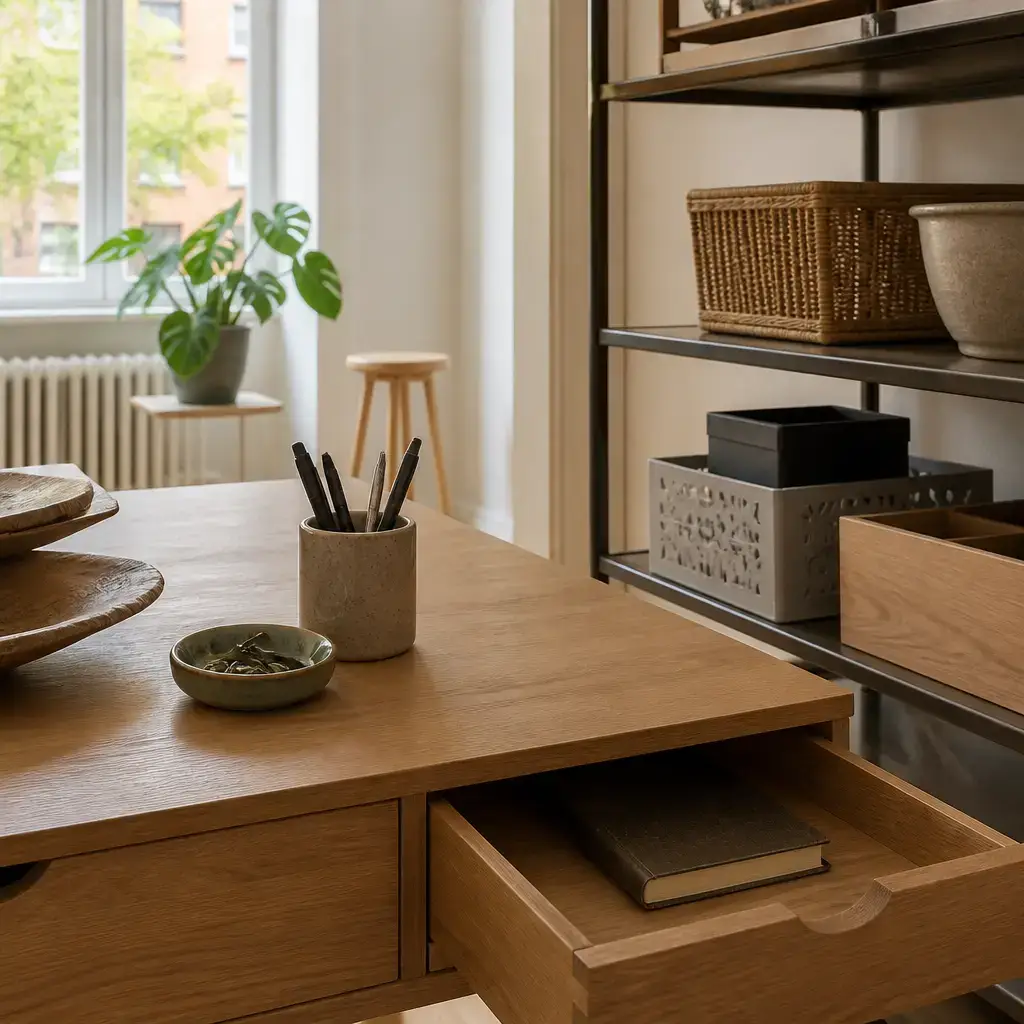
Use Borrowing a pen and notebook to practice German conversation, pronunciation, vocabulary, grammar, and quizzes.
Dialogue
Kann ich einen Stift benutzen?
kahn ikh EYE-nen shtift beh-NOOT-sen Can I use a pen?Nimm den schwarzen Stift aus dem Becher.
nim dayn SHVAHR-tsen shtift ous daym BEKH-er Take the black one from the cup.Ich brauche auch ein Notizbuch.
ikh BROW-khuh owkh eye-n noh-TEETS-bookh I need a notebook too.In der Schublade ist ein altes Notizbuch.
in dair SHOO-blah-duh ist eye-n AHL-tes noh-TEETS-bookh There is an old one in the drawer.Ich muss nur eine kurze Liste schreiben.
ikh muhs noor EYE-nuh KOORT-suh LIS-tuh SHRY-ben I only need to write a short list.Bring beide zurück, wenn du fertig bist.
bring BYE-duh tsoo-RIK ven doo FEHR-tikh bihst Bring both back when you finish.Ich lege sie auf deinen Schreibtisch.
ikh LAY-guh zee owf DYE-nen SHRYPT-ish I will put them on your desk.Dann sind sie leicht zu finden.
dahn zint zee lykht tsoo FIN-den That makes them easy to find.Sentence explanations
Kann ich einen Stift benutzen?
Can I use a pen?
- Kann ich
- Can I …?
- Stift
- pen
- benutzen
- use
More detail
Kann ich means “Can I …?” here. kann is the present-tense form of können with ich; in a yes/no question, the conjugated verb comes first, followed by the subject. The infinitive usually comes later in the clause when können expresses ability or permission. Example: Kann ich kommen? — “Can I come?” Stift means “pen” here. It is the masculine noun der Stift; as the object of benutzen, it appears in the accusative: einen Stift. The form einen marks the masculine singular accusative noun phrase. The indefinite article does not by itself state a numeric count; it presents a nonspecific pen. benutzen is the infinitive “to use.” With the modal verb können, it remains in the infinitive and appears at the end: Kann ich ... benutzen? The verb is regular in this form; its base form is also benutzen. Example: Ich benutze den Stift. — “I use the pen.” Together, Kann ich + einen Stift + benutzen? forms a yes/no question asking for permission or possibility: “Can I use a pen?”
Nimm den schwarzen Stift aus dem Becher.
Take the black one from the cup.
- Nimm
- take
- schwarzen
- black
- Stift
- pen
- aus dem
- from the
- Becher
- cup
More detail
Nimm is the informal singular imperative of nehmen (“to take”). It addresses one person: Nimm den Stift. — “Take the pen.” The polite or plural command is Nehmen Sie ..., while Nehmt ... addresses several people informally. schwarzen means “black” here. It is the inflected form of schwarz and agrees with the masculine accusative noun Stift after the definite article den: den schwarzen Stift. The ending is not on Stift; Stift remains the noun’s base form. Compare the basic form schwarz in ein schwarzer Stift (“a black pen”) and the form here, schwarzen, after den. Stift means “pen” here, matching the preceding context about using a pen. German nouns are capitalized. Its plural is Stifte: Die Stifte sind schwarz. — “The pens are black.” aus dem means “from the” and introduces the place something is taken out of. aus requires the dative case; dem is the masculine or neuter singular dative form of the definite article. This is a location of origin, not a direction into a place. For example, Nimm das Buch aus dem Schrank. means “Take the book from the cupboard.” Becher means “cup” here. It is a masculine noun: der Becher; after aus, the article becomes dative dem: aus dem Becher. Its plural is Becher, with the same visible form: zwei Becher — “two cups.” Together, Nimm den schwarzen Stift means “Take the black pen,” and aus dem Becher specifies where to take it from. The complete utterance is therefore “Take the black one from the cup,” with “the black one” referring to the pen identified in the German sentence and supported by the preceding context.
Ich brauche auch ein Notizbuch.
I need a notebook too.
- Ich
- I
- brauche
- need
- auch
- too; as well
- ein
- a/an
- Notizbuch
- notebook
More detail
Ich means “I” here and is the first-person singular personal pronoun in the subject position. German uses ich for the speaker as the subject; the object form is mich. Example: Ich lerne. — “I am learning.” brauche is the present-tense first-person singular form of brauchen, “to need.” The ending -e marks the ich form here: ich brauche, while du brauchst means “you need.” Example: Ich brauche Hilfe. — “I need help.” auch adds “too” or “as well.” It indicates that the need described here is added to something already mentioned or understood. Its exact placement can affect emphasis, but in this sentence it follows the verb and naturally means “too.” ein is the indefinite article “a/an.” It agrees with Notizbuch, which is neuter, and the noun is the accusative object of brauchen; for a neuter noun, the form is ein in both nominative and accusative. The article does not by itself assert a numerical count; it introduces an unspecified notebook. Example: Ich kaufe ein Buch. — “I am buying a book.” Notizbuch means “notebook.” It is a neuter noun, so it is capitalized in German and combines with the article as ein Notizbuch. The plural is Notizbücher. Example: Das Notizbuch ist neu. — “The notebook is new.” Together, Ich brauche gives “I need,” auch adds “too,” and ein Notizbuch gives “a notebook” as the needed object. The complete utterance means “I need a notebook too.”
In der Schublade ist ein altes Notizbuch.
There is an old one in the drawer.
- In
- in
- Schublade
- drawer
- ist
- is
- altes
- old
- Notizbuch
- notebook
More detail
In means “in” here and introduces the place where something is located. With a stationary location, German uses in with the dative: in der Schublade = “in the drawer.” For movement into a place, in normally takes the accusative instead, as in the example Ich lege das Buch in die Schublade. — “I put the book into the drawer.” Schublade is the feminine noun “drawer.” Its plural is Schubladen. In the fixed phrase, the feminine singular dative form of the article is der: in der Schublade. The noun itself does not show a special dative ending here. ist is the third-person singular present form of sein, “to be”: sein → ist. It agrees with the singular subject ein altes Notizbuch. In a location/existence pattern, In ... ist ... can present something as being in a place. Example: Auf dem Tisch ist ein Schlüssel. — “There is a key on the table.” altes means “old” here. It is the adjective alt, with the comparative älter (“older”) and superlative am ältesten (“oldest”). The ending -es appears because altes describes the neuter singular noun Notizbuch after the indefinite article ein: ein altes Notizbuch. The adjective, not the noun, carries this ending. Example: ein altes Foto — “an old photo.” Notizbuch is the neuter noun “notebook.” Its plural is Notizbücher. In this context, the fixed translation’s “one” refers to the notebook established by the surrounding context; German states the noun explicitly: ein Notizbuch. Together, In der Schublade gives the location, ist expresses being there, and ein altes Notizbuch identifies the singular item. The whole utterance means: “There is an old notebook in the drawer.”
Ich muss nur eine kurze Liste schreiben.
I only need to write a short list.
- Ich muss
- I need to
- nur
- only
- kurze
- short
- Liste
- list
- schreiben
- write
More detail
Ich muss means “I need to” here. The verb is müssen, which expresses necessity or obligation. muss is its present-tense first-person singular form: ich muss; with du, the form is du musst. After a modal verb such as müssen, the other verb remains in the infinitive and appears later in the clause. Example: Ich muss arbeiten. — “I need to work.” nur means “only.” Here it restricts the stated need to the described task: writing a short list. Its position helps determine what it limits; it does not change the necessity expressed by muss. kurze is the adjective kurz, “short.” It is the feminine singular accusative form used with Liste in eine kurze Liste. The adjective agrees with the noun phrase’s gender, number, and case. The base form is kurz; compare ein kurzer Text (“a short text”) and ein kurzes Wort (“a short word”). Liste means “list.” Its plural is Listen. In eine kurze Liste, the noun phrase means “a short list.” eine is the indefinite article for this feminine singular noun phrase; the singular meaning comes from the noun phrase’s singular form, not from the article alone as a numerical assertion. schreiben means “to write.” It is the infinitive used after muss. Example: Sie muss einen Brief schreiben. — “She needs to write a letter.” Together, Ich muss + nur + eine kurze Liste + schreiben means “I only need to write a short list.” The modal verb expresses necessity, nur limits the stated need, eine kurze Liste is the object, and schreiben completes the modal construction. The sentence states a present need.
Bring beide zurück, wenn du fertig bist.
Bring both back when you finish.
- Bring
- bring
- beide
- both
- zurück
- back
- wenn
- when
- fertig
- finished; done
- bist
- are
More detail
Bring is the imperative of bringen (“to bring”) for informal singular du. It gives a direct instruction to one person. The verb bringen is separable in the useful compound zurückbringen: in a main-clause command, the particle can appear at the end: Bring ... zurück. beide means “both,” referring here to the two items that are to be brought back. It is a form of beide used with the understood plural object; it does not itself identify the items by name. zurück means “back.” Together with bringen, it supplies the return meaning: etwas zurückbringen = “to bring something back.” In this sentence it is separated from Bring by the object beide. wenn introduces the time condition “when.” In a clause introduced by wenn, German places the conjugated verb at the end. fertig means “finished” or “done.” In fertig sein, it describes being finished with a task or activity. Example: Ich bin fertig. — “I am done.” bist is the second-person singular present form of sein (“to be”), used with du: du bist = “you are.” Here fertig bist means “are finished.” The subordinate clause wenn du fertig bist means “when you finish” in the fixed translation, more literally “when you are finished.” Its subject is du, and the verb bist comes last because wenn introduces the subordinate clause. Putting the parts together, Bring beide zurück is the command “Bring both back,” and wenn du fertig bist states when to do it: “when you finish.” The complete utterance is therefore: “Bring both back when you finish.”
Ich lege sie auf deinen Schreibtisch.
I will put them on your desk.
- Ich
- I
- lege
- put/place
- sie
- them
- auf
- on/onto
- deinen
- your
- Schreibtisch
- desk
More detail
Ich is the first-person singular pronoun: “I.” It identifies the speaker as the actor. A useful contrast is du “you” for one person addressed directly. lege comes from legen, “to put/place.” Here it is the first-person singular present form: ich lege. German present tense can refer to a planned near-future action when the time is clear, so the fixed translation uses “I will put.” Compare ich lege “I put / I am putting” with ich legte “I put / I placed” in the past. Example: Ich lege das Buch auf den Tisch. — “I put the book on the table.” sie is the accusative plural pronoun meaning “them” here. The fixed translation identifies it as plural, and the preceding context refers to “both.” The accusative form marks the things directly affected by lege. In another context, the same spelling can have other grammatical functions, so its intended meaning here comes from the sentence and context. auf means “on” or “onto.” With a placement verb such as legen, it introduces the destination or resulting location and takes the accusative in this use. This is the movement-or-change-of-location use of the two-way preposition, contrasting with a static location such as Die Bücher liegen auf dem Tisch. — “The books are on the table.” deinen is the masculine accusative singular form of the possessive determiner dein, “your” when addressing one person. It agrees with the noun it determines, not with the person who owns the desk: dein Schreibtisch is nominative, while auf deinen Schreibtisch is accusative after auf in this placement meaning. Compare deinen Tisch “your table” and deine Tasche “your bag”; the form changes with the noun’s grammatical gender and case. Schreibtisch means “desk.” It is a masculine noun: der Schreibtisch. As a destination after auf with legen, it appears in the masculine accusative phrase auf deinen Schreibtisch. Example: Der Stift liegt auf dem Schreibtisch. — “The pen is on the desk.” Together, Ich lege sie gives “I will put them,” and auf deinen Schreibtisch specifies the destination, “on your desk.” The complete utterance therefore means: “I will put them on your desk.”
Dann sind sie leicht zu finden.
That makes them easy to find.
- Dann
- then
- sind sie
- they are
- leicht
- easy
- zu finden
- to find
More detail
Dann means “then” here and links the result to the preceding situation: once the items are put on the desk, they are easy to find. German dann can also mean “in that case” when it introduces a consequence. sind sie uses sind, the present-tense plural form of sein (“to be”); sie is the plural pronoun meaning “they” in this sentence. The preceding translation identifies the referent as the items being put on the desk. Compare ich bin (“I am”), du bist (“you are”), and sie sind (“they are”). leicht means “easy” here. It is an adjective describing how readily the items can be found. Its opposite is schwer (“difficult”) in a suitable context. Example: Die Aufgabe ist leicht. — “The task is easy.” zu finden is zu plus the infinitive finden (“to find”). In the pattern etwas ist leicht zu finden, the thing is easy for someone to find; this construction expresses ease or difficulty of carrying out the action. Example: Der Schlüssel ist schwer zu finden. — “The key is difficult to find.” Together, Dann sind sie leicht zu finden means “Then they are easy to find.” With the fixed translation and preceding context, the full intended meaning is that putting the items on the desk makes them easy to find.
Grammar Points
Imperativ: Nimm + Akkusativ
Nimm einen schwarzen Stift.
nim EYE-nen SHVAHR-tsen shtiftTake a black pen.
The imperative gives a direct instruction. The verb comes first, and the noun phrase is in the accusative.
Adjektiv + zu + Infinitiv
leicht zu finden
lykht tsoo FIN-deneasy to find
Use zu before the infinitive after an adjective to describe an action as easy or difficult.
German Vocabulary
Quiz
Word Order
Arrange the words in the correct order.
Can I use a pen?
Show Answer
Kann ich einen Stift benutzen?I need a notebook too.
Show Answer
Ich brauche auch ein Notizbuch.I will put them on your desk.
Show Answer
Ich lege sie auf deinen Schreibtisch.Spelling
Tap the letters to spell the word.
to use
Show Answer
benutzento take
Show Answer
Nimmto need
Show Answer
braucheblack