10 minutes free every day
Continue audio lessons in the app
Word explanations appear automatically in sync with the audio.
No login required · synced translations · playback with the screen locked
Choose your learning language and open this lesson in the app.

About This Lesson
Use Getting Ready for Rain to practice German conversation, pronunciation, vocabulary, grammar, and quizzes.
Dialogue
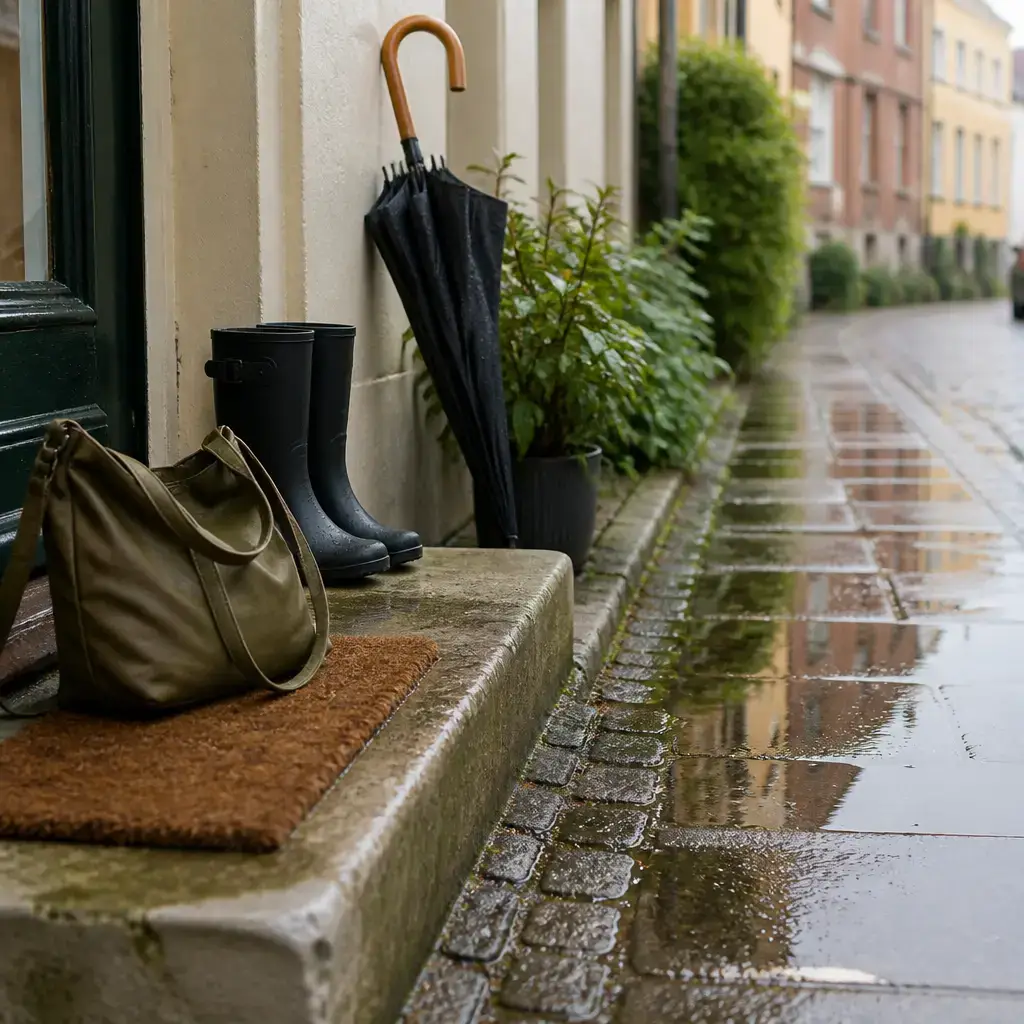
Draußen regnet es.
DROW-tsen RAYG-net ess. It is raining outside.Zieh deine Stiefel an, bevor du gehst.
TSEE deye-nuh SHTEE-fel AHN, beh-FOHR doo GAYST. Wear your boots before you leave.Auf dem Weg sind Pfützen.
OWF dem VAYK zint PFUET-sen. There are puddles on the path.Geh langsam um sie herum.
GAY LAHNG-zahm oom zee heh-ROOM. Step around them slowly.Meine Tasche könnte nass werden.
MY-nuh TAH-shuh KURN-tuh nahs VAYR-den. My bag might get wet.Halte sie unter deinem Mantel.
HAHL-tuh zee OON-ter DYE-nem MAHN-tel. Keep it under your coat.Ich sollte auch einen Regenschirm mitnehmen.
ikh SHOL-tuh owkh EYE-nen RAY-gen-shirm MIT-nay-men. I should take an umbrella too.Das hilft dir, trocken zu bleiben.
DAHS hilpft deer, TROK-en tsoo BLY-ben. That will help keep you dry.Sentence explanations
Draußen regnet es.
It is raining outside.
- Draußen
- outside
- regnet
- rains
- es
- it
More detail
Draußen means “outside” here and tells where the situation is happening. It is an adverb, so it does not change for person, number, or gender. Example: Draußen ist es kalt. — “It is cold outside.” regnet is the present-tense form of regnen (“to rain”) for the third-person singular pattern. German commonly uses this verb with the impersonal es in weather statements: Es regnet. — “It is raining.” The form regnet is not an imperative; it describes the current situation. es is the impersonal subject used in this weather expression. Here it does not refer to a particular thing or person; German uses it to fill the subject position in es regnet. This es is different from a referential pronoun meaning “it” when it points to a known noun. Together, Draußen gives the location, while regnet es expresses the weather event. The complete utterance means “It is raining outside.”
Zieh deine Stiefel an, bevor du gehst.
Wear your boots before you leave.
- Zieh … an
- put on
- deine
- your
- Stiefel
- boots
- bevor
- before
- du
- you
- gehst
- leave
More detail
Zieh ... an is the separable verb anziehen, meaning “to put on” clothing. Here Zieh is the singular informal imperative of anziehen; the prefix an moves to the end of the clause. Example: Zieh deine Jacke an. — “Put on your jacket.” deine means “your” here and agrees with the plural noun Stiefel. German possessive forms change according to the noun’s grammatical features; with plural nouns, deine is used for informal singular du ownership. This form does not itself state how many boots there are beyond the plural marking on Stiefel. Stiefel means “boots.” It is the plural form of der Stiefel; the singular and plural have the same spelling here, while the article distinguishes them: ein Stiefel — “a boot,” Stiefel — “boots.” bevor introduces a clause meaning “before.” It places the verb of that subordinate clause at the end. Example: Bevor du schläfst, lies ein Buch. — “Before you sleep, read a book.” du is the informal singular subject pronoun “you.” It refers to the person being addressed; the supplied sentence does not identify that person further. gehst is the second-person singular present form of gehen, “to go.” In this context, the fixed translation uses the natural English “leave”: du gehst can mean “you go” or “you leave,” depending on the situation. The present tense in the bevor clause describes the event that will occur after putting on the boots. Compare ich gehe — “I go,” du gehst — “you go.” Together, the imperative Zieh deine Stiefel an tells one person to put on their boots. bevor du gehst adds the time relation: this should happen before that person leaves. The complete utterance therefore means, “Put on your boots before you leave.”
Auf dem Weg sind Pfützen.
There are puddles on the path.
- Auf
- on
- Weg
- path
- sind
- are / exist
- Pfützen
- puddles
More detail
Auf means “on” here as part of the location phrase auf dem Weg. German auf can take the dative for a stationary location and the accusative for movement toward or onto something: Das Buch liegt auf dem Tisch. = “The book is on the table”; Ich lege das Buch auf den Tisch. = “I put the book on the table.” Weg means “path” here. Its base form is masculine: der Weg. In auf dem Weg, the masculine dative singular article is dem. The phrase therefore means “on the path.” sind is the third-person plural present form of sein (“to be”), used with the plural subject Pfützen. In this sentence, sein presents something as existing in a location, corresponding to English “there are.” Compare Eine Pfütze ist auf dem Weg. = “There is a puddle on the path.” Pfützen means “puddles” here. The singular is die Pfütze; Pfützen is its plural form. The following context refers back to these puddles with sie (“them”), consistent with this plural meaning. The sentence begins with the location Auf dem Weg. German main clauses normally keep the finite verb in the second position, so sind comes next, followed by the plural subject Pfützen: Auf dem Weg sind Pfützen. Literally, the structure is “On the path are puddles,” and the natural meaning is “There are puddles on the path.”
Geh langsam um sie herum.
Step around them slowly.
- Geh
- go
- langsam
- slowly
- um sie herum
- around them
More detail
Geh is the informal singular imperative of gehen (“to go”). The imperative addresses one person directly; the subject is understood as du, so it is not stated separately. Compare gehen (“to go”) with Geh! (“Go!”). Example: Geh nach Hause! — “Go home!” langsam means “slowly” here and describes how the movement should happen. The same form can also be an adjective meaning “slow,” as in ein langsamer Zug (“a slow train”); as an adverb, it does not take an ending in this use. Its opposite is schnell (“quickly/fast”). Example: Bitte sprich langsam. — “Please speak slowly.” um sie herum is the reusable pattern for moving or being “around them” in this sentence. sie is the accusative plural pronoun here, referring to “them” as established by the fixed translation. um ... herum places something or someone around a reference point; the separated elements form one construction. Example: Wir gehen um den See herum. — “We walk around the lake.” Together, Geh gives the command, langsam specifies the manner, and um sie herum specifies the route. The whole utterance therefore means: “Step around them slowly.”
Meine Tasche könnte nass werden.
My bag might get wet.
- Meine
- my
- Tasche
- bag
- könnte
- might / could
- nass
- wet
- werden
- become / get
More detail
Meine means “my” here and is the possessive determiner agreeing with Tasche. Its base form is mein; before a feminine singular noun in this sentence, it appears as meine. Example: Meine Jacke ist trocken. — “My jacket is dry.” Tasche means “bag.” It is a feminine noun: die Tasche; its plural is die Taschen. The form here is singular because the sentence refers to one bag. Example: Die Tasche ist schwer. — “The bag is heavy.” könnte is the possibility form of können (“can, be able to”). In this sentence it expresses that the event is possible: “might” or “could.” With a modal verb in this pattern, the other verb stays in the infinitive and goes to the end. Compare kann (“can”) with könnte (“might/could”): Die Tasche kann nass werden. — “The bag can get wet.” nass means “wet.” Here it is a predicative adjective after werden, so it has no adjective ending. Example: Der Mantel wird nass. — “The coat is getting wet.” werden means “become” or “get” in this construction. The pattern nass werden means “get wet”; könnte ... werden places the possibility marker before the infinitive. Example: Meine Schuhe könnten nass werden. — “My shoes might get wet.” Together, Meine Tasche identifies the bag, könnte marks the event as possible, and nass werden describes a change into a wet state. The complete meaning is: “My bag might get wet.”
Halte sie unter deinem Mantel.
Keep it under your coat.
- Halte
- keep; hold
- sie
- it
- unter
- under
- deinem
- your
- Mantel
- coat
More detail
Halte is the imperative singular of halten (“to hold” or “to keep”). It addresses one person informally. The imperative asks that person to maintain a position or state; here, the intended object is the bag mentioned in the fixed translation and context. Compare halten (base form), du hältst (“you hold”), and Halte! (“Hold!/Keep!”). sie is an accusative feminine singular pronoun here, meaning “it” and referring to the bag. German uses sie for a feminine singular referent in this grammatical role; the English translation’s “it” does not make the referent neuter in German. The accusative form marks what is being kept: Halte sie = “Keep it.” unter means “under.” With a location, it can be used with the dative: unter + dative describes where something is situated. This contrasts with its use with the accusative for movement to a position, for example Ich lege die Tasche unter den Tisch. — “I put the bag under the table.” deinem means “your” and is the dative masculine singular form of the informal singular possessive determiner dein. The dative is required here because unter deinem Mantel describes a location, and Mantel is masculine singular: unter deinem Mantel = “under your coat.” Compare dein Mantel (nominative), deinen Mantel (accusative), and deinem Mantel (dative). Mantel is a masculine noun meaning “coat.” Its plural is Mäntel. In this sentence, deinem Mantel identifies the covering location, not an object being moved. Together, Halte sie gives the command “Keep it,” and unter deinem Mantel specifies the location “under your coat.” The complete utterance is therefore: “Keep it under your coat.”
Ich sollte auch einen Regenschirm mitnehmen.
I should take an umbrella too.
- Ich
- I
- sollte
- should
- auch
- too; also
- einen
- an; a
- Regenschirm
- umbrella
- mitnehmen
- take along
More detail
Ich is the first-person singular pronoun, meaning the speaker. It is the subject here: Ich sollte ... = “I should ...”. A useful contrast is du for one person addressed directly and wir for “we.” sollte is the form of the modal verb sollen used here for “should” or “ought to.” In this sentence it expresses advice or an obligation viewed less strongly than a direct command. With a modal verb, the other verb normally stays in the infinitive at the end: Ich sollte warten. = “I should wait.” The form sollte can also occur as a past form of sollen in another context, so its meaning is determined by the sentence. auch means “too” or “also.” It adds this action to something else already relevant; it does not itself specify what that other thing is. Its position can vary, but in Ich sollte auch ... it is placed after the modal verb and before the object and final verb. einen is the masculine singular accusative form of the indefinite article. It marks Regenschirm as the direct object of mitnehmen: einen Regenschirm. The article’s form reflects the noun’s grammatical gender and its object role here; einen does not by itself assert a numerical count. Compare nominative ein Regenschirm with accusative einen Regenschirm. Regenschirm is the masculine noun for “umbrella.” Its plural is Regenschirme; the article changes accordingly: ein Regenschirm / zwei Regenschirme. The word is a German compound whose parts relate to rain and a protective screen, but the reusable meaning of the complete noun is simply “umbrella.” mitnehmen means “to take along” or “to bring with oneself.” It is a separable verb: in a finite main clause without a modal, the parts separate, as in Ich nehme einen Regenschirm mit. = “I take an umbrella along.” After sollte, however, the infinitive remains together at the end: Ich sollte einen Regenschirm mitnehmen. Together, Ich sollte gives “I should,” auch adds “too,” einen Regenschirm is the umbrella being taken along, and mitnehmen supplies the final infinitive required after the modal. The complete utterance therefore means: “I should take an umbrella too.”
Das hilft dir, trocken zu bleiben.
That will help keep you dry.
- Das
- that
- hilft
- helps
- dir
- you
- trocken
- dry
- bleiben
- stay; remain
More detail
Das is the demonstrative pronoun meaning “that” here. The surrounding context connects it with what was just mentioned, but the supplied sentences do not uniquely establish that it refers specifically to the umbrella rather than to the preceding matter more generally. At the beginning of a sentence, it is capitalized; that capitalization does not add a different meaning. hilft comes from helfen (“to help”). It is the present-tense form for a singular third-person subject: Das hilft. The person helped is expressed with the dative: Das hilft dir means “That helps you.” Example: Der Tipp hilft mir. — “The tip helps me.” dir is the informal singular “you” in the dative case. With helfen, the recipient or beneficiary is marked this way, not as a direct object. The corresponding dative forms include mir (“to me”) and Ihnen (“to you” formally or to you plural). trocken is an adjective meaning “dry.” Here it describes the state that the person is helped to maintain. In the expression trocken bleiben, it remains uninflected because it follows bleiben as a predicative adjective. Example: Ich bleibe trocken. — “I stay dry.” bleiben means “to stay” or “to remain.” It is the infinitive after zu: zu bleiben means “to stay.” A useful reusable pattern is jemandem helfen, etwas zu tun — “to help someone do something.” Example: Die Jacke hilft mir, warm zu bleiben. — “The jacket helps me stay warm.” Together, Das hilft dir means “That helps you,” and trocken zu bleiben expresses the state being helped: staying dry. The whole utterance therefore means “That will help keep you dry.”
Grammar Points
anziehen → Zieh ... an
Zieh Stiefel an.
TSEE SHTEE-fel AHN.Put on boots.
anziehen is separable: in the imperative, Zieh comes first and an moves to the end.
bevor + verb at the end
Bevor du gehst, ...
beh-FOHR doo GAYSTBefore you leave, ...
After bevor, the conjugated verb goes to the end of the subordinate clause.
German Vocabulary
Zieh deine Stiefel an.
Bevor du gehst.
Draußen regnet es.
Bevor du gehst.
Geh langsam um sie herum.
Meine Tasche könnte nass werden.
Auf dem Weg sind Pfützen.
Draußen regnet es.
Zieh deine Stiefel an.
Meine Tasche könnte nass werden.
Auf dem Weg sind Pfützen.
Meine Tasche könnte nass werden.
Quiz
Word Order
Arrange the words in the correct order.
It is raining outside.
Show Answer
Draußen regnet es.There are puddles on the path.
Show Answer
Auf dem Weg sind Pfützen.Step around them slowly.
Show Answer
Geh langsam um sie herum.Spelling
Tap the letters to spell the word.
outside
Show Answer
draußenpuddle
Show Answer
Pfützento rain
Show Answer
regnetbefore