10 minutes free every day
Continue audio lessons in the app
Word explanations appear automatically in sync with the audio.
No login required · synced translations · playback with the screen locked
Choose your learning language and open this lesson in the app.

About This Lesson
Use Talking about drawing in free time to practice German conversation, pronunciation, vocabulary, grammar, and quizzes.
Dialogue
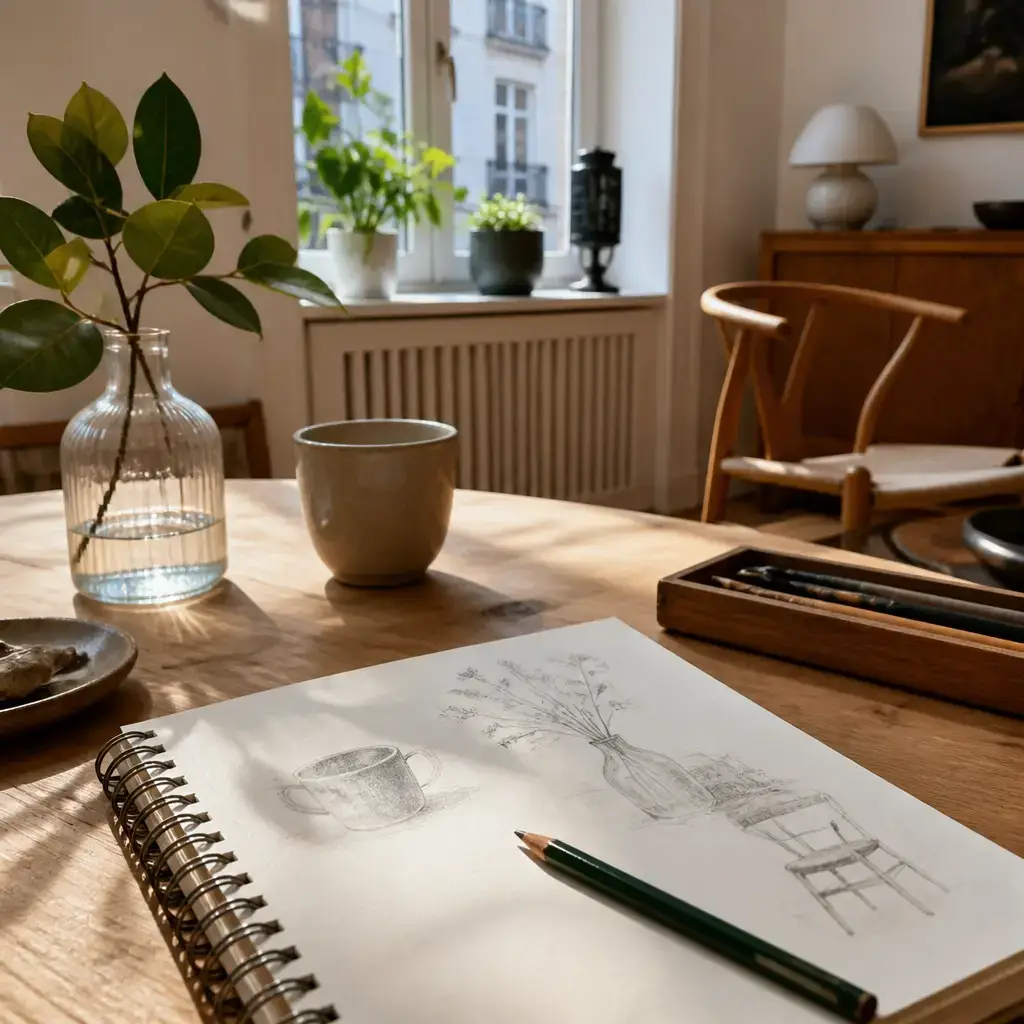
Was machst du in deiner Freizeit?
vahs MAHKST doo in DYE-ner FRY-tsight? What do you do in your free time?Ich zeichne gern zu Hause.
ikh TSYKH-nuh gairn tsoo HOW-zuh. I enjoy drawing at home.Das klingt nach einem entspannenden Hobby.
dahs KLINGT nahkh EYE-num ent-SHPAN-en-den HOH-bee. That sounds like a relaxing hobby.Ich zeichne meistens kleine Dinge in meinem Notizbuch.
ikh TSYKH-nuh MY-stens KLY-nuh DING-uh in MY-num noh-TEETS-bookh. I usually sketch small things in my notebook.Übst du oft?
UEPST doo awft? Do you practice often?Ein bisschen, meistens wenn ich Zeit habe.
eyne BISS-khen, MY-stens ven ikh tsight HAH-buh. A little, mostly when I have time.Vielleicht kann ich es auch versuchen.
fih-LYKHt kahn ikh ess owkh fair-TSOO-khen. Maybe I can try it too.Du kannst meinen alten Bleistift benutzen.
doo kahnst MY-nen AHL-ten BLAY-shtift buh-NUT-sen. You can use my old pencil.Sentence explanations
Was machst du in deiner Freizeit?
What do you do in your free time?
- Was
- what
- machst
- do
- du
- you
- deiner
- your
- Freizeit
- free time
More detail
Was means “what” here and asks for the activity being done. It is the interrogative pronoun at the beginning of the question. Example: Was liest du? — “What are you reading?” machst is the present-tense form of machen (“to do” or “to make”) for du: du machst. The same verb form can describe an activity in the present. Example: Was machst du heute? — “What are you doing today?” du is the informal singular pronoun “you.” It addresses one person and is the subject of machst. German uses du for the singular informal form; the formal “you” is Sie. deiner comes from the possessive form dein (“your,” for one person addressed informally). In in deiner Freizeit, Freizeit is feminine singular and the preposition in introduces a dative phrase here, so dein appears as deiner. The possessive form agrees with Freizeit in this phrase; it does not express who has the free time as a separate subject. Freizeit is a feminine noun meaning “free time,” the time available outside one’s other obligations. Its plural is Freizeiten, although the singular is the normal form in this expression. Example: In meiner Freizeit lese ich. — “In my free time, I read.” Together, in deiner Freizeit means “in your free time.” The question Was machst du in deiner Freizeit? combines Was (“what”) with machst du (“do you”) and asks which activities the person does during their free time. The word order is typical of a German question beginning with a question word: the question word comes first, followed by the conjugated verb and then the subject.
Ich zeichne gern zu Hause.
I enjoy drawing at home.
- Ich
- I
- zeichne
- draw
- gern
- gladly; enjoy doing so
- zu Hause
- at home
More detail
Ich is the first-person singular pronoun, meaning “I,” and is the subject here. A useful contrast is du (“you,” singular informal): Ich zeichne. means “I draw,” while Du zeichnest. means “You draw.” zeichne is the first-person singular present form of zeichnen (“to draw” or “to sketch”). The present form can describe an activity generally or one happening now, depending on context. The ending in ich zeichne marks the speaker as the subject; for example, Ich zeichne ein Haus. means “I am drawing a house.” gern is an adverb meaning “gladly” or, with an activity verb, “like doing.” It expresses that the speaker enjoys the activity rather than changing the tense of zeichne. The reusable pattern is Ich [verb]e gern = “I like [verb]ing”: Ich lese gern. means “I like reading.” zu Hause is the fixed expression “at home.” It functions as a location expression; Hause is conventionally capitalized in this phrase. Compare the separate movement expression nach Hause, meaning “homeward” or “to home”: Ich gehe nach Hause. means “I am going home.” Together, Ich zeichne gern says “I like drawing,” and zu Hause specifies the location. The complete utterance therefore means “I enjoy drawing at home.”
Das klingt nach einem entspannenden Hobby.
That sounds like a relaxing hobby.
- Das klingt
- That sounds
- nach
- like
- entspannenden
- relaxing
- Hobby
- hobby
More detail
Das klingt means “That sounds.” klingt is the present-tense third-person singular form of klingen (“to sound”): ich klinge, du klingst, er/sie/es klingt. Here Das is the pronoun “that,” referring to the idea under discussion; together, the construction evaluates how that idea seems. nach is used with klingen in the pattern klingen nach + dative: it introduces what something sounds like. The following noun phrase is therefore in the dative case. This is different from using klingen for the literal production of a sound, as in Die Glocke klingt (“The bell sounds/rings”). entspannenden means “relaxing” here. Its base form is the adjective entspannend; the ending -en appears because it modifies Hobby in the dative singular phrase einem entspannenden Hobby. Example: Das ist ein entspannender Abend. — “That is a relaxing evening.” Hobby is a neuter noun: das Hobby. In this sentence it appears after nach in the dative singular, einem Hobby; the adjective also shows the dative form in entspannenden. The plural is Hobbys. Together, Das klingt nach presents an impression, and einem entspannenden Hobby names what the idea seems like: “That sounds like a relaxing hobby.”
Ich zeichne meistens kleine Dinge in meinem Notizbuch.
I usually sketch small things in my notebook.
- zeichne
- sketch
- meistens
- usually
- kleine
- small
- Dinge
- things
- Notizbuch
- notebook
More detail
zeichne means “sketch” here. It is the first-person singular present form of zeichnen (“to draw/sketch”): ich zeichne. The present tense can describe either a current activity or a usual activity; here, meistens supplies the usual-frequency meaning. Example: Ich zeichne ein Haus. — “I sketch a house.” meistens is an adverb meaning “usually” or “most of the time.” It modifies the activity rather than a noun. Example: Ich lese meistens abends. — “I usually read in the evenings.” kleine means “small” and is the inflected form of the adjective klein. In kleine Dinge, it describes the plural noun Dinge. Because there is no article before this plural object, kleine has the strong plural accusative ending -e here. The comparison chain is klein (“small”), kleiner (“smaller”), am kleinsten (“smallest”). Example: Sie kauft kleine Bücher. — “She buys small books.” Dinge means “things.” It is the plural of the noun Ding (“thing”) and is the object of zeichne, naming what is being sketched. Example: Ich sehe viele Dinge. — “I see many things.” Notizbuch means “notebook.” It is a neuter compound noun: das Notizbuch; its plural is Notizbücher. In in meinem Notizbuch, in expresses a stationary location, so the phrase uses the dative. meinem is the dative neuter singular form of the possessive determiner meaning “my,” agreeing with Notizbuch. Example: Das Buch liegt in meinem Notizbuch. — “The book is in my notebook.” The whole sentence is assembled as Ich zeichne (“I sketch”), meistens (“usually”), kleine Dinge (“small things”), and in meinem Notizbuch (“in my notebook”). Thus it means: “I usually sketch small things in my notebook.”
Übst du oft?
Do you practice often?
- Übst
- practice
- du
- you
- oft
- often
More detail
Übst is the present-tense second-person singular form of üben (“to practise/practice”): du übst. The verb describes the activity being asked about here. In a yes/no question, the conjugated verb can come first: Übst du ...? Compare the statement Du übst. (“You practise.”). du is the informal second-person singular pronoun, meaning “you” for one person. It is the subject of übst, which is why the verb has the du form. German uses Sie for formal “you”; that is a different pronoun and verb pattern: Üben Sie? (“Do you practise?”). oft means “often” and indicates frequency. It modifies the practising, asking how regularly it happens. A useful contrast is selten (“rarely”): Übst du selten? means “Do you practise rarely?” Together, the order Übst du oft? is a German yes/no question: the conjugated verb Übst comes first, followed by the subject du, and oft specifies frequency. The complete meaning is “Do you practise often?”
Ein bisschen, meistens wenn ich Zeit habe.
A little, mostly when I have time.
- Ein bisschen
- a little
- meistens
- mostly
- wenn
- when
- ich
- I
- Zeit
- time
- habe
- have
More detail
Ein bisschen is a fixed quantity expression meaning “a little” or “a bit.” bisschen is a noun-like word in this expression, and ein belongs to the expression; the phrase gives an unspecified small amount, not an exact count. Example: Ich spreche ein bisschen Deutsch. — “I speak a little German.” meistens means “mostly” or “for the most part.” It modifies the situation described by the following clause here: the small amount applies mainly when the stated condition is true. Example: Ich arbeite meistens morgens. — “I mostly work in the morning.” wenn introduces a condition or recurring time situation, commonly translated here as “when.” It begins a subordinate clause, so the finite verb comes at the end of that clause. Compare Wenn ich Zeit habe, übe ich. — “When I have time, I practice.” ich is the first-person singular pronoun, “I,” used for the speaker. It is the subject of habe; the pronoun itself does not change for this role according to the gender of any noun. Zeit means “time.” In Zeit haben, it forms the common expression “to have time.” German often uses this noun without an article when referring generally to available time, as in Ich habe Zeit. — “I have time.” habe is the first-person singular present-tense form of haben, “to have”: ich habe, du hast, er/sie/es hat. In this sentence it means “have,” not possession of a particular object; together with Zeit, it means “have time.” Because it is in a subordinate clause introduced by wenn, it appears at the end: wenn ich Zeit habe. Together, meistens + wenn ich Zeit habe means “mostly when I have time.” The complete utterance is an elliptical reply to the preceding question: Ein bisschen supplies the amount, and the following clause specifies when that is usually true. Its intended meaning is “A little, mostly when I have time.”
Vielleicht kann ich es auch versuchen.
Maybe I can try it too.
- Vielleicht
- maybe
- kann ich
- I can
- es
- it
- auch
- also; too
- versuchen
- try
More detail
Vielleicht means “maybe” and makes the statement uncertain rather than definite. It can stand at the beginning of a sentence: Vielleicht komme ich morgen. — “Maybe I’ll come tomorrow.” kann ich uses the present-tense form kann of können with the first-person singular subject ich. Here können expresses the speaker’s ability or possibility: “I can.” The finite verb is in second position overall, so placing Vielleicht first causes the subject to follow the verb: Vielleicht kann ich .... Compare Ich kann ... — “I can ...” and Du kannst ... — “You can ...”; the form changes with the subject. es is an accusative neuter pronoun meaning “it” here. Its grammatical role is the object of versuchen; the fixed sentence does not identify exactly what es refers to. The form es can also serve other grammatical roles in German, so its meaning and role must be read from the sentence. auch means “also” or “too.” It adds the idea that this speaker or action is included as well. Its position here, before the final verb, contributes to the meaning “try it too.” For example, Ich komme auch. — “I’m coming too.” versuchen is the infinitive “to try.” After the modal verb kann, German places the other verb in the infinitive at the end: Ich kann es versuchen. — “I can try it.” The infinitive is versuchen; kann is the form that carries the present-tense and subject information. Together, Vielleicht kann ich es auch versuchen. means “Maybe I can try it too.” Vielleicht makes the whole possibility tentative, kann ich presents the speaker’s ability or possibility, es is the object being tried, and auch adds “too.”
Du kannst meinen alten Bleistift benutzen.
You can use my old pencil.
- Du kannst
- you can
- meinen
- my
- alten
- old
- Bleistift
- pencil
- benutzen
- use
More detail
Du kannst combines Du (“you,” informal singular) with kannst, the present-tense second-person singular form of können (“can; be able to”). With this modal verb, the other verb stays in the infinitive and moves to the end: Du kannst ... benutzen. Example: Du kannst kommen. — “You can come.” meinen means “my” here. Its base form is mein; the ending changes because it is the possessive determiner for the masculine singular direct object Bleistift in the accusative case. Compare mein Bleistift (“my pencil,” nominative) with meinen Bleistift (“my pencil,” accusative). This form expresses possession, not a quantity. alten means “old” here. Its base form is alt. The -en ending marks the adjective’s form in this noun phrase: masculine singular accusative after the possessive determiner meinen. Example: Ich benutze einen alten Stift. — “I use an old pen.” Bleistift means “pencil.” It is a masculine noun: der Bleistift; its plural is die Bleistifte. In this sentence it is the direct object of benutzen, so the noun phrase is accusative. Example: Der Bleistift ist kurz. — “The pencil is short.” benutzen is the infinitive “to use.” It is the lexical verb controlled by können; the modal kannst is conjugated, while benutzen remains in the infinitive at the end. Example: Wir benutzen den Computer. — “We use the computer.” Together, Du kannst expresses ability or permission in the intended sentence, meinen alten Bleistift is the possessed direct object, and benutzen names the action. The complete meaning is: “You can use my old pencil.”
Grammar Points
Verb + gern
zeichnen gern
TSYKH-nen gairnenjoy drawing
German uses gern after a verb to express that someone enjoys doing an activity.
German Vocabulary
Quiz
Word Order
Arrange the words in the correct order.
What do you do in your free time?
Show Answer
Was machst du in deiner Freizeit?I enjoy drawing at home.
Show Answer
Ich zeichne gern zu Hause.That sounds like a relaxing hobby.
Show Answer
Das klingt nach einem entspannenden Hobby.Spelling
Tap the letters to spell the word.
free time
Show Answer
Freizeitgladly; enjoy doing
Show Answer
gernto draw
Show Answer
zeichnelike; after