10 minutes free every day
Continue audio lessons in the app
Word explanations appear automatically in sync with the audio.
No login required · synced translations · playback with the screen locked
Choose your learning language and open this lesson in the app.

About This Lesson
Use Cooking as a Hobby to practice German conversation, pronunciation, vocabulary, grammar, and quizzes.
Dialogue
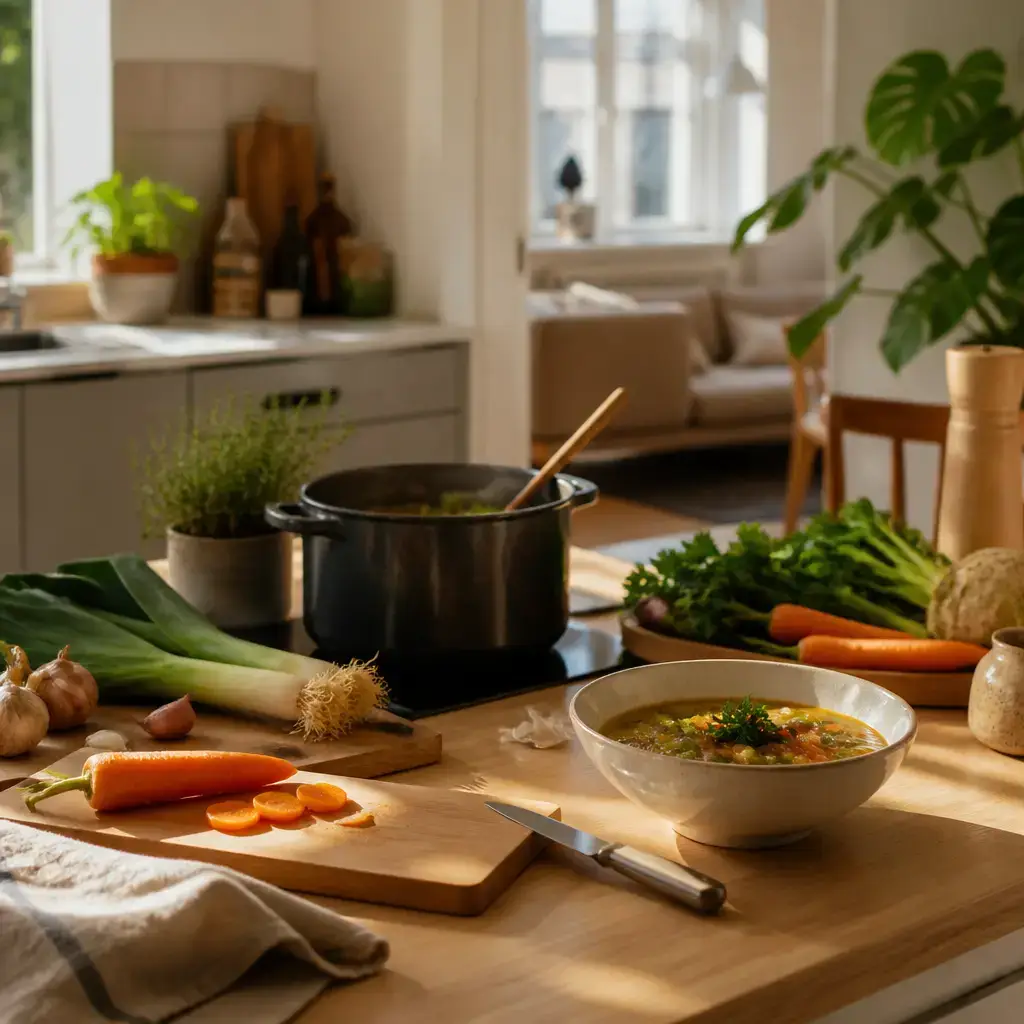
Ist Kochen dein Hobby?
ist KOH-khen dine HOB-bee? Is cooking your hobby?Ich mache gern einfaches Essen zu Hause.
ikh MAKH-uh gairn EYN-fakh-uhs ESS-un tsoo HOW-zuh. I like making simple food at home.Was machst du gern?
vahs makhst doo gairn? What do you like to make?Ich mache oft eine einfache Suppe.
ikh MAKH-uh oft EYE-nuh EYN-fakh-uh SUP-puh. I often make a simple soup.Benutzt du ein Rezept?
beh-NOOTST doo ine reh-TSEPT? Do you use a recipe?Ich benutze ein einfaches Rezept.
ikh beh-NOOT-suh ine EYN-fakh-uhs reh-TSEPT. I follow an easy one.Ich möchte die Suppe probieren, wenn sie fertig ist.
ikh MURKH-tuh dee SUP-puh proh-BEER-un, ven zee FAIR-tikh ist. I would like to try it when it is ready.Ich hebe etwas Suppe für dich auf.
ikh HAY-buh ET-vahs SUP-puh fyoor dikh owf. I will save some soup for you.Sentence explanations
Ist Kochen dein Hobby?
Is cooking your hobby?
- Ist
- is
- Kochen
- cooking
- dein
- your
- Hobby
- hobby
More detail
Ist is the present-tense form of sein (“to be”) for the third-person singular: sein → ist. In this sentence it comes first because German yes/no questions commonly place the finite verb before the subject: Ist ...? = “Is ...?” Kochen is the infinitive kochen (“to cook”) used as a noun, meaning “cooking” as an activity. German nominalized infinitives are capitalized and treated grammatically as neuter nouns. Compare Ich kochen (incorrect) with Ich koche (“I cook”); the capitalized form Kochen names the activity. dein means “your” when addressing one person informally with du. It is a possessive determiner related to du, not a form of Hobby. Here dein has the form used before a neuter singular nominative noun: dein Hobby. Possessive determiners take endings according to the noun phrase’s grammatical conditions; for example, deine Idee uses -e before feminine singular Idee. Hobby is a neuter singular noun meaning “hobby.” Its plural is Hobbys. In dein Hobby, the possessive determiner occupies the determiner position, so there is no separate indefinite article. This does not add a numerical claim. Together, Kochen is the subject, dein Hobby is the predicate noun phrase, and Ist marks the question. The whole utterance therefore means “Is cooking your hobby?”
Ich mache gern einfaches Essen zu Hause.
I like making simple food at home.
- Ich
- I
- mache
- make; do
- gern
- like to
- einfaches
- simple
- Essen
- food
- zu Hause
- at home
More detail
Ich is the first-person singular pronoun, “I.” It identifies the speaker as the person performing the action. The corresponding second-person singular form is du, as in a sentence addressed to one person. mache is the present-tense first-person singular form of machen, “to make” or “to do.” The pattern is ich mache (“I make/do”); here it means “make” because the object is food. gern is an adverb meaning “gladly” or, with an activity verb, “like to.” German commonly expresses a preference with gern after the conjugated verb: Ich lese gern. — “I like reading.” Here it marks a general liking for the activity. einfaches means “simple” here. It is the inflected form of the adjective einfach. In einfaches Essen, Essen is a neuter singular noun used as the accusative object, and there is no article or other determiner before the adjective. Therefore the adjective has the strong neuter singular accusative ending -es: einfach → einfaches. The ending belongs to the adjective, not to Essen. Essen is the noun “food” here. It is neuter and capitalized because German nouns are capitalized. In this sentence it is the object being made, and einfaches Essen means “simple food.” German also has the infinitive essen, “to eat”; the capitalized form and its role as a noun identify the form used here. zu Hause is the established expression “at home.” Hause occurs in this expression rather than being the ordinary modern form used for the noun in every context. The related destination expression nach Hause means “home” or “to home.” Together, Ich mache gives “I make,” gern adds the preference “like to,” einfaches Essen gives the thing made, and zu Hause gives the location. The complete meaning is: “I like making simple food at home.”
Was machst du gern?
What do you like to make?
- Was
- what
- machst
- make; do
- du
- you
- gern
- like to; gladly
More detail
Was means “what” here and asks for the thing affected by the action. It is the German question word used for an unspecified thing. For a person, German uses wer instead: Wer kommt? — “Who is coming?” machst is the form of machen (“to make; to do”) used with du in the present tense. The useful pattern is du machst; other present-tense forms include ich mache and sie machen. In this utterance, the fixed translation and context support the “make” sense: the question asks what the addressee likes to make. du is the informal singular “you.” It identifies the person addressed and is the subject of machst. German uses ihr for informal plural “you,” but that is a different form and would require a different verb form: Ihr macht ... — “You all make ...” gern is an adverb meaning “gladly” or, with an activity, “like to.” It commonly follows the conjugated verb: Ich lese gern. — “I like reading.” It does not itself mark tense; the present-time form is carried by machst. Together, Was machst du gern? follows the pattern question word + conjugated verb + subject + gern. Literally, it asks “What do you like to make?” The nearby sentence shows a compatible answer about making simple food at home, and the next one gives a specific example: making a simple soup. The question itself does not specify which thing the person likes to make.
Ich mache oft eine einfache Suppe.
I often make a simple soup.
- Ich
- I
- mache
- make
- oft
- often
- eine
- a
- einfache
- simple
- Suppe
- soup
More detail
Ich is the first-person singular pronoun, meaning “I.” It identifies the speaker as the person doing the action. The corresponding second-person singular form is du, as in Was machst du gern? (“What do you like to make?”). mache is the present-tense first-person singular form of machen (“to make” or “to do”). The useful pattern is ich mache = “I make/do”; the verb ending matches ich here. Example: Ich mache Kaffee. — “I make coffee.” oft means “often.” It describes repeated frequency and modifies the action mache here. Example: Ich koche oft. — “I often cook.” eine is the indefinite article used here with a feminine singular noun in the accusative case. It introduces a non-specific soup; it does not by itself state a numerical count. In this sentence, the article marks the noun phrase as the object of mache. Compare eine Suppe with ein Rezept in the next question; the article form reflects the noun’s grammatical gender and case. einfache means “simple” here. Its base form is the adjective einfach; einfache is the form used before the feminine singular noun Suppe in this noun phrase. Because the phrase is feminine singular accusative with an indefinite article, the adjective has the ending -e. Example: eine einfache Aufgabe — “a simple task.” Suppe means “soup.” It is a feminine noun. Here it is the accusative object of mache, forming eine einfache Suppe. Example: Die Suppe ist warm. — “The soup is warm.” Together, Ich mache gives “I make,” oft adds the frequency “often,” and eine einfache Suppe gives the object “a simple soup.” German therefore expresses the complete utterance as “I often make a simple soup.”
Benutzt du ein Rezept?
Do you use a recipe?
- Benutzt
- use
- du
- you
- Rezept
- recipe
More detail
Benutzt is the present-tense form of benutzen (“to use”) for du (“you”): ich benutze, du benutzt. The ending -st marks the second-person singular here. Example: Benutzt du einen Löffel? — “Do you use a spoon?” du is the informal singular “you.” It refers to one person addressed directly. In this question, it is the subject of benutzt. Rezept means “recipe.” Its base form is das Rezept; after the indefinite article, the phrase is ein Rezept. The plural is Rezepte, as in zwei Rezepte — “two recipes.” In a German yes/no question, the conjugated verb comes before the subject: Benutzt du ...? This contrasts with the statement order Du benutzt ... — “You use ...” The phrase ein Rezept means “a recipe”; ein is an indefinite article and does not by itself assert a numerical count. Together, Benutzt + du forms “do you use,” and ein Rezept supplies what is used. The whole utterance therefore means: “Do you use a recipe?”
Ich benutze ein einfaches Rezept.
I follow an easy one.
- benutze
- use; follow
- einfaches
- easy; simple
- Rezept
- recipe
More detail
benutze is the first-person singular present form of benutzen (“to use”). With Ich, it means “I use”; in this sentence, the fixed translation supports the natural English rendering “I follow” an easy recipe. The form changes with the subject: ich benutze, but du benutzt (“you use”), as in the preceding question. Example: Ich benutze mein Handy. — “I use my phone.” einfaches is the adjective einfach (“easy, simple”) with the ending -es. It describes Rezept, which is neuter (das Rezept). Because the noun phrase is an indefinite neuter object after benutzen, the form is ein einfaches Rezept. The adjective itself carries the -es ending; it is not a form of the noun. Example: Ich lese ein einfaches Buch. — “I read an easy book.” Rezept means “recipe.” Its base form is Rezept; its plural is Rezepte. Here it is the thing being used, namely the recipe referred to by the translation as “one.” Example: Das Rezept ist einfach. — “The recipe is easy.” Together, Ich benutze identifies the speaker as the user, and ein einfaches Rezept identifies what is used: an easy recipe. Thus the whole utterance means “I use an easy recipe,” naturally rendered by the fixed translation as “I follow an easy one.”
Ich möchte die Suppe probieren, wenn sie fertig ist.
I would like to try it when it is ready.
- Ich möchte
- I would like
- Suppe
- soup
- probieren
- to try
- wenn
- when
- sie
- it
- fertig
- ready
- ist
- is
More detail
Ich möchte expresses a polite or less direct wish: “I would like.” möchte is the first-person singular form used with ich; it is followed here by the infinitive probieren. Example: Ich möchte gehen. — “I would like to go.” Suppe means “soup.” It is a feminine German noun: die Suppe. Its grammatical gender supports the feminine singular pronoun sie used later; singularity alone does not determine gender. probieren means “to try” and here means to taste the soup. It is an infinitive. After möchte, the lexical verb remains in the infinitive and appears at the end of the main clause: Ich möchte die Suppe probieren. — “I would like to try the soup.” wenn introduces a conditional or time clause. Here it means “when,” introducing the time at which the speaker wants to try the soup. In a clause introduced by wenn, the finite verb goes to the end. sie means “it” here and refers to the soup. It is a feminine singular pronoun agreeing with feminine die Suppe. Lowercase sie can have other functions in German, including “she” or “they”; capitalized Sie is the formal “you,” so that is a different written form. fertig means “ready” in this sentence. With food, it can mean ready to eat or finished cooking. Example: Die Suppe ist fertig. — “The soup is ready.” ist is the third-person singular present form of sein, “to be”: sein → ist. It appears at the end because wenn sie fertig ist is a subordinate clause. The reusable pattern is wenn + subject + description + finite verb. Together, Ich möchte die Suppe probieren means “I would like to try the soup,” and wenn sie fertig ist means “when it is ready.” The complete utterance is: “I would like to try it when it is ready.”
Ich hebe etwas Suppe für dich auf.
I will save some soup for you.
- Ich
- I
- hebe … auf
- save; set aside
- etwas
- some
- Suppe
- soup
- für dich
- for you
More detail
Ich is the first-person singular pronoun, meaning “I.” It identifies the speaker as the person doing the saving. German pronouns change form by grammatical role; for example, ich is the subject form, while mich is the corresponding accusative form: Ich sehe mich = “I see myself.” hebe ... auf comes from the separable verb aufheben. Here it means “to save” or “to set aside” for later, not simply “to lift up.” The observed form hebe is the present-tense first-person singular form of aufheben; the prefix auf appears at the end of the clause. A useful pattern is Ich hebe X auf = “I save/set aside X.” German present tense can also refer to a planned or expected future action, which fits the fixed translation “I will save.” etwas means “some” in this sentence. It expresses an unspecified amount, not a precise quantity. It is commonly used with an uncountable substance: Ich trinke etwas Wasser. = “I drink some water.” Suppe means “soup.” It is a feminine noun, conventionally written with a capital letter in German. In etwas Suppe, it names the substance being saved; etwas indicates an unspecified amount of it. für dich means “for you.” für is a preposition that takes the accusative case, so the second-person singular pronoun is dich, not the subject form du: Das ist für dich. = “That is for you.” This is addressed to one person in the informal singular form. Together, Ich hebe etwas Suppe auf means “I will save some soup for you.” The speaker is the person who sets aside an unspecified amount of soup, and für dich identifies the intended beneficiary. The separable parts of aufheben combine around the object: Ich + hebe + etwas Suppe + für dich + auf.
Grammar Points
aufheben → hebe ... auf
Ich hebe etwas für dich auf.
ikh HAY-buh ET-vahs fyoor dikh owf.I save something for you.
aufheben is a separable verb: in a main clause, auf moves to the end.
wenn + verb at the end
Wenn du fertig bist, hebe etwas für dich auf.
ven doo FAIR-tikh bist, HAY-buh ET-vahs fyoor dikh owf.When you are finished, save something for yourself.
In a clause with wenn, the conjugated verb goes to the end.
German Vocabulary
Quiz
Word Order
Arrange the words in the correct order.
Is cooking your hobby?
Show Answer
Ist Kochen dein Hobby?What do you like to make?
Show Answer
Was machst du gern?I often make a simple soup.
Show Answer
Ich mache oft eine einfache Suppe.Spelling
Tap the letters to spell the word.
cooking
Show Answer
Kochenhobby
Show Answer
Hobbysimple; easy
Show Answer
einfachessoup