10 minutes free every day
Continue audio lessons in the app
Word explanations appear automatically in sync with the audio.
No login required · synced translations · playback with the screen locked
Choose your learning language and open this lesson in the app.

About This Lesson
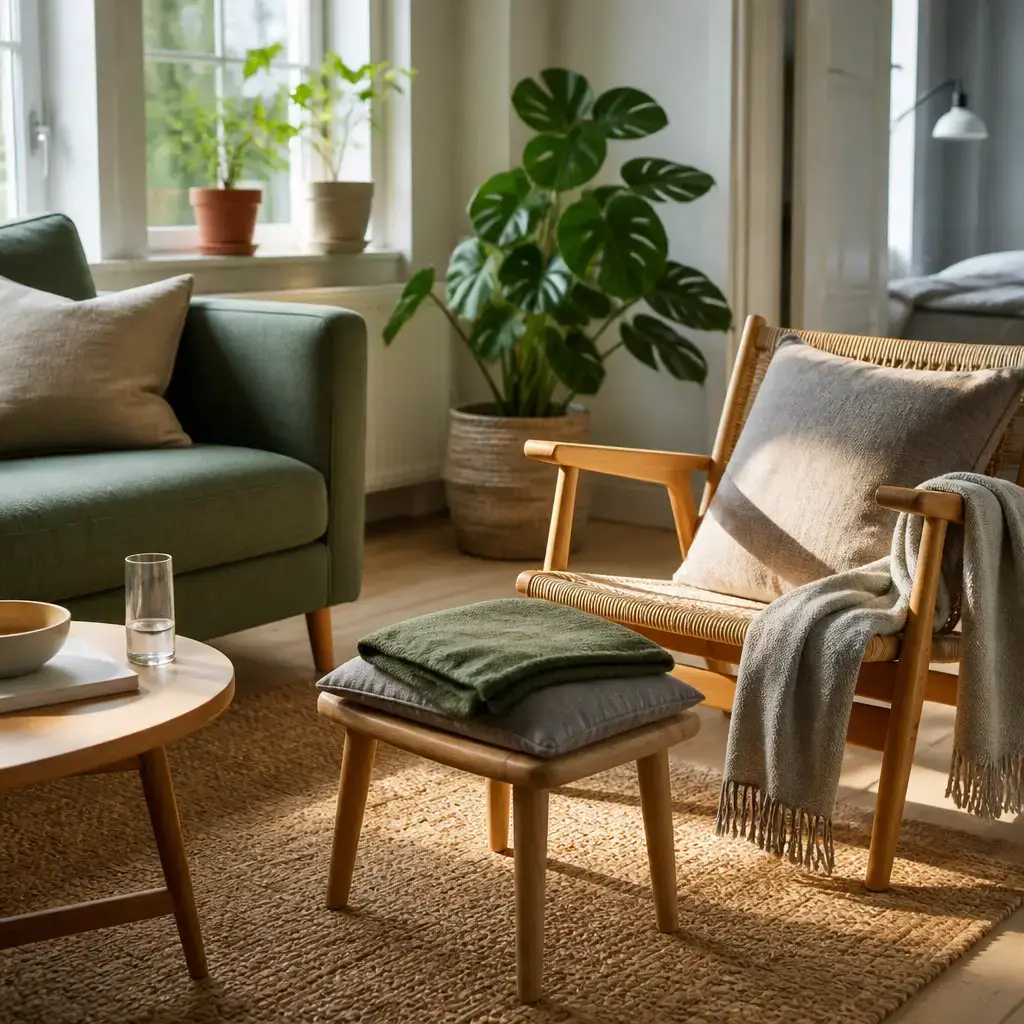
Use Resting a Sore Leg to practice German conversation, pronunciation, vocabulary, grammar, and quizzes.
Dialogue
Mein Bein tut ein bisschen weh.
mine BYNE toot uh BISS-hen vay My leg hurts a little.Setz dich einen Moment auf diesen Stuhl.
ZETS dikh EYE-nen moh-MENT owf DEE-zen shtool Sit on this chair for a moment.Ich bin heute zu viel gelaufen.
ikh bin HOY-tuh tsoo feel guh-LOW-fen I walked too much today.Leg dein Bein hier hoch und ruh dich aus.
layk dine BYNE heer hohkh unt roo dikh ous Put your leg up here and rest.Darf ich später ein bisschen herumgehen?
darf ikh SHPAY-tuh ine BISS-hen heh-ROOM-gay-en Can I walk around a little later?Geh nur, wenn es sich gut anfühlt.
gay noor, ven ess zikh goot AHN-fyoolt Walk only if it feels all right.Das Sofa ist bequemer als dieser Stuhl.
dahs ZOH-fah ist beh-KVAY-muh als DEE-zuh shtool The sofa feels better than this chair.Dann setz dich dorthin und halte dein Bein still.
dahn ZETS dikh DORT-hin unt HAL-tuh dine BYNE shtil Then sit there and keep your leg still.Sentence explanations
Mein Bein tut ein bisschen weh.
My leg hurts a little.
- Mein
- my
- Bein
- leg
- tut … weh
- hurts
- ein bisschen
- a little
More detail
Mein means “my” here and agrees with the singular neuter noun Bein. The possessive determiner has the form mein in this nominative neuter context; compare meine with a feminine noun such as meine Hand (“my hand”). The form expresses the possessor, not a numerical count. Bein means “leg” here. Its base form is Bein; the plural is Beine. German nouns are capitalized. Example: Mein Bein ist müde. — “My leg is tired.” tut ... weh is the useful German pattern for saying that something hurts. tut is the third-person singular present form of tun (“to do”), but in this expression the separated combination weh tun means “to hurt.” In a main clause, tut appears in the verb position while weh comes later: Mein Bein tut weh. — “My leg hurts.” The body part is the grammatical subject. A person who feels the pain can also be expressed with a dative pronoun, for example Mein Bein tut mir weh. — “My leg hurts me.” ein bisschen reduces the degree: “a little” or “slightly.” In this sentence it modifies how much the leg hurts. Example: Der Kopf tut ein bisschen weh. — “The head hurts a little.” Together, Mein Bein identifies the speaker’s leg, tut ... weh says that it hurts, and ein bisschen limits the degree of the pain. The complete utterance therefore means: “My leg hurts a little.”
Setz dich einen Moment auf diesen Stuhl.
Sit on this chair for a moment.
- Setz
- sit down
- dich
- yourself
- einen Moment
- for a moment
- auf
- onto
- diesen
- this
- Stuhl
- chair
More detail
Setz is the informal singular imperative of setzen. In this sentence it appears with reflexive dich in the reusable pattern Setz dich!, meaning “Sit down!” German distinguishes sich setzen (to move into a sitting position) from sitzen (to be seated): Ich setze mich = “I sit down,” while Ich sitze = “I am sitting.” dich is the informal singular accusative reflexive pronoun, referring back to the person being addressed. The same pattern changes with the subject: Setzt euch! means “Sit down!” when addressing several people. Here, Setz dich functions together as the command to sit down; dich is not a separate object being acted on independently. einen Moment is a common time expression meaning “for a moment” or “briefly.” Moment is a masculine noun, and einen is its accusative singular article in this expression. This phrase gives the duration of the requested action; it does not necessarily assert an exact measured unit of time. auf means “onto” here because the phrase describes movement toward a surface. With two-way prepositions such as auf, movement toward a destination takes the accusative: auf den Stuhl. For a fixed location, German uses the dative instead: auf dem Stuhl = “on the chair.” diesen is the masculine accusative singular form of the demonstrative dieser, “this.” It agrees with the masculine noun Stuhl while also marking the accusative required by movement with auf. The demonstrative identifies the chair intended in the sentence; its form is not the reason for the command itself. Stuhl means “chair.” Its plural is Stühle: Die Stühle sind frei. = “The chairs are free.” In the fixed utterance, Stuhl is singular and follows the masculine accusative form diesen. Together, Setz dich gives the informal singular command to sit down, auf diesen Stuhl specifies the destination, and einen Moment specifies the brief duration. The whole utterance therefore means: “Sit on this chair for a moment.”
Ich bin heute zu viel gelaufen.
I walked too much today.
- Ich bin
- I am (perfect auxiliary)
- heute
- today
- zu viel
- too much
- gelaufen
- walked
More detail
Ich bin: Ich means “I,” and bin is the first-person singular present form of sein (“to be”). Here bin is the auxiliary in the German perfect construction; it does not mean English “have.” With the movement meaning of laufen used here, German forms the perfect with sein: ich bin gelaufen. Example: Ich bin nach Hause gelaufen. — “I walked home.” heute: This is the time adverb “today.” It specifies when the walking happened. Example: Heute arbeite ich. — “Today I am working.” zu viel: This means “too much” and expresses an excessive amount. zu marks excess here, unlike viel alone, which means “much” or “a lot.” Example: Das ist zu viel. — “That is too much.” gelaufen: This is the past participle of laufen, whose meaning can be “to walk” or “to run” depending on context. In this fixed sentence, the fixed translation selects “walked.” Together with bin, it forms the perfect: bin gelaufen. Example: Sie ist schnell gelaufen. — “She walked or ran quickly.” Together, Ich bin ... gelaufen expresses “I walked,” heute adds “today,” and zu viel says that the amount of walking was excessive. The complete meaning is: “I walked too much today.”
Leg dein Bein hier hoch und ruh dich aus.
Put your leg up here and rest.
- Leg
- put / place
- dein
- your
- Bein
- leg
- hier
- here
- hoch
- up
- ruh dich aus
- rest
More detail
Leg is the informal singular imperative of legen, “to lay/put something down or in a position.” Here it is part of the separable verb hochlegen: Leg ... hoch means “put ... up.” The subject “you” is understood in this imperative and is not written. Example: Leg das Buch auf den Tisch. — “Put the book on the table.” dein means “your” and agrees with the possessed noun. With singular neuter Bein in the accusative, it has the form dein; compare deine Hand with feminine Hand and deinen Fuß with masculine accusative Fuß. These forms mark the grammatical relationship, not a numeric quantity. Bein is the neuter noun “leg.” Its plural is Beine. In this sentence, dein Bein is the thing being put up, so it is the accusative object of hochlegen. hier means “here,” indicating the place relevant to the speaker or situation. It modifies the placement expressed by Leg ... hoch; it is not part of the verb. hoch means “up” and completes the separable verb hochlegen in this clause. In a main-clause imperative, the separable part comes at the end: Leg dein Bein hoch. A related but different verb is aufstehen, “to get up”; auf does not mean that the speaker is putting an object up. ruh dich aus is the informal singular imperative of the reflexive verb sich ausruhen, “to rest.” The verb stem appears as ruh, dich is the reflexive pronoun for “you,” and aus is the separated verb part. Example: Ruh dich nach der Arbeit aus. — “Rest after work.” The form dich belongs to the informal singular addressee; a formal command uses Ruhen Sie sich aus. The first coordinated command is Leg dein Bein hier hoch: the understood “you” is told to put the listener’s leg up in the indicated place. und joins it to the second command, ruh dich aus, telling the same listener to rest. Together, the utterance means: “Put your leg up here and rest.”
Darf ich später ein bisschen herumgehen?
Can I walk around a little later?
- Darf ich
- Can I
- später
- later
- ein bisschen
- a little
- herumgehen
- walk around
More detail
Darf ich combines the present-tense form darf of dürfen (“may/be allowed to”) with ich (“I”). Here it asks for permission: “May I…?” Darf is the first-person singular form matching ich. In a yes/no question, the finite verb comes before the subject: Darf ich …? Compare Ich darf … (“I may …”) with Darf ich …? (“May I …?”). später means “later,” referring to a time after the current point. Example: Ich komme später. — “I’ll come later.” ein bisschen means “a little” or “a bit.” Here it limits the extent of the walking. It is a small-amount expression; ein does not by itself assert one separately counted object. Example: Warte ein bisschen. — “Wait a little.” herumgehen means “to walk around.” It is an infinitive used here after the modal verb darf. The separable verb appears as Ich gehe herum. in an ordinary present-tense statement, but after a modal verb the infinitive stays together at the end: Ich darf herumgehen. Together, Darf ich asks permission, später places the action later, ein bisschen limits its extent, and herumgehen names the permitted activity. The complete utterance means: “Can I walk around a little later?”
Geh nur, wenn es sich gut anfühlt.
Walk only if it feels all right.
- Geh
- go / walk
- nur
- only
- wenn
- if / when
- es
- it
- gut
- well / all right
- sich … anfühlt
- feels
More detail
Geh is the informal singular imperative of gehen (“to go,” and in this context “to walk”). The imperative addresses one person directly. For a formal addressee, German uses Gehen Sie; for several people addressed informally, Geht is used. nur means “only.” Here it limits the condition for going: going is presented as appropriate only under the condition that follows. Its exact scope comes from the combination with the following wenn-clause. wenn introduces a condition: “if.” It can also mean “when” for a repeated or future situation, but here the fixed translation supports the conditional reading. In a wenn-clause, the finite verb goes to the end. es is the pronoun used as the subject of the impersonal expression es fühlt sich gut an, corresponding here to “it feels all right.” The sentence does not identify a separate concrete referent for es. gut means “good” or, in this expression, “all right.” After sich anfühlen, it describes how something feels. Its comparative form is besser (“better”): Das fühlt sich besser an means “That feels better.” gut itself is the form used in the fixed sentence. sich and anfühlt form the separated reflexive verb sich anfühlen (“to feel”). The finite form is anfühlt, from sich anfühlen, with a third-person singular present-tense ending -t; sich is the reflexive element. In a main clause, the separable prefix appears at the end: Es fühlt sich gut an (“It feels all right”). Inside the wenn-clause, the finite verb is placed at the end and the prefix is joined to it: wenn es sich gut anfühlt (“if it feels all right”). Together, wenn es sich gut anfühlt means “if it feels all right.” Placing this condition after nur yields “only if it feels all right,” and the imperative Geh makes the complete utterance: “Walk only if it feels all right.”
Das Sofa ist bequemer als dieser Stuhl.
The sofa feels better than this chair.
- Sofa
- sofa
- ist
- is
- bequemer
- more comfortable
- als
- than
- dieser
- this
- Stuhl
- chair
More detail
Sofa means “sofa.” It is a neuter noun: das Sofa. German nouns are capitalized. Example: Das Sofa ist neu. — “The sofa is new.” ist is the third-person singular present form of sein (“to be”). It can link a subject with a description: Der Stuhl ist bequem. — “The chair is comfortable.” bequemer is the comparative form of the adjective bequem (“comfortable”). The chain is bequem — “comfortable,” bequemer — “more comfortable,” am bequemsten — “the most comfortable.” Here it describes the sofa as more comfortable, matching the fixed meaning “feels better” in this comparison. als introduces the standard of comparison after a comparative: bequemer als ... — “more comfortable than ...”. Do not confuse this use with wenn (“if/when”), which introduces a condition or time clause. dieser means “this” and agrees with the noun it accompanies. With masculine singular Stuhl in the nominative, the form is dieser; other forms include diese for feminine singular or plural and dieses for neuter singular. Example: Dieser Tisch ist groß. — “This table is large.” Stuhl means “chair.” It is a masculine noun: der Stuhl. Example: Der Stuhl ist bequem. — “The chair is comfortable.” Together, Das Sofa ist bequemer als dieser Stuhl says that the sofa is more comfortable than this chair. The comparative bequemer supplies the “more comfortable” relation, and als dieser Stuhl identifies the chair used for comparison. In the fixed translation, this is expressed naturally as “The sofa feels better than this chair.”
Dann setz dich dorthin und halte dein Bein still.
Then sit there and keep your leg still.
- Dann
- then
- setz
- sit
- dich
- yourself
- dorthin
- there
- halte
- keep; hold
- dein
- your
- Bein
- leg
- still
- still
More detail
Dann means “then” and places this instruction after something already mentioned or understood. It is a time adverb and does not change form. setz is the informal singular imperative of sich setzen, “to sit down.” The verb is reflexive here: du setzt dich becomes Setz dich! in the command. The imperative form setz addresses one person informally; a formal command uses a different form. Example: Setz dich bitte. — “Please sit down.” dich is the accusative reflexive pronoun referring to the person being addressed. It belongs with setz, not with the later instruction. Compare Du setzt dich. — “You sit down.” and Du setzt ihn. — “You seat him.” dorthin means “there” with a destination or direction: it indicates where the person should sit. German distinguishes this directional word from dort, which generally means “there” as a location: Geh dorthin. — “Go there.” halte is the informal singular imperative of halten, “to keep” or “to hold.” Here it means maintaining a condition, not physically holding the leg in one’s hands. Example: Halte die Tür offen. — “Keep the door open.” dein is the informal singular possessive determiner, “your.” It agrees with the possessed noun, not with the owner. Before Bein, a neuter accusative noun, it appears as dein: dein Bein. The corresponding form before a feminine noun is deine, as in deine Hand — “your hand.” Bein means “leg” in this sentence. Its base form is the noun Bein; the plural is Beine. With halten, it is the object being kept still: Halte dein Bein still. — “Keep your leg still.” still describes the condition to be maintained: the leg should not move. In this use it functions predicatively after halten; it is not an inflected adjective before a noun. The related opposite is beweglich or, for the immediate contrast, in Bewegung: Halte deine Hand still. — “Keep your hand still.” Together, Dann setz dich dorthin means “Then sit there,” with dich marking the reflexive action and dorthin specifying the destination. und halte dein Bein still adds the coordinated instruction “and keep your leg still.” The complete utterance is therefore: “Then sit there and keep your leg still.”
Grammar Points
Trennbare Verben: tun ... weh / legen ... hoch
Das Bein tut ein bisschen weh. Leg es hoch.
dahs BYNE toot uh BISS-hen vay. layk ess hohkh.The leg hurts a little. Put it up.
Bei trennbaren Verben steht die Vorsilbe im Hauptsatz am Ende: tut ... weh, leg ... hoch.
wenn + Nebensatz: ... sich ... anfühlt
Wenn sich das Bein gut anfühlt, geh später herum.
ven zikh dahs BYNE goot AHN-fyoolt, gay SHPAY-tuh heh-ROOM.When the leg feels all right, walk around later.
Nach „wenn“ steht das konjugierte Verb im Nebensatz am Ende: sich ... anfühlt.
German Vocabulary
Setz dich einen Moment auf diesen Stuhl.
Mein Bein tut ein bisschen weh.
Mein Bein tut ein bisschen weh.
Ich bin heute zu viel gelaufen.
Leg dein Bein hier hoch und ruh dich aus.
Leg dein Bein hier hoch und ruh dich aus.
Ich bin heute zu viel gelaufen.
Setz dich einen Moment auf diesen Stuhl.
Setz dich einen Moment auf diesen Stuhl.
Setz dich einen Moment auf diesen Stuhl.
Mein Bein tut ein bisschen weh.
Ich bin heute zu viel gelaufen.
Quiz
Word Order
Arrange the words in the correct order.
My leg hurts a little.
Show Answer
Mein Bein tut ein bisschen weh.I walked too much today.
Show Answer
Ich bin heute zu viel gelaufen.Can I walk around a little later?
Show Answer
Darf ich später ein bisschen herumgehen?Spelling
Tap the letters to spell the word.
to walk; to run
Show Answer
gelaufenmoment
Show Answer
Momentchair
Show Answer
Stuhltoday