10 minutes free every day
Continue audio lessons in the app
Word explanations appear automatically in sync with the audio.
No login required · synced translations · playback with the screen locked
Choose your learning language and open this lesson in the app.

About This Lesson
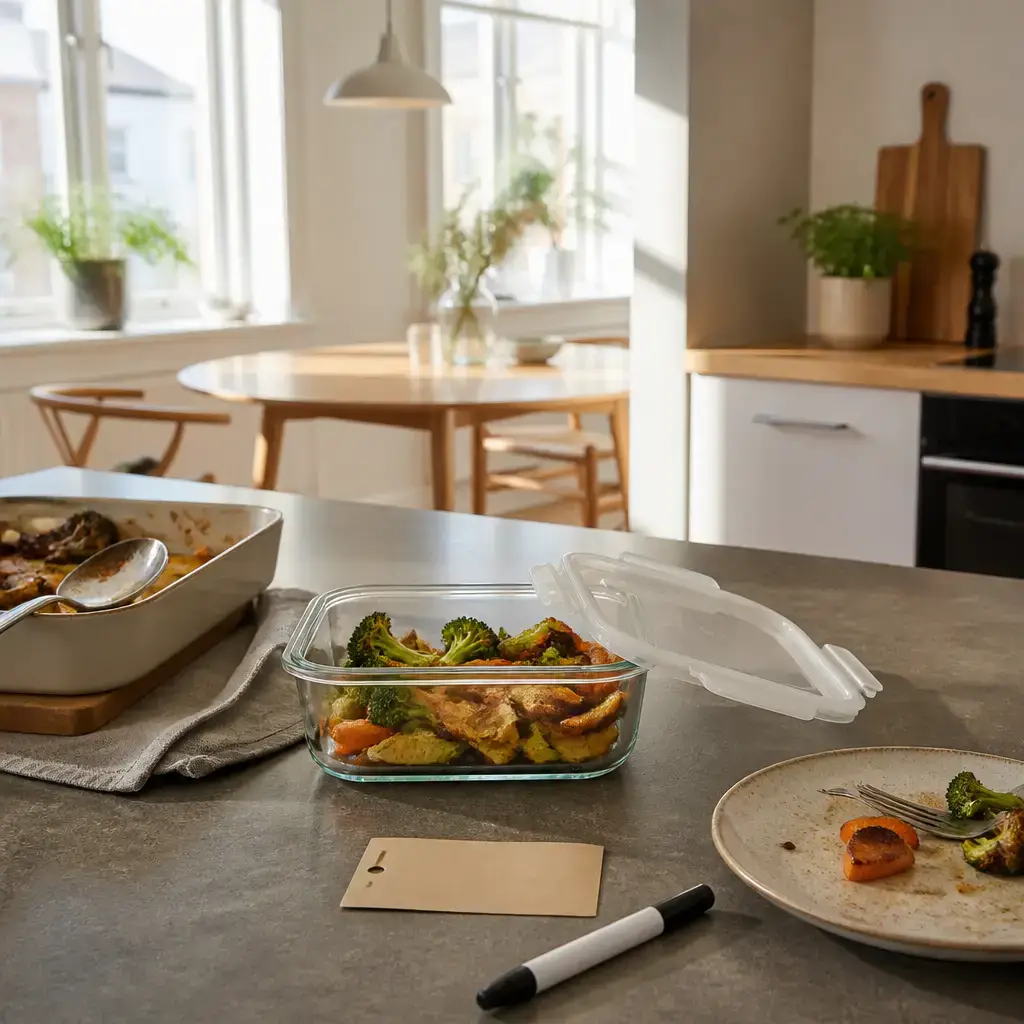
Use Saving leftovers for tomorrow's lunch to practice German conversation, pronunciation, vocabulary, grammar, and quizzes.
Dialogue
Es sind viele Reste vom Abendessen übrig.
ess zint FEE-luh RES-tuh fom AH-bent-ess-en UE-brikh There are a lot of leftovers from dinner.Lass sie uns in einen sauberen Behälter tun.
lass zee oons in EYE-nen ZOW-buh-ren beh-HEL-ter toon Let's put them in a clean container.Kann ich sie morgen zum Mittagessen aufwärmen?
kahn ikh zee MOR-gen tsoom MIT-tahk-ess-en OWF-vair-men Can I reheat them for lunch tomorrow?Das kannst du, wenn wir sie bis dahin im Kühlschrank aufbewahren.
dahs kahnst doo, venn veer zee biss dah-HIN im KUEHL-shrank OWF-buh-VAH-ren You can if we keep them in the fridge until then.Soll ich ein Etikett auf den Behälter kleben?
zoll ikh ayn eh-tee-KETT owf dayn beh-HEL-ter KLAY-ben Should I put a label on the container?Dann wissen wir morgen, was drin ist.
dahn VISS-en veer MOR-gen, vahss drin ist That way, tomorrow we will know what is inside.Ich klebe ein deutliches Etikett darauf.
ikh KLAY-buh ayn DOYT-likh-es eh-tee-KETT dah-ROWF I'll put a clear label on it.Das macht das Mittagessen einfacher.
dahs mahkht dahs MIT-tahk-ess-en EYN-fahkher That will make lunch easier.Sentence explanations
Es sind viele Reste vom Abendessen übrig.
There are a lot of leftovers from dinner.
- Es sind
- there are
- viele
- many; a lot of
- Reste
- leftovers
- vom
- from the
- Abendessen
- dinner
- übrig
- left over
More detail
Es sind introduces an existence statement: “there are.” sind is the third-person plural present form of sein (“to be”), chosen because the thing that exists, Reste, is plural. Here Es is an introductory subject rather than a specifically identified thing. A reusable pattern is Es sind + plural noun: Es sind drei Stühle hier. — “There are three chairs here.” viele means “many” or, naturally in this translation, “a lot of.” It is a quantity word used with the plural noun Reste; it does not itself state an exact number. Compare singular viel with an uncountable noun: viel Wasser — “a lot of water.” Reste means “leftovers” here. Its base form is singular der Rest (“the remainder” or “leftover”); Reste is its plural form. The plural noun is the grammatical subject of the existence statement. Example: Die Reste sind im Kühlschrank. — “The leftovers are in the refrigerator.” vom is the contracted form of von dem, meaning “from the” in this context. von takes the dative case, and dem is the dative masculine or neuter definite article. The following noun, Abendessen, is neuter: das Abendessen; therefore von dem Abendessen contracts to vom Abendessen. Abendessen means “dinner” as a meal. It is a neuter noun, so its definite article is das: das Abendessen. In this sentence, vom Abendessen identifies the source of the leftovers: they are leftovers from dinner. übrig means “left over” or “remaining.” In übrig sein, it describes what remains after some has been used or consumed. It is not the form of Reste; Reste is the noun, while übrig is the descriptive word. Example: Es ist noch Kuchen übrig. — “There is still cake left.” Together, Es sind viele Reste says “There are a lot of leftovers,” vom Abendessen specifies that they are from dinner, and übrig states that they remain. The complete utterance therefore means: “There are a lot of leftovers from dinner.”`
Lass sie uns in einen sauberen Behälter tun.
Let's put them in a clean container.
- Lass
- let’s
- sie
- them
- uns
- us
- in einen
- into a
- sauberen
- clean
- Behälter
- container
- tun
- put
More detail
Lass is the 2nd-person singular imperative of lassen (“to let” or “to leave”). With uns and another verb in the infinitive, Lass uns ... is a common way to say “let’s ...”. Here, Lass addresses one person; it is not the main action “put.” sie means “them” here. It is the object being put into the container. In the supplied context, it refers to the leftovers mentioned previously and in the translation. The form sie can have other grammatical functions in German, but its role here is determined by this sentence and context. uns means “us.” In Lass ... uns ... tun, it identifies the people who will carry out the infinitive action: “let us put ...”. The form is also used for other roles in German, so its exact role comes from this construction. in einen expresses movement into a destination. The accusative form einen follows in when the meaning is movement into something; in einem would be used for location inside something without movement. einen is the masculine singular accusative form of the indefinite article ein. sauberen means “clean.” It is the inflected form of the adjective sauber. Here it describes the masculine singular noun Behälter in the accusative phrase einen sauberen Behälter. The ending -en is required by this article-and-case combination; it is not an inflection of Behälter. Behälter means “container.” Its base form is Behälter; the plural is also Behälter, with the article distinguishing forms when needed. For example, ein Behälter means “a container,” while mehrere Behälter means “several containers.” tun is the infinitive of tun, a broad verb meaning “to do” or, in suitable contexts, “to put/place.” It comes at the end of this German infinitive construction. Here it describes placing the leftovers in the container, not merely doing something in general. The pattern is Lass ... [object] ... tun = “let ... put/do ...”. Together, Lass sie uns in einen sauberen Behälter tun means “Let us put them into a clean container.” uns supplies the people carrying out the action, sie is what is moved, and in einen sauberen Behälter gives the destination. The infinitive tun completes the action after the imperative Lass.
Kann ich sie morgen zum Mittagessen aufwärmen?
Can I reheat them for lunch tomorrow?
- Kann ich
- Can I
- sie
- them
- morgen
- tomorrow
- zum Mittagessen
- for lunch
- aufwärmen
- reheat
More detail
Kann ich forms a yes/no question with können (“can, be able to”). kann is the present-tense form for ich; the subject ich follows it here. With a modal verb, the other verb remains an infinitive at the end: Kann ich ... aufwärmen? means “Can I reheat ...?” Example: Kann ich kurz helfen? — “Can I help briefly?” sie means “them” here. It is the accusative plural pronoun, referring to the food already mentioned. The form sie can also have other grammatical roles in German, so its exact role comes from the sentence; here it is the thing being reheated. morgen means “tomorrow” and places the action on the following day. It can also appear in other positions, but its time meaning stays the same in this sentence. zum Mittagessen means “for lunch.” zum is the contracted form of zu dem; this phrase uses zu to mark the occasion or intended time associated with lunch. Mittagessen is a neuter noun and is capitalized in German. aufwärmen means “to reheat” or “to warm up.” It is a separable verb: without a modal, the first-person present form is ich wärme ... auf, but after kann the infinitive aufwärmen stays together at the end. This verb is used for food that is being made warm again, rather than cooked from the beginning. Together, Kann ich asks for permission or possibility, sie identifies the food being reheated, morgen sets the time, and zum Mittagessen gives the occasion. The final infinitive aufwärmen completes the modal construction, producing: “Can I reheat them for lunch tomorrow?” This is a natural everyday way to ask whether reheating the food will be possible or permitted.
Das kannst du, wenn wir sie bis dahin im Kühlschrank aufbewahren.
You can if we keep them in the fridge until then.
- Das
- that
- kannst du
- you can
- wenn wir
- if we
- sie
- them
- bis dahin
- until then
- Kühlschrank
- fridge
- aufbewahren
- keep; store
More detail
Das is a demonstrative pronoun meaning “that” here. It points to the action under discussion rather than naming a noun. As a pronoun, it stands independently; compare the reusable pattern Das kann ich — “I can do that.” kannst du means “you can.” The verb is können, “to be able to/can”; kannst is its present-tense second-person singular form with du. The modal verb comes before the subject in this main clause because the clause begins with Das, while the finite verb remains in the second position: Das kannst du .... Example: Das kannst du morgen machen. — “You can do that tomorrow.” wenn wir begins a conditional clause: “if we.” wenn introduces the condition, and wir is the first-person plural subject. In a German wenn-clause, the finite verb normally goes to the end. The condition here is completed by aufbewahren at the end of the clause. sie means “them” in this sentence. The fixed translation identifies it as a plural object. Here it is the accusative object of aufbewahren; the visible form sie is also the nominative form for a plural third-person pronoun, so the form itself does not show the case. Example: Wir sehen sie. — “We see them.” bis dahin means “until then.” bis marks the endpoint in time, and dahin refers to that previously understood time or point. Together, they form a useful time expression: Warte bis dahin. — “Wait until then.” Kühlschrank means “fridge” or “refrigerator.” The full location phrase in the sentence is im Kühlschrank, literally “in the fridge”; im is the contracted form of in dem. With a stationary location, in takes the dative here, giving dem Kühlschrank. The noun is masculine: der Kühlschrank, with plural die Kühlschränke. aufbewahren means “to keep” or “to store.” It is an infinitive, and in this sentence it stays whole at the end of the wenn-clause. It is a separable-prefix verb consisting of auf + bewahren, but the infinitive is written as one word. Example: Wir bewahren das Essen im Kühlschrank auf. — “We store the food in the fridge.” In the subordinate clause, the same verb appears as the complete infinitive at the end: ..., wenn wir das Essen im Kühlschrank aufbewahren. The whole structure is Das kannst du, wenn ...: “You can do that if ...” The main clause says that the earlier-mentioned action is possible. The wenn-clause supplies the condition: the items (sie) are to be kept in the fridge until the indicated time (bis dahin). Thus the complete utterance means: “You can if we keep them in the fridge until then.”
Soll ich ein Etikett auf den Behälter kleben?
Should I put a label on the container?
- Soll ich
- Should I
- Etikett
- label
- auf
- on; onto
- Behälter
- container
- kleben
- stick; put on
More detail
Soll ich begins a yes/no question: sollen means “should/be supposed to,” and ich is the first-person singular subject. In this pattern, the finite verb comes first and the subject follows: Soll ich ...? = “Should I ...?” The form soll is the present-tense form of sollen for ich and er/sie/es; the subject identifies which meaning applies. Example: Soll ich warten? — “Should I wait?” Etikett means “label.” It is a neuter noun: das Etikett; after the indefinite article, ein Etikett is the form used here. The plural is Etiketten. Example: Das Etikett ist neu. — “The label is new.” auf expresses the surface or destination “on/onto” here. With placement toward a destination, it is used with the accusative case. This is different from describing a fixed position, where auf commonly takes the dative: Ich klebe das Etikett auf den Behälter. — “I stick the label onto the container.” / Das Etikett ist auf dem Behälter. — “The label is on the container.” Behälter means “container.” It is a masculine noun: der Behälter. Here den Behälter is accusative singular because it is the destination after auf; the masculine definite article changes from der to den in the accusative. Example: Der Behälter ist leer. — “The container is empty.” kleben means “to stick” or, in this context, “to attach/apply” something with adhesive. It is the infinitive after the modal verb sollen, so it remains at the end of the question. The same verb can describe something adhering: Das Etikett klebt auf dem Behälter. — “The label is stuck to the container.” Together, Soll ich asks whether the speaker ought to do something, ein Etikett names the object, auf den Behälter marks the destination, and kleben supplies the action. The complete meaning is: “Should I put a label on the container?”
Dann wissen wir morgen, was drin ist.
That way, tomorrow we will know what is inside.
- Dann
- then; that way
- wissen
- know
- wir
- we
- morgen
- tomorrow
- was drin ist
- what is inside
More detail
Dann means “then” here in the sense of “that way” or “in that case.” It links the statement to the intended result of the situation. Example: Dann machen wir es morgen. — “Then we’ll do it tomorrow.” wissen means “to know” information or a fact. In the sentence, it is the present-tense form used with wir; the useful forms include ich weiß (“I know”) and wir wissen (“we know”). Compare kennen, which is used for being familiar with a person, place, or thing: Ich kenne Berlin. — “I know Berlin / I’m familiar with Berlin.” wir is the first-person plural subject pronoun, “we.” It identifies the speaker together with at least one other person and controls the plural verb form wissen. morgen means “tomorrow,” the day after the day of speaking. German can use the present tense for a future event when a time expression such as morgen makes the future time clear: Wir arbeiten morgen. — “We’re working tomorrow.” was drin ist is a subordinate clause meaning “what is inside.” was introduces the thing whose identity or contents are to be known. drin is a colloquial shortened adverb meaning “inside” or “in there.” ist is the third-person singular present form of sein (“to be”); in this subordinate clause, it appears at the end. The pattern was + [place/state] + ist can be reused: Ich weiß, was hier drin ist. — “I know what is inside here.” Together, Dann wissen wir morgen gives “That way, tomorrow we will know,” and was drin ist specifies what will be known: what is inside. German uses present wissen rather than a separate future form here, while morgen places the knowing in the future. The complete meaning is: “That way, tomorrow we will know what is inside.”
Ich klebe ein deutliches Etikett darauf.
I'll put a clear label on it.
- Ich
- I
- klebe
- stick; attach
- deutliches
- clear
- Etikett
- label
- darauf
- on it
More detail
Ich is the first-person singular subject: “I.” German subject pronouns have case forms, so Ich is the nominative form used for the doer of the action. klebe is the first-person singular present form of kleben, “to stick” or “to attach.” The present tense can also describe a planned or imminent action, so it fits the intended “I’ll put” here. Example: Ich klebe das Bild an die Wand. — “I stick the picture onto the wall.” deutliches means “clear” here, in the sense of easy to see or understand. It is the attributive form of the adjective deutlich. Its ending is -es because it describes the neuter accusative noun Etikett after the indefinite article ein: ein deutliches Etikett. The adjective itself, not the noun, carries this ending. Etikett is the neuter noun “label.” Its basic form is das Etikett; its plural is die Etiketten. Example: Das Etikett ist deutlich. — “The label is clear.” darauf means “on it” in this sentence. It is a pronominal adverb built from da- and auf, and it refers to the item identified as “it” in the fixed translation. German often uses forms such as darauf for an inanimate “on it,” rather than repeating the noun. Example: Ich lege das Buch darauf. — “I put the book on it.” Together, Ich klebe gives the actor and action, ein deutliches Etikett gives the attached object and describes it as clear, and darauf specifies the surface or item receiving the label. The whole utterance therefore means: “I’ll put a clear label on it.”
Das macht das Mittagessen einfacher.
That will make lunch easier.
- Das
- that
- macht
- makes
- das
- the
- Mittagessen
- lunch
- einfacher
- easier
More detail
Das is the subject here: the demonstrative pronoun means “that,” referring to the relevant action or situation rather than naming a specific noun in this sentence. das is the neuter singular nominative form. Example: Das ist gut. — “That is good.” macht is the third-person singular present form of machen (“to make” or “to do”): machen → macht. In the reusable pattern etwas + adjective + machen, it means “make something [adjective]”: Das macht den Weg kürzer. — “That makes the way shorter.” German present tense can refer to a future result when the context supports it, which is why the fixed translation uses “will make.” The second das is not the pronoun from the beginning. It is the definite article “the,” and it introduces the neuter noun Mittagessen (“lunch”). The article agrees with the noun’s grammatical gender. The noun phrase is the accusative object of macht; with a neuter noun, the definite article is das in both nominative and accusative, so the form itself does not visibly distinguish those two cases. Mittagessen is a compound noun and is written as one word; in this sentence it means the midday meal. einfacher is the comparative form of the adjective einfach (“easy” or “simple”): einfach → einfacher (“easier”). After machen in this pattern, it describes the resulting state of the object: the lunch becomes easier in the relevant sense. As a predicative comparative here, it has no adjective ending. Example: Die Übung macht den Einstieg einfacher. — “The exercise makes getting started easier.” Together, Das macht gives “That will make,” das Mittagessen gives “the lunch,” and einfacher gives “easier.” The complete utterance therefore means: “That will make lunch easier.”
Grammar Points
Trennbare Verben: aufbewahren → ... aufbewahren
Ich bewahre das Mittagessen im Kühlschrank auf.
ikh beh-VAH-ruh dahs MIT-tahk-ess-en im KUEHL-shrank owfI store the lunch in the fridge.
The prefix auf- separates from the verb and moves to the end of the clause.
Komparativ: einfacher
Ein einfacher Behälter ist einfacher.
ayn EYN-fahkher beh-HEL-ter ist EYN-fahkherA simple container is easier.
The adjective form einfacher expresses a comparison: “easier” or “simpler.”
German Vocabulary
Es sind viele Reste vom Abendessen übrig.
Das kannst du, wenn wir sie bis dahin im Kühlschrank aufbewahren.
Kann ich sie morgen zum Mittagessen aufwärmen?
Lass sie uns in einen sauberen Behälter tun.
Das kannst du, wenn wir sie bis dahin im Kühlschrank aufbewahren.
Soll ich ein Etikett auf den Behälter kleben?
Das kannst du, wenn wir sie bis dahin im Kühlschrank aufbewahren.
Kann ich sie morgen zum Mittagessen aufwärmen?
Kann ich sie morgen zum Mittagessen aufwärmen?
Es sind viele Reste vom Abendessen übrig.
Lass sie uns in einen sauberen Behälter tun.
Es sind viele Reste vom Abendessen übrig.
Quiz
Word Order
Arrange the words in the correct order.
I'll put a clear label on it.
Show Answer
Ich klebe ein deutliches Etikett darauf.That will make lunch easier.
Show Answer
Das macht das Mittagessen einfacher.Spelling
Tap the letters to spell the word.
left over
Show Answer
übrigclean
Show Answer
sauberenlunch
Show Answer
Mittagessenleftover