10 minutes free every day
Continue audio lessons in the app
Word explanations appear automatically in sync with the audio.
No login required · synced translations · playback with the screen locked
Choose your learning language and open this lesson in the app.

About This Lesson
Use Asking for a copy of a document to practice German conversation, pronunciation, vocabulary, grammar, and quizzes.
Dialogue
Könnte ich eine Kopie von diesem Dokument bekommen?
KURN-tuh ikh EYE-nuh koh-PEE fohn DEE-zem doh-koo-MENT beh-KOM-men? Could I get a copy of this document?Ich muss zuerst das Original sehen.
ikh moos tsoo-AIRST dahs oh-ree-gee-NAHL ZAY-en. I need to see the original first.Soll ich ein Antragsformular ausfüllen?
zoll ikh eye-n AHN-trahks-for-moo-LAHR owss-FOOL-en? Should I fill out a request form?Bitte füllen Sie das Formular aus.
BIT-tuh FOOL-en zee dahs for-moo-LAHR owss. Please complete the form.Dann kann ich die Kopie machen.
dahn kahn ikh dee koh-PEE MAKH-en. Then I can make the copy.Ich brauche nur die Seite mit dem Stempel.
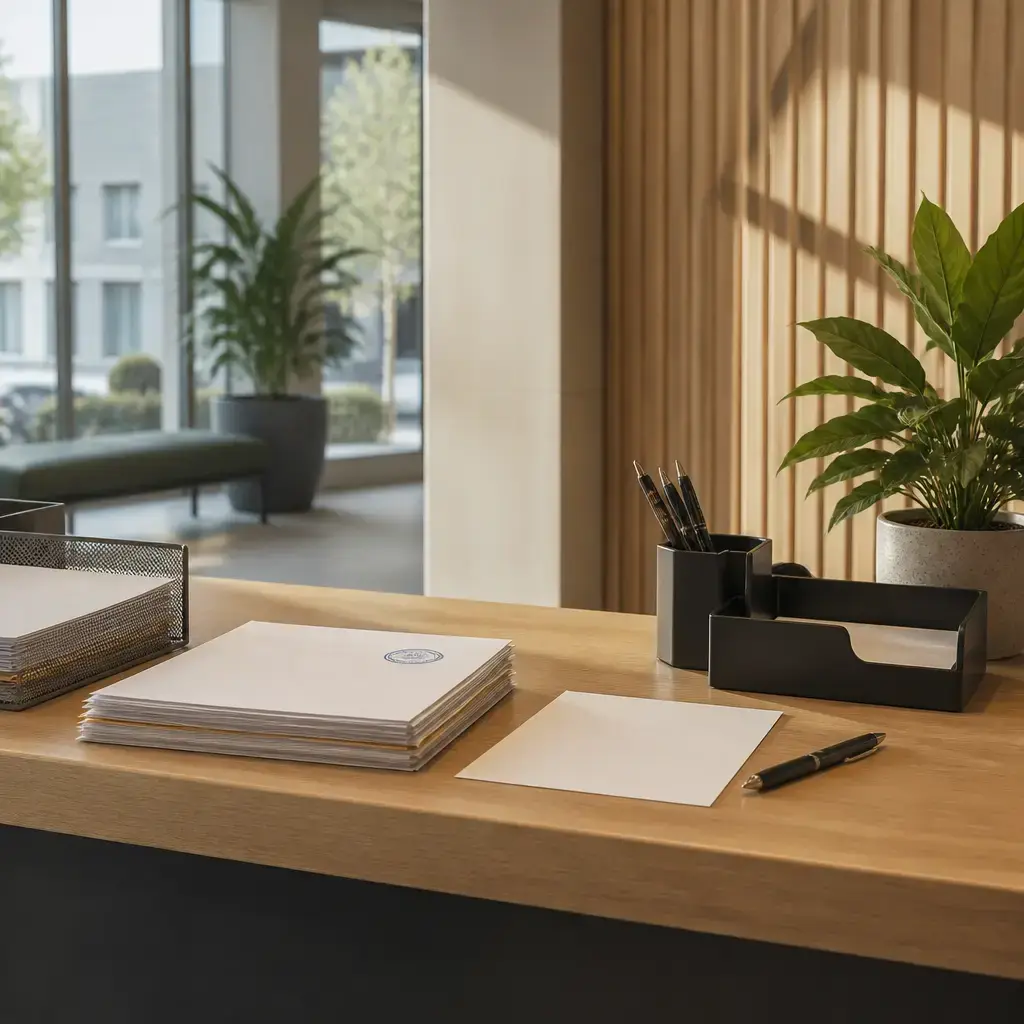
ikh BROW-khuh noor dee ZYE-tuh mit daym SHTEM-pel. I only need the page with the stamp.Ich kopiere diese Seite und halte die anderen Seiten zusammen.
ikh koh-PEE-ruh DEE-zuh ZYE-tuh oont HAL-tuh dee AHN-duh-ren ZYE-ten tsoo-ZAH-men. I will copy that page and keep the other pages together.Bitte behandeln Sie das Original vorsichtig.
BIT-tuh beh-HAHND-len zee dahs oh-ree-gee-NAHL FOHR-zikh-tikh. Please handle the original carefully.Ich gebe Ihnen alles zusammen zurück.
ikh GAY-buh EE-nen AH-les tsoo-ZAH-men tsoo-RUEK. I will return everything together.Sentence explanations
Könnte ich eine Kopie von diesem Dokument bekommen?
Could I get a copy of this document?
- Könnte ich
- Could I…?
- eine Kopie
- a copy
- diesem
- this
- Dokument
- document
- bekommen
- get; receive
More detail
Könnte ich combines könnte, the subjunctive II form of können (“can; be able to”), with ich (“I”). In this question, the form expresses a polite possibility or request: “Could I …?” The finite modal verb is in first position, the subject follows it, and the other verb moves to the end in its infinitive form. eine Kopie means “a copy.” Kopie is a feminine noun, so its indefinite article is eine in the accusative singular here. The article marks an unspecified copy; it does not by itself state a numerical count as a separate fact. Example: Ich brauche eine Kopie. — “I need a copy.” diesem is a demonstrative form of dies-, meaning “this” here. It is dative singular because von is followed by the dative. Since Dokument is neuter, the matching form is diesem: von diesem Dokument — “of/from this document.” Dokument is the neuter noun “document.” In the fixed sentence, it appears in the von phrase that identifies which document the copy is from. Example: Das Dokument ist wichtig. — “The document is important.” bekommen is the infinitive “get” or “receive.” With the modal könnte, it stays in the infinitive and stands at the end of this question. Example: Könnte ich eine Antwort bekommen? — “Could I get an answer?” Together, eine Kopie von diesem Dokument means “a copy of this document.” The question pattern Könnte ich … bekommen? politely asks whether the speaker could receive it. Thus the whole utterance means: “Could I get a copy of this document?”
Ich muss zuerst das Original sehen.
I need to see the original first.
- Ich muss
- I need to
- zuerst
- first
- Original
- original
- sehen
- see
More detail
Ich muss uses müssen with ich: muss is the present-tense form for the first-person singular. With an infinitive, müssen expresses necessity or obligation. Here it combines with sehen to mean “I need to see.” zuerst means “first,” indicating that seeing the original comes before another relevant step. It is an adverb, so it does not change form. Example: Ich lese zuerst das Dokument. — “I read the document first.” Original is the noun meaning “original,” as opposed to Kopie (“copy”). In the sentence it appears with the neuter singular article das: das Original. The article marks the noun phrase as accusative here because it is what the speaker needs to see. Example: Ich brauche das Original. — “I need the original.” sehen is the infinitive “to see.” After the modal verb muss, the infinitive comes at the end of this main clause. Its base form is sehen; the present-tense form for ich is ich sehe when it is used without a modal. Example: Ich sehe das Dokument. — “I see the document.” Together, Ich muss + zuerst + das Original + sehen gives: “I need to see the original first.” The modal expresses the need, zuerst sets the order, das Original is what must be seen, and sehen supplies the main action.
Soll ich ein Antragsformular ausfüllen?
Should I fill out a request form?
- Soll ich
- Should I…?
- Antragsformular
- request form
- ausfüllen
- fill out
More detail
Soll ich means “Should I …?” Here, soll is the first-person singular present form of sollen, used to ask about the speaker’s recommended or expected action. In a yes/no question, the finite verb comes before the subject: Soll ich …? Compare Ich soll … (“I am supposed to …”), which is a statement rather than a question. Antragsformular is a compound noun meaning “request/application form.” It combines Antrag (“request” or “application”) and Formular (“form”). German nouns are capitalized. The preceding ein is an indefinite article; here it introduces a form without stating a numerical count. ausfüllen means “to fill out” or “to complete” a form. It is a separable verb: with a finite verb, the prefix separates, as in Ich fülle das Formular aus. With the modal verb soll, however, ausfüllen stays as a complete infinitive at the end: Soll ich das Formular ausfüllen? This placement is a useful pattern for German yes/no questions with a modal: Soll ich + object + infinitive? Example: Soll ich dieses Formular ausfüllen? — “Should I fill out this form?” Together, Soll ich asks whether the speaker should perform an action, ein Antragsformular identifies the object, and ausfüllen names that action. The complete utterance therefore means: “Should I fill out a request form?”
Bitte füllen Sie das Formular aus.
Please complete the form.
- Bitte
- please
- füllen … aus
- fill out
- Formular
- form
More detail
Bitte makes the request polite: “please.” It can also introduce other requests, for example: Bitte warten Sie. — “Please wait.” füllen ... aus comes from the separable verb ausfüllen, meaning “to fill out” a form or document. In the formal imperative, the finite part appears as füllen Sie and the prefix aus moves to the end: Füllen Sie das Formular aus. The verb füllen by itself means “fill,” while ausfüllen expresses completing something by filling in its required information. Formular means “form.” Its useful full form is das Formular: Formular is a neuter noun, so the definite article is das in this singular accusative use. For example, Ich fülle das Formular aus. — “I am filling out the form.” Sie is the formal second-person pronoun used when addressing one or more people politely. In this sentence it is the subject of the formal imperative. The capital letter distinguishes this formal pronoun from lowercase sie, which has other grammatical uses. Together, Bitte + füllen Sie ... aus forms a polite formal request, and das Formular identifies what should be completed. The whole utterance means: “Please complete the form.”
Dann kann ich die Kopie machen.
Then I can make the copy.
- Dann
- then
- kann ich
- I can
- Kopie
- copy
- machen
- make; do
More detail
Dann means “then” here: it places this action after the previously mentioned step or situation. German also uses it for a result or consequence, as in Wenn du Zeit hast, dann komm. — “If you have time, then come.” kann ich combines kann, the form of können (“can; be able to”), with ich (“I”). kann is the present-tense form used with ich, and it expresses ability or possibility here. In a German main clause, placing Dann first puts the finite verb kann in the next position, before the subject: Dann kann ich .... Compare Ich kann ..., where the subject comes first. Do not treat kann as a form of machen; it is the modal verb, while machen supplies the action. Kopie is the noun “copy.” Its base form is die Kopie; the feminine article is part of the noun phrase, not a statement about the number of copies. In this sentence, die Kopie refers to the specific copy intended in the fixed translation. A useful related form is the plural die Kopien — “copies.” machen means “make” here. It is the infinitive of the verb and follows the modal kann: ich kann ... machen means “I can make ...”. With a modal verb, the other verb normally remains in the infinitive and goes to the end of the clause. Machen can also mean “do” in other contexts, but “make” is the relevant sense here. Together, Dann kann ich die Kopie machen. means “Then I can make the copy.” Dann marks the time or consequence, kann ich expresses the speaker’s ability or possibility, and die Kopie machen names the action. The sentence uses the reusable pattern Dann kann ich + [object] + [infinitive].
Ich brauche nur die Seite mit dem Stempel.
I only need the page with the stamp.
- Ich
- I
- brauche
- need
- nur
- only
- Seite
- page
- mit dem
- with the
- Stempel
- stamp
More detail
Ich is the first-person singular pronoun, “I.” It is the form used for the speaker as the subject. For example: Ich lerne. — “I am learning.” brauche comes from brauchen, “to need.” brauche is the present-tense first-person singular form: ich brauche. The verb takes the needed thing as its direct object. For example: Ich brauche Hilfe. — “I need help.” nur means “only” here. It limits what is needed: the speaker needs the page with the stamp, rather than additional pages. Its position before the noun phrase makes that restriction clear in this sentence. Seite means “page.” The form is singular; its plural is Seiten. With brauchen, the needed item is a direct object, so the feminine singular definite article is accusative die: die Seite. The selected phrase contains the noun itself; together with the article in the sentence, it forms die Seite, “the page.” mit dem means “with the” in this phrase. mit requires the dative case. Stempel is masculine, so its singular definite article changes to dative dem: mit dem Stempel. This is a case change, not a plural marker. Stempel means “stamp.” Its plural is Stempel, so the form itself does not change between singular and plural; the article or other accompanying words can show the difference. Here dem identifies it as masculine singular dative. For example: Ich brauche einen Stempel. — “I need a stamp.” Together, die Seite mit dem Stempel means “the page with the stamp”: mit dem Stempel specifies which page is meant. The complete utterance Ich brauche nur die Seite mit dem Stempel. means “I only need the page with the stamp.”
Ich kopiere diese Seite und halte die anderen Seiten zusammen.
I will copy that page and keep the other pages together.
- kopiere
- copy
- diese
- that
- Seite
- page
- halte
- keep / hold
- anderen
- other
- Seiten
- pages
- zusammen
- together
More detail
kopiere is the first-person singular present form of kopieren (“to copy”): ich kopiere. German present forms can also describe a planned near-future action, which fits the fixed translation’s “I will copy.” Example: Ich kopiere den Brief. — “I am copying the letter” or “I will copy the letter,” depending on context. diese is a demonstrative determiner. Here, the fixed translation gives its intended meaning as “that”; it accompanies the feminine singular noun Seite in the object phrase diese Seite. The dies- series changes with the noun phrase: diese Seite, dieses Blatt, diese Seiten. Seite is the feminine noun “page” here. Its plural is Seiten: die Seite — “the page”; die Seiten — “the pages.” In other contexts, Seite can also mean “side,” but “page” is the intended meaning in this utterance. halte comes from halten, “to hold” or “to keep,” and is its first-person singular present form: ich halte. With zusammen, it contributes to the separable verb zusammenhalten, “to keep together.” The vowel change in du hältst does not occur in ich halte. anderen means “other” here. It modifies Seiten in die anderen Seiten, where it has the weak plural form after the definite article die. In this sentence, the noun phrase is the object of halte ... zusammen. Compare eine andere Seite — “another page” with die anderen Seiten — “the other pages.” Seiten is the plural of Seite, so it means “pages” here. It is the object in die anderen Seiten and is understood as accusative plural in this clause. Example: Ich ordne die anderen Seiten. — “I arrange the other pages.” zusammen means “together” here and is the separable prefix of zusammenhalten. In a main clause, the finite verb is typically in second position and the separable prefix goes to the end: Ich halte die Seiten zusammen. — “I keep the pages together.” In the supplied sentence, the subject Ich is shared by both coordinated clauses and is omitted from the second one, producing und halte ... zusammen. The sentence coordinates two actions with the same subject, Ich: Ich kopiere diese Seite means “I will copy that page,” and halte die anderen Seiten zusammen means “keep the other pages together.” und joins the actions. The complete meaning is: “I will copy that page and keep the other pages together.”
Bitte behandeln Sie das Original vorsichtig.
Please handle the original carefully.
- Bitte
- please
- behandeln
- handle
- Sie
- you (formal)
- das
- the
- Original
- original
- vorsichtig
- carefully
More detail
Bitte makes the request polite: “please.” It can appear at the beginning or end of a request. Example: Bitte warten Sie. — “Please wait.” behandeln means “to handle” here, in the sense of dealing with something carefully. In behandeln Sie, the verb is the polite imperative. German polite imperatives use the infinitive form plus the formal pronoun Sie: Behandeln Sie ... — “Handle ...” / “Please handle ...”. The same spelling can also be the present-tense form for sie meaning “they,” but the capitalized Sie here marks formal “you.” Sie is the formal second-person pronoun. It is capitalized and uses the same form for singular and plural formal “you”; its specific number is not identified here. In this sentence it is the person being asked to handle something. das is the definite article “the” for the neuter noun Original. It is accusative here because behandeln acts directly on what is handled. For this neuter noun, the article is das in both nominative and accusative: das Original. Original means “original” as a noun, referring here to the original item or document. Its plural is Originale. Example: Ich bewahre das Original auf. — “I keep the original.” vorsichtig means “carefully” here. The adjective vorsichtig is used adverbially to describe how the handling is done; it does not change form in this use. Its opposite is unvorsichtig — “careless” or “carelessly,” depending on its role. Together, Bitte behandeln Sie forms a polite formal request, and das Original is the thing receiving the action. vorsichtig states the manner of the action. The complete utterance is: “Please handle the original carefully.”
Ich gebe Ihnen alles zusammen zurück.
I will return everything together.
- gebe … zurück
- return
- Ihnen
- to you (formal)
- alles
- everything
- zusammen
- together
More detail
gebe ... zurück is the separable-verb pattern from zurückgeben, “to return” or “to give back.” gebe is the first-person singular present form of geben (“to give”); the prefix zurück moves to the end in this main clause. German present tense can refer to a future action when the intended time is clear, which matches “I will return” here. The subject is Ich, so the form is gebe, not a form for another person. Ihnen is the formal second-person pronoun in the dative case, marking the recipient: “to you.” The capital letter is part of the conventional spelling of formal Sie forms. The verb pattern is jemandem etwas zurückgeben: return something to someone. alles is the pronoun “everything.” In this sentence it is the thing being returned, so it fills the accusative object position. It is an independent pronoun here, not a noun that needs to be supplied after it. zusammen is an adverb meaning “together.” It specifies that the items are returned as one combined set rather than separately. For example: Ich schicke die Unterlagen zusammen. — “I am sending the documents together.” Together, Ich gebe Ihnen alles zusammen zurück means “I will return everything to you together.” The German sentence presents Ich as the person returning alles, Ihnen as the formal recipient, and zusammen as describing how the return is made.
Grammar Points
ausfüllen: Füllen Sie ... aus
Füllen Sie bitte das Antragsformular aus.
FOOL-en zee BIT-tuh dahs AHN-trahks-for-moo-LAHR owss.Please fill out the application form.
In a separable verb, the prefix aus moves to the end in this polite command.
zurückgeben: Geben Sie ... zurück
Geben Sie bitte das Original zurück.
GAY-ben zee BIT-tuh dahs oh-ree-gee-NAHL tsoo-RUEK.Please return the original document.
The separable prefix zurück moves to the end in a polite command.
German Vocabulary
Quiz
Word Order
Arrange the words in the correct order.
I need to see the original first.
Show Answer
Ich muss zuerst das Original sehen.Should I fill out a request form?
Show Answer
Soll ich ein Antragsformular ausfüllen?Please complete the form.
Show Answer
Bitte füllen Sie das Formular aus.Spelling
Tap the letters to spell the word.
first
Show Answer
zuerstget
Show Answer
bekommensee
Show Answer
sehenmake