10 minutes free every day
Continue audio lessons in the app
Word explanations appear automatically in sync with the audio.
No login required · synced translations · playback with the screen locked
Choose your learning language and open this lesson in the app.

About This Lesson
Use Finding a Conference Room to practice German conversation, pronunciation, vocabulary, grammar, and quizzes.
Dialogue
Könnten Sie mir sagen, wo der Konferenzraum ist?
KURNT-ən zee meer ZAHG-ən, voh dair kohn-feh-RENTS-rowm ist? Could you tell me where the conference room is?Gehen Sie an der Lobby vorbei. Der Raum ist in der Nähe der Aufzüge.
GAY-ən zee ahn dair LOH-bee foh-AR-BYE. Dair rowm ist in dair NAY-ə dair OWF-tsoo-guh. Go past the lobby. It's near the elevators.Soll ich von hier den Aufzug nehmen?
Zohl ikh fon heer dain OWF-tsoog NAY-mən? Should I take the elevator from here?Fahren Sie damit einen Stock höher.
FAHR-ən zee dah-MIT EYE-nən shtok HUR-ər. Take it up one floor.Dann biegen Sie links in den Flur ab.
Dahn BEEG-ən zee links in dain floor ahp. Then turn left into the hallway.Gibt es eine Karte, die ich benutzen kann?
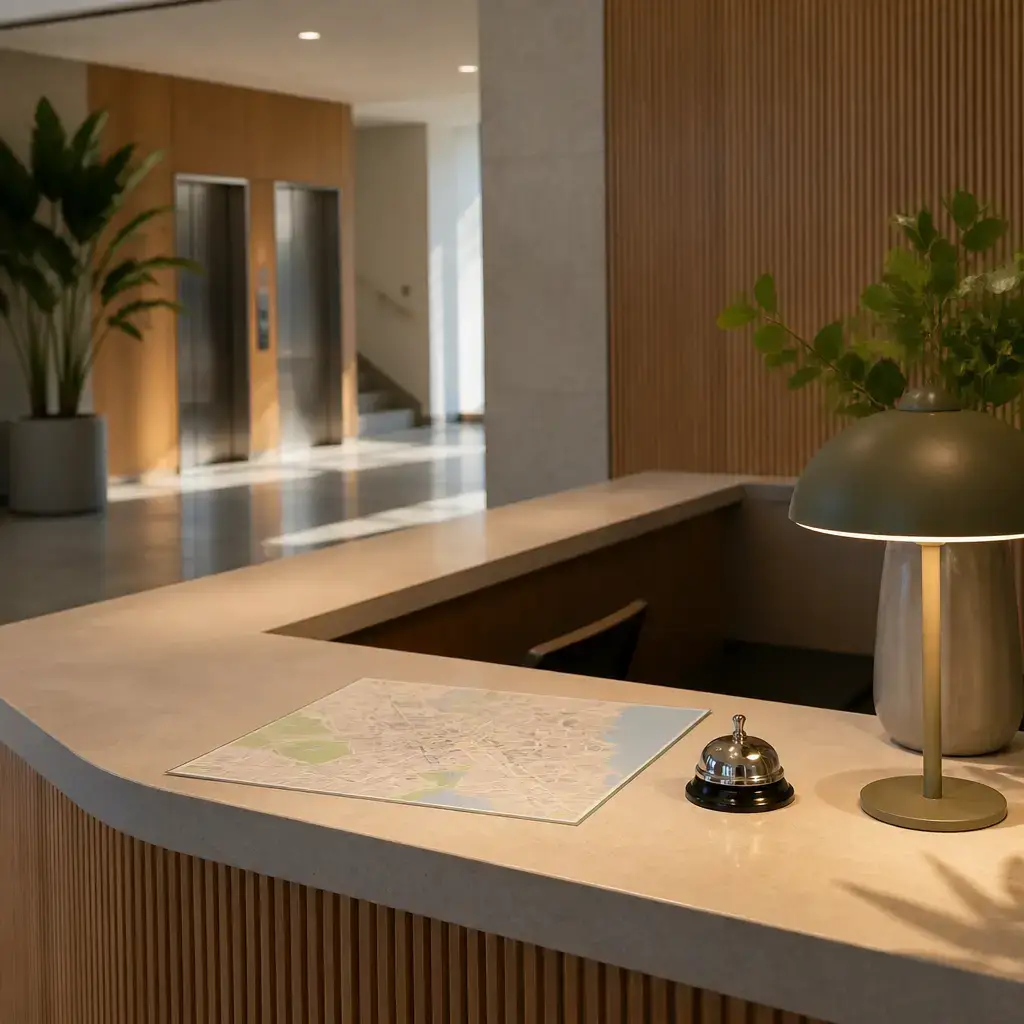
Geept ess EYE-nə KAR-tə dee ikh beh-NOOT-sən kahn? Is there a map I can use?An der Rezeption gibt es eine.
Ahn dair reh-tsep-TSEE-ohn geept ess EYE-nə. There's one by the reception desk.Das hilft. Ich bin zum ersten Mal in diesem Gebäude.
Dahs hilft. Ikh bin tsoom AIR-stən mahl in DEE-zəm geh-BOY-də. That helps. It's my first time in this building.Der Raum ist nahe am Ende des Flurs markiert.
Dair rowm ist NAH-ə ahm EN-də dess floors mahr-KEERT. The room is marked near the end of the hall.Sentence explanations
Könnten Sie mir sagen, wo der Konferenzraum ist?
Could you tell me where the conference room is?
- Könnten Sie
- could you
- mir
- to me
- sagen
- tell
- wo
- where
- Konferenzraum
- conference room
- ist
- is
More detail
Könnten Sie is a polite formal way to ask “could you.” Könnten is the Konjunktiv II form of können (“can, be able to”), used here to make the request less direct; Sie is the formal “you” and is written with a capital letter. For an informal singular addressee, German uses du with a different verb form: Könntest du ...? mir means “to me.” It is the dative form of the first-person pronoun: ich → mir. The dative marks the person who receives the information. Example: Er hilft mir. — “He helps me.” sagen means “tell” or “say.” Here it is the infinitive after the modal verb könnten; the modal carries the finite verb form, while sagen stays in the infinitive. A useful pattern is Könnten Sie mir sagen, ...? — “Could you tell me ...?” wo means “where.” It introduces the embedded question about a place. In German, the finite verb normally goes to the end of this kind of subordinate clause: wo der Konferenzraum ist (“where the conference room is”). This differs from a direct question such as Wo ist der Konferenzraum? (“Where is the conference room?”), where the verb comes directly after the question word. Konferenzraum means “conference room.” It is a compound noun made from Konferenz (“conference”) and Raum (“room”). The noun is masculine: der Konferenzraum; its plural is die Konferenzräume. ist means “is” here. It is the third-person singular present form of sein (“to be”), agreeing with the singular noun der Konferenzraum. The corresponding plural form is sind: Die Konferenzräume sind ... — “The conference rooms are ...”. Together, Könnten Sie mir sagen makes a polite formal request, and wo der Konferenzraum ist supplies the information being requested. The complete utterance therefore means: “Could you tell me where the conference room is?”
Gehen Sie an der Lobby vorbei. Der Raum ist in der Nähe der Aufzüge.
Go past the lobby. It's near the elevators.
- Gehen Sie
- please go
- an der … vorbei
- past
- Lobby
- lobby
- Raum
- room
- ist
- is
- in der Nähe
- near
- Aufzüge
- elevators
More detail
Gehen Sie is a formal command meaning “go.” gehen is the base form; Sie is the formal pronoun used for one person or more than one person, and the verb form is the same in both cases. In this sentence, the combination gives a polite direction rather than a statement that someone is going. an der ... vorbei is a reusable pattern meaning “past ...” or “by ...”: an + dative noun + vorbei. The two parts belong together even though vorbei comes later. der is the dative feminine article here, and Lobby is feminine. Example: Gehen Sie am Hotel vorbei. — “Go past the hotel.” Lobby means “lobby.” Its plural is Lobbys (also written Lobbies in some usage), but the form in the utterance is singular. Raum means “room.” Its plural is Räume, with the vowel change and plural ending. Here, Der Raum is a definite noun phrase: “the room.” In the supplied context, it refers to the room being asked about. ist is the third-person singular present form of sein, “to be”: sein → ist. It agrees with the singular noun Raum. Example: Der Raum ist groß. — “The room is large.” in der Nähe is a fixed location phrase meaning “near” or “in the vicinity of.” It can be followed by a noun phrase: in der Nähe des Bahnhofs means “near the station.” In the utterance, it introduces the location of the room. Aufzüge is the plural of Aufzug, “elevator.” The singular is der Aufzug; the plural is die Aufzüge. In der Aufzüge, the article and noun together mean “of the elevators”: der is the genitive plural article, while Aufzüge is the plural noun form. Together, Gehen Sie an der Lobby vorbei means “Go past the lobby.” Der Raum ist in der Nähe der Aufzüge means “The room is near the elevators.” The two sentences therefore give a formal direction: first pass the lobby, and the room is located near the elevators.
Soll ich von hier den Aufzug nehmen?
Should I take the elevator from here?
- Soll ich
- Should I…?
- von hier
- from here
- Aufzug
- elevator
- nehmen
- take
More detail
Soll ich is the first-person singular form of sollen in the present tense. In this question, Soll ich …? asks whether the speaker ought to do something: “Should I …?” The modal verb is followed by an infinitive at the end of the clause. von hier means “from here.” von takes the dative case, and hier is an invariable place adverb. This phrase identifies the starting point of the action. Aufzug is the masculine noun for “elevator.” Its plural is Aufzüge. In the sentence, the full noun phrase is den Aufzug: the masculine singular definite article is den because the elevator is the direct object of nehmen. nehmen is the infinitive “to take.” After the modal verb soll, it remains in the infinitive and appears at the end of the question. For example, Soll ich den Bus nehmen? means “Should I take the bus?” Together, Soll ich asks for guidance, von hier gives the starting point, and den Aufzug nehmen means “take the elevator.” The whole utterance therefore means: “Should I take the elevator from here?”
Fahren Sie damit einen Stock höher.
Take it up one floor.
- Fahren Sie
- go / travel (formal instruction)
- damit
- with it
- Stock
- floor / storey
- höher
- higher / up
More detail
Fahren Sie is the formal imperative of fahren, used to address one person politely. Here fahren means “go/travel,” not specifically “drive,” because the context is an elevator. The formal imperative is formed with the infinitive fahren followed by Sie: Fahren Sie .... damit is a pronominal adverb meaning “with it” or “using it.” Here it refers to the elevator mentioned in the preceding question. When the noun is stated instead, German can use mit dem Aufzug (“with/by the elevator”). Stock means “floor” or “storey” in this building-related sense. Its plural can be Stöcke or Stockwerke; the observed form is singular because it appears in einen Stock höher. höher is the comparative of hoch (“high”): hoch → höher (“higher”). Here it describes a level above the current one; the comparison is carried by höher, not by Stock. The chunk einen Stock höher means “one floor higher.” einen is the masculine accusative form of the indefinite article before masculine Stock; in this fixed chunk, together with the noun and comparative, it expresses the one-floor destination conveyed by the translation. Example: Wir wohnen einen Stock höher. — “We live one floor higher.” Together, Fahren Sie damit gives a polite instruction to go using the elevator, and einen Stock höher specifies the destination. The whole utterance means: “Take it up one floor.”
Dann biegen Sie links in den Flur ab.
Then turn left into the hallway.
- Dann
- then
- biegen … ab
- turn
- Sie
- you (formal)
- links
- left
- in den
- into the
- Flur
- hallway
More detail
Dann means “then” and links this instruction to the preceding step. It places the action in sequence: first one action, then this one. biegen ... ab is the separable verb abbiegen, “to turn.” In this sentence, the parts are separated because German places the prefix ab at the end of a main-clause instruction. The formal imperative pattern is Biegen Sie ... ab (“Please turn ...”). Example: Biegen Sie rechts ab. — “Turn right.” Sie is the capitalized formal “you.” It is used when addressing one or more people politely; the form itself does not identify the number here. links means “left” and specifies the direction. The contrasting direction is rechts, “right.” Example: Gehen Sie links. — “Go left.” in den Flur means “into the hallway.” Flur is a masculine noun. The preposition in takes the accusative here because the instruction expresses movement into a destination: den Flur. With a stationary location, in can instead take the dative: im Flur means “in the hallway.” Together, Dann biegen Sie links in den Flur ab. means “Then turn left into the hallway.” The sequence is Dann (“then”) + the formal instruction biegen Sie ... ab (“turn”) + the direction links + the destination in den Flur.
Gibt es eine Karte, die ich benutzen kann?
Is there a map I can use?
- Gibt es
- Is there? / Are there?
- Karte
- map
- benutzen
- use
- kann
- can
More detail
Gibt es is the common German way to ask whether something exists or is available. It is built from geben (“to give”), but in this impersonal question the phrase means “is there?” or “are there?” rather than describing a person giving something. The form gibt is the third-person singular present form of geben; the question pattern stays Gibt es ...? even when the thing being asked about is plural. Karte means “map” here. Its base form is the feminine noun die Karte; the indefinite phrase in this sentence is eine Karte (“a map”). The same noun can have other context-dependent meanings, such as “card,” but the translation and travel context establish the map meaning here. A useful related word is der Stadtplan, specifically “city map,” but Karte alone is the form used in the fixed sentence. benutzen is the infinitive “to use.” In die ich benutzen kann, it appears before the finite modal verb at the end of the relative clause. Example: Ich kann den Stadtplan benutzen. — “I can use the city map.” kann is the first-person singular present form of the modal verb können, “can” or “be able to.” Its subject here is ich, so ich kann means “I can.” In the relative clause, the finite modal verb kann comes last: die ich benutzen kann — “that I can use.” Other present forms include du kannst (“you can”) and er/sie kann (“he/she can”); kann is used with ich and also with er, sie, and es. The relative pronoun die introduces information identifying the map: it connects eine Karte with ich benutzen kann, so the phrase means “a map that I can use.” Here die agrees with the feminine singular noun Karte; inside the relative clause, it is the accusative object of benutzen. The subject of that clause is ich, and kann expresses the speaker’s ability to use the map. Together, Gibt es eine Karte asks whether a map exists or is available. The relative clause die ich benutzen kann narrows the request to one the speaker can use. The complete meaning is: “Is there a map I can use?”
An der Rezeption gibt es eine.
There's one by the reception desk.
- Rezeption
- reception desk
- gibt es
- there is / there are
- eine
- one
More detail
Rezeption means “reception desk” here. It is a feminine noun: die Rezeption. In the location phrase an der Rezeption, an takes the dative for a stationary location, so die becomes der. German nouns are capitalized. Example: Ich warte an der Rezeption. — “I am waiting at the reception desk.” gibt es is the reusable German existential construction meaning “there is” or “there are.” gibt is the present-tense third-person singular form of geben; es is part of this construction, not a separately translated object here. Example: Gibt es hier einen Aufzug? — “Is there an elevator here?” eine means “one” in this sentence. It is the feminine singular form used independently, with the noun omitted because the preceding context supplies it: the question mentions eine Karte, so this answer can mean that there is one map by the reception desk. The form eine also appears before a feminine singular noun, as in eine Karte (“a map”). Together, An der Rezeption gives the location, gibt es introduces the existence of something there, and eine identifies one feminine item understood from context. The whole utterance means: “There’s one by the reception desk.”
Das hilft. Ich bin zum ersten Mal in diesem Gebäude.
That helps. It's my first time in this building.
- Das
- That
- hilft
- helps
- Ich bin
- I am
- zum ersten Mal
- for the first time
- in
- in
- diesem
- this
- Gebäude
- building
More detail
Das means “that” here as a demonstrative pronoun referring to something already understood in the conversation. Its specific referent is not named in the supplied sentence. Unlike the article das, this form stands on its own as the subject. hilft is the present-tense form of helfen (“to help”) for a third-person singular subject: Das hilft = “That helps.” Compare Ich helfe (“I help”) and sie helfen (“they help”). Ich bin uses sein (“to be”) in the first-person singular present: ich bin = “I am.” This construction introduces the speaker’s situation; it does not itself express possession. zum ersten Mal is the reusable expression “for the first time.” zum is the contraction of zu dem, and ersten is the ordinal form corresponding to eins (“one”): erste, zweite, dritte (“first,” “second,” “third”). In this sentence, the expression means that this is the speaker’s first occurrence of being in the relevant place, giving the natural translation “It’s my first time.” in means “in” here and introduces a location. With a stationary location, German uses the dative after in; movement into a place would normally use the accusative instead. For example, Ich bin im Gebäude means “I am in the building,” while Ich gehe in das Gebäude means “I am going into the building.” diesem means “this” in the dative form used with the following noun. The form reflects the noun phrase’s grammatical requirements here; it is not a separate indication of quantity. The demonstrative agrees with Gebäude, which is neuter, and dative neuter is diesem. Gebäude means “building.” Its base form is das Gebäude; the noun remains Gebäude in the singular dative, with the dative shown by the article/demonstrative rather than by a change to the noun itself. A useful contrast is das Gebäude (“the building,” nominative or accusative) and dem Gebäude (“the building,” dative). Together, Das hilft says “That helps.” Then Ich bin zum ersten Mal in diesem Gebäude says that the speaker is in this building for the first time. The complete utterance is therefore: “That helps. It’s my first time in this building.”
Der Raum ist nahe am Ende des Flurs markiert.
The room is marked near the end of the hall.
- Raum
- room
- nahe
- near
- Ende
- end
- Flurs
- hall
- markiert
- marked
More detail
Raum means “room” here. Its base form is der Raum; the form shown is singular, and der marks masculine singular nominative in this sentence because the room is the subject. The plural is die Räume. nahe means “near” and is unchanged here. It describes location. A useful pattern is nahe + dative: nahe dem Bahnhof means “near the station.” In the sentence, the following am is the contraction of an dem, and the phrase nahe am Ende means “near the end.” Ende means “end.” It is the neuter noun das Ende. In am Ende, am stands for an dem, so Ende is in the dative: an dem Ende. The phrase am Ende des Flurs means “at/near the end of the hall,” with des Flurs specifying whose end. Flurs is the genitive singular form of der Flur, “hall” or “corridor.” The ending -s marks genitive singular here: des Flurs means “of the hall.” This is different from the nominative form der Flur. Example: Die Tür des Flurs ist offen. — “The hall’s door is open.” markiert comes from the verb markieren, “to mark.” It is the past participle form. Together with ist, it forms ist markiert, meaning “is marked.” In this sentence, that construction presents the room as marked or identified, rather than describing an action currently being performed. Example: Der Eingang ist markiert. — “The entrance is marked.” Putting the parts together: Der Raum is the subject, ist markiert says that it is marked, and nahe am Ende des Flurs gives its location. The complete meaning is: “The room is marked near the end of the hall.”
Grammar Points
Wo?
Wo?
voh?Where?
„Wo“ fragt nach einem Ort und steht meist am Anfang einer Ortsfrage.
zum ersten Mal
zum ersten Mal
tsoom AIR-stən mahlfor the first time
Feste Wendung für etwas, das erstmals geschieht.
German Vocabulary
der Aufzüge
Fahren Sie damit
einen Stock höher
der Konferenzraum
biegen Sie links ... ab
an der Lobby vorbei
in der Nähe
den Aufzug nehmen
Könnten Sie mir sagen
einen Stock höher
an der Lobby vorbei
wo der Konferenzraum ist
Quiz
Word Order
Arrange the words in the correct order.
Take it up one floor.
Show Answer
Fahren Sie damit einen Stock höher.There's one by the reception desk.
Show Answer
An der Rezeption gibt es eine.Spelling
Tap the letters to spell the word.
vicinity; proximity
Show Answer
Nähelobby
Show Answer
Lobbyto take
Show Answer
nehmenpast; by