10 minutes free every day
Continue audio lessons in the app
Word explanations appear automatically in sync with the audio.
No login required · synced translations · playback with the screen locked
Choose your learning language and open this lesson in the app.

About This Lesson
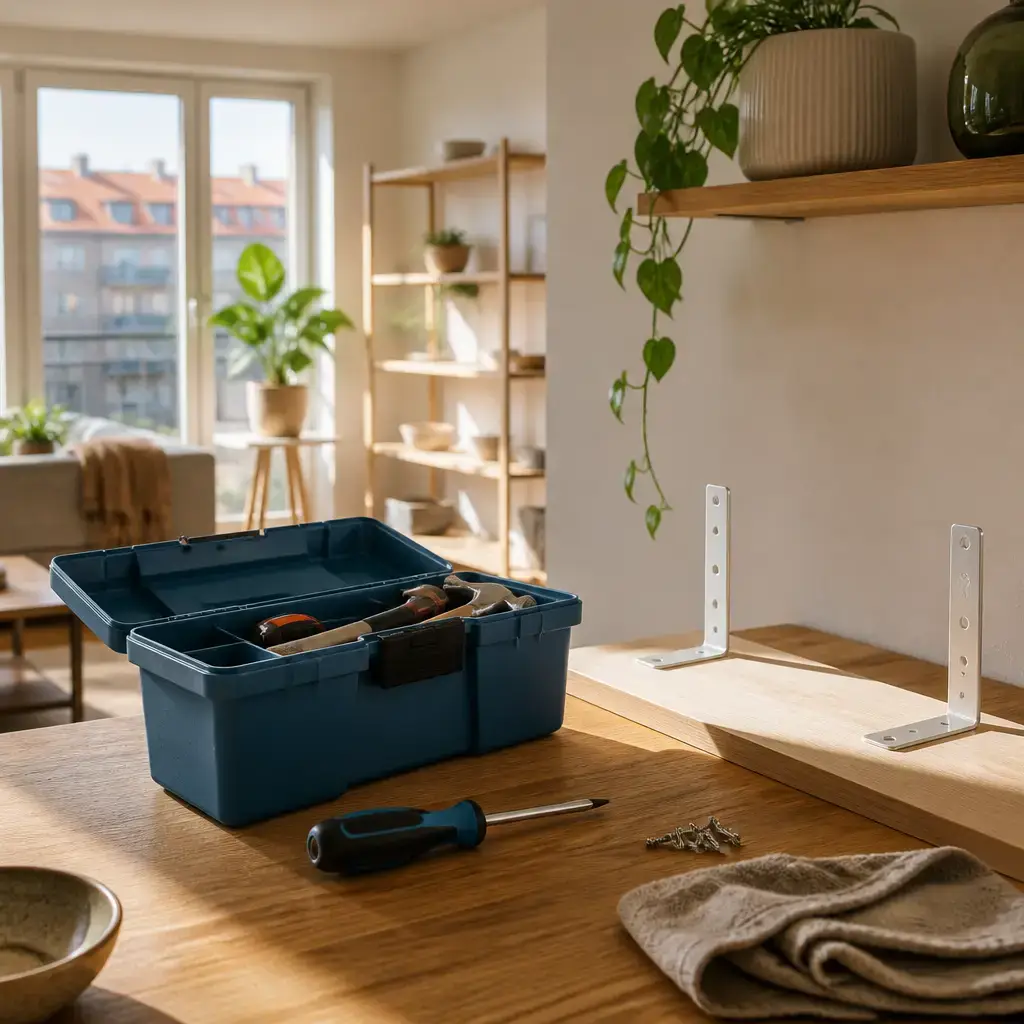
Use Borrowing a screwdriver and agreeing on a return time to practice German conversation, pronunciation, vocabulary, grammar, and quizzes.
Dialogue
Kann ich mir deinen Schraubenzieher für eine kleine Reparatur ausleihen?
kahN ikh meer DYE-nen SHROW-ben-tsee-uh fer EYE-nuh KLY-nuh reh-pah-rah-TOOR OWS-lye-en? Could I borrow your screwdriver for a small repair?Er ist im blauen Werkzeugkasten.
air ist im BLOW-en VAIRK-tsoyk-kah-sten. It is in the blue toolbox.Ich muss die Halterungen am Regal festziehen.
ikh moos dee HAL-ter-oong-en ahm reh-GAHL FEST-tsee-en. I need to tighten the shelf brackets.Benutze den mittelgroßen Schraubenzieher.
beh-NOOT-suh dehn MIT-tel-groh-sen SHROW-ben-tsee-uh. Use the medium screwdriver.Er passt besser zu diesen Halterungen.
air pahst BESS-er tsoo DEE-zen HAL-ter-oong-en. It fits those brackets better.Wann soll ich ihn zurückbringen?
vahn zohl ikh een tsoo-ROOK-bring-en? When should I return it?Bitte bring ihn vor dem Abendessen zurück.
BIT-tuh bring een fohr dehm AH-bent-ess-en tsoo-ROOK. Please bring it back before dinner.Wenn er staubig wird, wische ich ihn zuerst ab.
ven air SHTOW-bikh veert, VISH-uh ikh een tsoo-AIRST ahp. If it gets dusty, I'll wipe it off first.Das hilft, die Werkzeuge in gutem Zustand zu halten.
dahs hilft, dee VAIRK-tsoy-guh in GOO-tem tsoo-SHTAHNT tsoo HAL-ten. That helps keep the tools in good shape.Sentence explanations
Kann ich mir deinen Schraubenzieher für eine kleine Reparatur ausleihen?
Could I borrow your screwdriver for a small repair?
- Kann ich
- Could I …?
- mir
- for myself
- deinen
- your
- Schraubenzieher
- screwdriver
- für
- for
- kleine
- small
- Reparatur
- repair
- ausleihen
- borrow
More detail
Kann ich forms a yes/no question. kann is the first-person singular form of können with ich; in a statement, the order is Ich kann ..., but a yes/no question places the conjugated verb first. Here the request is expressed as a possibility: “Could I ...?” mir is the dative reflexive pronoun meaning “for myself” in this construction. The reusable pattern is sich etwas ausleihen: literally borrowing something for oneself. The pronoun changes with the person: ich leihe mir etwas aus, du leihst dir etwas aus. deinen means “your” here and agrees with the masculine accusative noun Schraubenzieher. The possessive form dein becomes deinen before a masculine accusative noun. It addresses one person informally; the formal possessive form would be Ihren. Schraubenzieher is the noun “screwdriver.” Its compound structure is useful in vocabulary: Schraube means “screw,” and Zieher is related to “puller,” but the whole word is the ordinary noun for the tool. Its grammatical gender is masculine: der Schraubenzieher. für means “for” and introduces the purpose or intended use here. It takes the accusative case. The complete following noun phrase is für eine kleine Reparatur: eine is the feminine accusative form of the indefinite article, kleine is the adjective klein with the corresponding ending, and Reparatur is feminine. The article does not itself state a numerical count; it presents the repair as an unspecified one. kleine describes Reparatur as “small.” The base form is klein; in this phrase the adjective has the ending -e after eine before the feminine accusative noun. Example: eine kleine Pause — “a short break.” Reparatur means “repair” or “repair job.” It is a feminine noun: die Reparatur. Example: Die Reparatur dauert lange. — “The repair takes a long time.” ausleihen means “to borrow” when used for taking something temporarily from someone. It is a separable verb: in a main-clause statement, Ich leihe mir deinen Schraubenzieher aus; in this question, the infinitive remains together at the end after kann. The pattern Kann ich mir ... ausleihen? is a reusable way to ask permission to borrow something. Together, Kann ich mir deinen Schraubenzieher ... ausleihen? asks whether the speaker may borrow the listener’s screwdriver, and für eine kleine Reparatur gives the intended purpose: “Could I borrow your screwdriver for a small repair?”
Er ist im blauen Werkzeugkasten.
It is in the blue toolbox.
- Er ist
- it is
- im
- in the
- blauen
- blue
- Werkzeugkasten
- toolbox
More detail
Er ist combines the masculine singular pronoun Er with ist, the present-tense form of sein for er. German uses Er for a masculine noun; in the fixed translation, English uses “it,” and the preceding context supports the screwdriver as the item being located. The form ist is also used with sie and es, but the pronoun itself is specifically masculine here. im is the contraction of in dem. For a static location, the two-way preposition in takes the dative case: in dem Werkzeugkasten becomes im Werkzeugkasten. For movement into the container, it takes the accusative instead: Ich lege es in den Werkzeugkasten means “I put it into the toolbox.” blauen is the inflected form of the adjective blau (“blue”). It describes the masculine singular noun Werkzeugkasten. Because this location phrase has dative dem after in, the adjective has the ending in dem blauen Werkzeugkasten; after contraction, this appears as im blauen Werkzeugkasten. A useful comparison chain is blau (“blue”), blauer (“bluer”), am blauesten (“the bluest”). Werkzeugkasten is a masculine noun meaning “toolbox.” It is a compound of Werkzeug (“tool”) and Kasten (“box” or “case”); its basic-form article is der: der Werkzeugkasten. Example: Der Werkzeugkasten ist schwer. — “The toolbox is heavy.” Together, Er ist states where the item is, and im blauen Werkzeugkasten gives its static location inside the blue toolbox. The complete meaning is: “It is in the blue toolbox.”
Ich muss die Halterungen am Regal festziehen.
I need to tighten the shelf brackets.
- Ich muss
- I need to / I must
- Halterungen
- brackets
- Regal
- shelf / shelving unit
- festziehen
- tighten
More detail
Ich muss means “I need to” or “I must” here. muss is the first-person singular present form of müssen: ich muss, du musst, sie muss. With a modal verb such as müssen, the other verb remains in the infinitive and goes to the end of the main clause: Ich muss warten. — “I need to wait.” Halterungen means “brackets” here. It is the plural of the feminine noun die Halterung, meaning “bracket” or “mounting.” The plural is die Halterungen; the ending -en belongs to this noun’s plural form. Example: Die Halterungen sind fest. — “The brackets are secure.” Regal means “shelf” or “shelving unit.” It is the neuter noun das Regal. In am Regal, am is the contraction of an dem: an takes the dative for this stationary relation, so das Regal becomes dem Regal. Here, am Regal identifies the shelf or shelving unit associated with the brackets; the fixed translation expresses this in the phrase “shelf brackets.” Example: Das Werkzeug steht am Regal. — “The tool is by the shelf.” festziehen means “to tighten.” It is a separable verb. In a main clause without a modal, its parts separate: Ich ziehe die Schraube fest. — “I tighten the screw.” After muss, the infinitive stays together at the end: Ich muss die Schraube festziehen. — “I need to tighten the screw.” Together, Ich muss die Halterungen am Regal festziehen. means “I need to tighten the shelf brackets.” Ich is the person who needs to act, die Halterungen are what is tightened, and am Regal identifies the shelf or shelving unit involved.
Benutze den mittelgroßen Schraubenzieher.
Use the medium screwdriver.
- Benutze
- use
- mittelgroßen
- medium-sized
- Schraubenzieher
- screwdriver
More detail
Benutze is the 2nd-person singular imperative of benutzen (“to use”). It addresses one person informally and gives a direct instruction. Example: Benutze den Schlüssel. — “Use the key.” The formal command is different: Benutzen Sie den Schlüssel. mittelgroßen means “medium-sized” here. Its base form is mittelgroß; the ending -en is the adjective inflection used with the masculine accusative noun phrase den mittelgroßen Schraubenzieher. The ending belongs to the adjective, not to the noun. Example: Ich nehme den großen Schraubenzieher. — “I’ll take the large screwdriver.” Schraubenzieher is the noun “screwdriver.” In this sentence it is singular and masculine, shown by den in the accusative after the command verb. The noun itself has the same form in the singular nominative and accusative: der Schraubenzieher / den Schraubenzieher. Together, den mittelgroßen Schraubenzieher means “the medium screwdriver” as the object of benutze. The complete utterance is an informal singular command: “Use the medium screwdriver.”
Er passt besser zu diesen Halterungen.
It fits those brackets better.
- Er
- it
- passt … zu
- fits/suits …
- besser
- better
- diesen
- those
- Halterungen
- brackets
More detail
Er is the third-person singular masculine pronoun in the nominative case. Here it refers to the screwdriver from the preceding sentence: German Schraubenzieher is masculine, so the corresponding pronoun is er (“it” in this context). The capital letter appears because it begins the sentence. Compare sie for a feminine or plural referent and es for a neuter singular referent. passt is the present-tense third-person singular form of passen, “to fit” or “to suit”: passen → er passt. The verb agrees with the subject Er. A useful pattern is etwas passt zu etwas (“something fits/suits something”), with zu followed by the dative case. Example: Der Deckel passt zu dem Behälter. — “The lid fits the container.” zu introduces the thing that the item fits or suits. In this sentence it is part of the reusable pattern passen zu + dative, rather than meaning a physical direction such as “to” in every possible use. besser is the comparative form of gut: gut (“good/well”) → besser (“better”) → am besten (“best”). Here it compares the fit with another relevant option or standard: it fits better, without the sentence specifying the comparison explicitly. diesen is the dative plural form of the demonstrative dies-, meaning “these/those” according to the intended translation here. It agrees with the plural noun Halterungen and has the dative form because zu requires dative. The same demonstrative family has forms such as diese in some other grammatical environments; the form is chosen by case and number, not by the noun’s proximity alone. Halterungen is the plural of Halterung, a bracket or holder. The plural ending is part of the noun form: die Halterung → die Halterungen. In this sentence the plural noun names the brackets referred to by the translation. Together, Er passt means “it fits,” zu diesen Halterungen means “those brackets” with the dative required by zu, and besser adds the comparison. The complete utterance therefore means: “It fits those brackets better.”
Wann soll ich ihn zurückbringen?
When should I return it?
- Wann
- when
- soll ich
- should I
- ihn
- it
- zurückbringen
- bring back; return
More detail
Wann asks about time: “when”. It can begin a question such as Wann kommst du? (“When are you coming?”). In this sentence, it asks for the time or occasion of the return. soll ich contains the modal verb sollen in its first-person singular form soll, plus ich (“I”). Here, soll asks what action is expected or advisable: “should I”. The infinitive belonging to the modal verb comes later in the sentence. Compare Ich soll warten (“I am supposed to wait”) with Ich soll ihn zurückbringen (“I should bring it back”). ihn is the masculine singular accusative form of er (“he” or, for a grammatically masculine noun, “it”). Its accusative form marks the item directly affected by the action. The English translation uses “it”; German selects ihn according to the grammatical form required for that referent, not because English assigns it masculine gender. zurückbringen is the infinitive meaning “to bring back” or “to return”. It combines zurück (“back”) with bringen (“bring”). In a finite clause, this separable verb commonly appears as bringt ... zurück, for example: Ich bringe das Buch zurück. — “I bring the book back.” After a modal verb, the infinitive remains together at the end: Ich soll ihn zurückbringen. Together, Wann asks for the time, soll ich asks what the speaker is expected or advised to do, ihn identifies the object affected by that action as “it”, and zurückbringen specifies bringing it back. The whole utterance therefore means: “When should I return it?”
Bitte bring ihn vor dem Abendessen zurück.
Please bring it back before dinner.
- Bitte
- please
- bring … zurück
- bring back
- ihn
- it
- vor dem
- before the
- Abendessen
- dinner
More detail
Bitte makes the request polite. It can appear at the beginning or elsewhere in a request; here it does not change the action. bring ... zurück is the separable verb zurückbringen, “to bring back.” In this sentence, bring is the informal singular imperative: the speaker addresses one person and leaves the subject unstated. In a main-clause imperative, the separable prefix zurück moves to the end. Compare the non-imperative form: Du bringst es zurück. — “You bring it back.” ihn is the accusative form of the third-person singular masculine pronoun. Its grammatical form is masculine, while the fixed translation identifies its referent simply as “it”; German grammatical gender does not necessarily describe the object's natural gender. The accusative form marks the thing being brought back. The related forms are er for the subject form and ihn for the accusative form. vor dem expresses a time limit meaning “before the.” vor takes the dative in this temporal phrase, and dem is the dative form of the definite article for a neuter or masculine singular noun. Here it stands with Abendessen, which is neuter: das Abendessen → vor dem Abendessen. Abendessen is the noun “dinner.” The compound contains Abend (“evening”) and Essen (“meal/food”), but it is used as one noun here and is capitalized because German nouns are capitalized. Together, Bitte bring ihn zurück gives “Please bring it back,” and vor dem Abendessen sets the deadline. The complete utterance therefore means: “Please bring it back before dinner.”
Wenn er staubig wird, wische ich ihn zuerst ab.
If it gets dusty, I'll wipe it off first.
- Wenn
- if; when
- er
- he
- staubig
- dusty
- wird
- gets; becomes
- wische … ab
- wipe off
- ich
- I
- ihn
- it
- zuerst
- first
More detail
Wenn introduces a condition: “if” here. In a German wenn-clause, the finite verb normally goes to the end: Wenn er staubig wird = “if it gets dusty.” It can also mean “when” when the situation is expected or recurring; the fixed translation selects “if.” er is a third-person singular masculine-form pronoun. In this sentence, the fixed translation renders the relevant item as “it”; the German pronoun form itself is masculine, while the supplied data does not identify the item by name. This is separate from ihn, which is the accusative form used later. staubig means “dusty.” The ending -ig forms many adjectives meaning “having or characterized by” something; for example, steinig means “stony.” Here staubig describes the condition reached by the item. wird is the third-person singular present form of werden (“to become; to get”). werden has the forms ich werde, du wirst, er/sie/es wird; in staubig werden, it means “to get/become dusty,” not simply “to be.” wische ... ab is the split form of the separable verb abwischen, “to wipe off.” The finite part is wische, the first-person singular present form of abwischen, and the particle ab moves to the end of the main clause: Ich wische es ab = “I wipe it off.” The quoted words are separated because the verb is separable. ich means “I” and marks the first-person singular subject of wische. In the main clause after the initial condition, German places the finite verb before the subject: wische ich ... ab, while the subject still means “I.” ihn is the accusative singular masculine-form pronoun, meaning “him” or, as in the fixed translation, “it.” It is the object being wiped off. The nominative counterpart is er; the form changes because er is a subject form and ihn is an object form. The pronoun’s grammatical form does not by itself identify the item by name. zuerst means “first,” indicating the order of this action. It modifies the wiping action, so ich wische ihn zuerst ab means “I’ll wipe it off first.” Together, Wenn er staubig wird sets the condition “if it gets dusty.” wische ich ihn zuerst ab gives the resulting action, “I’ll wipe it off first.” The complete utterance is therefore: “If it gets dusty, I’ll wipe it off first.”
Das hilft, die Werkzeuge in gutem Zustand zu halten.
That helps keep the tools in good shape.
- Das
- that
- hilft
- helps
- Werkzeuge
- tools
- gutem
- good
- Zustand
- condition
- in gutem Zustand
- in good condition
- zu halten
- to keep
More detail
Das is a demonstrative pronoun meaning “that” here and functions as the subject. Its specific referent is not identified by this sentence. The form das is also used as a neuter singular article or pronoun, but those are different functions; here it stands independently before the verb. hilft comes from helfen (“to help”). It is the present-tense third-person singular form: ich helfe, du hilfst, er/sie/es hilft. With an action, helfen commonly appears with zu + infinitive: Das hilft, die Arbeit zu erledigen. — “That helps get the work done.” Werkzeuge means “tools” here. Its singular base form is das Werkzeug; Werkzeuge is the plural. In this sentence it is the object of halten, and the plural form is also used for the accusative after die. gutem is the dative masculine/neuter form of the adjective gut (“good”). The ending is carried by the adjective because Zustand is masculine singular and in expresses a static location or state here. Compare: in gutem Zustand — “in good condition”; in gutem Licht — “in good light.” Zustand means “condition” or “state.” Its base form is the masculine noun der Zustand. In the reusable pattern in gutem Zustand / in schlechtem Zustand, the adjective describes the state something is in. The opposite adjective schlecht gives “in bad condition.” in gutem Zustand is the complete phrase “in good condition.” With in used for a static state, German uses the dative here: in gutem Zustand. This phrase describes the condition to be maintained; it does not itself say that the tools are currently in that condition independently of the sentence. zu halten comes from halten (“to keep” or “to hold”). zu halten is its infinitive with zu, used after hilft in the pattern etwas hilft, etwas zu tun — “something helps to do something.” In etwas in einem Zustand halten, halten means “keep” or “maintain,” not simply “hold” physically. Example: Sie versucht, das Gerät sauber zu halten. — “She tries to keep the device clean.” Together, Das hilft means “That helps,” and die Werkzeuge in gutem Zustand zu halten means “to keep the tools in good condition.” The whole utterance therefore means “That helps keep the tools in good shape.”
Grammar Points
diesen/deinen + Adjektivendung + Nomen
Benutze diesen blauen Werkzeugkasten.
beh-NOOT-suh DEE-zen BLOW-en VAIRK-tsoyk-kah-sten.Use this blue toolbox.
Nach diesen steht das Adjektiv im Akkusativ: diesen blauen Werkzeugkasten.
in + Dativ: in gutem Zustand
Das Werkzeug ist in gutem Zustand.
dahs VAIRK-tsoyk ist in GOO-tem tsoo-SHTAHNT.The tool is in good condition.
Bei einem festen Zustand steht nach in der Dativ: in gutem Zustand.
German Vocabulary
Kann ich mir deinen Schraubenzieher ... ausleihen?
Benutze den mittelgroßen Schraubenzieher.
im blauen Werkzeugkasten
deinen Schraubenzieher
die Halterungen ... festziehen
die Halterungen am Regal
Er ist im blauen Werkzeugkasten.
eine kleine Reparatur
am Regal
für eine kleine Reparatur
deinen Schraubenzieher
im blauen Werkzeugkasten
Quiz
Word Order
Arrange the words in the correct order.
It is in the blue toolbox.
Show Answer
Er ist im blauen Werkzeugkasten.Use the medium screwdriver.
Show Answer
Benutze den mittelgroßen Schraubenzieher.It fits those brackets better.
Show Answer
Er passt besser zu diesen Halterungen.Spelling
Tap the letters to spell the word.
blue
Show Answer
blauenyour
Show Answer
deinenbracket; support
Show Answer
Halterungenborrow