10 minutes free every day
Continue audio lessons in the app
Word explanations appear automatically in sync with the audio.
No login required · synced translations · playback with the screen locked
Choose your learning language and open this lesson in the app.

About This Lesson
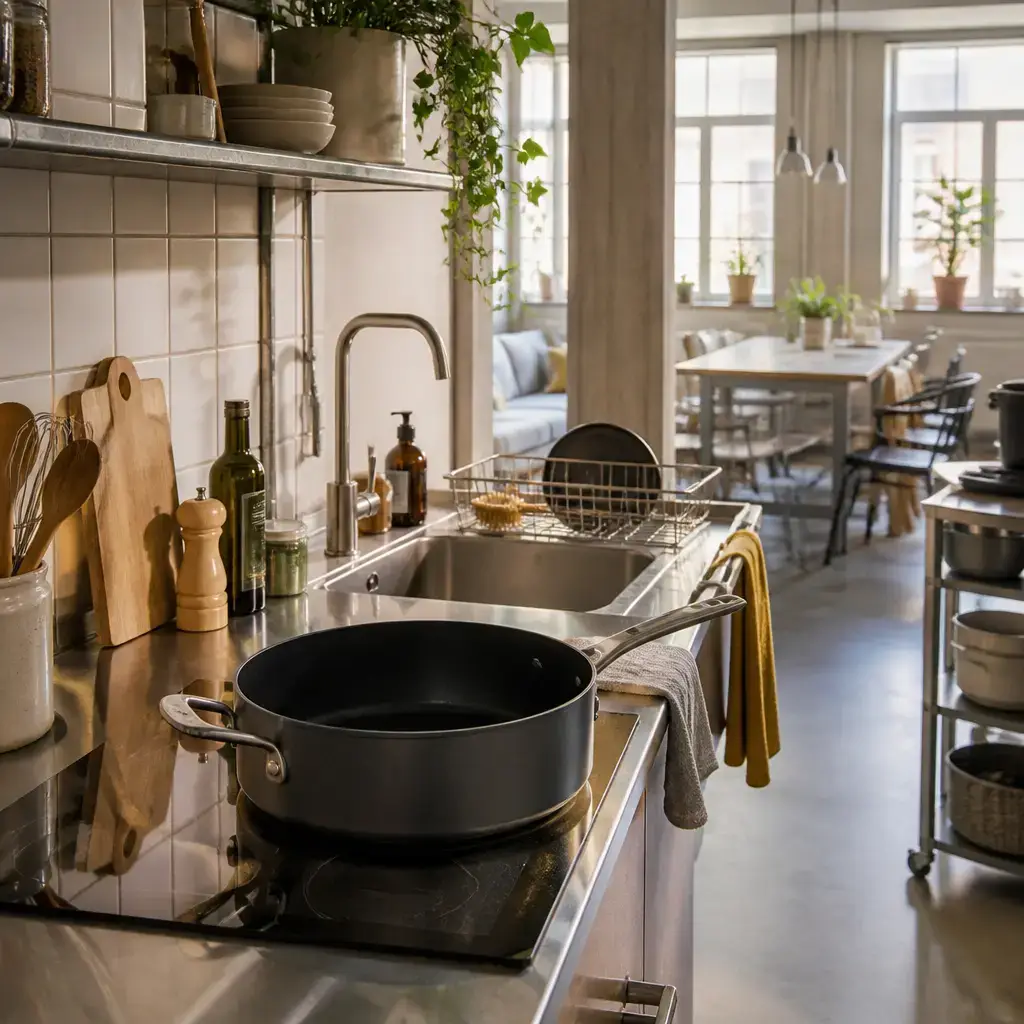
Use Borrowing a Large Pan to practice German conversation, pronunciation, vocabulary, grammar, and quizzes.
Dialogue
Kann ich mir heute deine große Pfanne ausleihen?
kahn ikh meer HOY-tuh DYE-nuh GROH-suh PFAN-nuh OWS-lie-en? Can I borrow your large pan today?Ja, aber pass auf den Griff auf, weil er heiß wird.
yah, AH-ber pass owf dayn grif owf, vyle air highss veert. You can, but watch the handle because it gets hot.Ist sie auf diesem Herd in Ordnung?
ist zee owf DEE-zem hairt in ORD-noong? Will it be all right on this stove?Sie sollte in Ordnung sein, wenn du die Hitze niedrig hältst.
zee SHOL-tuh in ORD-noong zine, ven doo dee HIT-suh NEE-drikh helst. It should be fine if you keep the heat low.Ich werde sie direkt nach dem Abendessen abwaschen.
ikh VAIR-duh zee dee-REKT nahkh daym AH-bent-ess-en AHP-vah-shen. I will wash it right after dinner.Bitte trockne sie gut ab, bevor du sie mir zurückbringst.
BIT-tuh TROK-nuh zee goot AHP, beh-FOR doo zee meer tsoo-RUEK-bringst. Please dry it well before bringing it back to me.Wann möchtest du sie zurückhaben?
vahn MURKH-test doo zee tsoo-RUEK-hah-ben? When would you like it back?Nach dem Abendessen ist es in Ordnung.
nahkh daym AH-bent-ess-en ist ess in ORD-noong. After dinner is fine.Ich brauche sie erst später in dieser Woche wieder.
ikh BROW-khuh zee airrst SHPAY-ter in DEE-zer VOH-khuh VEE-der. I will not need it again until later this week.Sentence explanations
Kann ich mir heute deine große Pfanne ausleihen?
Can I borrow your large pan today?
- Kann ich
- Can I…?
- mir
- for myself
- heute
- today
- deine
- your
- große
- large
- Pfanne
- pan
- ausleihen
- borrow
More detail
Kann ich begins a yes/no question. kann is the present-tense form of können for ich; können expresses ability or permission, and here the fixed translation supports the permission request “Can I…?” In a German yes/no question, the conjugated verb comes before the subject: Kann ich ...? Compare the reusable pattern Kann ich + infinitive? = “Can I ...?” mir is the dative reflexive pronoun meaning “for myself” in this construction. It connects the borrowing action to the speaker as the person who will make use of the borrowed object. The relevant pronoun forms include mir for “to/for me” and dir for “to/for you”; the form is determined by the pronoun’s role, not by the noun Pfanne. heute means “today” and places the borrowing request on the current day. It is an adverb, so it does not change to agree with another word. For example, Ich komme heute. means “I’m coming today.” deine is the informal singular “your” form used with Pfanne here. The possessive form agrees with the thing possessed: deine Pfanne. dein is the corresponding form with a neuter noun in the same basic case pattern, as in dein Buch (“your book”). The choice of deine is therefore not determined by the owner’s gender; it reflects the grammatical properties of the possessed noun and its role in the sentence. große means “large” here. Its base form is groß; große is the inflected form used before Pfanne in this noun phrase. The adjective describes the pan’s size. A useful comparison is groß = “large,” größer = “larger,” am größten = “largest.” Pfanne is the noun “pan.” Its plural is Pfannen. In this sentence, Pfanne is singular and is the object being borrowed. The adjective and possessive form are placed before it: deine große Pfanne = “your large pan.” ausleihen is the infinitive “to borrow” in the intended meaning. The prefix aus- remains attached in this infinitive. In a finite main clause, the separable verb can split: Ich leihe mir die Pfanne aus. means “I borrow the pan.” In the question, ausleihen stays at the end because it is governed by the modal verb kann: Kann ich ... ausleihen? Together, Kann ich mir deine große Pfanne ausleihen? asks whether the speaker may borrow the listener’s large pan today. The modal question Kann ich ...? supplies the request for permission, mir marks the speaker as the beneficiary, heute gives the time, deine große Pfanne identifies the object, and final ausleihen names the action. This is a natural, everyday request; the following context confirms that the request concerns a pan whose handle may become hot.
Ja, aber pass auf den Griff auf, weil er heiß wird.
You can, but watch the handle because it gets hot.
- pass auf
- watch out; pay attention
- Griff
- handle
- er
- it
- heiß
- hot
- wird
- gets; becomes
More detail
pass auf is the informal singular imperative of the separable verb aufpassen (“to pay attention; to watch out”). In this sentence, aufpassen auf means “to watch/pay attention to” something. The preposition auf is used with the accusative here: auf den Griff. Example: Pass auf den Hund auf. — “Watch the dog.” Griff means “handle” here. Its base form is the masculine noun der Griff; after auf in this use, it appears as the accusative den Griff. The noun itself is the part that identifies the handle; the article carries the visible case change. er is a third-person singular masculine pronoun. Here it refers to der Griff, as confirmed by the translation “the handle.” German pronouns agree grammatically with the noun’s gender, so der Griff is referred to as er even though the English translation uses “it.” Example: Der Griff ist stabil. Er ist aus Metall. — “The handle is sturdy. It is made of metal.” heiß means “hot.” It is the adjective describing the handle’s resulting condition in this sentence. Its opposite is kalt, “cold.” Example: Die Pfanne ist heiß. — “The pan is hot.” wird is the third-person singular present form of werden, “to become; to get” in this use. The form agrees with singular er: er wird. With an adjective, werden describes a change into a state: Er wird heiß. — “It gets hot.” This differs from Er ist heiß, which states that it is hot rather than focusing on becoming hot. weil introduces the reason for the warning. In the subordinate clause weil er heiß wird, the finite verb wird comes at the end. The pattern is weil + subject + ... + verb: weil das Wasser kalt wird — “because the water gets cold.” The opening Ja, aber responds affirmatively to the preceding request, then adds a caution: “Yes, but...” The complete structure is Pass auf den Griff auf (“Watch the handle”) plus weil er heiß wird (“because it gets hot”). Together, the utterance means: “You can, but watch the handle because it gets hot.”
Ist sie auf diesem Herd in Ordnung?
Will it be all right on this stove?
- Ist sie
- Is it / will it be
- auf
- on
- diesem
- this
- Herd
- stove
- in Ordnung
- all right
More detail
Ist sie uses ist, the third-person singular present form of sein (“to be”). In this question, sie is understood as “it” from the fixed translation; its specific referent is not named in the sentence. German yes/no questions commonly put the finite verb first: Ist sie ...? = “Is it ...?” or, with the situation referring to a future result, “Will it be ...?” auf means “on” here. With a stationary location, auf takes the dative; with movement onto a surface, it commonly takes the accusative instead. Compare the reusable patterns auf dem Herd (“on the stove,” location) and etwas auf den Herd stellen (“put something on the stove,” movement). diesem means “this” and is the dative masculine or neuter form of the demonstrative dies-. It agrees with the noun it determines: dieser Herd (nominative), diesen Herd (accusative), diesem Herd (dative). Here the dative form is required by the locative use of auf; Herd is masculine. Herd means “stove” or “cooker.” Its useful basic forms include der Herd (singular) and die Herde (plural). In this utterance, Herd is singular and follows the dative article form diesem. in Ordnung is a fixed expression meaning “all right,” “fine,” or “okay.” It describes an acceptable condition rather than physical position. For example, Alles ist in Ordnung. means “Everything is fine.” Together, Ist sie forms the yes/no question, auf diesem Herd specifies the location “on this stove,” and in Ordnung asks whether the situation or object will be acceptable there. The whole utterance therefore means “Will it be all right on this stove?”
Sie sollte in Ordnung sein, wenn du die Hitze niedrig hältst.
It should be fine if you keep the heat low.
- Sie sollte
- It should
- in Ordnung
- fine; all right
- sein
- be
- wenn
- if
- die Hitze
- the heat
- niedrig
- low
- hältst
- keep
More detail
Sie sollte means “it should” here. Sie is the third-person singular feminine pronoun used for the item referred to as “it” in the fixed translation; it is not the formal second-person pronoun Sie (“you”). sollte is the form of sollen used here to express expectation or a likely satisfactory result. The infinitive after it comes at the end of the main clause: Sie sollte ... sein = “It should ... be.” in Ordnung is a common fixed expression meaning “fine” or “all right.” With sein, in Ordnung sein is a reusable way to describe something as being acceptable or in a satisfactory condition. For example: Alles ist in Ordnung. — “Everything is fine.” wenn introduces a condition: “if” or, depending on context, “when.” In this sentence it presents the condition for the expected result. In a German subordinate clause introduced by wenn, the finite verb goes to the end: wenn du ... hältst. die Hitze means “the heat.” die is the definite article used with this feminine noun; the article has the same form in the nominative and accusative here, while the sentence structure shows that the heat is what is being kept at a certain level. Hitze is the noun for heat, not the temperature reading itself in every possible context. niedrig means “low.” Here it is a predicative adjective after halten: etwas niedrig halten = “keep something low.” It does not take an ending in this use, because it is not placed directly before the noun. For comparison, niedriger means “lower,” and hoch is the useful opposite of niedrig. hältst is the second-person singular present form of halten, used with du. In this construction, halten means “keep” rather than simply “hold”: du hältst die Tür offen means “you keep the door open.” The form hältst shows the vowel change from the base form halten and the du ending. Because it is the finite verb of the wenn clause, it appears at the end of that clause. Together, Sie sollte in Ordnung sein says that the item is expected to be fine. wenn du die Hitze niedrig hältst gives the condition: this is expected to be true if you keep the heat low. The complete meaning is “It should be fine if you keep the heat low.”
Ich werde sie direkt nach dem Abendessen abwaschen.
I will wash it right after dinner.
- Ich werde
- I will
- sie
- it
- direkt nach
- right after
- dem Abendessen
- dinner
- abwaschen
- wash
More detail
Ich werde combines Ich (“I”) with the first-person singular form of werden (“will/become”). Here werden is the auxiliary for the future: Ich werde ... abwaschen = “I will wash ...”. The lexical verb stays in the infinitive at the end of this construction. Example: Ich werde morgen kochen. — “I will cook tomorrow.” sie means “it” here, as established by the fixed translation. In this sentence it is the accusative object of abwaschen. The form sie can also represent a feminine singular pronoun or a plural pronoun in other grammatical contexts; the singular “it” reading is the one intended here. German object pronouns change form according to grammatical case, so the nominative counterpart for a feminine singular referent is also sie, while the masculine singular accusative counterpart is ihn. direkt nach expresses that one event follows another with no intended interval: “right after”. In the time expression direkt nach dem Abendessen, nach is a preposition governing the dative. Example: Wir gehen direkt nach dem Unterricht. — “We are going right after class.” dem Abendessen means “dinner”. Abendessen is a neuter noun, and dem is its definite article in the dative singular. The dative form appears here because this is a time expression with nach; it does not mean that dinner is being washed. abwaschen means “to wash”, especially to wash dishes or another washable item. It is a separable verb: in a main-clause present-tense sentence, Ich wasche sie ab. means “I wash it.” With future werden, the infinitive remains together at the end: Ich werde sie abwaschen. Do not confuse this with waschen, the more general verb “to wash”; abwaschen presents the washing as washing something off or washing an item, often in a dishwashing context. Together, Ich werde + sie + direkt nach dem Abendessen + abwaschen gives: “I will wash it right after dinner.” The future auxiliary appears in second position, the object comes before the time expression, and the infinitive abwaschen closes the sentence. The utterance is a straightforward everyday statement about when the washing will happen.
Bitte trockne sie gut ab, bevor du sie mir zurückbringst.
Please dry it well before bringing it back to me.
- Bitte
- please
- trockne … ab
- dry off
- sie
- it
- gut
- well
- bevor
- before
- sie
- it
- mir
- to me
- zurückbringst
- bring back
More detail
Bitte makes the request polite. At the beginning of a request, it can accompany an imperative: Bitte komm herein. = “Please come in.” trockne … ab comes from the separable verb abtrocknen, “to dry off.” The form trockne is the informal singular imperative addressed to du; the prefix ab moves to the end in this imperative. In a main-clause statement, the same verb appears as Du trocknest sie ab. = “You dry it off.” The first sie is the thing being dried. Here the fixed translation and context support the singular “it”; grammatically, this form is the accusative of the feminine singular pronoun sie. Its specific noun referent is not named in the supplied sentences. Compare the subject form sie (“she”) and the plural forms sie (“they/them”); the role and context determine the reading. gut means “well” here and modifies the action abtrocknen, so it describes how thoroughly or effectively the drying should be done. The adjective gut can also be used attributively, as in ein gutes Tuch = “a good cloth,” but that is a different use from this adverbial use. bevor introduces a clause meaning “before.” It places the action in that clause earlier than the action in the request. A clause beginning with bevor is subordinate, so its finite verb goes to the end: bevor du gehst = “before you leave.” The second sie is the object of zurückbringst, again understood as “it” from the fixed translation and context. It is separate from the first occurrence: the first sie is the object of drying, while this one is the object of bringing back. mir means “to me.” It is the dative form of ich and marks the recipient or person to whom something is brought. The form chain is ich (subject), mich (accusative object), mir (dative recipient): Du bringst mir das Buch. = “You bring me the book.” zurückbringst is the du form of the separable verb zurückbringen, “to bring back.” The base form of this observed verb is zurückbringen; it is built from zurück- and bringen, with zurück- adding the meaning of return. In the bevor clause, the prefix and verb remain joined and the finite verb is final: bevor du sie mir zurückbringst. In a main clause, the prefix separates: Du bringst sie mir zurück. = “You bring it back to me.” Together, Bitte trockne sie gut ab means “Please dry it well.” The subordinate clause bevor du sie mir zurückbringst adds “before you bring it back to me.” The complete utterance is therefore: “Please dry it well before bringing it back to me.”
Wann möchtest du sie zurückhaben?
When would you like it back?
- Wann
- when
- möchtest du
- would you like
- sie
- it
- zurückhaben
- have back
More detail
Wann means “when” and asks for a time. It is a question word, not a statement about whether something happens. Example: Wann kommst du? — “When are you coming?” möchtest du expresses what the addressed person would like. möchtest is the second-person singular form of mögen in the subjunctive II form used for “would like”; du is the singular “you.” Compare Du magst es — “You like it” — with Du möchtest es — “You would like it.” With a different subject, the form changes: Ich möchte ... — “I would like ...” sie is the object pronoun meaning “it” here, as established by the fixed translation and context. In German, this form can also represent other grammatical possibilities in other contexts, but here it refers to the item being brought back. As an object, it is in the accusative; the form sie itself does not reveal whether the intended item’s grammatical gender is feminine or whether a plural reading is possible, so the supplied meaning is important. zurückhaben means “have back.” It is an infinitive made from zurück (“back”) and haben (“have”), and it appears at the end because möchten is followed by an infinitive in this request pattern. Example: Ich möchte mein Buch zurückhaben. — “I would like to have my book back.” Together, Wann asks for the time, möchtest du asks about the other person’s preference, sie identifies the item, and zurückhaben expresses having it back again. The whole utterance therefore means: “When would you like it back?”
Nach dem Abendessen ist es in Ordnung.
After dinner is fine.
- Nach
- after
- Abendessen
- dinner
- ist es
- it is
- in Ordnung
- fine; okay
More detail
Nach introduces a time that comes later than a reference point. In Nach dem Abendessen, it is the temporal preposition “after” and takes the dative here: das Abendessen becomes dem Abendessen. A reusable pattern is nach + dative for “after …”. Abendessen means “dinner” and is a noun, so it is capitalized in German. Its base form in this phrase is das Abendessen; after nach, the article is dem because the phrase is in the dative. Example: Nach dem Film gehe ich nach Hause. — “After the film, I go home.” ist es uses ist, the third-person singular present form of sein (“to be”), with es, the German pronoun/form used in this impersonal expression. Here es does not identify a specific person or object; the fixed translation presents the time phrase as what is acceptable. Useful forms are sein (base form), ist (third-person singular), and sind (plural or formal second person in the present). Example: Es ist spät. — “It is late.” in Ordnung is a fixed adjective phrase meaning “fine” or “okay.” It commonly follows sein: Alles ist in Ordnung. — “Everything is fine.” In the fixed sentence, it evaluates the proposed time as acceptable rather than describing dinner itself. Together, Nach dem Abendessen sets the time, ist es forms the impersonal “it is,” and in Ordnung says that this timing is acceptable: “After dinner is fine.”
Ich brauche sie erst später in dieser Woche wieder.
I will not need it again until later this week.
- Ich
- I
- brauche
- need
- sie
- it
- erst später
- not until later
- dieser
- this
- Woche
- week
- wieder
- again
More detail
Ich is the first-person singular subject: “I.” The same form is used whether the speaker is male or female. Example: Ich lerne Deutsch. — “I am learning German.” brauche is the first-person singular present form of brauchen (“to need”): ich brauche. German present tense can also refer to a future situation when the time is clear, as it is here through erst später in dieser Woche. Example: Ich brauche morgen Hilfe. — “I will need help tomorrow.” sie is the object form used here for the intended “it.” In this sentence it is an accusative feminine singular pronoun, although the specific thing it refers to is not identified in the supplied text. The form can have other grammatical roles in other contexts, so its role here comes from its position as the object of brauche and from the fixed translation. Example: Ich sehe sie. — “I see it.” erst später expresses a time limit: “only later” or, with an English negative future rendering, “not until later.” später is the comparative form of spät (“late”): spät — “late,” später — “later.” Here it does not mean that the speaker needs the item now; it places the next need at a later time. Example: Wir treffen uns erst später. — “We will not meet until later.” dieser belongs to the demonstrative pattern meaning “this.” In dieser Woche, it is the feminine dative form agreeing with the feminine noun Woche; the dative is used in this time expression after in. The form changes with grammatical case and gender, for example diese Woche is the accusative form used for “this week” as a direct time expression, while in dieser Woche means “in this week.” Woche is the feminine noun “week.” Its plural is Wochen. Example: Diese Woche ist voll. — “This week is busy.” wieder means “again,” showing that the need will recur. It is separate from erst später: erst später ... wieder means that the next occurrence of needing it will be later, not that the speaker needs it again immediately. Example: Ich komme morgen wieder. — “I will come again tomorrow.” Together, Ich brauche sie gives “I need it,” while erst später in dieser Woche places that need only later during the current week, and wieder marks it as a recurrence. The German present form brauche is therefore understood with future time reference: “I will not need it again until later this week.”
Grammar Points
trennbare Verben: Verbpräfix am Satzende
Du passt auf den heißen Griff auf.
doo past owf dayn HIGHSS-en grif owf.You watch out for the hot handle.
Bei trennbaren Verben steht das Präfix im Hauptsatz am Ende: aufpassen → Du passt ... auf.
werden + Adjektiv
Der Herd wird heiß.
dair hairt veert highss.The stove gets hot.
werden + Adjektiv beschreibt eine Veränderung oder einen neuen Zustand: Der Herd wird heiß.
German Vocabulary
Quiz
Word Order
Arrange the words in the correct order.
When would you like it back?
Show Answer
Wann möchtest du sie zurückhaben?Spelling
Tap the letters to spell the word.
pan
Show Answer
Pfannelarge
Show Answer
großetoday
Show Answer
heuteyour