10 minutes free every day
Continue audio lessons in the app
Word explanations appear automatically in sync with the audio.
No login required · synced translations · playback with the screen locked
Choose your learning language and open this lesson in the app.

About This Lesson
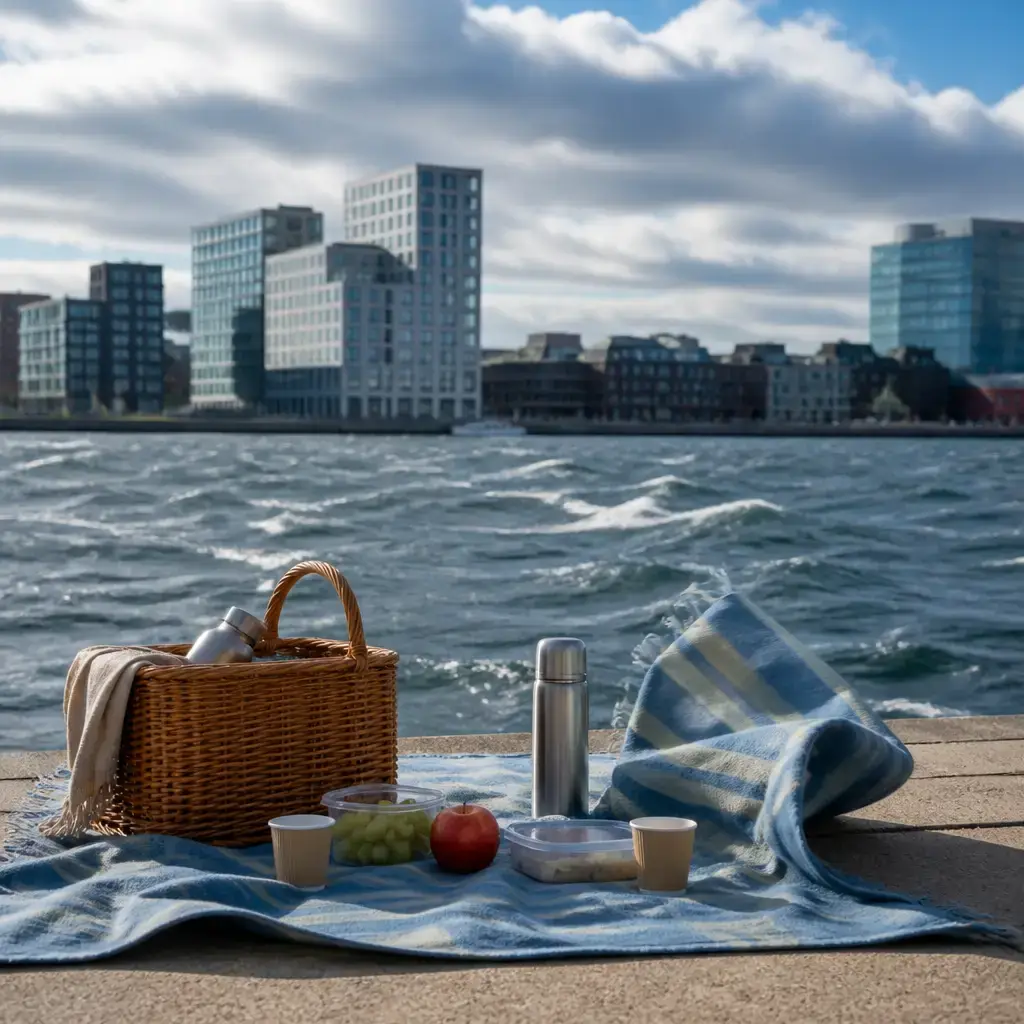
Use Cancel the picnic because of strong wind to practice German conversation, pronunciation, vocabulary, grammar, and quizzes.
Dialogue
Der Wind ist viel stärker als gestern.
dehr VINT ist feel SHTAIR-kuh ahls GES-tairn. The wind is much stronger than yesterday.Ein Picknick könnte heute nicht gemütlich sein.
ine PIK-nik KURR-tuh HOY-tuh nikht guh-MOOT-likh zine. A picnic might not be comfortable today.Die Decke würde immer wieder wegfliegen.
DEE DEK-kuh VUR-duh IM-muh VEE-duh VEK-flee-gun. The blanket would keep blowing away.Draußen zu essen könnte auch schwierig sein.
DROW-sun tsoo ESS-un KURR-tuh owkh SHVEE-rikh zine. Also, eating outside could be difficult.Sollen wir absagen und uns stattdessen drinnen treffen?
ZOL-lun veer AHP-zah-gun oont oons SHTAHT-dess-un DRIN-un TREF-un? Should we cancel and meet indoors instead?Das wäre sicherer und einfacher.
dahs VAIR-uh ZIKH-uh-rer oont IN-fakh-er. That would be safer and easier.Ich werde es allen im Gruppenchat sagen.
ikh VAIR-duh ess AHL-un im GROOP-un-khaht ZAH-gun. Let me tell everyone in the group chat.Ein Café in der Nähe des Parks wäre eine gute Wahl.
ine kuh-FAY in dare NAY-uh dess PARKS VAIR-uh EYE-nuh GOO-tuh VAHL. A cafe near the park would be a good choice.Sentence explanations
Der Wind ist viel stärker als gestern.
The wind is much stronger than yesterday.
- Wind
- wind
- ist
- is
- viel
- much
- stärker
- stronger
- als gestern
- than yesterday
More detail
Wind means “wind” here. It is a masculine German noun, and German nouns are capitalized. In Der Wind, Der is the definite article in the nominative masculine singular; its form reflects the noun’s gender, case, and definiteness, not gender alone. Example: Der Wind ist kalt. — “The wind is cold.” ist is the third-person singular present form of sein (“to be”), used because der Wind is singular. The useful present-tense pattern is er/sie/es ist — “he/she/it is.” viel means “much” in this comparison. It strengthens the comparative that follows: viel stärker means “much stronger,” not merely “stronger.” stärker is the comparative form of the adjective stark (“strong”): stark → stärker → am stärksten (“strong” → “stronger” → “strongest”). The umlaut in ä is part of this comparative form. Because it follows ist as a predicate adjective, stärker has no additional adjective ending here. Example: Der Wind ist stärker. — “The wind is stronger.” als gestern supplies the comparison standard: als is used for “than” after a comparative, and gestern is the time adverb “yesterday.” Together, they mean “than yesterday.” Example: Heute ist es wärmer als gestern. — “Today it is warmer than yesterday.” The sentence assembles as Der Wind (“the wind”) + ist (“is”) + viel stärker (“much stronger”) + als gestern (“than yesterday”). Thus, Der Wind ist viel stärker als gestern. means “The wind is much stronger than yesterday.”
Ein Picknick könnte heute nicht gemütlich sein.
A picnic might not be comfortable today.
- Ein
- a/an
- Picknick
- picnic
- könnte … sein
- might be
- heute
- today
- nicht
- not
- gemütlich
- comfortable; cozy
More detail
Ein is the indefinite article used with a singular noun. Here it introduces Picknick, but it does not by itself assert a numerical count. German articles also show grammatical gender and case: ein Picknick is a neuter singular noun phrase in the nominative, because Picknick is neuter. Picknick means “picnic.” It is a neuter noun and is written with a capital letter in German. Its plural is Picknicks. Example: Wir machen ein Picknick. — “We are having a picnic.” könnte ... sein expresses possibility: “might be.” könnte is the third-person singular Konjunktiv II form of können (“can; be able to”), used here to express possibility rather than ability. The infinitive sein (“to be”) appears at the end of the clause. The pattern könnte + infinitive is reusable: Das könnte schwierig sein. — “That might be difficult.” heute means “today,” referring to the current day. It is an adverb and does not change form. Example: Heute ist es ruhig. — “Today it is quiet.” nicht is the ordinary German negator “not.” Here it negates the adjective gemütlich, so the possible state described is one that is not comfortable or cozy. Its exact scope comes from the surrounding construction. gemütlich means “comfortable” or “cozy” here. It is an adjective describing the picnic’s possible condition. The same adjective can describe a pleasant, cozy atmosphere or place, depending on context. Example: Das Zimmer ist gemütlich. — “The room is cozy.” Together, Ein Picknick supplies the subject, könnte ... sein presents a possibility, heute locates it in the current day, and nicht gemütlich gives the negated description. The complete meaning is: “A picnic might not be comfortable today.”
Die Decke würde immer wieder wegfliegen.
The blanket would keep blowing away.
- Decke
- blanket
- würde
- would
- immer wieder
- again and again
- wegfliegen
- blow away
More detail
Decke means “blanket” here. It is a feminine noun: die Decke; its plural is die Decken. The article and noun together show the subject of the sentence, but Decke itself does not show gender through its ending. Example: Die Decke ist warm. — “The blanket is warm.” würde is the conditional form of werden used with an infinitive. The pattern würde + infinitive presents a hypothetical or conditional situation: “would …”. Here, würde does not mean that the blanket “becomes” something; the following verb supplies the action. Example: Ich würde bleiben. — “I would stay.” immer wieder means that something happens repeatedly, with the event recurring over time. It is stronger than a single wieder (“again”) because it describes repeated recurrence. Example: Der Wind kommt immer wieder. — “The wind keeps coming back.” wegfliegen means “to fly away” or, for a light object, “to blow away.” It is an intransitive compound verb: the subject is the thing that moves away, rather than a person directly moving another object. Its useful forms include fliegt weg (present), flog weg (simple past), and ist weggeflogen (perfect). In a finite main clause, the separable prefix appears at the end: Die Decke fliegt weg. — “The blanket is flying away.” After würde, the infinitive remains together: Die Decke würde wegfliegen. Together, Die Decke würde ... wegfliegen means “The blanket would ... blow away.” Inserting immer wieder between the conditional verb and the infinitive gives Die Decke würde immer wieder wegfliegen: the blanket would repeatedly fly or blow away, not just do so once. The sentence therefore describes a repeated hypothetical result, consistent with the fixed translation “The blanket would keep blowing away.”
Draußen zu essen könnte auch schwierig sein.
Also, eating outside could be difficult.
- Draußen
- outside
- zu essen
- to eat; eating
- könnte
- could
- auch
- also
- schwierig
- difficult
- sein
- be
More detail
Draußen means “outside” and is an adverb describing where the eating takes place. It can be used without a noun: Wir essen draußen. — “We eat outside.” Its position can vary, but here it comes first to set the situation. zu essen is the infinitive “to eat” with zu. In this sentence, the whole infinitive phrase functions as the subject: “eating outside.” The pattern zu + infinitive is common when an action is treated as a topic or subject. Example: Draußen zu arbeiten ist angenehm. — “Working outside is pleasant.” könnte is the Konjunktiv II form of können (“can; be able to”). Here it expresses possibility: “could,” rather than asserting that the difficulty will definitely occur. The finite modal verb is in the second position of this main clause, after the initial infinitive phrase. Example: Das könnte helfen. — “That could help.” auch means “also” or “too.” It adds this possibility to another consideration; it does not itself express the possibility. Its exact scope comes from the surrounding clause. schwierig is the adjective “difficult.” Here it is used predicatively after sein, so it describes the situation rather than changing to agree with a noun. Example: Die Aufgabe ist schwierig. — “The task is difficult.” sein is the infinitive of sein (“to be”). Because könnte is a modal verb, the other verb remains in the infinitive at the end: könnte ... schwierig sein — “could be difficult.” Together, Draußen zu essen makes eating outside the topic, könnte presents the assessment as a possibility, and auch links it to another consideration. Thus the full utterance means: “Also, eating outside could be difficult.”
Sollen wir absagen und uns stattdessen drinnen treffen?
Should we cancel and meet indoors instead?
- Sollen wir
- Shall we …?
- absagen
- cancel
- uns … treffen
- meet each other
- stattdessen
- instead
- drinnen
- indoors
More detail
Sollen wir uses present-tense sollen with wir (“we”). In this question, it proposes a joint action: “Should we …?” The infinitive that follows completes the proposal. Compare Sollen wir gehen? — “Should we go?” absagen is a separable verb meaning “to cancel” an appointment, event, or arrangement. Its base form is absagen; in a main-clause statement, the prefix separates: Wir sagen ab. — “We are cancelling.” Here it remains in the infinitive after sollen. uns is the accusative reflexive pronoun for wir, meaning that the subject and the people being met are the same group. The reusable pattern is sich treffen (“to meet”): Wir treffen uns morgen. — “We are meeting tomorrow.” The form uns agrees with the first-person plural subject wir in this construction. stattdessen is an adverb meaning “instead” or “instead of that.” It contrasts the proposed meeting indoors with the earlier possibility of eating outside. It is not part of the verb’s inflection and can be placed elsewhere when the sentence structure allows it. drinnen is an adverb meaning “indoors” or “inside,” describing the location of the meeting. It contrasts with draußen (“outdoors”), the location mentioned in the preceding context. Example: Wir bleiben drinnen. — “We are staying indoors.” Together, Sollen wir absagen proposes cancelling the relevant plan, and uns stattdessen drinnen treffen proposes that the same group meet indoors instead. The conjunction und links the two coordinated actions. Thus the complete utterance means: “Should we cancel and meet indoors instead?”
Das wäre sicherer und einfacher.
That would be safer and easier.
- Das
- that; it
- wäre
- would be
- sicherer
- safer
- einfacher
- easier
More detail
Das means “that” here and points to the proposal or situation being discussed. In this use it is a standalone demonstrative pronoun, not an article introducing a noun; its exact referent is supplied by the surrounding discussion. wäre is the Konjunktiv II form of sein (“to be”). The useful pattern is wäre + adjective: “would be …,” expressing a hypothetical or proposed assessment rather than stating that it is definitely so. Example: Das wäre gut. — “That would be good.” sicherer is the comparative form of sicher (“safe” or “secure”): sicher → sicherer (“safer” or “more secure”) → am sichersten (“safest” or “most secure”). Here it is a predicative adjective after wäre; in this position, the comparative adjective has no additional gender or case ending. einfacher is the comparative form of einfach (“easy” or “simple”): einfach → einfacher (“easier” or “simpler”) → am einfachsten (“easiest” or “simplest”). Like sicherer, it describes the proposal or situation through the verb wäre. The conjunction und links the two coordinated descriptions. Together, Das wäre sicherer und einfacher. means “That would be safer and easier.” The speaker presents the referenced proposal as having both qualities in a hypothetical assessment.
Ich werde es allen im Gruppenchat sagen.
Let me tell everyone in the group chat.
- Ich werde
- I will
- es
- it
- allen
- everyone
- im Gruppenchat
- in the group chat
- sagen
- tell; say
More detail
Ich werde combines the subject ich (“I”) with werde, the first-person singular present form of werden. With an infinitive later in the clause, werden forms the German future: Ich werde ... sagen = “I will tell/say ...”. In this fixed sentence, the translation uses “Let me tell ...”, but the German wording itself presents the action as the speaker’s intention or future action, not as a separate imperative form. Compare Ich werde kommen = “I will come.” es is the accusative personal pronoun “it”. It is the direct object of sagen here: the speaker will say or tell “it”. German pronouns change by grammatical case; for this pronoun, the accusative form is es, while the nominative form is also es when “it” is the subject. Its specific referent is not identified in the supplied sentence. allen means “to everyone” here. It is the dative plural form of alle (“all/everyone”) and marks the people receiving the information. The form allen is used for a dative plural recipient; for example, Ich helfe allen means “I help everyone.” This word does not itself state a numerical count. im Gruppenchat means “in the group chat”. im is the contraction of in dem; with a location, in takes the dative, and dem Gruppenchat is the dative form of the masculine noun der Gruppenchat. The compound noun Gruppenchat combines Gruppe (“group”) and Chat (“chat”), but it functions as one noun. Compare im Büro = “in the office.” sagen is the infinitive “to say” or “to tell”. After the finite form werde, the infinitive remains at the end of this main clause: Ich werde ... sagen. The verb commonly takes the content as an accusative object and, when a recipient is expressed, that recipient in the dative, as in Ich sage ihm die Wahrheit = “I tell him the truth.” Together, Ich werde es allen im Gruppenchat sagen means “I will tell everyone in the group chat.” The structure is: subject + future auxiliary werden + the content being told + the recipient + the location phrase + the infinitive sagen at the end. In the fixed translation, this is rendered naturally as “Let me tell everyone in the group chat.”
Ein Café in der Nähe des Parks wäre eine gute Wahl.
A cafe near the park would be a good choice.
- Café
- cafe
- in der Nähe
- nearby
- Parks
- park
- wäre
- would be
- gute
- good
- Wahl
- choice
More detail
Café is the noun meaning “cafe” here. Its plural is Cafés, so the acute accent and final -s are retained in the plural. in der Nähe is a reusable location expression meaning “near” or “in the vicinity.” A common pattern is in der Nähe von + a noun: Das Café ist in der Nähe von meinem Hotel. — “The cafe is near my hotel.” In this sentence, the following noun phrase uses the genitive instead: in der Nähe des Parks. Parks is the genitive singular form of the masculine noun Park. The ending -s marks the relation “of the park”; the form is not a plural here. The genitive article is des: die Nähe des Parks means “the vicinity of the park.” wäre is the Konjunktiv II form of sein (“to be”), used here for a hypothetical or suggested assessment: “would be.” The useful chain is sein — “to be,” ist — “is,” wäre — “would be.” For example, Das wäre hilfreich. — “That would be helpful.” gute is the attributive form of the adjective gut (“good”). It describes Wahl, not Café. In eine gute Wahl, the adjective has the -e ending because it is in a nominative feminine noun phrase with the indefinite article eine. Compare eine gute Idee — “a good idea.” Wahl is the feminine noun meaning “choice” or “option.” Its plural is Wahlen, although the singular is required here by eine: eine Wahl — “a choice.” The sentence begins with Ein Café, an indefinite noun phrase meaning “a cafe.” in der Nähe des Parks specifies its location, literally “near the park.” wäre presents the assessment hypothetically, and eine gute Wahl supplies that assessment: the cafe would be a good choice. Together, the utterance means “A cafe near the park would be a good choice.”
Grammar Points
Komparativ: Adjektiv + -er
stärker, sicherer, einfacher
SHTAIR-kuh, ZIKH-uh-rer, IN-fakh-erstronger, safer, easier
German often forms the comparative by adding -er to the adjective.
Adjektiv vor einem Nomen: gute Wahl
gute Wahl
GOO-tuh VAHLgood choice
Before a feminine noun, the adjective takes the ending -e in this form.
German Vocabulary
Die Decke
Ein Picknick
viel stärker
Der Wind
Quiz
Word Order
Arrange the words in the correct order.
The blanket would keep blowing away.
Show Answer
Die Decke würde immer wieder wegfliegen.That would be safer and easier.
Show Answer
Das wäre sicherer und einfacher.Spelling
Tap the letters to spell the word.
blanket
Show Answer
Deckepicnic
Show Answer
Picknickyesterday
Show Answer
gesterncomfortable; cozy