10 minutes free every day
Continue audio lessons in the app
Word explanations appear automatically in sync with the audio.
No login required · synced translations · playback with the screen locked
Choose your learning language and open this lesson in the app.

About This Lesson
Use Dressing for Changing Weather to practice German conversation, pronunciation, vocabulary, grammar, and quizzes.
Dialogue
Das Wetter ändert sich diese Woche ständig.
dahs VET-uh AIRN-dut zikh DEE-zuh VO-khuh SHTEN-dikh The weather keeps changing this week.Zieh mehrere Schichten an, damit du sie im Laufe des Tages anpassen kannst.
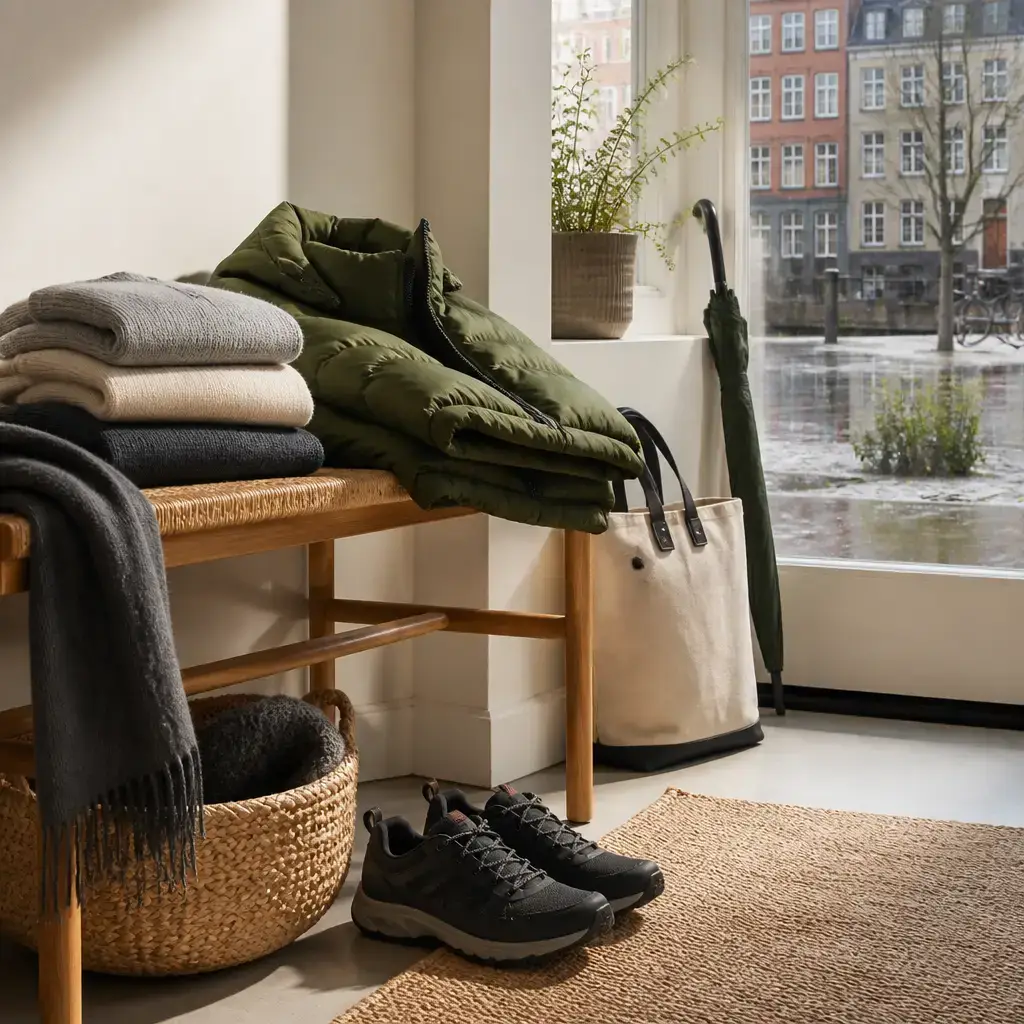
tsee MEHR-uh-ruh SHIKH-tun AHN, dah-MIT doo zee im LOW-fuh dess TAH-gess AHN-pah-sun kahnst Wear layers so you can adjust during the day.Soll ich auch eine warme Jacke mitnehmen?
zoll ikh owkh EYE-nuh VAR-muh YAH-kuh MIT-nay-mun Should I bring a warm jacket too?Nimm eine warme Jacke für den Morgen mit.
nim EYE-nuh VAR-muh YAH-kuh fyr den MOR-gun mit Bring one for the morning.Dann kannst du die Jacke später tragen, wenn es wärmer wird.
dahn kahnst doo dee YAH-kuh SHPAY-tuh TRAH-gun, ven ess VER-muh veert Then carry it later if it gets warmer.Ich brauche auch Schuhe, in denen man gut laufen kann.
ikh BROW-khuh owkh SHOO-uh, in DAY-nun mahn goot LOW-fun kahn I also need shoes that are easy to walk in.Wähle ein leichtes Paar mit gutem Halt, falls die Wege nass sind.
VAY-luh ayn LIEKH-tuss PAHR mit GOO-tum hahlt, fahls dee VAY-guh nahss zint Choose a light pair with a solid grip in case the paths are wet.Das sollte passen, wenn es am Nachmittag wärmer wird.
dahs ZOL-tuh PAH-sun, ven ess ahm NAHKH-mit-tahk VER-muh veert That should work if the afternoon warms up.Dann kannst du die Jacke tragen, ohne dass sie sich schwer anfühlt.
dahn kahnst doo dee YAH-kuh TRAH-gun, OH-nuh dahss zee zikh SHVAIR ahn-FYOOLT Then you can carry the jacket without feeling weighed down.Sentence explanations
Das Wetter ändert sich diese Woche ständig.
The weather keeps changing this week.
- Wetter
- weather
- ändert sich
- changes
- Woche
- week
- ständig
- constantly
More detail
Wetter means “weather” here. It is a neuter noun: das Wetter. German nouns are capitalized. Example: Das Wetter ist gut. — “The weather is good.” ändert sich is the third-person singular present form of the reflexive construction sich ändern, “to change.” The subject is das Wetter, so the verb is ändert; sich shows that the subject undergoes the change. Compare Das Wetter ändert sich. — “The weather is changing” with Ich ändere den Plan. — “I am changing the plan,” where ändern has a separate object. Woche means “week.” In diese Woche, the demonstrative and noun form a time expression meaning “this week.” Woche is feminine (die Woche), and the form diese agrees with it. German can use such a time expression without a preposition to say when something happens. Example: Diese Woche arbeite ich viel. — “I am working a lot this week.” ständig means “constantly” or “continually.” As an adverb here, it describes the repeated or ongoing nature of the weather’s changes. It does not change form for the subject. Example: Der Wind weht ständig. — “The wind is blowing constantly.” Together, Das Wetter is the subject, ändert sich says that it is changing, diese Woche places the changes in the current week, and ständig emphasizes that they happen repeatedly or without much interruption. The complete meaning is: “The weather keeps changing this week.”
Zieh mehrere Schichten an, damit du sie im Laufe des Tages anpassen kannst.
Wear layers so you can adjust during the day.
- Zieh … an
- put on
- mehrere
- several
- Schichten
- layers
- damit
- so that
- sie
- them
- im Laufe des Tages
- during the day
- anpassen
- adjust
- kannst
- can
More detail
Zieh ... an is the separable verb anziehen, “to put on” or “to wear.” Here Zieh is the informal singular imperative addressed to du; the prefix an moves to the end: Zieh ... an! Example: Zieh deine Schuhe an! — “Put on your shoes!” mehrere means “several” and modifies the plural noun Schichten. It indicates more than one, without specifying an exact number. Schichten is the plural of Schicht, “layer.” Example: Ich trage mehrere Schichten. — “I am wearing several layers.” damit introduces a purpose clause, roughly “so that.” In this clause, the finite verb goes to the end. sie means “them” here and refers to the layers; it is the accusative plural personal pronoun. Example: Ich öffne die Fenster, damit sie frische Luft bekommen. — “I open the windows so that they get fresh air.” im Laufe des Tages means “during the day” or, more literally, “over the course of the day.” im is a contraction of in dem; des Tages is the genitive form of der Tag. This expression presents the day as the period in which something happens. anpassen means “to adjust” or “adapt.” In this sentence it takes sie as its object: the layers can be adjusted. As an infinitive, it remains at the end of the damit clause. Example: Du kannst den Sitz anpassen. — “You can adjust the seat.” kannst is the second-person singular present form of the modal verb können, “can” or “be able to.” With du, the form is du kannst; the other verb stays in the infinitive: Du kannst die Schichten anpassen. — “You can adjust the layers.” Together, the sentence gives the informal instruction Zieh mehrere Schichten an (“Wear several layers”) and then gives its purpose: damit du sie im Laufe des Tages anpassen kannst (“so that you can adjust them during the day”). The complete meaning is: “Wear layers so you can adjust them during the day.”
Soll ich auch eine warme Jacke mitnehmen?
Should I bring a warm jacket too?
- Soll ich
- Should I
- auch
- also; too
- warme
- warm
- Jacke
- jacket
- mitnehmen
- take along; bring
More detail
Soll ich contains sollen in the present-tense first-person singular form soll plus the subject pronoun ich. Here it asks whether bringing the item is advisable or wanted: “Should I …?” In a yes/no question, the finite verb comes before the subject. Compare the reusable pattern Soll ich ...? — “Should I ...?” auch means “too” or “also” here. It adds this action to something already under consideration. Its exact position can vary with emphasis, but in this sentence it comes before the noun phrase it adds. warme is the adjective warm, “warm,” describing Jacke. The adjective has the form warme because it stands before a feminine singular noun in the phrase eine warme Jacke; after the indefinite article eine, this adjective form marks the relevant case and gender combination. Useful forms include warm and the comparative wärmer (“warmer”). Example: Die Jacke ist warm. — “The jacket is warm.” Jacke is a feminine noun meaning “jacket.” In eine warme Jacke, it is the direct object of the action, so the noun phrase is in the accusative; with the indefinite article, feminine singular accusative still has eine. Example: Ich kaufe eine Jacke. — “I am buying a jacket.” mitnehmen is the separable verb mitnehmen, meaning “to take along” or “to bring.” Its base components are nehmen (“take”) and the separable prefix mit- (“along”), but the observed form is the single infinitive mitnehmen. Because it follows the modal verb soll, it remains an infinitive at the end: Soll ich die Jacke mitnehmen? — “Should I bring the jacket?” In a simple finite statement, the prefix separates: Ich nehme die Jacke mit. — “I bring the jacket along.” Together, Soll ich asks whether the speaker should do something, auch adds that action as another possibility, and eine warme Jacke mitnehmen means “bring a warm jacket along.” The complete utterance is therefore: “Should I bring a warm jacket too?”
Nimm eine warme Jacke für den Morgen mit.
Bring one for the morning.
- Nimm … mit
- bring along
- warme
- warm
- Jacke
- jacket
- Morgen
- morning
More detail
Nimm ... mit is the reusable command pattern formed from nehmen (“take”) and the separable prefix mit- (“along”). Nimm is the informal singular imperative of nehmen, used to address one person. Because mitnehmen is separable, mit appears at the end of the clause: Nimm die Jacke mit. — “Take the jacket along.” Here, the words between Nimm and mit specify what is to be brought. warme describes Jacke as warm. Its base form is warm. In eine warme Jacke, the adjective has the ending -e because this is a feminine singular noun phrase with the indefinite article eine in the accusative case; the phrase is the object of Nimm. The feminine nominative form has the same ending in eine warme Jacke, but the ending is not caused by femininity alone. Example: ein warmer Tee — “a warm tea”; the adjective ending changes with the noun phrase’s gender, number, case, and determiner. Jacke means “jacket.” It is a feminine noun: die Jacke; its plural is die Jacken. In this sentence, eine warme Jacke is the item to be taken along. Example: Die Jacke ist neu. — “The jacket is new.” Morgen means “morning” here. It is a masculine noun: der Morgen. After the preposition für, the masculine singular noun phrase is accusative, so der becomes den: für den Morgen means “for the morning.” Example: Am Morgen trage ich eine Jacke. — “In the morning I wear a jacket.” The parts assemble as Nimm + eine warme Jacke + für den Morgen + mit: “Bring a warm jacket along for the morning.” The fixed translation’s “one” refers to the jacket, supported by the preceding and following context; eine is the indefinite article here, not by itself a claim about a numerical count. This is a direct instruction to one person in the informal singular.
Dann kannst du die Jacke später tragen, wenn es wärmer wird.
Then carry it later if it gets warmer.
- Dann
- then
- kannst du
- you can
- Jacke
- jacket
- später
- later
- tragen
- carry
- wärmer
- warmer
- wird
- gets
More detail
Dann means “then” and places the action in relation to an already understood time or condition. Example: Dann gehen wir. — “Then we’ll go.” kannst du combines kannst, the second-person singular present form of können (“can, be able to”), with du (“you”). The form kannst is used with du; other forms include ich kann (“I can”) and sie können (“they can” or formal “you can”). In this sentence, kannst du expresses that the addressee is able or permitted to do the action named by the following infinitive. In a question, the same order can ask Kannst du kommen? — “Can you come?” die Jacke means “the jacket.” The noun Jacke is feminine in German, so the definite article is die in the nominative and accusative singular. Here die Jacke is the object of tragen, so it is accusative; for this feminine noun, the article still has the form die. Example: Ich kaufe die Jacke. — “I’m buying the jacket.” später means “later,” referring to a time after the relevant earlier time. Example: Wir sprechen später. — “We’ll talk later.” tragen is the infinitive meaning “to carry” or “to wear.” In this fixed sentence, the supplied translation selects the meaning “carry” for the jacket. The infinitive appears after the modal verb kannst; in a main clause, the conjugated modal occupies the finite-verb position and tragen remains at the end: Du kannst die Jacke tragen. — “You can carry the jacket.” wärmer is the comparative form of the adjective warm (“warm”): warm → wärmer (“warmer”) → am wärmsten (“warmest”). It describes a higher temperature than at the relevant comparison point. Example: Heute ist es wärmer. — “Today it is warmer.” wird is the third-person singular present form of werden (“become, get” in this use). With the impersonal subject es (“it”), es wird wärmer means “it gets warmer” or “the weather becomes warmer.” werden has other uses as well, but here it marks a change into a warmer state. Example: Es wird dunkel. — “It gets dark.” The sentence begins with Dann, followed by the finite verb kannst and subject du, giving the main-clause order Dann kannst du .... The object die Jacke, time adverb später, and infinitive tragen complete the action. The clause wenn es wärmer wird means “if/when it gets warmer”: wenn introduces the condition or time circumstance, and German places the conjugated verb wird at the end of that subordinate clause. Together, the utterance means: “Then you can carry the jacket later if it gets warmer.”
Ich brauche auch Schuhe, in denen man gut laufen kann.
I also need shoes that are easy to walk in.
- Ich brauche
- I need
- auch
- also
- Schuhe
- shoes
- in denen
- in which
- man
- one; people in general
- gut
- well
- laufen
- walk
- kann
- can
More detail
Ich brauche combines ich (“I”) with brauche, the first-person singular present form of brauchen (“to need”). The subject is the speaker, and the verb expresses a current need. For example: Ich brauche Wasser. — “I need water.” auch means “also” and adds this need to something already mentioned or understood. Its position here places it after the finite verb, a common position for this kind of added information. For example: Ich brauche auch eine Tasche. — “I also need a bag.” Schuhe is the plural of der Schuh, “shoe.” The plural form is used because the utterance refers to shoes as a plural item rather than one individual shoe. For example: Die Schuhe sind bequem. — “The shoes are comfortable.” in denen begins a relative clause referring back to the plural noun Schuhe. denen is the dative plural form of the relative pronoun; in takes the dative here because the meaning is being in or wearing the shoes, not movement into them. The relative clause therefore means “in which” in this sentence. For example: Das sind die Schuhe, in denen ich wandere. — “Those are the shoes I hike in.” man is an impersonal pronoun meaning “one” or “people in general.” It does not identify a particular person. It is grammatically third-person singular, so the verb form that accompanies it is singular. For example: Man lernt durch Übung. — “One learns through practice.” gut means “well” here and describes how the walking can be done. As an adverb, it modifies laufen; it is not an adjective agreeing with Schuhe. For example: Sie kann gut schwimmen. — “She can swim well.” laufen is the infinitive meaning “to walk” in this context; depending on context, the same verb can also mean “to run.” With Schuhe and the fixed translation, the intended sense is walking. The infinitive remains after the modal verb in this clause. For example: Ich laufe jeden Morgen. — “I walk every morning.” kann is the third-person singular present form of the modal verb können (“can; be able to”). With man, it expresses that people in general are able to walk well. In a main clause, the infinitive normally follows the finite modal verb at the end: Man kann gut laufen. — “One can walk well.” Together, Schuhe, in denen man gut laufen kann means “shoes that are easy to walk in.” The relative clause specifies the useful property of the shoes: they allow people in general to walk well. The complete utterance means “I also need shoes that are easy to walk in.”
Wähle ein leichtes Paar mit gutem Halt, falls die Wege nass sind.
Choose a light pair with a solid grip in case the paths are wet.
- Wähle
- choose
- leichtes
- light
- Paar
- pair
- gutem
- good
- Halt
- grip
- falls
- in case / if
- Wege
- paths
- nass
- wet
More detail
Wähle is the singular informal imperative of wählen (“to choose”). The ending -e is a common imperative form here: Wähle ein Paar. — “Choose a pair.” The sentence addresses one person. The polite form is Wählen Sie; the informal plural form is Wählt. leichtes means “light” here, referring to the weight of Paar. Its base form is leicht; the ending -es marks the adjective in ein leichtes Paar, where Paar is neuter, singular, and the object of wähle. Compare: ein leichter Schuh — “a light shoe”; leichte Schuhe — “light shoes.” Paar means “pair.” Its plural is Paare. In this sentence, ein Paar refers to one pair as a unit; the article ein does not by itself explain a numeric count beyond the meaning of the noun phrase. gutem means “good” in the sense of providing a solid or reliable quality. Its base form is gut. The ending -em belongs to the adjective gut, not to Halt: mit gutem Halt. The preposition mit requires the dative, and the masculine noun Halt therefore gives the phrase this form. Compare mit gutem Schutz — “with good protection.” Halt means “grip” here: the ability of the footwear to hold firmly, especially on a surface. It is a masculine noun, normally used without a plural in this sense. Guter Halt is the corresponding nominative form, while mit gutem Halt is dative after mit. falls introduces a condition meaning “in case” or “if.” It introduces a subordinate clause, and the finite verb goes to the end of that clause. A reusable pattern is falls + clause: Nimm eine Jacke mit, falls es kalt wird. — “Take a jacket with you in case it gets cold.” Wege is the plural of Weg, “path” or “way.” Here it is the subject of the clause: die Wege means “the paths.” The plural form has no visible case ending in this nominative phrase; the definite article die and the context identify the plural. nass means “wet.” It is a predicate adjective after sein, so it does not take an adjective ending here: Die Wege sind nass — “The paths are wet.” Its comparative is nasser (“wetter”), as in Der Weg ist nasser. — “The path is wetter.” Together, Wähle ein leichtes Paar gives the instruction “Choose a light pair.” mit gutem Halt adds the desired feature, “with a solid grip.” falls die Wege nass sind gives the condition; because falls introduces a subordinate clause, sind appears at its end. The complete meaning is: “Choose a light pair with a solid grip in case the paths are wet.”
Das sollte passen, wenn es am Nachmittag wärmer wird.
That should work if the afternoon warms up.
- Das sollte
- That should
- passen
- work; fit
- wenn
- if
- es
- it
- Nachmittag
- afternoon
- wärmer
- warmer
- wird
- becomes
More detail
Das sollte combines the demonstrative pronoun das (“that”) with sollte, the third-person singular form of sollen in the subjunctive II. Here sollte expresses an expectation: “should.” Das is neuter singular and refers to the situation or option being evaluated; the sentence itself does not identify a more specific noun. passen means “to work” or “to fit” in the relevant sense. The useful pattern is etwas passt for saying that something is suitable or works. Example: Der Termin passt. — “The appointment works for me.” In the fixed sentence, passen is the infinitive after the modal verb sollte. wenn introduces a condition: “if” or “when.” In a subordinate clause introduced by wenn, the finite verb moves to the end. This gives the reusable pattern ..., wenn ... wird for a condition whose change is described at the end of the clause. es is the neuter singular pronoun used here as the grammatical subject of the weather or temperature statement. It does not identify a particular object; in this construction, German uses es for the impersonal situation. Nachmittag is the masculine noun meaning “afternoon.” In am Nachmittag, am is the contraction of an dem, and the noun is in the dative: literally, “in/on the afternoon.” A useful time phrase is am Morgen, “in the morning,” alongside am Nachmittag. wärmer is the comparative form of the adjective warm: warm → wärmer → am wärmsten (“warm” → “warmer” → “warmest”). It describes a rise in temperature here. Example: Heute ist es wärmer. — “It is warmer today.” wird is the third-person singular present form of werden, “to become” in this use. With the adjective wärmer, wärmer wird means “becomes warmer” or “warms up.” Because this is a wenn subordinate clause, the finite form wird appears at the end: wenn es ... wärmer wird. Together, Das sollte passen says “That should work.” The conditional clause wenn es am Nachmittag wärmer wird specifies the condition: “if the afternoon warms up.” The complete utterance therefore means, “That should work if the afternoon warms up.”
Dann kannst du die Jacke tragen, ohne dass sie sich schwer anfühlt.
Then you can carry the jacket without feeling weighed down.
- Dann
- then
- kannst du
- you can
- Jacke
- jacket
- tragen
- carry
- ohne dass
- without ...
- sie
- it
- schwer
- heavy
- anfühlt
- feels
More detail
Dann means “then” and links this sentence to the situation already mentioned. It can also introduce a consequence: Dann machen wir das morgen. — “Then we’ll do that tomorrow.” kannst du is the second-person singular present form of können (“can, be able to”) plus du (“you”). können is a modal verb, so the other verb stays in the infinitive and comes later: Du kannst die Jacke tragen. — “You can carry the jacket.” The form kannst is for du; kann is used with er, sie, or es. die Jacke means “the jacket.” Jacke is a feminine noun, so its nominative form uses die; here it is the object of tragen, so the feminine accusative form is also die: Ich trage die Jacke. — “I am carrying the jacket.” tragen is the infinitive “to carry” here. With clothing, tragen can also mean “to wear,” but the fixed translation supports the carrying sense in this sentence. After a modal such as können, the infinitive is used without zu. ohne dass introduces a subordinate clause meaning “without ...” when that clause has its own subject. In German, the finite verb goes to the end of this clause: ohne dass sie sich schwer anfühlt. This is different from ohne zu, which is used when the understood subject is the same as in the main clause. sie is the feminine singular pronoun “it” here, referring to the jacket. Its form agrees with the feminine noun, while its role in this subordinate clause is the subject of anfühlt. schwer means “heavy.” In sich schwer anfühlen, it describes how something feels: Der Rucksack fühlt sich schwer an. — “The backpack feels heavy.” The adjective does not receive an ending here because it follows the verb rather than directly preceding a noun. anfühlt is the third-person singular present form of the separable reflexive verb sich anfühlen (“to feel”). Its parts appear together in the subordinate clause: sie sich schwer anfühlt; in a main clause, the separable prefix moves to the end: Die Jacke fühlt sich schwer an. — “The jacket feels heavy.” Together, Dann kannst du die Jacke tragen says “Then you can carry the jacket.” The subordinate clause ohne dass sie sich schwer anfühlt adds the condition that the jacket does not feel heavy. The complete meaning is: “Then you can carry the jacket without feeling weighed down.”
Grammar Points
Trennbare Verben: anziehen → Zieh ... an
Zieh warme Schichten an.
tsee VAR-muh SHIKH-tun AHNPut on warm layers.
With separable verbs, an- moves to the end of a main clause or imperative.
Komparativ: warm → wärmer
Das Wetter fühlt sich wärmer an.
dahs VET-uh fyoolt zikh VER-muh AHNThe weather feels warmer.
Many German adjectives form comparisons by adding -er: warm becomes wärmer.
German Vocabulary
Quiz
Spelling
Tap the letters to spell the word.
week
Show Answer
Wocheto adjust
Show Answer
anpassenwarm
Show Answer
warmeweather