10 minutes free every day
Continue audio lessons in the app
Word explanations appear automatically in sync with the audio.
No login required · synced translations · playback with the screen locked
Choose your learning language and open this lesson in the app.

About This Lesson
Use Checking the Correct Line to practice German conversation, pronunciation, vocabulary, grammar, and quizzes.
Dialogue
Entschuldigung, ist das die richtige Schlange?
ent-SHOOL-dee-goong, ist dahs dee RIKH-ti-guh SHLAHNG-uh? Excuse me, is this the right line?Diese Schlange ist für den Informationsschalter.
DEE-zuh SHLAHNG-uh ist fyoor den in-for-mah-TSYOHNS-shahl-ter. This queue is for the information desk.Ich muss meine Mitgliedskarte verlängern.
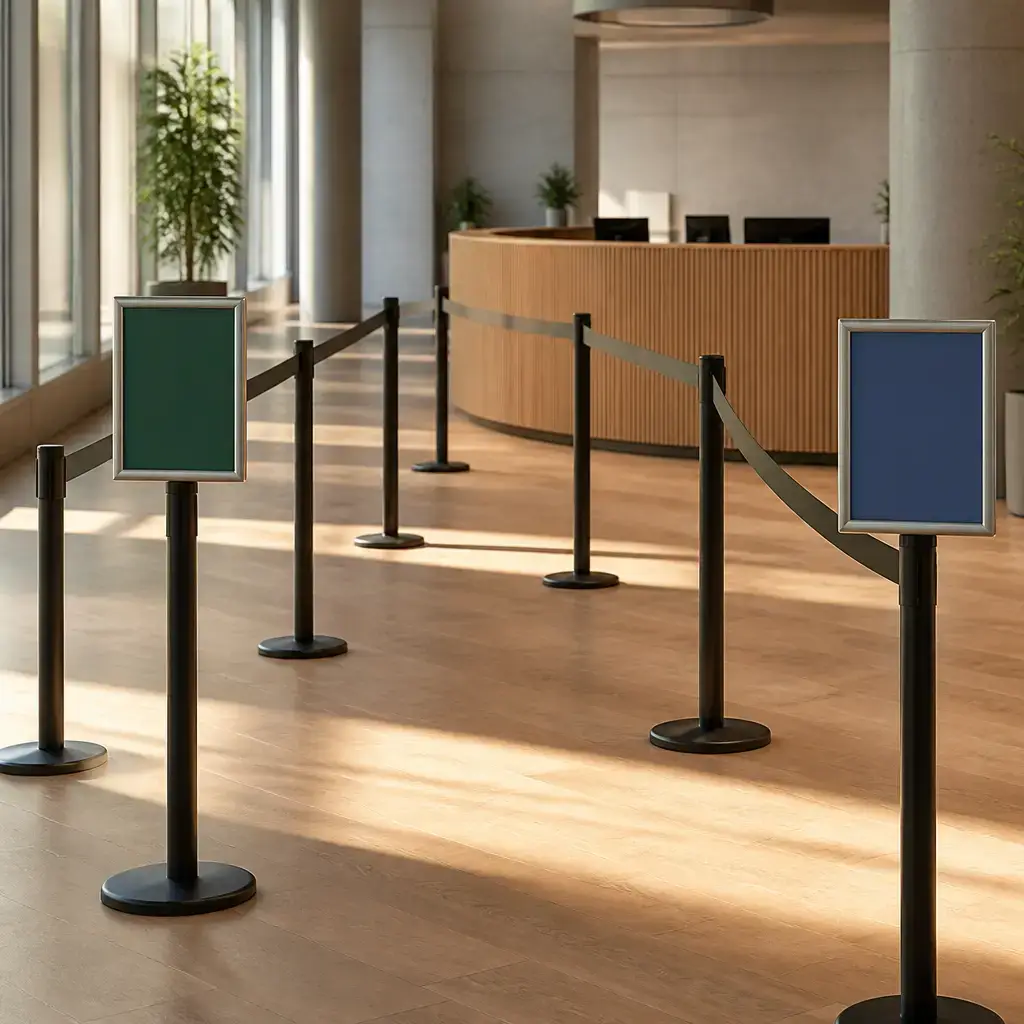
ikh moos MY-nuh MIT-gleets-KAR-tuh fer-LENG-ern. I need to renew my membership card.Dann sollten Sie sich in der Schlange beim blauen Schild anstellen.
dahn ZOL-ten zee zikh in dair SHLAHNG-uh bym BLAH-oo-en SHILT ahn-SHTEL-en. Then you should join the line by the blue sign.Ich habe fast am falschen Ort gewartet.
ikh hah-buh fahst ahm FAL-shen ort guh-VAR-tet. I almost waited in the wrong place.Das ist verwirrend, weil die beiden Schlangen so nah beieinander sind.
dahs ist fer-VIR-ent, vyle dee BY-den SHLAHNG-en zoh nah bye-eye-NAN-der zint. It is confusing because both lines are close.Ich wechsle jetzt die Schlange, bevor mehr Leute kommen.
ikh VEK-s luh yetst dee SHLAHNG-uh, buh-FOR mair LOY-tuh KOM-en. I'll move before more people arrive.Die Schlange dort ist jetzt kürzer.
dee SHLAHNG-uh dort ist yetst KYOORT-ser. That line is shorter now.Sentence explanations
Entschuldigung, ist das die richtige Schlange?
Excuse me, is this the right line?
- Entschuldigung
- Excuse me
- ist das
- is this
- richtige
- right; correct
- Schlange
- queue; line
More detail
Entschuldigung is a polite way to get someone's attention, equivalent here to “Excuse me.” In other contexts, the same word is the noun “apology”; here it is a short address formula. ist das combines ist, the third-person singular present form of sein (“to be”), with das, meaning “this” here. German yes/no questions commonly place the finite verb first: Ist das ...? means “Is this ...?” Das is neuter singular in form, while its specific referent is supplied by the situation rather than named in the question. richtige comes from the adjective richtig, “right” or “correct.” In die richtige Schlange, the adjective has the ending -e because this is a feminine singular nominative noun phrase with the definite article die. This is a weak adjective ending; the adjective's base form remains richtig. A useful contrast is richtig (“right/correct”) and falsch (“wrong/incorrect”). Example: Ist das die richtige Adresse? — “Is this the correct address?” Schlange is a feminine noun. Here it means “queue” or “line,” as confirmed by the translation and the following context about the information desk. The same noun can mean “snake” in another context, but that is not the intended meaning here. In die richtige Schlange, die is the definite article accompanying this feminine singular noun phrase; the article itself does not state how many people are in the queue. Example: Die Schlange ist kurz. — “The line is short.” Together, die richtige Schlange means “the right line,” and the verb-first question structure Ist das ...? asks whether the indicated line is the correct one. With the opening Entschuldigung, the complete utterance is a polite request for confirmation: “Excuse me, is this the right line?”
Diese Schlange ist für den Informationsschalter.
This queue is for the information desk.
- Diese
- this
- Schlange
- queue
- ist für
- is for
- Informationsschalter
- information desk
More detail
Diese means “this” and is the feminine singular nominative form of the demonstrative determiner. It agrees with Schlange, which is the subject here. The form changes with gender, number, and grammatical case: for example, dieser Tisch means “this table,” while diese Schlange means “this queue.” Schlange is a feminine noun: die Schlange. In this utterance, its meaning is “queue” or “line,” as confirmed by the fixed translation and the preceding question. The same German noun can also mean “snake” in another context, so the surrounding meaning determines the sense. A useful related form is the plural Schlangen, “queues” or “snakes,” depending on context. ist für combines ist, the third-person singular present form of sein (“to be”), with für, meaning “for.” The phrase pattern etwas ist für ... can identify what something is intended for. Für requires the accusative case, but the quoted words do not themselves show the following noun’s article or ending. Example: Der Platz ist für Gäste. — “The seat is for guests.” Informationsschalter is a compound noun meaning “information desk.” It combines Information (“information”) and Schalter (“counter” or “desk”). German nouns are capitalized, and this compound is masculine: der Informationsschalter. In the full sentence, für requires the accusative, so the complete noun phrase is den Informationsschalter (“the information desk”): der becomes den in the masculine accusative. Together, Diese Schlange means “this queue,” ist für marks its intended destination or purpose as “is for,” and den Informationsschalter means “the information desk.” The complete utterance therefore means: “This queue is for the information desk.”
Ich muss meine Mitgliedskarte verlängern.
I need to renew my membership card.
- Ich muss
- I need to / I must
- meine
- my
- Mitgliedskarte
- membership card
- verlängern
- renew
More detail
Ich muss combines ich (“I”) with the present-tense form muss of müssen (“must; need to”). muss is the first-person singular form; the modal verb is followed by an infinitive at the end of the clause. Example: Ich muss arbeiten. — “I need to work.” meine means “my” here. It is the possessive determiner for the speaker and has the form meine because it accompanies the feminine singular noun Mitgliedskarte in the accusative role required by verlängern. The possessive form therefore reflects the noun’s grammatical form, not a change in the owner. Example: Ich sehe meine Tasche. — “I see my bag.” Mitgliedskarte is a feminine compound noun meaning “membership card”: Mitglied means “member” and Karte means “card.” Its plural is Mitgliedskarten. German compounds are written as one word, and the compound’s grammatical gender is feminine here, as shown by die Mitgliedskarte and the form meine in this sentence. verlängern is the infinitive meaning “to renew” or, more literally in some contexts, “to extend.” With müssen, it remains in the infinitive and goes to the end of the clause. Example: Ich muss meinen Pass verlängern. — “I need to renew my passport.” Together, Ich muss expresses the speaker’s need or obligation, meine Mitgliedskarte identifies the item being acted on, and verlängern names the action: “I need to renew my membership card.”
Dann sollten Sie sich in der Schlange beim blauen Schild anstellen.
Then you should join the line by the blue sign.
- Dann
- then
- sollten Sie
- you should
- sich … anstellen
- line up
- Schlange
- line; queue
- beim
- by the; at the
- blauen
- blue
- Schild
- sign
More detail
Dann means “then” and places this advice in sequence. It can also introduce a consequence: Dann ... = “Then ...” or “In that case ...”. sollten Sie expresses a recommendation: “you should”. sollten is the Konjunktiv II form of sollen used here for advice. Formal Sie can refer to one person or more than one person, so this form alone does not identify the number. The stronger obligation is expressed with Sie müssen ... (“you must ...”). The discontinuous construction sich ... anstellen means “to line up” here. sich is the reflexive form used with formal Sie; it is part of the verb construction, not an omitted object. Because sollten is a modal verb, anstellen remains an infinitive at the end of the clause. In a main clause without that modal, the separable verb appears as Sie stellen sich an (“You line up”). Schlange means “line” or “queue” here. The noun is feminine: die Schlange; its plural is die Schlangen. The phrase in der Schlange means “in the line”, and sich in der Schlange anstellen means “to join the line”. beim is the contraction of bei dem, meaning “by/at the”. Bei takes the dative case when it expresses location. For example, beim Eingang means “by the entrance”. blauen means “blue” here. Its base form is blau; the -en ending is adjective inflection, not part of the base form. In dem blauen Schild, the adjective has the dative masculine ending -en, because beim contains dem and Schild is masculine in this sense. Schild means “sign” here. In this sense, it is neuter: das Schild; after bei dem, the dative form is dem Schild. Its plural is die Schilder when referring to signs. Taken together, Dann sets the sequence, sollten Sie gives the recommendation, sich in der Schlange anstellen describes joining the line, and beim blauen Schild identifies the location. The whole sentence means: “Then you should join the line by the blue sign.”
Ich habe fast am falschen Ort gewartet.
I almost waited in the wrong place.
- Ich habe
- I have
- fast
- almost
- am
- at the
- falschen
- wrong
- Ort
- place
- gewartet
- waited
More detail
Ich habe is the first-person singular present form of haben, “to have.” Here it is an auxiliary, not the main meaning “possess”: with the participle gewartet at the end, it forms the German perfect for a past event. The reusable pattern is Ich habe + participle, as in Ich habe gearbeitet. — “I worked” or “I have worked.” fast means “almost” and modifies the event expressed by the rest of the sentence. It presents the waiting as something that nearly happened, rather than as a completed wait in the wrong place. am is the contraction of an dem, meaning “at the” here. In this use, an describes a location and takes the dative. The contraction is common before a masculine or neuter singular noun with dem; it is not an independent noun or verb. falschen is the inflected form of the adjective falsch, “wrong.” It describes Ort here. The ending -en is used because the adjective follows the definite article contained in am (an dem), and the noun phrase is masculine singular dative: an dem falschen Ort. This is the adjective’s form; Ort is the noun’s base form, not its source. Ort means “place” or “location.” Its plural is Orte; in this sentence it is singular and appears in the dative after the location phrase an dem. Ort is a more specific place-word than a general reference such as Stelle in some contexts, but the fixed sentence simply identifies the location as the wrong place. gewartet is the past participle of warten, “to wait.” With habe, it forms the perfect: Ich habe gewartet — “I waited” or “I have waited.” The verb warten normally takes auf when stating what or whom someone waits for, as in Ich habe auf den Bus gewartet. — “I waited for the bus.” No object of waiting is stated in the fixed sentence. Together, Ich habe ... gewartet gives the past event “I waited,” fast makes that event nearly realized, and am falschen Ort specifies the location as “at the wrong place.” The complete meaning is: “I almost waited in the wrong place.”
Das ist verwirrend, weil die beiden Schlangen so nah beieinander sind.
It is confusing because both lines are close.
- Das ist
- it is
- verwirrend
- confusing
- weil
- because
- die beiden
- both
- Schlangen
- lines; queues
- nah
- close
- beieinander
- together
More detail
Das ist uses das as an impersonal “it” and ist as the present-tense form of sein for a third-person singular subject. Here it introduces the assessment that follows; it does not identify a particular noun as the referent of das. verwirrend means “confusing” here: it describes something that causes confusion. It is related to the verb verwirren (“to confuse”). Compare verwirrt, which describes someone or something as confused: Die Situation ist verwirrend. — “The situation is confusing.” weil means “because” and introduces the reason for the statement. In a German weil clause, the finite verb normally goes to the end. die beiden means “both” in this phrase. beiden identifies two items together with the plural noun that follows; it is not an indefinite article and does assert a pair here. Schlangen is the plural of die Schlange. In this fixed utterance, the translation and the surrounding queue context support the intended meaning “lines” or “queues,” rather than the animal meaning that the same German noun can also have. Die Schlangen sind lang. — “The lines are long.” nah means “close” or “near.” It is the positive form of the adjective; the comparative is näher (“closer”), and the superlative is am nächsten (“closest”). beieinander means “together” or “close to one another,” describing the relative position of multiple things. With nah, nah beieinander forms the reusable pattern “close together”: Die beiden Häuser stehen nah beieinander. — “The two houses are close together.” Together, Das ist verwirrend says “It is confusing.” weil die beiden Schlangen so nah beieinander sind gives the reason: “because both lines are so close together.” So intensifies the description, and the weil clause places sind, the present-tense plural form of sein, at the end. The complete utterance is therefore: “It is confusing because both lines are close.”
Ich wechsle jetzt die Schlange, bevor mehr Leute kommen.
I'll move before more people arrive.
- Ich
- I
- wechsle
- switch / change
- jetzt
- now
- Schlange
- line / queue
- bevor
- before
- mehr
- more
- Leute
- people
- kommen
- come / arrive
More detail
Ich is the first-person singular subject: “I.” German uses this form when the speaker performs the action. For example, Ich warte. means “I am waiting.” wechsle is the first-person singular present form of wechseln, “to change” or “to switch.” Here, with die Schlange, it means changing from one queue to another. The present tense can also express a planned or imminent action, so the fixed translation’s “I’ll move” fits the form. Compare ich wechsle with du wechselst (“you switch”) and er/sie wechselt (“he/she switches”). jetzt means “now” and places the change at the present moment. It modifies the action rather than changing the form of the verb. Schlange means “line” or “queue” in this context, not the animal “snake.” It is a feminine noun: die Schlange. In die Schlange, the article has the same visible form in the nominative and accusative, while wechseln takes the thing being changed as its object. The surrounding context supports the queue meaning. bevor introduces a time clause meaning “before.” It links the speaker’s intended change with a later event. A clause introduced by bevor normally places its finite verb at the end: bevor mehr Leute kommen. mehr means “more” here, referring to a greater number of people. It is a quantity word and does not itself assert a specific number. For example, Mehr Leute warten. means “More people are waiting.” Leute means “people.” It is a plural noun; the common singular equivalent for an individual person is Person, not a regular singular form made from Leute. In this sentence, Leute is the plural subject of kommen. kommen means “come” or, in this arrival context, “arrive.” It is the finite present form for sie/sie plural and appears at the end of the bevor clause. The present tense describes the expected future arrival here; German does not require a separate future form for this meaning. Together, Ich wechsle jetzt die Schlange says that the speaker is changing queues now. bevor mehr Leute kommen gives the time limit: this happens before additional people arrive. The whole utterance therefore means “I’ll move before more people arrive,” with the context making the move a change to another queue.
Die Schlange dort ist jetzt kürzer.
That line is shorter now.
- Schlange
- line
- dort
- there
- ist
- is
- jetzt
- now
- kürzer
- shorter
More detail
Schlange is a feminine noun. Here, supported by the fixed translation and context, it means “line” or “queue,” not the animal meaning that this word can also have. Its plural is Schlangen. The article in Die Schlange shows the noun’s feminine singular form; the noun itself does not change for gender. dort means “there” and points to a location understood from the situation. Together with Die Schlange, it identifies the line located there. Example: Der Bus ist dort. — “The bus is there.” ist is the third-person singular present form of sein (“to be”): sein → ist. It agrees with the singular subject Die Schlange. Example: Die Tür ist offen. — “The door is open.” jetzt means “now.” It places the statement in the present situation and can be moved in some sentences without changing its basic time reference. Example: Jetzt ist die Tür offen. — “The door is open now.” kürzer is the comparative form of the adjective kurz (“short”): kurz → kürzer (“shorter”) → am kürzesten (“shortest”). The umlaut is part of this comparative form. The sentence does not state what the line is shorter than; the comparison is understood from the situation. Example: Der Weg ist kürzer. — “The route is shorter.” The structure is Die Schlange dort (“the line there”) + ist (“is”) + jetzt (“now”) + kürzer (“shorter”). Thus the whole utterance means: “That line is shorter now.”
Grammar Points
weil + ... + Verb am Ende
weil mehr Leute kommen
vyle mair LOY-tuh KOM-enbecause more people are coming
In a weil-clause, the conjugated verb moves to the end of the clause.
German Vocabulary
Quiz
Word Order
Arrange the words in the correct order.
Excuse me, is this the right line?
Show Answer
Entschuldigung, ist das die richtige Schlange?This queue is for the information desk.
Show Answer
Diese Schlange ist für den Informationsschalter.I need to renew my membership card.
Show Answer
Ich muss meine Mitgliedskarte verlängern.Spelling
Tap the letters to spell the word.
to renew; to extend
Show Answer
verlängernto join a queue; to line up
Show Answer
anstellenqueue; line
Show Answer
Schlangethen