10 minutes free every day
Continue audio lessons in the app
Word explanations appear automatically in sync with the audio.
No login required · synced translations · playback with the screen locked
Choose your learning language and open this lesson in the app.

About This Lesson
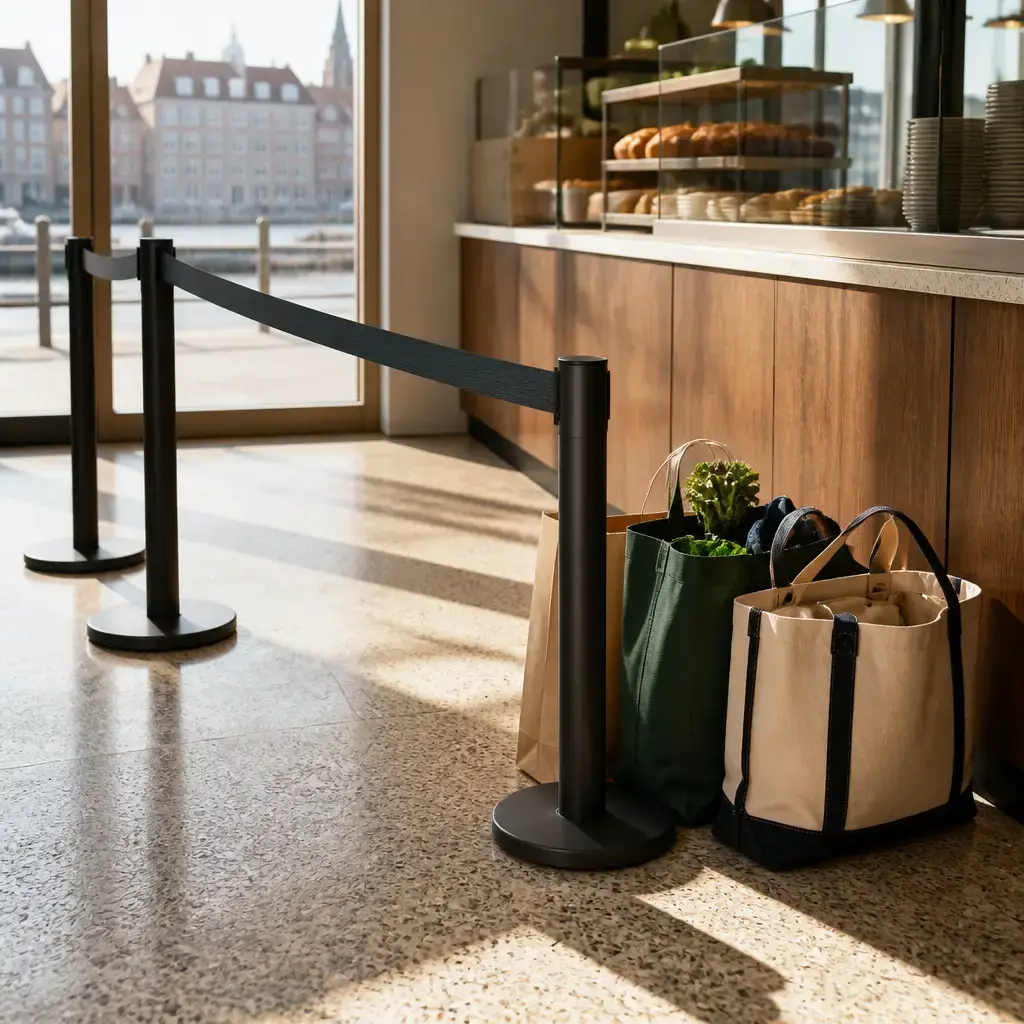
Use Letting someone go first in line to practice German conversation, pronunciation, vocabulary, grammar, and quizzes.
Dialogue
Entschuldigung, du kannst vor mir gehen.
ent-SHOOL-di-goong, doo kahnst fohr meer GAY-en. Excuse me, you can go ahead of me.Bist du sicher? Ich möchte dir deinen Platz nicht wegnehmen.
bist doo ZIKH-uh? ikh MOEKH-tuh deer DYE-nen plahts nikht VEKH-nay-men. Are you sure? I don't want to take your place.Das ist in Ordnung, deine Taschen sehen schwer aus.
dahs ist in OHRD-noong, DYE-nuh TAH-shen ZAY-en shvair ows. It's all right, your bags look heavy.Danke, das ist sehr nett.
DAHN-kuh, dahs ist zair net. I appreciate it.Ich brauche an der Theke nur eine Minute.
ikh BROW-khuh ahn dair TAY-kuh noor EYE-nuh mee-NOO-tuh. I'll only be a minute at the counter.Ich kann noch ein bisschen warten.
ikh kahn nokh ayn BISS-khen VAHR-ten. I can wait a little longer.Ich passe auf, dass ich dich nicht aufhalte.
ikh PAH-suh owf, dahs ikh dikh nikht OWF-hahl-tuh. I'll make sure I don't hold you up.Sentence explanations
Entschuldigung, du kannst vor mir gehen.
Excuse me, you can go ahead of me.
- Entschuldigung
- Excuse me
- du kannst
- you can
- vor mir
- ahead of me
- gehen
- go
More detail
Entschuldigung is used here as a polite way to get someone's attention, equivalent to “Excuse me.” It is also the noun meaning “apology” or “excuse,” but in this sentence it functions as a polite opening rather than as part of the sentence's main action. du kannst contains du, the informal singular “you,” and kannst, the present-tense form of können for du. können expresses ability or possibility; in this sentence, the fixed translation supports permission or an offered possibility: you may go ahead. The forms are ich kann, du kannst, er/sie/es kann; the -st in kannst marks the second-person singular form here. vor mir means “ahead of me” in this context. vor is a preposition, and mir is the dative form of ich (“I/me”): ich → mir. With movement or position, vor can describe being in front of someone; here, vor mir gehen means going ahead of me rather than behind me. gehen means “to go” and is the infinitive. After the modal verb kannst, the infinitive stays at the end of the clause: Du kannst gehen — “You can go.” Together, Entschuldigung, du kannst vor mir gehen. means “Excuse me, you can go ahead of me.” The opening is polite, du kannst presents the possibility or permission, and vor mir gehen specifies the relative position and movement. The following context confirms that the intended situation concerns allowing the other person to take the speaker's place.
Bist du sicher? Ich möchte dir deinen Platz nicht wegnehmen.
Are you sure? I don't want to take your place.
- Bist du
- are you
- sicher
- sure
- Ich möchte
- I would like / I want
- dir
- to you
- deinen
- your
- Platz
- place
- nicht
- not
- wegnehmen
- take away
More detail
Bist du uses sein (“to be”) in the present tense for informal second-person singular: du bist. German yes/no questions commonly put the finite verb first: Bist du ...? Example: Bist du bereit? — “Are you ready?” Sicher means “sure” here, expressing confidence. It is an adjective; after sein, it appears in its basic form rather than taking an ending. Bist du sicher? therefore asks whether the listener is confident about something. Ich möchte expresses the speaker’s wish: “I would like” or, in this context, “I want.” Möchte is the first-person singular form of the verb mögen in the Konjunktiv II; it is also commonly taught as the polite modal form möchten. It softens a desire or intention. Example: Ich möchte helfen. — “I would like to help.” Dir is the informal singular “you” in the dative case. Here it marks the person whose place might be taken. The corresponding informal accusative form is dich, but this sentence requires dir with the construction meaning “take something away from someone.” Deinen means “your” and refers to one informal singular addressee. It has the masculine accusative ending -en because it modifies Platz: deinen Platz. The possessive determiner agrees with the noun’s grammatical gender, number, and case; it does not itself mean that the addressee possesses a particular number of places. Platz is a masculine noun meaning “place” or “spot.” In this utterance it means the person’s place or position, not necessarily a physical seat. As the object of wegnehmen, it is accusative: der Platz becomes den Platz, and with dein, deinen Platz. Nicht negates the intended action. Its position before wegnehmen makes the meaning “not take away.” The sentence does not express a refusal by itself; Ich möchte ... nicht says that the speaker does not want to perform the action. Wegnehmen means “to take away.” It is a separable verb: in a finite clause, ich nehme ... weg, but after möchte it remains as the infinitive wegnehmen at the end. With a person in the dative and a thing in the accusative, jemandem etwas wegnehmen means “take something away from someone.” In this context, jemandem den Platz wegnehmen means “take someone’s place.” Together, dir deinen Platz wegnehmen means “take your place away,” naturally “take your place.” The question Bist du sicher? comes first. Then Ich möchte introduces the speaker’s softened intention, dir identifies the affected person, deinen Platz identifies the place, and nicht wegnehmen negates the action. The complete utterance is: “Are you sure? I don’t want to take your place.”
Das ist in Ordnung, deine Taschen sehen schwer aus.
It's all right, your bags look heavy.
- Das ist in Ordnung
- That’s all right
- deine
- your
- Taschen
- bags
- sehen … aus
- look; seem
- schwer
- heavy
More detail
Das ist in Ordnung is a reusable way to say that something is acceptable or okay. ist is the third-person singular present form of sein (“to be”); Das is a demonstrative pronoun meaning “that” or “it” here, without the supplied sentence identifying a more specific referent. The fixed phrase in Ordnung means “okay” or “all right.” Example: Alles ist in Ordnung. — “Everything is okay.” deine means “your” before the plural noun Taschen. It is a possessive determiner based on dein; in this form, it agrees with a plural noun, while the number of the person addressed is not specified. Example: deine Bücher — “your books.” Taschen is the plural of die Tasche, “bag.” The singular/plural contrast is die Tasche / die Taschen. In the fixed sentence, the bags are the subject of the following verb. sehen ... aus is the separable verb aussehen, “to look” or “to appear.” In a main clause, its parts separate: the conjugated verb sehen appears in the second position and aus goes to the end. sehen is the present-tense form used with a plural subject such as die Taschen; the singular counterpart is sieht ... aus. Example: Die Schuhe sehen neu aus. — “The shoes look new.” schwer means “heavy” here. It is an adjective used after aussehen, so it has no ending in this position: Die Taschen sehen schwer aus. — “The bags look heavy.” The same adjective can have other meanings in other contexts, such as “difficult,” but “heavy” is the intended meaning in this sentence. Together, deine Taschen identifies the bags as belonging to the person addressed, and sehen schwer aus says that they give the appearance of being heavy. The first part, Das ist in Ordnung, says that the relevant situation is acceptable. The complete meaning is: “It’s all right, your bags look heavy.”
Danke, das ist sehr nett.
I appreciate it.
- Danke
- Thanks
- das ist
- that is
- sehr
- very
- nett
- kind; nice
More detail
Danke means “thanks” here. It is a common standalone expression of gratitude; the longer form Danke schön is also used. Example: Danke für deine Hilfe. — “Thanks for your help.” das ist combines das, a demonstrative pronoun meaning “that” or “it” here, with ist, the third-person singular present form of sein (“to be”). The exact thing referred to by das is not identified in the fixed sentence, so it is best understood as the situation or thing being appreciated. Example: Das ist gut. — “That is good.” sehr is an intensifier meaning “very.” It normally comes before the adjective or adverb it strengthens: sehr nett means “very nice” rather than simply “nice.” Example: Das ist sehr wichtig. — “That is very important.” nett is an adjective meaning “nice” or “kind.” In das ist ... nett, it is a predicate adjective after sein, so it has no adjective ending. When it comes before a noun, its ending changes according to the noun phrase: ein netter Mann — “a nice man.” Together, das ist sehr nett literally means “that/it is very nice.” With Danke at the beginning, the utterance expresses gratitude for something: “Thanks, I appreciate it.” The German wording describes the appreciated thing or action as very nice; the fixed English translation gives the intended natural meaning.
Ich brauche an der Theke nur eine Minute.
I'll only be a minute at the counter.
- Ich
- I
- brauche
- need
- an
- at
- der
- the
- Theke
- counter
- nur
- only
- eine
- a
- Minute
- minute
More detail
Ich means “I” here, the first-person singular subject. The same form is used whether the speaker is male or female; the verb shows the person in this sentence. brauche is the first-person singular present form of brauchen, “to need.” The useful pattern is ich brauche ... = “I need ...” or, with a duration, “I need ... time.” Example: Ich brauche fünf Minuten. — “I need five minutes.” an introduces the location in an der Theke. With a stationary location, German uses an with the dative; with a movement toward a location, the case can differ. Example: Ich warte an der Tür. — “I’m waiting at the door.” der is the dative singular feminine form of the definite article die. Here it belongs to Theke, which is feminine: die Theke; after this stationary use of an, it becomes an der Theke. Theke means “counter” or “bar/counter.” Its useful basic form is die Theke; the plural is die Theken. In this sentence, an der Theke means “at the counter.” nur means “only” and limits the duration mentioned afterward. It does not mean that the speaker needs the counter; the location phrase and the time phrase have separate roles. eine is the indefinite article accompanying the feminine noun Minute. The form is eine here because Minute is feminine and this noun phrase is in the accusative after brauchen; for this feminine noun, nominative and accusative singular both use eine. Minute means “minute.” It is feminine: die Minute. The plural is Minuten, as in zwei Minuten (“two minutes”). The sentence combines Ich brauche (“I need”), an der Theke (“at the counter”), nur (“only”), and eine Minute (“one minute”). Literally, it says that the speaker needs only one minute at the counter. In the supplied translation, this is naturally expressed as “I’ll only be a minute at the counter.”
Ich kann noch ein bisschen warten.
I can wait a little longer.
- Ich kann
- I can
- noch
- still; longer
- ein bisschen
- a little
- warten
- wait
More detail
Ich kann expresses “I can” here. kann is the first-person singular present form of können; the subject is Ich. In a main clause with a modal verb, the modal is conjugated in the second position and the other verb stays in the infinitive at the end: Ich kann warten = “I can wait.” noch means “still” here and gives the waiting a continuing sense: the waiting can continue for some additional time. With a time expression, English may naturally use “longer,” as in the fixed translation. Its meaning here is not the contrastive “still/yet” found in every possible use of noch. ein bisschen means “a little” or “a small amount.” It is a common quantity expression and can modify an activity or degree: Ich bin ein bisschen müde. = “I am a little tired.” warten is the infinitive “to wait.” Its useful present-tense forms include ich warte (“I wait/I am waiting”) and du wartest (“you wait/you are waiting”). After können, it remains warten rather than taking a personal ending. Together, Ich kann + noch + ein bisschen + warten means “I can still wait a little longer.” The modal states that the speaker is able or willing to continue waiting; noch ein bisschen specifies that the additional waiting time is small.
Ich passe auf, dass ich dich nicht aufhalte.
I'll make sure I don't hold you up.
- Ich passe auf
- I’ll make sure
- dass
- that
- dich
- you
- nicht
- not
- aufhalte
- hold up; delay
More detail
Ich passe auf is the first-person singular present form of aufpassen, used here in the construction aufpassen, dass .... In this use, it means taking care or making sure that something happens. The verb is separable: in a main clause, auf appears at the end, as in Ich passe auf; in a subordinate clause, the complete form stays together at the end. Example: Ich passe auf die Tasche auf. — “I’ll keep an eye on the bag.” dass introduces a subordinate clause and means “that.” It sends the conjugated verb to the end of that clause. A reusable pattern is Ich passe auf, dass ... — “I’ll make sure that ...”. dich is the accusative singular form of the second-person pronoun, meaning “you” as the person affected by the action. The related nominative form is du: Du siehst mich. — “You see me.” nicht negates the following action or clause. Here it makes the intended action “not hold you up,” rather than “hold you up.” Its position can change with the scope of negation, so it is useful to connect it to the action being negated in this sentence. aufhalte is the first-person singular present form of aufhalten, “to hold up” or “to delay.” In the subordinate clause, the prefix remains attached and the conjugated verb is final: ..., dass ich dich nicht aufhalte. The base form is aufhalten; the observed form has ich as its subject. Example: Entschuldigung, ich will dich nicht aufhalten. — “Sorry, I don’t want to hold you up.” Together, Ich passe auf, dass expresses making sure of a result, and ich dich nicht aufhalte states the result being avoided: “that I do not hold you up.” The complete utterance therefore means “I’ll make sure I don’t hold you up.”
Grammar Points
aufpassen → Pass ... auf
Pass auf!
PAHS owfPay attention!
In the imperative, the separable prefix auf moves to the end.
dein + masculine accusative noun → deinen
deinen Platz
DYE-nen plahtsyour place
The possessive determiner dein becomes deinen before a masculine noun in the accusative.
German Vocabulary
deinen Platz
dir deinen Platz
Entschuldigung, du kannst vor mir gehen.
du kannst vor mir gehen
Das ist in Ordnung.
deinen Platz
sehen schwer aus
deine Taschen sehen schwer aus
Bist du sicher?
deine Taschen sehen schwer aus
vor mir
deinen Platz nicht wegnehmen
Quiz
Word Order
Arrange the words in the correct order.
Excuse me, you can go ahead of me.
Show Answer
Entschuldigung, du kannst vor mir gehen.I appreciate it.
Show Answer
Danke, das ist sehr nett.I can wait a little longer.
Show Answer
Ich kann noch ein bisschen warten.Spelling
Tap the letters to spell the word.
place; spot
Show Answer
Platzto take away
Show Answer
wegnehmento go
Show Answer
gehenyour